sergey brin

Tech leaders funding Matt Mahan’s campaign for California governor say it’s not about tech

San José Mayor Matt Mahan’s run for California governor has been defined from the start by his donor list.

Mahan entered the race late and with little statewide name recognition, but catapulted into contention thanks to massive funding from billionaire tech titans, venture capitalists, cryptocurrency investors and other Silicon Valley elites. In a state with more than 23 million voters and hugely expensive media markets, the money signaled Mahan would be a contender.

It also spurred accusations from his more liberal Democratic competitors and powerful labor leaders that Mahan is beholden to Big Tech, including forces aligned with President Trump.

California Labor Federation President Lorena Gonzalez Fletcher recently described Mahan as “funded by Trump’s big tech billionaires,” while fellow Democratic candidate Tom Steyer — a billionaire running against corporate interests — called him “MAGA Matt Mahan.”

That framing has persisted, despite Mahan being a centrist Democrat who has publicly criticized Trump.

On Thursday, Mahan released a four-page “Plan to Hold Big Tech Accountable and Ensure AI Works for All Californians.” The proposal called for AI and data centers to pay for their power and water needs, fund workforce stability initiatives and ensure human oversight of AI tools in critical sectors such as healthcare. It also called for the state to use AI to become more efficient, to bar cellphones in schools and to require parental consent for kids 15 and under joining social media.

In an interview with The Times, Mahan, 43, said AI is “one of the most significant trends in society” and needs to be addressed.

He also rejected the notion that he would do Big Tech’s bidding, and the idea that his support from tech leaders is entirely or even largely premised on his plans for their industry.

“I’ve spoken very little about tech with any of my donors,” he said.

Mahan said his fundraising has instead been “centered on how we get California on a better path in terms of building housing, improving the quality of our public schools, solving our biggest problems,” which “just resonates with people in the tech industry.”

A ‘digital native’

Mahan, the son of a teacher and a mailman, grew up in the farming community of Watsonville but commuted to San José to attend high school at Bellarmine College Prep on scholarship as a low-income student. He went on to Harvard University, where he was student body president and classmates with Facebook founder Mark Zuckerberg, spent a year in Bolivia building irrigation systems, and then taught for two years in Alum Rock as part of the Teach for America program.

He then joined Causes, an early Facebook application that allowed nonprofits to build grassroots support online, and rose to become chief executive. In 2014, he co-founded Brigade, a nonpartisan platform where voters could advocate for issues, which was acquired in 2019. He won a San José City Council seat in 2020, and was elected mayor in 2022.

An early mayoral profile described Mahan as painting a whiteboard behind his desk to “write on the wall as I did in my tech days.” Another noted he used ChatGPT to write speeches. A third recounted how he’d used AI to make city buses run faster.

Mahan said he learned as a startup leader and a classroom teacher that metrics matter — that “when we take our precious tax dollars and invest them in public services, we should measure our performance.”

He said he has always believed government should take the best tech has to offer while being vigilant about the risks it poses, which maybe comes naturally to him as a millennial who remembers “the world before the internet” but is also something of a “digital native.”

Donors explain

Between Jan. 1 and April 18, Mahan’s campaign raised nearly $13.5 million, according to state campaign finance filings. During the same period, an independent expenditure backing Mahan called Back to Basics raised about $22.7 million, while another launched by the group Deliver for California raised nearly $3.3 million.

The donors are a who’s who of tech leaders, venture capitalists and other leaders in the gig, gaming, digital media and AI defense fields.

Sergey Brin, the co-founder of Google, gave the maximum individual contribution of $39,200 to Mahan directly, and $1 million to the Deliver for California committee. Reed Hastings, the co-founder and chairman of Netflix, gave the maximum contribution to Mahan, plus $1 million to the Back to Basics committee.

Some donors, such as LinkedIn co-founder Reid Hoffman, who gave the maximum to Mahan, are well-known supporters of progressive causes. Others, such as Palantir co-founder Joe Lonsdale and crypto founder David Marcus, who maxed out to Mahan, are also Trump backers.

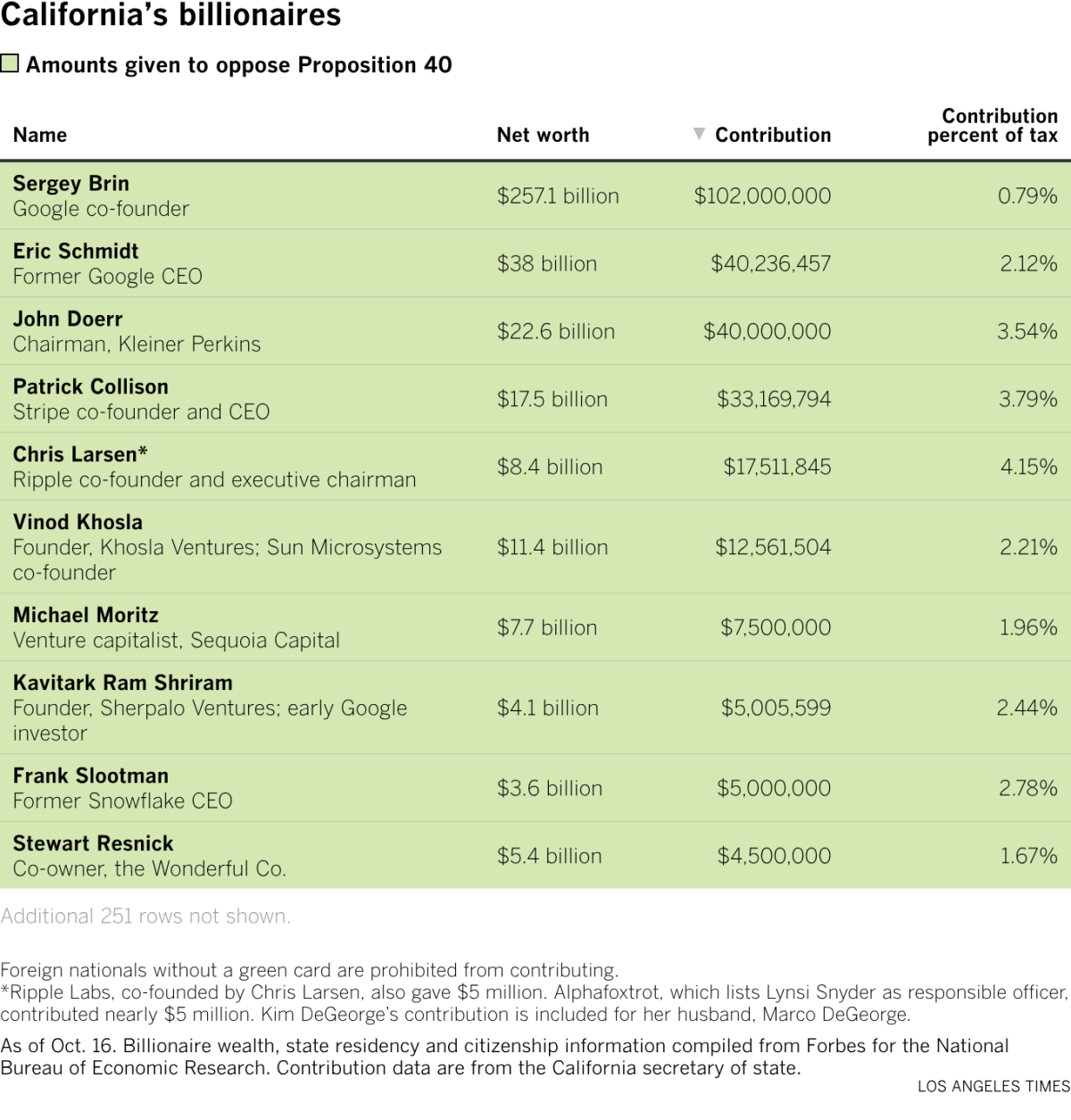
Brin, a friend of Gov. Gavin Newsom since the Democrat was mayor of San Francisco, has been moving rightward recently. He has donated to the Republican National Committee and in March was appointed to the White House tech advisory council. He’s also a major donor to the nonprofit opposing the ballot measure for a new tax on California billionaires — which Mahan also is against.

Brin, Lonsdale and Marcus did not respond to a request for comment. Hastings and Hoffman declined to comment.

Several other tech donors did speak with The Times — and universally described their support for Mahan as less to do with his tech policies, and more to do with issues important to all Californians.

Jamie Siminoff, who sold his home security startup Ring to Amazon for $1 billion and gave the maximum donation to Mahan, said he thinks L.A., where he lives, is the “greatest city in the world” and California is the “best state in the world.” But he sees Mahan as someone who could make improvements by bringing the state toward the political middle on public safety, housing and homelessness.

“He’s just like a nice, pragmatic, sort of centrist person, from what I can see, [who] wants to make California better, and I’m 100% behind that.”

Siminoff said it doesn’t hurt that Mahan speaks the same language as many tech leaders, who are mostly just “pragmatic inventors and entrepreneurs” who want California’s leader to be “principled in thinking about fixing things.”

Ruchi Sanghvi, the first female engineer at Facebook and a former Dropbox executive who state records show donated $25,000 to Mahan, said she has known Mahan since he was leading Causes but fell out of touch. When he entered the governor’s race, and she “got all these emails from people that I respect” saying they were supporting him, she asked for a meeting.

At that meeting, she said, Mahan “really dug in on some of the core issues that I care about,” including housing, homelessness and education.

The San Francisco resident, political independent and mother of three said the idea that tech leaders are backing Mahan because they believe he will scratch their back in business is wrong. Referring to his tech plan’s restrictions on social media for youth, she said, “I don’t think of that as scratching my back.”

Instead, “what really resonates with me and my peers is that, yes, he is pragmatic,” Sanghvi said. “He cares about measurable outcomes, which I think is very critical.”

Marc Merrill, co-founder, co-chairman and chief product officer of L.A.-based video game developer and e-sports company Riot Games, gave the maximum to Mahan, as did his wife, Ashley, founder of the sleepwear brand Lunya. In a statement to The Times, Merrill said he and his wife are lifelong Californians who love the state and support Mahan because of his record “addressing California’s most pressing challenges with practical, results-oriented solutions” in San José.

Merrill said Mahan brought down violent crime, reduced homelessness with “data-driven programs that address root causes rather than just managing the problem,” and “fostered an environment where businesses are choosing to invest and grow in the city.”

Tech vs. labor?

Gonzalez Fletcher said tech leaders have long “been very clear about their desire to support candidates who won’t regulate AI, to support candidates who will go after organized labor” — and their support for Mahan is no different.

She pointed as an example to a March event attended by Mahan and hosted by one of his most vocal backers: Garry Tan, a venture capitalist and chief executive of Y Combinator, a startup incubator in San Francisco.

At the event — which was part of Tan’s launch of a new statewide group called Garry’s List, which he has described as a “Rotary Club for radical centrism” — Chris Larsen, the co-founder of the cryptocurrency network Ripple, railed against the influence of unions in California politics and the “weak” response from business leaders, according to video.

“We’ve got to fight on par with the unions when they’re proposing stupid, job-killing ideas like the San Francisco CEO tax,” Larsen said. He noted that several other candidates for governor, including former Orange County Rep. Katie Porter, whom he’d donated to, had backed the measure to tax companies that pay their chief executive 100 times more than their average employee.

Neither Tan nor Larsen responded to a request for comment.

Gonzalez Fletcher, a former state legislator, said the argument that California Democrats have caused the state’s biggest problems by bowing to unions is false, and that what is more true is that “ruling class” Democrats such as Newsom “acquiesce to business interests” driving the state’s affordability and homelessness crises.

She said employers get away with underpaying workers and big landlords are allowed to take advantage of renters. She said Airbnb, as a tech example, has gone unchecked despite causing “a lot of the removal of housing stock.”

She said one reason she opposes Mahan is that he “suffers from the same love affair with Big Tech” as Newsom.

Steyer — who has funded his own campaign to the tune of nearly $200 million — has repeatedly struck a similar note.

Earlier this month, his campaign wrote that “Mahan continues to fail working Californians by catering to tech billionaires and wealthy special interest groups.” In February, it wrote that although Mahan had the support of “powerful special interests hellbent on keeping California a playground for the rich,” Steyer had the backing of “bus drivers, cafeteria workers, and custodians.”

Airbnb declined to comment but in the past has denied claims its platform substantially contributes to housing affordability issues, and has donated to housing initiatives. Airbnb co-founder Nathan Blecharczyk, a Mahan donor, did not respond to a request for comment.

Mahan said he values unions, in part because he grew up in a union household and benefited from the high-quality healthcare that provided, included when he was hospitalized for a collapsed lung as a teenager.

He said he has also worked with tech employers who “are inventing the future, quite literally,” and “creating a lot of jobs and opportunity.”

Mahan said the idea the two are inherently at odds is false, because “business needs labor, and labor needs business,” and the real question is “how to balance everyone’s needs.”

“If we don’t have a strong enough regulatory environment, and business has too much power, workers can be exploited, the environment can be exploited and we can see really negative social outcomes,” he said. “But the flip side is also true. If labor in our politics has too much power, you can also see distortions, you can see investment flow elsewhere, you can see less housing get built.”

Mahan said that “neither side has a monopoly on the truth,” and that government has to “bring people together and strike the right balance.”

He also defended Airbnb, which in San José pays taxes just like hotels, he said.

“We don’t see Airbnb as an antagonistic thing. We don’t let them take over the market, we regulate them, we charge them, and we use their tax revenue to provide services to people.”

He said the state’s housing crisis is due to over-regulation slowing new building to the point where it cannot keep up with job growth — which he called “fundamentally unsustainable and unfair” to low-income folks pushed out of job centers as a result.

The answer is building more homes, more quickly, he said, including by reducing building fees and streamlining permitting processes — which he said he has done in San José and would replicate statewide as governor.

“I am, first and foremost, focused on making government deliver results that make a real difference in people’s lives,” he said. “That’s my North Star.”

Source link

Google co-founder Sergey Brin confronted Gavin Newsom — then launched a political war

In a treehouse nestled in redwoods north of San Francisco, Gov. Newsom stood cold and hungry as Sergey Brin, the world’s fourth-richest man, and his wellness-influencer girlfriend told him they were leaving the state.

It was late in the evening at a Christmas party hosted by crypto titan Chris Larsen — featuring singer Janelle Monáe and a towering abominable snowman with glowing red eyes — when Brin and his partner, Gerelyn Gilbert-Soto, confronted Newsom about a new proposal to tax billionaires in California, according to people who’ve spoken with the governor. Such a levy could hit Brin’s stake in Alphabet Inc. and his $272.6 billion fortune.

Newsom, who opposes the wealth tax, was still telling people about the lengthy exchange at the party months later, complaining of a lingering cold the pair had given him, according to the people, who asked not to be named discussing private conversations with the governor.

Brin, meanwhile, followed through. He left the state, bought a lakeside mansion in Nevada, and started bankrolling a billionaire political uprising in California.

Newsom, through a spokesperson, declined to comment on the interaction. “The governor has been very clear with everyone, no matter who they are, that this effort will do serious damage to the state, including for public safety workers and schools, at the expense of one special interest group,” Izzy Gardon, a spokesperson, said.

A representative for Brin didn’t respond to requests for comment.

Brin’s political push reflects a broader awakening among California’s ultrawealthy. Over the past six months, the proposed billionaire tax and a heated governor’s race have drawn tech titans and business leaders more directly into the state’s affairs — a space many of them have traditionally kept at arm’s length.

Prior to this year, Brin’s last contribution in a California election cycle was 2010 when Arnold Schwarzenegger was governor and the Google co-founder largely backed climate causes. He’s now spent more than $58 million in the last four months, including an extra $9 million disclosed late Friday, but more importantly has helped mobilize a network of fellow tech titans in a push to sway state issues.

“The wealth tax was a wake up call, it was a fire that just lit up Silicon Valley literally in a matter of weeks,” said Steven Maviglio, a veteran Democratic strategist. “I’ve never seen anything like it.”

Altogether, ultrawealthy donors have injected more than $270 million into California’s political scene in this election cycle. Outside of the wealth tax, billionaire Tom Steyer is emerging as a top Democratic candidate for governor after the downfall of former Representative Eric Swalwell following allegations of sexual assault. Steyer, a former hedge fund manager, has spent more than $140 million in his election bid, crowding TV airwaves with ads and labeling himself a “class traitor” with a campaign modeled after Vermont Senator Bernie Sanders.

Ballots for the June 2 primary election start going out next week. Brin and a cohort of the ultrawealthy including Coinbase CEO Brian Armstrong and venture capitalists Vinod Khosla and John Doerr have plowed millions into supporting Matt Mahan, a Silicon Valley mayor, with a back-to-basics agenda and a penchant for taking on the state’s Democratic establishment.

That money has helped Mahan buy airtime and attracted controversy, but his polling numbers remain stuck in the single digits while Steyer’s well-funded progressive campaign is gaining favor with voters. Brin has also backed Republican Steve Hilton, who’s currently leading polls.

“You have two polar opposites going on. You have a billionaire running who has actually fully adopted an agenda that the vast majority of voters agree with: Taxing billionaires, funding healthcare, fighting back against ICE,” said Lorena Gonzalez, head of the state’s largest union group, the California Federation of Labor Unions. “And then you have billionaires pushing a candidate whose talking points are apologetic to the tech industry.”

The billionaire political activism in California mirrors larger shifts in Silicon Valley and the nation. President Donald Trump has given tech billionaires broad access to the White House, inviting Brin and other industry captains over for dinner and to join advisory boards.

Back in September, Trump singled out Gilbert-Soto as Brin’s “really wonderful MAGA girlfriend” at a White House dinner also attended by Mark Zuckerberg, Tim Cook and Sam Altman. She has publicly supported Republican Steve Hilton for California governor, a candidate Trump endorsed and Brin has also donated to.

In California, Brin’s newfound political action was catalyzed by the wealth tax proposal, which would levy a one-time 5% tax on billionaires to help offset federal healthcare cuts. In a Signal group chat earlier this year with other Silicon Valley elite, Brin floated the idea of raising hundreds of millions of dollars to influence California politics, according to a person who saw the message.

Brin left California for Nevada ahead of a Jan. 1 residency deadline for the proposed wealth tax. He moved to a $42 million mansion on the Nevada side of Lake Tahoe, featuring two glass-walled funiculars.

Shortly after leaving California, Brin contributed $20 million to a new group dedicated to fighting the tax while also pushing pro-business and housing affordability policies, Building a Better California, making him the single largest contributor. He added $37 million over the spring, as the group quickly started supporting a trio of anti-wealth tax measures that could nullify a billionaire tax if it gets passed in an election. One of the measures, the so-called Transparency Act, has enough signatures to qualify for the November ballot, its backers claimed on Monday.

Building a Better California “remains fixed on long-term reforms supported by most Californians: housing affordability, stable funding for education, infrastructure investments, and government accountability,” a spokesperson said.

Joining Brin in the effort were other billionaires, including former Google CEO Eric Schmidt, Stripe CEO Patrick Collison and venture capitalist Michael Moritz. Peter Thiel, who also left California ahead of the New Year’s Day deadline, gave $3 million to a separate committee opposing the wealth tax.

“They don’t trust California anymore,” said David Lesperance, a tax attorney who specializes in relocations and has helped move five families out of the state because of the wealth tax threat.

Brin and his fellow billionaires helped push up the costs to gather the more than 870,000 signatures required to qualify a ballot measure. This forced the union behind the wealth tax, SEIU-UHW, to spend more on their efforts.

Now, the union says it has succeeded in getting the signatures it needed, which will likely force the business leaders opposing it into further spending.

“A very small group of the most controversial billionaires on the planet tried to stop Californians from being able to save their local emergency rooms and hospitals — but our current signature tally proves frontline healthcare workers will prevail in bringing this commonsense proposal to voters,” said Suzanne Jimenez, SEIU-UHW’s chief of staff. “When our growing coalition files these signatures, David will have won the first round against Goliath.”

Other billionaires have bankrolled their own political initiatives, including Larsen, who set up his own network of influence groups with names like Grow California and Golden State Promise.

Many in Sacramento are skeptical that Brin and his fellow ultra-rich will succeed in swaying California state politics. They point to the failed candidacy of former eBay executive Meg Whitman, who spent around $144 million of her own fortune to become governor, or even venture capitalist Tim Draper’s longshot initiative to split California into six separate states.

“They’re trying to extrapolate from their own industry, which might have been fabulously successful, that they know something about political advertising, when they don’t,” said Garry South, a veteran Democratic strategist. “They think, ‘Hey, I’ve got money I can throw it around,’ and they don’t really do their homework.”

Political consultants describe their frustration with some wealthy tech donors, who often view their political giving through an investment lens, promising big checks and not following through if they don’t see momentum. That’s led to questions about whether the California billionaire activism would continue if Mahan’s governor bid fails and the wealth tax passes.

Even Larsen, who’s worth around $13 billion, has expressed anxiety that not enough business leaders are stepping into politics. “It’s a lot of talk, and they’re happy, but we don’t see the firepower we need to take on the SEIUs,” he said, referring to the state’s largest union.

Newsom, for his part, acknowledges that many of the state’s wealthiest residents are willing to donate significant sums of money, but want to do it on their own terms and not through a tax.

“Some will never give a penny away,” he said at a Bloomberg News event in January, not long after his encounter with Brin in the treehouse. “Some I respect. Some I don’t.”

Kamisher and Carson write for Bloomberg.

Source link