People Power Party protests ballot shortage at Seoul polling stations

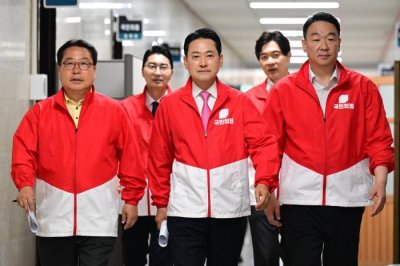
People Power Party campaign committee chief Jang Dong-hyeok attends a central campaign committee meeting at the National Assembly in Seoul on Wednesday, the day of South Korea’s local elections and parliamentary by-elections. Photo by Asia Today
June 3 (Asia Today) — The People Power Party protested Wednesday after voting was temporarily halted at some polling stations in Seoul’s Songpa Ward because of ballot shortages, calling the incident “a serious violation of voters’ political rights.”
Chung Hee-yong, the party’s secretary-general, held an emergency news conference and criticized the National Election Commission over the incident.
“This is a shocking incident that should not and must not happen at a polling site in South Korea in 2026,” Chung said. “It goes beyond simple lack of election preparation and reflects a deplorable failure to fulfill the duty of election management.”
Chung called for “strong and immediate action” by the election commission.
“First, swift measures must be taken so that citizens who could not vote because of ballot shortages can exercise their voting rights,” he said.
Song Eon-seog, the party’s floor leader, also issued an emergency statement.
“We are receiving absurd reports that citizens in Seoul cannot vote because ballots are unavailable,” Song said. “Seoul citizens, you must not give up voting under any circumstances. Even if it is difficult, please wait calmly and make sure to vote.”
Song said the situation infringed on citizens’ right to participate in elections.
“We strongly urge the National Election Commission to guarantee voting rights so that citizens who waited can vote even after 6 p.m.,” he said. “Transfer the ballots quickly.”
Song also said the party had received reports that voting was taking place at several polling stations nationwide without People Power Party observers present.
“Is this the 19th century? Does this make any sense?” he said. “As soon as the election ends, we will immediately push for a fact-finding investigation into this incident and make sure those responsible are held accountable.”
Bae Hyun-jin, chairwoman of the People Power Party’s Seoul chapter, also held an emergency news conference.
“A shortage of ballots in an election is not a simple mistake. It proves that the basic election management system, the foundation of democracy, has completely collapsed,” Bae said.
She criticized the election commission for saying the shortages resulted from a sudden increase in voter turnout.
“The commission responded as if it were nothing serious,” Bae said. “We will continue to demand measures to prevent a recurrence and disciplinary action against those responsible for the election management failure that violated the sovereign act of Seoul citizens.”
The People Power Party said it had identified eight polling stations affected by ballot shortages: Munjeong 2-dong No. 2, Jamsil 2-dong No. 6, Jamsil 7-dong No. 2, Jamsil 4-dong No. 5, Garak 2-dong Nos. 3 and 7, Cheongdam-dong No. 4 and Guui 3-dong No. 6 in Gwangjin Ward.
— Reported by Asia Today; translated by UPI
© Asia Today. Unauthorized reproduction or redistribution prohibited.
Original Korean report: https://www.asiatoday.co.kr/kn/view.php?key=20260603010001076