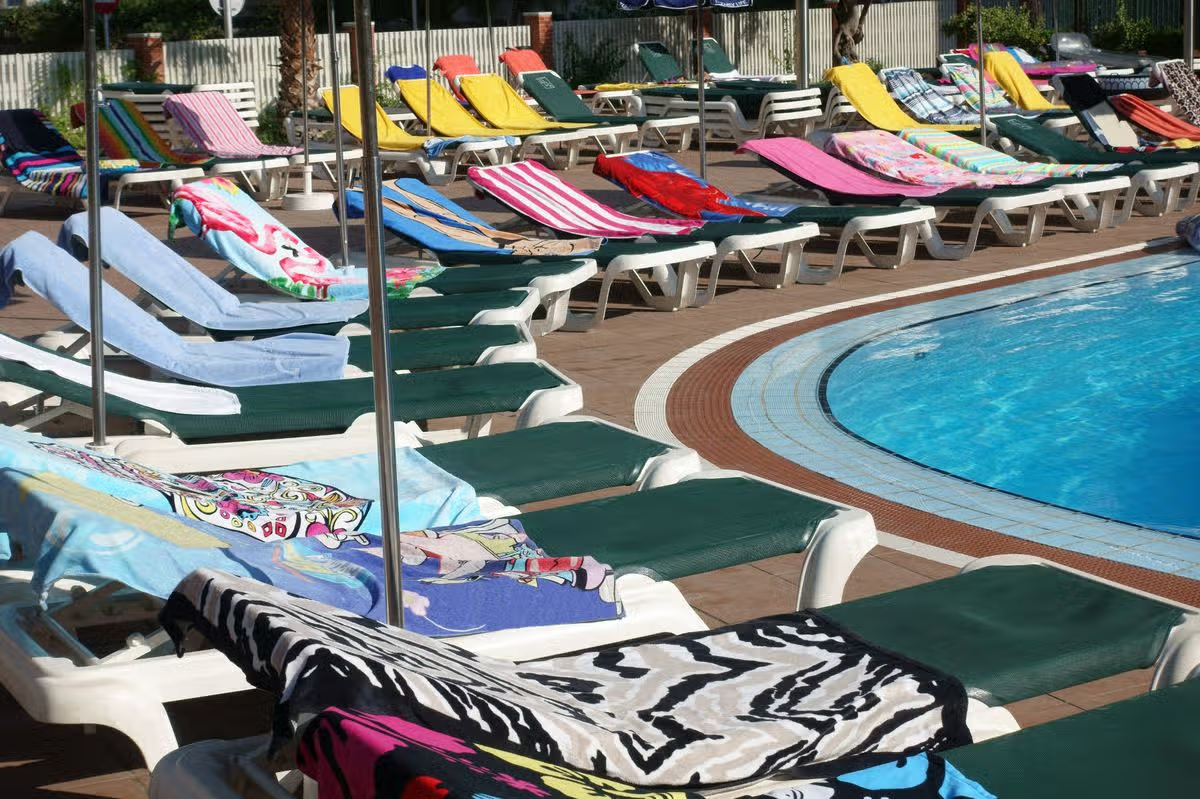
The yearly sunbed wars are in full swing, and one TikToker has captured Brits pioneering a new way to queue for sunbeds without having to miss breakfast
Sunbed wars can put a dampener on your holiday (stock photo)(Image: Getty Images)
If you’re heading to a holiday hotspot such as Spain, Portugal, Greece, or Turkey, then the odds are you’ll see people reserving their sunbed first thing in the morning.
Whether the hotel is busy or not, you’ll often see a queue of Brits, and let’s face it, many other European nationalities too queueing up for the grand opening of the pool area so they can lay down their towel before they even hit the breakfast buffet.
But one TikTok poster has discovered a new hack that her fellow holidaymakers were using to avoid even needing to queue, and while it meant they could avoid needing to hang around the lobby, comments slammed it as ‘selfish’.
Content cannot be displayed without consent
The poster Sarah, who posts on TikTok as @mrsbainbridge, posted the video taken at the Hotel Best Oasis Park in Salou, Spain, showing a neat line of beach bags, inflatables, and other items holding peoples’ place in the queue while their owners are presumably doing something more fun.
In the caption, Sarah wrote: “Never have I came across somewhere like this for sun bed wars of a morning” as she panned across the variety of abandoned items. In a second video, she captured the massive queue, this time populated with people waiting to nab their favourite spot.
Comments overwhelmingly agreed with Sarah. Some said they simply wouldn’t follow the informal system: “I’m not waiting in a queue behind a bag. Straight to back of the first human I see in the queue.”, while another agreed: “nah if you’re not physically in the queue then I’m walking to the front”.
Others questioned whether there were steps the hotel could take to minimise the impact. One person suggested: “The hotel should be taking all those bags and putting them into an orderly pile in the corner. Same with towels left on sun beds for more than 40 minutes”.
Other posters who claimed they’d visited the same hotel as Sarah shared their story. One claimed: “Was there start of July, worse when the doors open.. absolute chaos! Grown men pushing children out of the way etc,” while another added: “Just left there. Joke each morning. Kids nearly getting trampled on then people putting towels down and disappear for the day.”
Sarah isn’t the only one to post videos of the hotel’s sunbed wars. Another user named Mandy posted a video captioned “10am sunbed dash” showing a huge queue of families with towels and inflatables trying to reserve a spot. Warning: video contains strong language.
In June, @deajak1405 also posted a video showing a ‘rat race’ which showed the view of the daily sunbed grab from his balcony. The user is heard laughing as grown adults are shown pushing through the doors as they open, jogging towards the pool area to find their favoured spot.
Some reviews of the hotel on TripAdvisor also highlight the hotel’s sunbed issues. A review from July claims: “The set up for sunbeds at this hotel is ridiculous. The doors to the pool open at 10am, people queue from 9am, then others just run past for a bed. My daughter 14 years old was pushed to the ground one day then my wife and daughter were verbally abused on other day. We also witnessed to major arguments in the week.”
Hotel Best Oasis Park has been contacted for comment.
Have a story you want to share? Email us at webtravel@reachplc.com
Spain has condemned the “selfish, polarising and unlawful” reaction of some EU countries to the influx of about 60,000 migrants from Morocco to Ceuta.
Officials say almost all those who reached the enclave on 30 July have returned, while Spain’s Interior Minister Fernando Grande-Marlaska said on Saturday that the death toll had risen to at least 67.
It comes after Italy temporarily suspended the EU’s border-free Schengen arrangement with Spain, as Prime Minister Giorgia Meloni called the scenes “shocking”.
Finland and Denmark backed Italy’s move, while Czech Prime Minister Andrej Babiš urged a temporary suspension of Spain’s Schengen membership.
In a letter to European Commission President Ursula von der Leyen, Spanish Prime Minister Pedro Sánchez said he had “serious concerns” about some European governments.
He said the Spanish government had fully restored control over the border and prevented any “unauthorised onward movement towards continental Europe” in less than 48 hours.
While most had shown “support and solidarity”, Sanchez said other European governments had chosen to attack Spain, “driven by prejudice, fake news, ignorance, or political interest”, and pointed out that Ceuta was not part of the Schengen area.
“The European Union cannot afford this kind of selfish, polarising and unlawful reaction,” he said.
The Spanish leader called for an urgent meeting with EU interior ministers to “reaffirm that the security of our external borders is a shared responsibility of all Member States”.
Meanwhile, 22 of the EU’s 27 countries also called for emergency talks in an open letter, citing “serious concerns” regarding the developments in Ceuta.
The nations “welcome that Spain and Morocco are cooperating closely to ensure the swift return of migrants”, but said a video conference of EU interior ministers would help reach agreement on mobilising EU instruments and support for Spain to restore “effective control” of the border and prevent further uncontrolled crossings.
British Prime Minister Andy Burnham said he had spoken to Sanchez and the UK was “providing what help we can”.
Mothers and daughters are often caught in a double bind: biologically kindred yet divided by competing claims on identity and selfhood. In Cay Kim’s debut novel “The Future Perfect”, that bond is tangled by cultural discontinuity.
The novel’s mother has been reared in a South Korean household that places a high value on academic rigor and head-down discipline. She devotes all of her energy to grinding that work ethic into her daughter (Kim’s characters are unnamed), who is shuttled between her native Seoul and Minnesota, and grapples with finding the one true way for her to navigate the world.
I spoke with Kay, a native of Seoul who relocated to the States, about mothers, daughters and the unstoppable power of language.
You’re reading Book Club
An exclusive look at what we’re reading, book club events and our latest author interviews.
By continuing, you agree to our Terms of Service, which include arbitration and a class action waiver. You agree that we and our third-party vendors may collect and use your information, including through cookies, pixels and similar technologies, for the purposes set forth in our Privacy Policy such as personalizing your experience and ads.
✍️ Author Chat
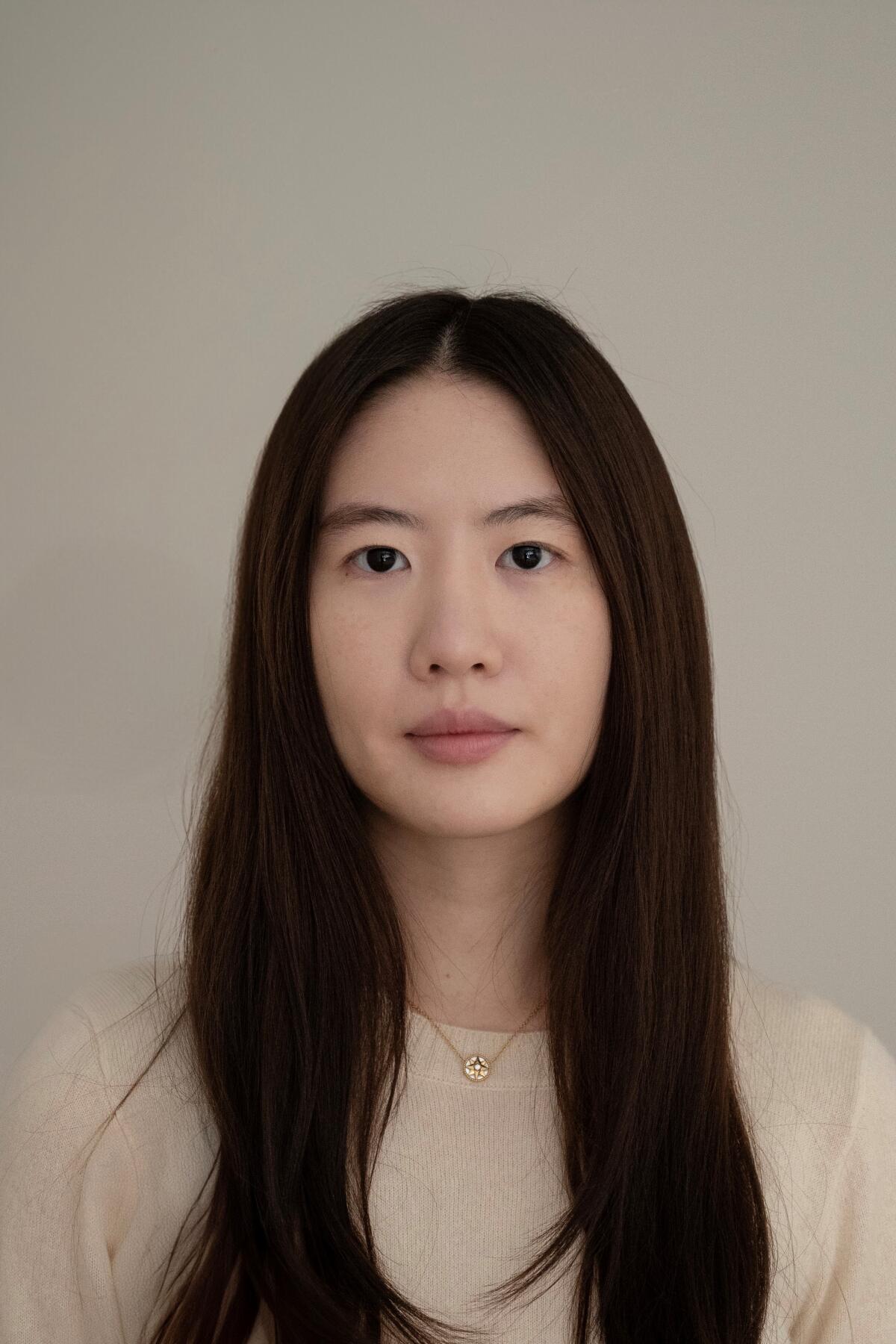
Author Cay Kim
(Margaryta Bushkin)
This is your first novel. Did you start writing it in college?
This actually originated from a long poem that I wrote. I didn’t know I was going to turn it into a novel at the time. I just had the idea, the summer before my MFA, to expand each stanza into a chapter. That made the writing process relatively easier for me because it was such a straightforward process. I already had the frame of it.
Even though the novel is grounded in a very specific milieu — that of a child who is ensnared between Korean and American cultures — it’s very much a universal story, of a mother who feels the burden of raising a perfect daughter and is resentful when the daughter rebels against her ministrations.
It’s something that occupies so much of my head space. I wanted the mother to be portrayed as a victim of her society. The way that people choose to parent isn’t something that they learn in a vacuum. She has deep-seated beliefs about suffering and self-abnegation. But there’s a point at which an act of service risks inverting into a selfish act.
A big concept for the mother is endurance.
Exactly. It’s a generational trauma the mother is dealing with. She has had such ingrained beliefs passed down to her, and she’s unable to recognize when her methods result in her own mental and physical splintering, as well as her daughter’s.
Is it a function of the mother’s ego, or some kind of twisted narcissism?
She is putting herself through so much suffering because she believes she is doing the right thing. And there’s an extent to how much you can excuse that self-unawareness.
Yet despite this, the daughter feels tied to her mother, even when they are at loggerheads and she is living thousands of miles away.
The mother is such an integral part of the daughter’s consciousness that severance is impossible. They have a shared history and the daughter wants to share things with her mother, even when they are fighting. When she feels lonely at Stanford, the daughter verbalizes the fact that she has learned loneliness from her mother.
There are a lot of scenes in the novel tied to meals prepared by either the mother or the grandmother.
I do a lot of thinking about how cooking plays a role in our everyday lives. It’s something that people can spend hours preparing, only to have it disappear. It’s her mother’s domain. It is so opposed to the way the father thinks, which is very much tied to capital, to amassing and saving money.
The daughter really comes into herself when she is exposed to American culture.
Minnesota is where she acquires language for the first time. Language is so important to this character. Then she is shuffled back to Korea, and this disjunction is the thing that propels her narrative development. But as the story goes on, the daughter reaches a point where she has such mastery of expression and that is a power she acquires.
“The Future Perfect” is written in a very precise and concise way. What fiction writers do you admire, or who may have served as models?
I love writers whose use of language jolts the mind. My favorite writer of all time is Marguerite Duras. “The Lover” reads so easy but when you pay attention to the language, it’s very precisely engineered. I also love Clarice Lispector, for the way she expresses human spirituality.
Is this book drawn from your life? I ask that only because your protagonist winds up attending Stanford, as you did.
When I first started learning how to write, my teacher always used to say that writing shouldn’t necessarily contain the factual truth, but it should have emotional truth. And I feel like that has been the core of my writing practice throughout my life, and that even for those that don’t think consciously about it, that’s often the case.
This Q&A was edited for length and clarity.
📰 The Week(s) in Books
Country music performer Kenny Chesney sat down with Holly Gleason, the co-author of his new memoir, to talk about writing the book.
(Jill Trunnell)
The state of Ohio is celebrating America’ssemiquincentennial by offering a statewide reading project that features Toni Morrison’s fictional oeuvre, thus providing a vivid alternative history of the country. “Not only does her work re-center African Americans in the story of our country, it also tackles major events from our founding, through slavery, to the impact of Jim Crow, to the great migration and beyond,” Literary Cleveland Executive Director Matt Weinkam tells Leigh Haber.
Chef-Podcaster-Author etc. Eddie Huang has written his first novel, a lightly autobiographical twirl through the foodie-verse called “Come Undone.“ “This book was very much about breaking up with your family to start your own,” he tells Mariella Rudi.
At a time when teen literacy is declining, Rudi polled five high school teachers to find out what books students should be reading now.
Gabrielle Korn’s novel “Long Island Girls” is a Millennial coming-of-age story that drips with Y2K nostalgia and the ways in which youthful optimism and hope can drift into middle-aged cynicism. “One thing I wanted to capture about early adulthood is the constant humiliation,” Korn tells Emily St. Martin. “The thing about being young is that people are so resentful of your youth, but you don’t understand that it’s resentment, you just think everybody hates you.”
📖 Bookstore Faves
The Loved Ones bookshop
(James Alan Duran)
J.C. Gabel, the owner of local book imprint Hat and Beard, has opened a new bookshop called The Loved One, and it already feels like an essential anchor for Historic Filipinotown’s burgeoning cultural scene. The store, which is also a gallery and events space, is expansive (5,000 square feet) and inviting, with patinated hardwood floors and a wall of picture windows that bathes the interior in natural light. I spoke with Gabel about his future plans for his new space.
What is the mission statement of The Loved One?
The Loved One reflects our ongoing commitment to independent publishing, original exhibitions, and the belief that books (and ideas within them) are best experienced in conversation with one another, in-person, whenever possible. In our post-post digital age, the serendipitous nature of organically curating physical objects is, in a sense, the point of the entire operation. We envision The Loved One as a space where everyone can exchange ideas, free from data-mining tech overlords, AI slop and click-bait tomfoolery.
What kind of books are you selling?
We’re going to focus mostly on new books about the visual arts, but we’ll also have several curated tables of fiction and nonfiction organized by subject and publisher, to highlight and promote the work of publishers we admire. Moreover, our genre-based book clubs and live author events — which will run weekly by August — will also influence the titles carried in the shop, too. Lastly, we’re bringing back Big Table, our books and conversation podcast — which we started with Dub Lab during COVID — now that we have a physical space to host and record these conversations.
It’s a very large space. What are your plans for it?
We are really keeping the space as modular as possible so we can change the interior of both storefronts to exhibit art and photography, as well as host author events, artist talks, live music, comedy, book clubs, etc.
You’re also a publisher, with Hat and Beard. How will that tie into The Loved One?
At least half of the arts programming I bring to the table will tie back to Hat and Beard’s original publications; the other half will be curated by Aubrie Wienholt and her team, working in tandem with myself and the H&B family. H&B will, of course, continue to program events all over the city regularly, but it will be nice to have a storefront again for the publishing house. We also intend to sell our rare and limited edition bundles of our books at TLO. There will finally be a physical space where one can come see this work in person before purchasing.
What about Historic Filipinotown? The Loved One is such a cool addition to what is becoming a vital cultural hub for L.A.
We are honored and thrilled to be working out of Historic Filipinotown. So much has opened in and around this neighborhood since COVID. It is a really vibrant community. There is a great camaraderie among all the small businesses in and around our cluster off Temple Street and Glendale Boulevard. Our immediate neighbors, Couplet Coffee and the bar 1642, are both actively involved in our programming monthly: Couplet has sent over a pop-up barista to serve coffee and tea at our literary events, and most of our after-parties are now held at 1642, two doors down.