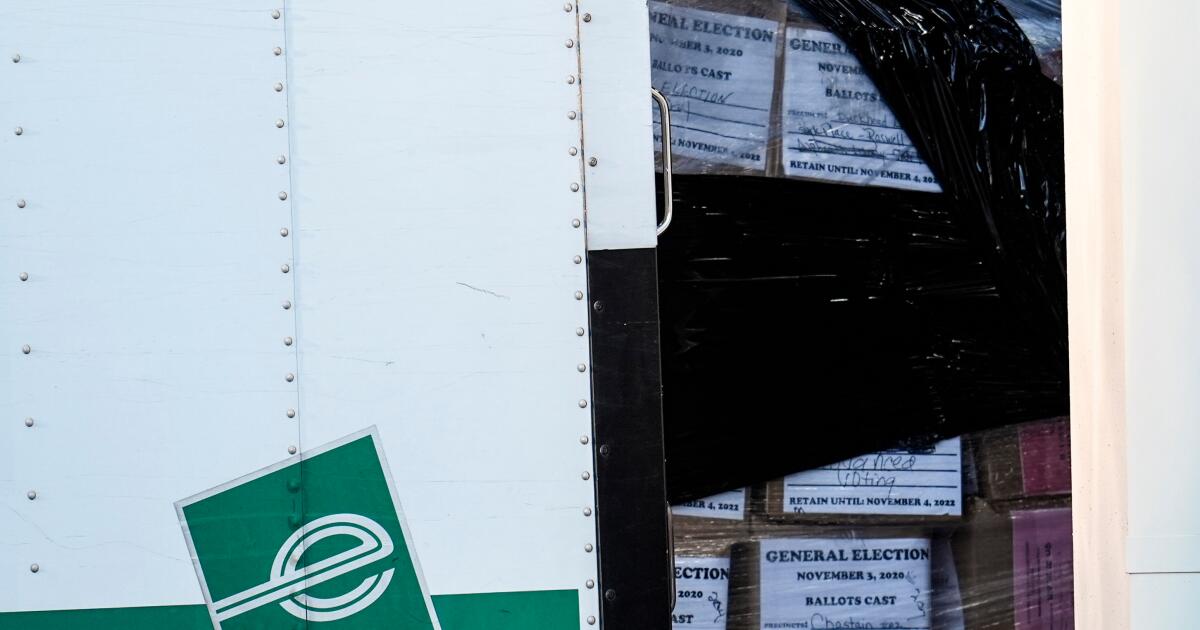
Georgia’s Fulton County and Trump administration square off in court over seized 2020 ballots
ATLANTA — Attorneys for Georgia’s Fulton County and President Trump’s administration squared off in court Friday over the county’s demand that the FBI return seized ballots and other materials from the 2020 election.
Abbe Lowell, an attorney representing Fulton County, noted that the January raid was “unusual” because it involved an old election and allegations that have already been investigated in the years since Trump, a Republican, lost the county and the state to Joe Biden, a Democrat.
Lowell contended that the Trump administration seized the materials because it grew impatient with litigation the Justice Department filed to obtain them last year. “There’s abundant law that the left hand of the department needs to know what the right hand is doing,” Lowell told U.S. District Judge J.P. Boulee.
Michael Weisbuch, representing the federal government, replied that the separate civil litigation wasn’t “relevant in any respect.” He said the administration has already provided Fulton County with digital copies of everything taken and needs to retain physical copies to carry out its own investigation.
Boulee wrote in a scheduling order that the hearing was needed after the two sides failed to reach an agreement in court-ordered mediation.
Trump’s actions alarm Democrats and election officials
The Jan. 28 seizure from a warehouse near Atlanta targeted the elections hub in Georgia’s most populous county, which is heavily Democratic and includes most of Atlanta. Fulton County has been at the center of unfounded claims by Trump and his allies that widespread election fraud cost him reelection.
The FBI’s move was among several actions by the Trump administration that have alarmed Democrats and many election officials who are concerned it’s using law enforcement to pursue the president’s personal grievances and is planning ways to interfere in this year’s midterm elections. The FBI also used a subpoena earlier this month to obtain records related to an audit of the 2020 presidential election in Maricopa County in Arizona, another battleground state Trump lost that year.
At the same time, the Justice Department is fighting numerous states in court for access to voter data that includes sensitive personal information. Election officials, including some Republicans, have said handing over the information would violate state and federal privacy laws.
Justice Department says it’s investigating 2020 ‘irregularities’
Lawyers for Fulton County argued in a court filing that the seizure of its documents was “improper and unjustified” and demonstrates “callous disregard” for the Fourth Amendment protection against unreasonable search and seizure. The Justice Department seeks to “set a precedent that would grant the federal government unchecked power to interfere with the local administration of elections,” it wrote.
Justice Department attorneys argued that preparing a detailed affidavit and presenting it to a judge “is the exact opposite of ‘callous disregard’” for those constitutional rights. “Their goal to disrupt an ongoing federal criminal investigation is clear,” they wrote of Fulton County officials.
The Justice Department said it is investigating “irregularities that occurred during the 2020 presidential election in the County” and identified two laws that might have been violated. One requires election records to be maintained for 22 months, while the other prohibits procuring, casting or tabulating false, fictitious or fraudulent ballots.
The filing said the FBI is looking into whether Fulton County properly retained ballot images; whether some ballots were scanned and counted multiple times; whether unfolded, unmailed ballots were counted as mail-in absentee ballots; and potential irregularities concerning tabulator tapes from the scanners used to count ballots.
Fulton County’s lawyers wrote that the “deficiencies” or “defects” in the county’s handling of the 2020 election cited in the affidavit are the kinds of human errors that commonly occur without any intentional wrongdoing and cannot establish probable cause.
Election tech expert cites problems in the affidavit
To support their claims, Fulton County officials submitted a sworn declaration from Ryan Macias, an election technology and security expert who advised the county during the 2020 election. He said the affidavit contains “a multitude of false or misleading statements and omissions” and offered explanations for the alleged “deficiencies.”
Investigations by the Georgia secretary of state and independent reviews contradict the core allegations of the affidavit, which is “rife with statements from witnesses lacking credibility, with extraordinary and undisclosed biases,” Fulton’s lawyers argued.
Georgia’s votes in the 2020 presidential race were counted three times, including once by hand, and each count affirmed Biden’s win.
Federal government lawyers rejected the idea that the FBI agent who wrote the affidavit “intentionally or recklessly misled” the judge, writing that “the supposed misrepresentations and omissions flagged by Petitioners are illusory and/or immaterial.” They also asserted that a lapse of the statute of limitations on the potential crimes does not negate probable cause.
The Justice Department also noted that a federal magistrate judge reviewed the FBI affidavit and signed off on the search warrant. Fulton County sought to have the FBI agent who wrote the affidavit testify at Friday’s hearing, but the Justice Department objected and the judge sided with the federal government.
Brumback writes for the Associated Press. AP writer Nicholas Riccardi in Denver contributed to this report.