second

LeBron James, Lakers showcase their clutch-time prowess vs. Rockets

LeBron James tapped the ball away from Houston’s Reed Sheppard. Marcus Smart fired a two-handed pass to James, who bobbled it and slapped it to Luke Kennard. Kennard faked a shot. He whipped a pass back to James.

Down three with 14 seconds left in regulation of Game 3 of the first round of the Western Conference playoffs Friday, James lined up a three. Two Houston players ran into each other while desperately trying to defend the shot.

With the ball hanging in the air and the game on the line, was there ever a doubt on the Lakers’ bench?

“Absolutely not,” guard Bronny James said. “It’s the Lakers.”

Already one of the league’s best clutch-time teams, the Lakers stirred up magic again Friday, overcoming a six-point deficit in the final 30 seconds of the fourth quarter to earn a 112-108 overtime win over the Houston Rockets. The Lakers took a commanding 3-0 lead in the best-of-seven series and will go for their first playoff series sweep since the second round in 2010 on Sunday in Houston.

The Lakers already won two nervy road games over the Rockets during the regular season. But the hero from those wins was dressed in a crisp white T-shirt and gray pants Friday. Luka Doncic, nursing a left hamstring injury, even took off his white jacket during the dramatic overtime. He had no reason to worry with James at the helm.

The 41-year-old played 45 minutes and four seconds, hit the game-tying three-pointer with 13.6 seconds left in regulation and had a team-high 29 points, 13 rebounds and six assists. Smart had 21 points, 10 assists and, for the second straight game, five steals, including one with 27.8 seconds left in regulation that set up three critical free throws.

The veterans have played in 406 combined playoff games and, hoping to add another win, showed the mentality shaped through each one.

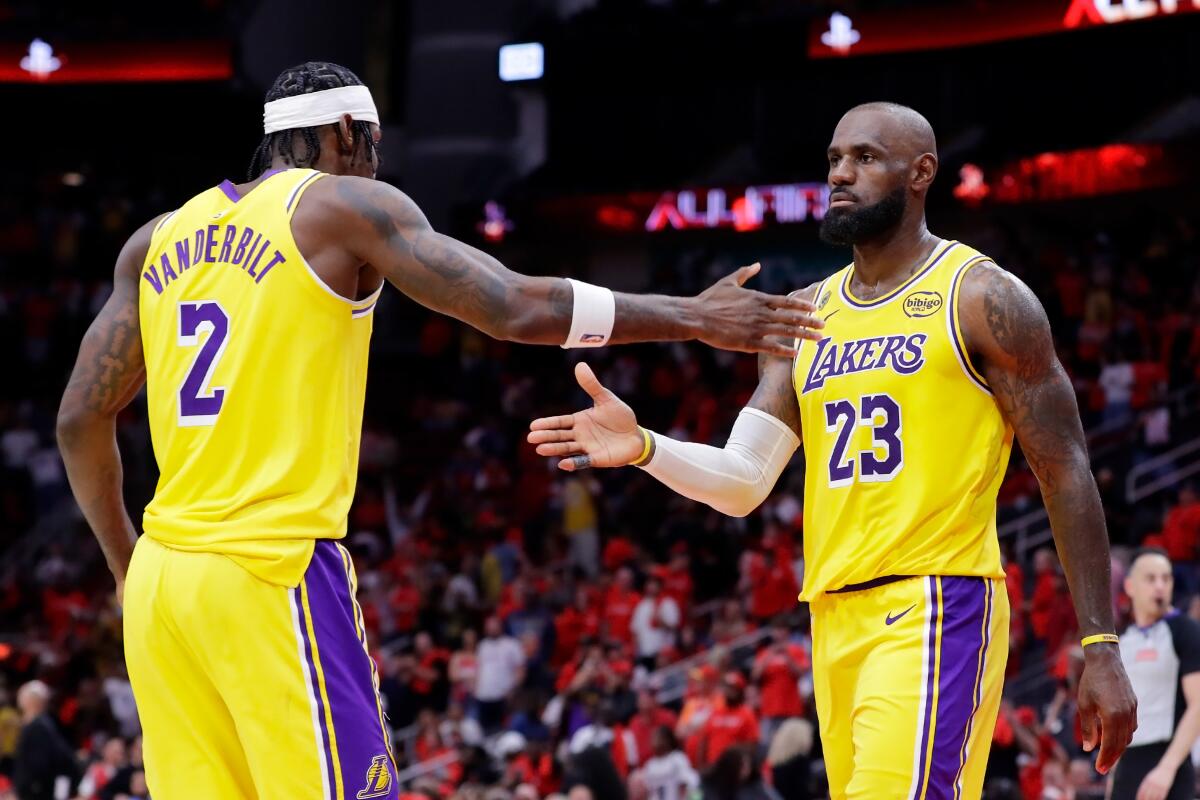
Lakers forwards Jarred Vanderbilt, left, and LeBron James celebrate after their overtime against the Houston Rockets.

Lakers forwards Jarred Vanderbilt, left, and LeBron James celebrate after their overtime against the Houston Rockets in Game 3 on Friday night.

(Michael Wyke / Associated Press)

“We’re just trying to have that killer mentality right now,” said Smart, who had eight of the Lakers’ 11 overtime points. “We got them on the ropes and then it’s our job to try to finish.”

The Rockets were desperate to avoid the dreaded 0-3 hole. They stormed back from a 15-point first-half deficit and took a one-point lead with 4:59 remaining on a three-pointer from Sheppard. The Houston crowd, which did not fill up until well into the first quarter, erupted.

James turned the ball over for the fourth time in the fourth quarter when Alperen Sengun tipped a bounce pass away from Kennard. Sengun appeared to punctuate the season-saving win with a one-handed dunk over James with 40.6 seconds left in the fourth quarter.

In the moment, Lakers forward Rui Hachimura admitted later, the Lakers felt a slight dip in their energy. They needed something to turn the tide.

Smart intercepted a lazy pass by Houston forward Jabari Smith Jr., and Jae’Sean Tate fouled the Lakers guard on a three-point attempt with 25.4 seconds left. He made all three free throws. The crowd grew restless. When James hit the game-tying three, those wearing the Rockets’ red T-shirts stood in stunned silence.

A vocal minority of Lakers fans were buzzing.

“Next play. Next play,” Lakers coach JJ Redick said of the Lakers’ mindset during the critical stages of the game. “I mean, look, there’s a lot of things that happened tonight that were not perfect. … But you just kind of get onto the next play. And that, to me, is a hallmark of poise; that’s a hallmark of composure.”

While the Lakers had the league’s best record in clutch time games during the regular season (22-8), the Rockets ranked 16th. With a 22-23 record in games within five points in the final five minutes, the Rockets had the fifth-most clutch-time losses. Only Indiana, Memphis, Brooklyn, Dallas and New Orleans had more such losses.

Houston coach Ime Udoka called the foul on Smart “terrible.” Instead of passing to a wide-open Sengun, Sheppard tried to split a double-team on the decisive turnover. Sengun’s attempt at a game-winner when he got stood up by Jaxon Hayes on a turnaround baseline floater wasn’t the play the Rockets drew up, Udoka said.

“Horrendous mistakes,” the third-year Rockets coach said. “I don’t want to say youth or scared of the moment or whatever the case.”

The Rockets, who lost in seven games in the first round of the playoffs last year, were without star Kevin Durant for the second time this series. He missed the game with a sprained left ankle, an injury he sustained in the fourth quarter of Game 2. He was sidelined for Game 1 because of a knee contusion he picked up in practice. The 37-year-old was remarkably durable this season, ranking second in the NBA in minutes played. His presence was a lifeline for a team that lost point guard Fred VanVleet to a torn anterior cruciate ligament last September.

Durant was ruled out about 90 minutes before tip off. When told of the injury update during his pregame news conference, Redick was not fazed. The Lakers know who they have on their side.
Source link

Contributor: Regulate the ‘Enhanced Games’ as a medical experiment and a marketing stunt

It felt like the Olympics. Crowds cheering. The American flag standing tall above the bleachers. Trainers jumping with anticipation. A swimmer staring in disbelief at the clock after his final stroke. The Jumbotron announced: Kristian Gkolomeev — 20.89 seconds. A new world record in the 50-meter freestyle.

Well, kind of.

I’ve left out some details. There was only one swimmer. The crowd? Just doctors, trainers and filmmakers. This was not in an Olympic city nor an Olympic year, but in Greensboro, N.C., in 2025. And there were no iconic rings on the banners, just “Enhanced Games.”

Yes, Gkolomeev swam faster than César Cielo, the official record holder at the time (20.91 seconds). But he did it “enhanced” — a polite way to say that he used performance-enhancing drugs. At the Enhanced Games, doping isn’t punished. It’s required.

The concept, as described by the organization: “to create the definitive scientific, cultural and sporting movement that safely evolves mankind into a new superhumanity.”

Backed by investors such as Peter Thiel and Donald Trump Jr.’s 1789 Capital, the Enhanced Games embodies a techno-utopian ideal: athletes as canvases for chemical optimization, testing the limits of human health for a lot of money. Gkolomeev earned $1 million for his record.

So far, the competition has happened at one-off pop-up events. But in May, Las Vegas will host the first full-scale Enhanced Games, a four-day meet in swimming, track and field, and weightlifting. The group advertises a “potential prize purse of $7.5 million for just a single day of competition,” plus appearance fees.

Does it need to be said? Apparently yes: The Enhanced Games glorifies the risky use of enhancement drugs.

Steroids can harden arteries, elevate stroke risk, damage the liver and permanently alter hormone systems. They are not electrolyte tablets or a little preworkout creatine. If Lance Armstrong had been rewarded — rather than sanctioned — for doping, what would have happened to competitive cycling?

Fans — and especially kids — mimic their idols. As risky as the drugs are for athletes at the Enhanced Games, with its “medical commission” to give the illusion of safety, the substances are even more dangerous when used by people without medical supervision.

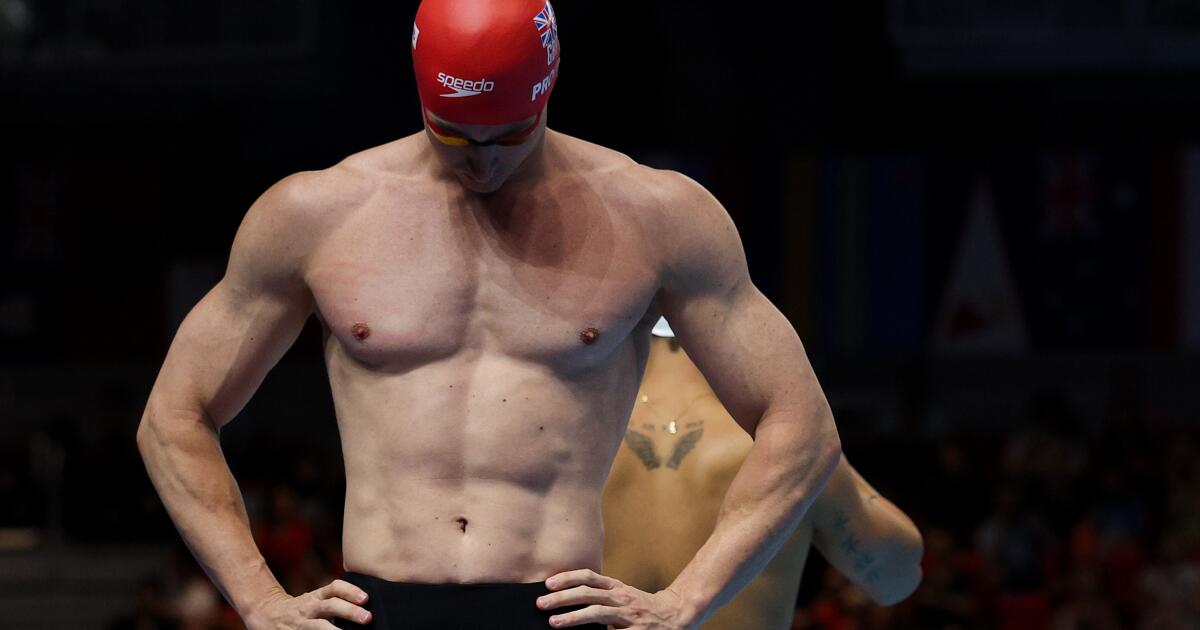
The games also expose the economic neglect that drives athletes toward such competition. As Benjamin Proud, the British silver medalist who recently joined the Enhanced Games, put it: “It would have taken me 13 years of winning a World Championship title in order to win what I could win in one race at these games.”

Indeed, the Enhanced Games might look like an easy way out. Only nine swimmers worldwide received prize money and performance bonuses above $75,000 in 2025, according to World Aquatics.

Investors clearly hope to make money off the games as well. The organization is moving closer to becoming a publicly traded company. The economics are not mysterious.

But the Enhanced Games are not just another sporting event. They are an arena for biomedical experimentation and should be regulated as such. The games should face limits similar to those imposed on other high-risk industries, including age restrictions and strict advertising rules.

We already know how to govern legal, profitable activities that carry serious health risks.

In the United States, that means oversight from the Food and Drug Administration and the Federal Trade Commission — bodies that regulate drug protocols and police misleading commercial claims. A steroid-based competition should not be treated as a sport but as a medical experiment and a marketing stunt.

Regulations on pharmaceutical advertising offer a useful model for the Enhanced Games. Prescription drugs are advertised every night on television, but only under strict rules. They require fair balance (content must present benefits and risks with comparable prominence, readability and duration) and a “major statement” of risks (most serious risks must be spoken aloud and not obscured by visuals or music).

Right now, when you play Gkolomeev’s “world-record” video on YouTube, a medical-risk warning appears for barely five seconds — then vanishes. If a cholesterol drug must audibly warn viewers of stroke risk, why shouldn’t a steroid-based competition do the same?

Enhanced Games content should be accompanied by clear warnings of the risks of performance-enhancing drugs and be clearly labeled, age-gated and distributed as high-risk content more akin to pornography than to a boxing match.

Prohibition is not the answer. Trying to shut down these games only fuels a controversy-driven brand. Just recently, the Enhanced Games sued organizations such as World Aquatics and the World Anti-Doping Agency, alleging antitrust violations and that blocking athletes from participating at the Enhanced Games is illegal. As those organizations fight back, they will be seeking to protect the integrity of mainstream sports, but they will also inadvertently be promoting the Enhanced Games.

If we want kids to admire clean athletes rather than those using banned drugs, the Las Vegas launch must not reach the world as a Super Bowl would. The Enhanced Games should not be televised or allowed to stream online to minors. Otherwise, Las Vegas, in May, risks becoming an unregulated public-health experiment mislabeled as a sporting event.

Fabricio Ramos dos Santos is a lawyer, entrepreneur and sports investor.

Source link

Lakers beat Rockets in Game 2 with a new Big Three

Do the Lakers have a new Big Three?

LeBron James, Marcus Smart and Luke Kennard are putting in their bid to make it so.

They did the heavy lifting for the Lakers, combining for 76 points, 16 rebounds and 16 assists to carry the Lakers to a 101-94 win over the Houston Rockets in Game 2 of the Western Conference playoffs Tuesday night at Crypto.com Arena.

James had another near triple-double with 28 points, eight rebounds and seven assists to help the Lakers take a commanding 2-0 lead in the best-of-seven series. He capped his night with a two-handed dunk with 55.3 seconds left to make sure the Lakers didn’t blow a 15-point lead they built in the first half.

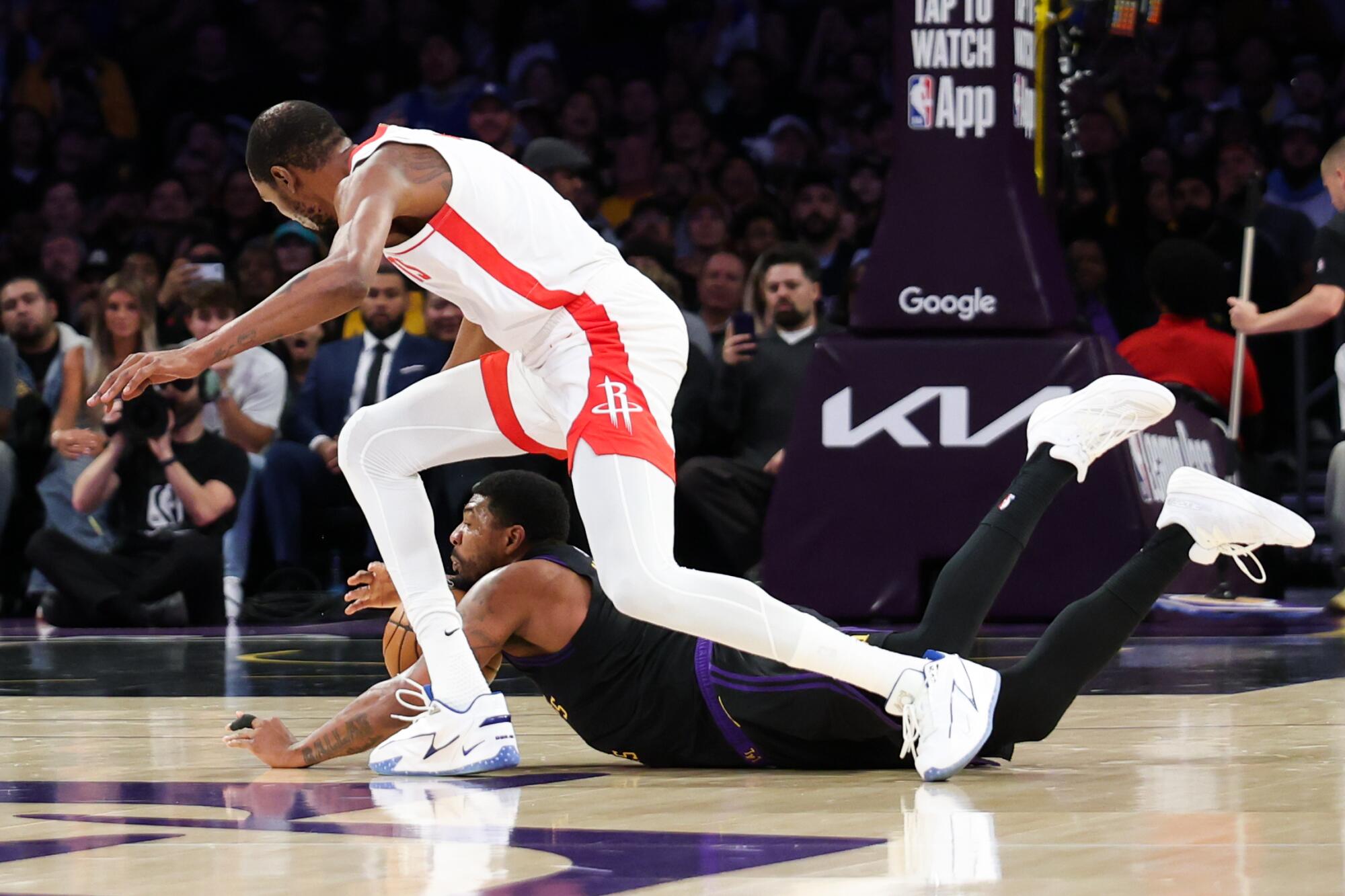
Lakers guard Marcus Smart, sprawled on the court, steals the ball from Rockets forward Kevin Durant during the first quarter.

Lakers guard Marcus Smart, sprawled on the court, steals the ball from Rockets forward Kevin Durant during the first quarter of Game 2.

(Robert Gauthier / Los Angeles Times)

Smart had 25 points, seven assists and two rebounds while his defense was outstanding once again. Smart, who was eight-for-13 from the field, drilled a big-time three-pointer late in the fourth quarter to give the Lakers an eight-point lead.

Kennard had 23 points, six rebounds and two assists. His two free throws with 14.3 seconds left capped the scoring.

And once again, the Lakers showed their clutch genes, this time doing so with Luka Doncic (Grade 2 left hamstring strain) and Austin Reaves (Grade 2 left oblique muscle strain), sitting on the bench injured.

The Lakers had the best clutch record in the NBA during the regular season, going 22-8 in games when the score was within five points in the final five minutes. The Rockets on the other hand, went 22-23 during clutch moments, ranking 16th in the league.

“We all got to pick up our play,” James said. “When you’ve got two big guns out like we have, we all got to pick up our play. And that’s all it’s about. We’re all just trying to contribute, make contributions in all facets of the game, pick up our play. Obviously, we’re missing Luka and missing AR, so we’re just trying to seize the opportunity. That’s all.”

Kevin Durant returned to play after missing Game 1 because of a right knee contusion, and he was sharp early on, scoring 20 points in the first half. But Durant had just three points in the second half and he had nine turnovers for the game.

With the Rockets hosting Game 3 on Friday night, James said he found no comfort in how the Lakers defended Durant.

“None. That just makes him even madder going into Game 3. No satisfaction,” James, who played 39 minutes and 12 seconds, said. “You know, we did our job. We did that. But the guy’s a first-ballot Hall of Famer and he’s going to make way more great plays than not. So, we don’t have no satisfaction. That game is over and done with, but it’s still a tall challenge.”

Lakers guard Luke Kennard takes the ball from Rockets forward Kevin Durant during Game 2.

Lakers guard Luke Kennard takes the ball from Rockets forward Kevin Durant during Game 2 of their first-round playoff series at Crypto.Com Arena on Tuesday.

(Robert Gauthier/Los Angeles Times)

The starting backcourt of Smart and Kennard, starting in place of Doncic and Reaves, had the kind of first-quarter scoring display Doncic is known for delivering.

Smart had 14 points in the first 12 minutes, shooting five for seven from the field and three for four from three-point range. Kennard had 10 points in the first, shooting four for six from the field and two for three from three-point range.

“Whether those guys are here or not, obviously we would love for them to be here,” said Smart, who played 35:29. “They elevate us to a whole other level, right? And we understand that. But they’re not and there’s nothing we can do about it but step our game up for those guys.”

During the regular season, Doncic, Reaves and James were the Big Three for the Lakers.

But James has two new mates to help the cause, and Smart and Kennard are holding it down.

It started in Game 1, when James, Smart and Kennard combined for 61 of the Lakers’ 107 points, 14 rebounds and 24 assists.

Houston forward Kevin Durant passes the ball under pressure from Lakers forward Rui Hachimura and center Jaxson Hayes.

Houston forward Kevin Durant passes the ball under pressure from Lakers forward Rui Hachimura and center Jaxson Hayes Tuesday night at Crypto.com Arena.

(Robert Gauthier/Los Angeles Times)

“We know throughout the game we’re going to have the ball in our hands the most, us three,” said Kennard, who played 41:58. “Again, it’s just playing within the flow of the game when we can. Seeing what adjustments they made earlier in the game and just trying to find ways to beat it. I thought we did a good job of staying poised and under control overall. … But, like I said, us three, we know we’re going to have the ball the majority of the time when it comes down to it and we have to be aggressive and look for the right play each time.”

Etc.

When asked about a report saying Reaves has progressed to one-on-one court work and what Doncic is able to do, Lakers coach JJ Redick said, “Yeah, no update on the timeline for either of those guys.”

“Austin has started a return-to-play [plan,] but we don’t have any timeline update for him,” Redick added. “And then Luka I think is gonna start some court work here soon. But again, no update on timeline.”

Redick was asked if Reaves returning to play meant he is starting some support work.

“Yeah. But he, again, it’s an upper-body injury versus a lower-body injury, so it’s different things,” Redick said.

Redick was asked one last time what return-to-play progression looks like for Reaves.

“That’s above my pay grade,” Redick said.

Source link

Kings let late Game 2 lead slip away and lose to Avalanche in overtime

The Kings haven’t won an NHL playoff series since the last time they won the Stanley Cup, which is to say it’s been a while.

They’re halfway to another early exit after a 2-1 overtime loss to the Colorado Avalanche on Tuesday, a result that gave the Avalanche a 2-0 lead in the best-of-seven series. The winning goal came from Nicolas Roy 7:44 in the extra period.

The Kings’ lone goal came from Artemi Panarin while captain Gabriel Landeskog had the other Colorado goal.

“We did play really well,” interim coach D.J. Smith said. “We’ve got to find a way to win a game. Clearly, good isn’t enough. We’ve got to win a game and keep taking a piece of them and keep playing physical and give ourselves a chance to keep lengthening the series.”

Panarin gave the Kings a 1-0 lead on a wrister from the inside edge of the right circle with less than seven minutes left in regulation. It was his second power-play goal of the series and it came on the Kings’ fifth power play of the night.

It also came after the Kings got a fortunate break, with a Colorado clearing pass striking a linesman, leading to a faceoff in the Kings’ offensive end.

Landeskog evened things for Colorado 3 1/2 minutes later, escaping Kings forward Scott Laughton to skate to a Martin Necas pass through the crease before pushing the puck inside the left post to send the game to overtime.

For the Kings, it marked their 34th overtime in 84 games this season, an NHL record. They lost 21 of them but Tuesday’s was the most painful, with Roy scoring on a deflection in the crease.

“We had every opportunity,” Smith said. “You’ve got to be able to close it out.”

The teams now head to Crypto.com Arena for games Thursday and Sunday with the Kings needing at least one win to extend their season.

“I expect that we’ll be better at home,” Smith said.

To do that, the Kings are going to have to stop wasting the kind of opportunities they had in Denver, where they converted just two of nine power-play chances and failed to score on a penalty shot in the first two games.

The physical series turned chippy in late in Game 1 and that carried over to the start of Game 2 with a pair of scuffles, each involving more than a half-dozen players, breaking out 12 seconds apart midway through the first period. The teams combined for seven penalties in a fast-paced opening 20 minutes played with a lot of open ice.

Quinton Byfield had two chances to put the Kings on the board just more than three minutes into the second period but Colorado goalie Scott Wedgewood came up big both times.

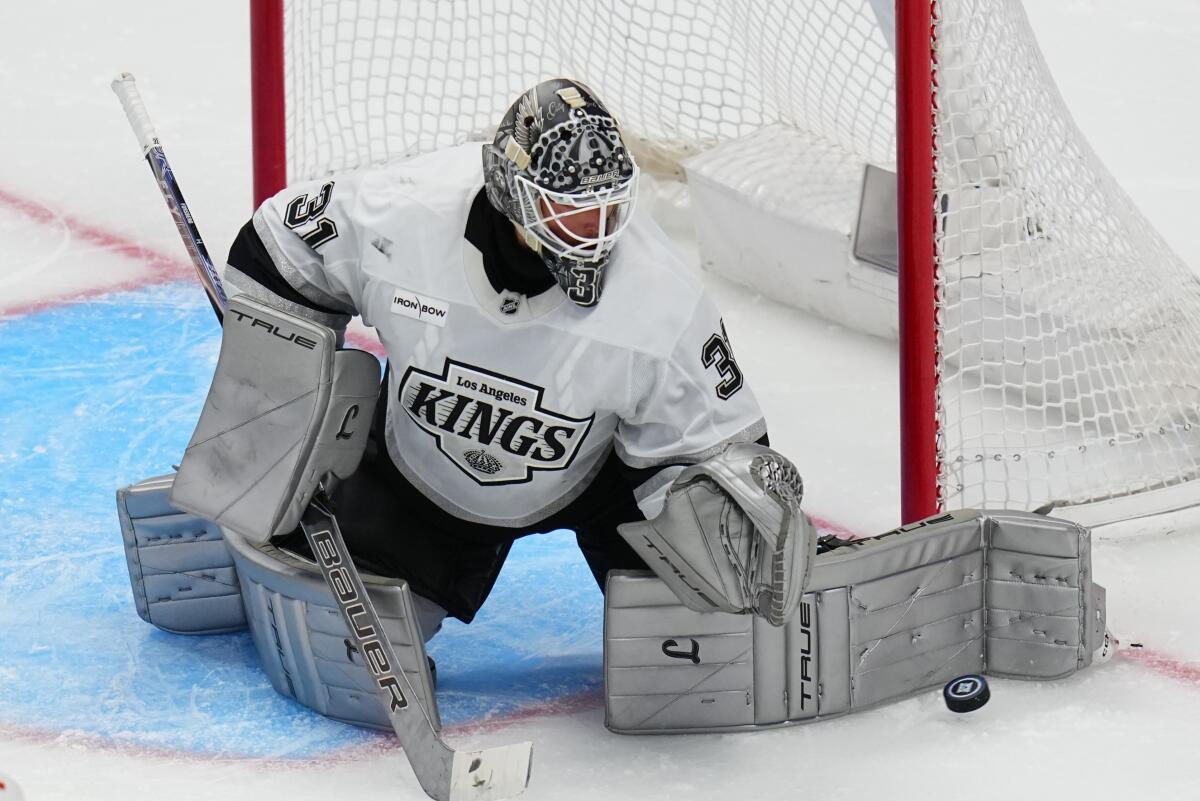
Kings goaltender Anton Forsberg makes a save during overtime of Game 2.

Kings goaltender Anton Forsberg makes a save during overtime of Game 2.

(Jack Dempsey / Associated Press)

The first came when Byfield charged Wedgewood on a breakaway, only to have the goalie stop his wrister from in close. But Avalanche defenseman Cale Makar was called for hooking Byfield from behind on the play, setting up a penalty shot. Wedgewood stopped that too.

An over-excited group of fans celebrated the two saves by breaking a pane of glass behind the Kings bench, sending the coaches scurrying and pausing the game for several minutes as workmen repaired the damage. But 16 seconds after play resumed, the Avalanche took another penalty, their sixth of seven on the night.

The Colorado penalties left the Kings with a man advantage for nearly a quarter of the game’s first 25 minutes, but their power play couldn’t take advantage against a Colorado penalty kill that ranked No. 1 in the NHL during the regular season.

“Obviously, you just want the opportunities,” forward Trevor Moore said. “Now we’ve just got to make the most of them.”

Colorado’s best scoring chance in the first two periods came on a three-on-one rush less than five minutes before the second intermission, but Kings defenseman Mikey Anderson reached in to break up the play and keep the game scoreless.

Colorado celebrates its Game 2 victory over the Kings.

Colorado celebrates its Game 2 victory over the Kings.

(Jack Dempsey / Associated Press)

Sam Malinski appeared to give the Avalanche the lead on a slap shot from above the left circle 10 seconds into the final period, but after the horn sounded and the goal was put in the scoreboard, the officials correctly ruled the puck had struck the outside of the net.

Five minutes later Byfield fanned on a loose puck in the crease, allowing Wedgewood to roll over and clear it from in front of the open net.

Now the Kings come home, where they won six of their final seven regular-season games, the only loss coming in a shootout. But they haven’t beaten the Avalanche anywhere this season and if they have to at least once in the next two games to avoid their seventh straight first-round playoff exit.

“Thought we played better tonight,” Moore said. “So we’ve to to try to just take the positives and get to L.A. and play a good game.”

Source link

Quick final pit stop helps Alex Palou win Long Beach Grand Prix

For two thirds of Sunday’s Acura Long Beach Grand Prix, Alex Palou bided his time… waiting for the one break he needed.

It came in the form of a caution on the 58th lap, allowing him to overtake front-runner Felix Rosenqvist exiting pit lane and hold the lead the rest of the way, taking the checkered flag by 3.96 seconds for his third triumph in five IndyCar Series races this season and his first at Long Beach.

Right after being showered with applause and confetti at victory lane, the 29-year-old Spaniard thanked his crew, whose quick work on the last pit stop proved to be the difference.

“Everyone was coming in on that yellow and they did an incredible job,” he said. “We were either going to win it or not win right there.”

Rosenqvist settled for second and Scott Dixon, Palou’s Chip Ganassi Racing teammate, was third.

It was the 11th win over the last 22 races dating back to 2024 for the Barcelona native and the 22nd win of his career, tying him with Tony Bettenhausen and Emerson Fittipaldi. It also vaulted him to the top of the Series standings as he chases his fourth Series championship in a row and fifth overall. Palou won the opener March 1 in St. Petersburg (also a street course) and the fourth race March 29 in Alabama.

Palou led for only 32 of the 90 laps Sunday and acknowledged it would have been difficult to catch Enqvist if not for the stoppage.

“I wasn’t giving up but it would’ve been tough to get him today,” Palou admitted. “He was already three seconds ahead. I was happy with my car but I was struggling more on the soft tires than the hards so I’d say my chances were low. The feeling was great seeing all the open space coming out of pit lane because when you spend 60 laps behind a car it disturbs you. I tried to match him on soft tires but it wasn’t working.”

Alex Palou speeds through a curve of the track.

Alex Palou speeds through a curve of the track.

(Ronaldo Bolaños / Los Angeles Times)

In six starts at Long Beach, Palou has never finished lower than fifth.

There is little room to maneuver on the 1.968-mile course with 11 tight turns, but after starting in the third position next to defending champion Kyle Kirkwood, Palou managed to sneak past Pato O’Ward into second place heading into the first turn on Lap 2.

“Making that move on the straightaway was big because I knew it was one of our only chances to get a pass on Pato,” Palou said. “I got that good run on that last corner and he didn’t expect it.”

This year marked the 51st edition of the longest-running major street race in North America, which started in 1975 as part of the Formula 5000 Series, switched to the CART/Champ Car World Series in 1984 and joined the IndyCar Series in 2009.

The top four qualifiers started on softer, high-grip “alternate” tires to establish position while the rest of the grid started on harder, more durable “primaries” to manage degradation on the 110-degree track surface. Of the 25 starters, 24 completed the 177.12 miles.

“We were going to make the two-stop strategy work but didn’t know if it would be doable or not,” Palou added. “As soon as I saw I couldn’t get Felix it was all about patience, fuel and waiting for the right time. I owe this win to my team. Without that pit stop I probably wouldn’t be sitting here now. It only takes one mistake to go from second to seventh but they’re great under pressure.”

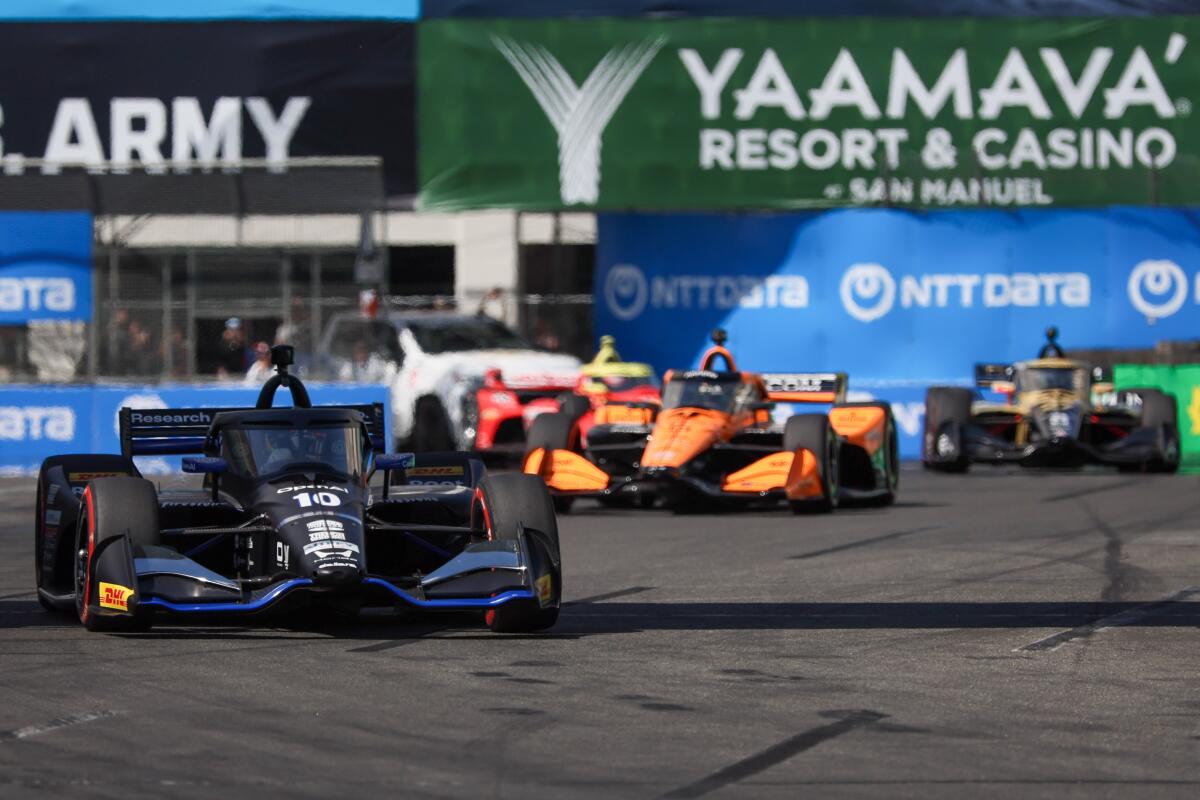
Cars make their way down a straightaway during Long Beach Grand Prix.

Cars make their way down a straightaway during Long Beach Grand Prix.

(Ronaldo Bolaños / Los Angeles Times)

Past winners Will Power and Josef Newgarden moved into the top two positions after Rosenqvist pitted but the Swede regained the lead when Newgarden pitted for the first time on Lap 37 and dropped back to 14th.

The first 45 laps were caution-free as Rosenqvist, Palou, Kirkwood, David Malukas and O’Ward held the top five spots. Newgarden fell out of contention when a flat spot on his left front tire dropped him back to 14th.

Rosenqvist’s three-second lead was erased when debris on the track exiting the Aquarium Fountain drew the only yellow flag all afternoon and narrowed the gap. Capitalizing on favorable pit position, Palou emerged from the lane just ahead of Rosenqvist.

After earning the pole position with a lap time of 1 minute, 7.4625 seconds in qualifying, the runner-up had mixed emotions after leading for 51 laps with no win to show for it.

“You want to win when you have an opportunity but I’m proud of today,” Rosenqvist said. “We weren’t as good as Alex on the blacks… the last pit cycle was the defining moment. We had to come around 14, he had more of an opening and his crew nailed it. That happens.”

Kirkwood, who was vying for his third win in four years, finished right where he started in fourth.

“I had a good cushion and figured even with a bad stop I’d probably stay ahead but I knew there’d probably be a yellow at some point and there it came,” Rosenqvist lamented. “Considering Alex had primary [tires] also I think we would’ve been able to hold him off. It’s definitely disappointing when you can’t wrap it up.”

Dixon, who started in the position, earned his first podium this season and the 136th of his career.

Fans watch with two laps left in the race.

Fans watch with two laps left in the race.

(Ronaldo Bolaños / Los Angeles Times)

“The race itself was a bit blah — I sat in the same position for most of it,” Dixon said. “Luckily for us we had it easy out of that last stop.”

Al Unser Jr. holds the record for most wins at Long Beach, chalking up six in eight years, including an unmatched four in a row from 1988 to 1991.

Tom Sargent is becoming a fan of street circuits after two wins this weekend. Driving the Porsche 911 Cup for GMG Racing in the Mobil Pro Class, the 22-year-old Australian led from start to finish in Race 1 of the Carrera Cup North America on Saturday. In Race 2 on Sunday morning, he again started from the pole and claimed a 0.965-second victory over Aaron Jeansonne to complete the double.

In his last bid at Long Beach three years ago, he hit the wall on Lap 2 but still finished second.

“Momentum in sports is critical and the past few weeks have been really cool for me,” Sargent said. “I didn’t do any street circuit racing before I came to the States. Maybe it fits my driving style.”

Source link

Angels struggle to hit against Padres, suffer loss at Angel Stadium

Ramón Laureano and Fernando Tatis Jr. each drove in two runs apiece, Germán Márquez threw 5 2/3 scoreless innings in a strong start and the San Diego Padres beat the Angels 4-1 on Saturday night.

Adrian Morejon (2-0) struck out two in 1 1/3 scoreless relief innings for the win and Mason Miller earned his seventh save despite giving up a single and a walk in the ninth.

Miller, who has allowed two hits, walked two and struck out 25 in 10 1/3 innings this season, extended his scoreless streak to 31 2/3 innings dating to last Aug. 6.

The teams were in a scoreless tie when Freddy Fermin and Jake Cronenworth opened the eighth with four-pitch walks off Ryan Zeferjahn (1-1). Laureano chopped an RBI single through the middle for a 1-0 lead, snapping San Diego’s 16-inning scoreless streak. Tatis followed with an RBI hit-and-run dribbler through a vacated second-base spot for a 2-0 lead.

The Angels trimmed the deficit to 2-1 in the bottom of the eighth when Logan O’Hoppe and Adam Frazier singled off Jason Adam and Nolan Schanuel hit a two-out RBI single. But Jo Adell grounded out to end the inning.

San Diego pushed the lead to 4-1 in the ninth on Laureano’s sacrifice fly and Tatis’ RBI single.

Márquez gave up two hits, struck out five — all in the fourth and fifth innings — and walked two.

Angels starter Yusei Kikuchi allowed four hits, struck out eight and walked one in six innings.

Jackson Merrill robbed Yoán Moncada of a solo homer with a leaping catch at the right-center-field wall in the second, holding onto the ball as he collided with Tatis.

The game was twice delayed for several minutes. In the second, O’Hoppe, the Angels’ catcher, took a foul tip off his neck. In the fifth a 96-mph fastball from Kikuchi grazed Cronenworth’s chin. Both players remained in the game.

Up next

Padres RHP Michael King (2-1, 2.78 ERA) will face Angels LHP Reid Detmers (1-1, 3.57 ERA) in Sunday’s series finale.

Source link