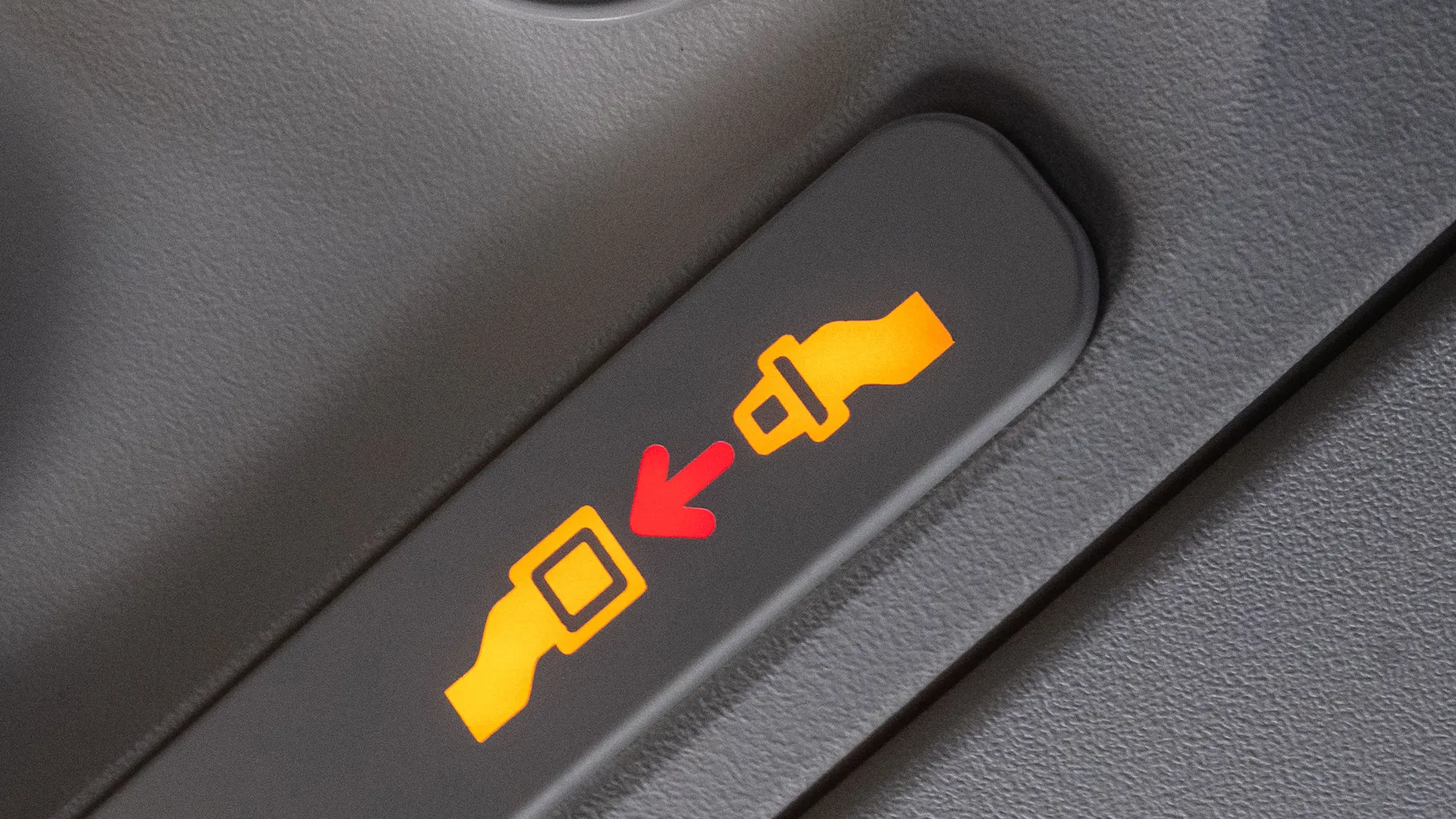
Passengers warned after FAA threatens $37,000 fines just for removing your seatbelt

IMPATIENT passengers who unfasten seatbelts before their plane has come to a complete stop at the gate could get hit with $37,000 fines.
There’s one key reason for the Federal Aviation Administration (FAA) to penalize unruly flyers racing to be the first to disembark flights.
It’s a violation of federal law to ignore illuminated safety signs such as an aircraft’s “fasten seatbelt” sign.
But that doesn’t stop people from opening their safety restraints and reaching for their cabin bags in overhead luggage compartments.
The rule applies during the taxi, takeoff, and landing stages – until the aircraft has safely reached the gate and the sign has been turned off.
Passengers must remain buckled in while the seatbelt sign is illuminated, the FAA has warned.
Snubbing these safety instructions can result in a hefty civil penalty of up $37,000.
The regulation dates back to the 1970s, and was imposed for safety reasons.
After a plane lands, passengers are at risk of falling or other injuries if they stand and attempt to move while the aircraft taxis to the gate.
Seatbelts restrain the body movement when excessive force is applied, for example in a crash, explained Skybrary.
Keeping them fastened helps passengers survive by preventing flyers from being thrown around the aircraft and against hard objects or other people.
It also “prevents people being thrown out of the aircraft in case of a hull breach,” the website added.
What defines an unruly passenger?
- Illegal use of narcotics
- Refusing to follow safety instructions, including seat belt, smoking, or device rules
- Verbal confrontations with crew or other passengers
- Physical altercations onboard
- Interfering with crew duties
- Refusing to board or exit a plane
- Making threats toward crew, passengers, or the aircraft
- Sexual harassment or abuse
- Riotous behavior such as screaming, kicking seats, or banging tray tables
There have been fatalities as a result of a failure to comply with the rule.
For example, in July 2013, a Boeing passenger flight operated by Asiana Airlines from Seoul Incheon, South Korea, to San Francisco crashed within the airport’s perimeter shortly before completing a landing.
The aircraft had hit the sea wall situated prior to the runway and the tail had detached.
Two people were found dead outside the plane, after being ejected at impact.
The dead girls were both 16-year-old students, Wang Linjia and Ye Mengyuan.
More than a decade ago, a passenger on board a Southwest Airlines flight appealed an FAA penalty after he left his seat and approached the front of the aircraft while the safety sign was on.
He was slapped with a $3,300 civil penalty.
In 2013 an appeal heard that the man, Brian Wallaesa, believed he should not be held accountable for his behavior in 2009 because he was having a medical emergency.
But his appeal was denied as he “failed to prove that he had a medical emergency that caused him to lose control of his actions on that flight,” according to the decision.
“About an hour outside of Las Vegas, the captain turned on the ‘fasten seatbelt’ sign and informed the flight attendants that he wanted them to sit down and wear their seat belts because he expected the flight to experience turbulence.
“Not long afterwards, while the ‘fasten seatbelt’ sign was lit, Wallaesa stood up and walked quickly toward the front of the airplane,” the filings added.
When flight attendants asked him to return to his seat, “he refused.”
The FAA had originally sought a $5,500 civil penalty, but he was given a $3,300 fine after his appeal was denied.
History of Aviation Safety Belt Policy
Many travelers don’t know that disobeying illuminated safety signs violates federal law
Major General Benjamin D. Foulois, one of the first military pilots, invented the safety belt to prevent himself from being thrown out of the aircraft in the early 1900s.
- His idea for a seatbelt began to spread throughout the aviation community
- By the time World War I began in Europe in 1914, the US military began installing seat belts or harnesses in aircraft
- After the war, seat belts started to appear in civil aircraft
- By 1928, seatbelts were mandatory in all types of aircraft, but passengers were not required to wear them
- The purpose of safety belts was to prevent passengers from being tossed around or thrown out of the cockpit during turbulence or other maneuvers in the 1920s
- In 1947, the Air Force conducted a study which found that if secured with a safety belt, the human body can withstand at most 4870 pounds of force without injury
- In 1971, amendments to the Federal Aviation Regulations required that “each occupant of an aircraft fasten his safety belt during the takeoff and landing of that aircraft”
- Large planes still use the lap belt due to its design and aerodynamics – shoulder belts require a strong secure anchor spot, which would need the airline seats to be heavier, making the plane less aerodynamic
Source: FAA
In 2021, the FAA proposed a $14,000 civil fine for an Endeavor Airlines passenger who allegedly unfastened her seat belt while the warning sign was illuminated.
The passenger had also refused to wear a mask properly despite repeated instructions from flight attendants.
“I can’t tell you how many times on a domestic flight, 10, 15, 20, 30 people would get up before we were parked at the gate,” ex-American Airlines flight attendant Steve Burman told the New York Times last May.
He saw a woman being injured after a bag toppled on top of her when an overhead bin was opened too soon.
The FAA has recently implemented a “zero-tolerance policy” of issuing fines.
This is due to skyrocketing cases of problem passengers risking the safety of crew and fellow flyers.
Unruly passengers can face fines of up to $37,000 per incident – as well as criminal prosecution, the agency confirmed last year.
Previously, the maximum civil penalty per violation was $25,000.
The $37,000 fine per violation for passengers also applies to flyers who assault, threaten, intimidate, or interfere with airline crew members, said World of Aviation.
Some cases also lead to FBI referrals.
A penalty also now applies to commercial flights to Turkey, with fines set at about $70 for flyers who move before the seatbelt sign turns off.