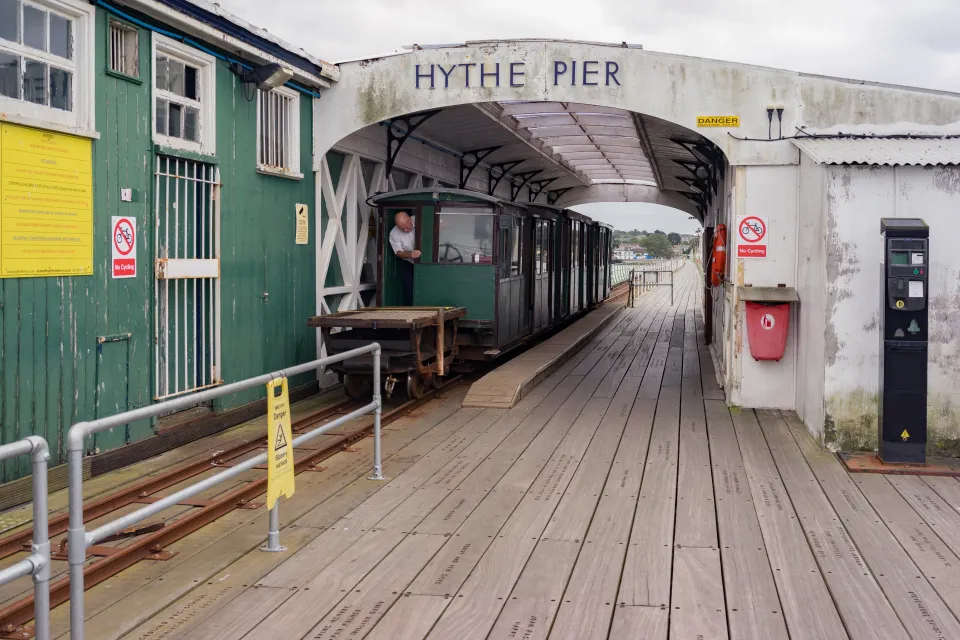
A HISTORIC Hampshire pier is set to reopen to the public for the first time since its closure in 2024 after undergoing months of work.
Hythe Pier will reopen on Thursday, April 2 following major electrical improvements and a subtle revamp.
Sign up for the Travel newsletter
Thank you!
Located in Hampshire, the pier is a crucial stopping point for the Hythe FerryCredit: Getty
Under the management of Hythe Pier Companies, it will cost visitors £1 to walk along the pier, but children under five will be allowed on for free.
A spokesperson for the Hythe Pier, Train and Ferry Group said: “Every £1 you spend goes back into the pier, supporting its future as we begin our transition into a charity.
“Come and walk the full length of the pier (700 yards / 640 meters) take in the views, and be part of this next chapter.”
The attraction is the UK’s seventh-longest pier but has been shut for more than a year and has kept essential ferry services closed, disrupting life for locals.
A crucial stopping point for the Hythe Ferry, which ran regular services to Southampton before the closure, the pier has been essential to the community.
Although the reopening is good news for tourists, the essential ferry and train services that once connected the village to Southampton are not yet back on track.
Local councillor Malcolm Wade explained that the pontoon, owned by ferry operator Red Funnel, has been broken for almost two years, leaving commuters, football fans and day trippers cut off.
“We’re waiting for Red Funnel to decide what they’re going to do, because they’ve already written to us to say they’re not interested in running the ferry anymore and we want our ferry back”, he said.
Hythe Pier, Train and Ferry Group said: “We could see how incredibly important it was that we bring our much-loved pier back to the community.
“This is hopefully the first step towards restoring the service.”
The attraction is the UK’s seventh-longest pierCredit: Getty
WE’RE spoilt for choice when it comes to seaside towns here in England – from retro to cool, there’s something for everyone.
But some of our favourites are the ones that feel like you’re stepping back in time to a different era – less penny slot machines and more stone fishermans’ cottages.
Sign up for the Travel newsletter
Thank you!
Kara says you should visit her local beach in BroadstairsCredit: AlamyHead of Sun Travel Lisa suggests heading north to SeahousesCredit: Alamy
The Sun Travel team reveals our favourite old fashioned seaside spots…
Sandgate, Kent
“Sandgate is often forgotten about as a day trip destination, being just outside of Folkestone with no train station of its own.
“But it’s one of my favourites to visit with far fewer crowds, and has retained its old-worldy feel.
“It doesn’t have attractions, only Sandgate Castle which was built by Henry VIII but is now a private residence. So instead it’s a great spot for relaxing by the beach, as well as an up-and-coming food and drink scene.
“There’s The Ship Inn overlooking the beach which, on a windy day, is the cosiest spot for a local beer and pie. But the high street itself is just as beautiful, lined with vintage antique stores, coffee shops and bars.
“Start your day with a coffee at Orchard Lane Coffee House, and get tempted by one of their rotating pastry options, or opt for brunch at Loaf just down the road.
“Then go for a long walk on the promenade lining the beach, watching the wind surfers and even canoers (or go for a sea swim yourself in the summer).
“Or if visiting in the evening, John Dory is the best place for some wine tasting with the owners really knowing their stuff.” – Deputy Travel Editor, Kara Godfrey
Brixham, Devon
“The English Riviera in Devon – formed of the three towns of Paignton, Torquay and Brixham – is a great holiday spot, but Torquay and Paignton can often be busy with tourists.
“If you fancy a quieter spot but still want a taste of the English Riviera, then head to Brixham, which remains today one of the busiest fishing ports in the UK.
“The harbour is great for spotting pretty boats and gazing at the swans. And definitely head to the Breakwater as this is where you are most likely to see the town’s resident seals.
“This is also where you’ll find the main beach, Breakwater Beach, which is a Blue Flag spot.
“If dipping into the sea is too daunting, check out the 53-metre saltwater tidal pool, just a couple of minutes’ walk from the beach.” Travel Reporter, Cyann Fielding
“The arrival of the railway in 1861 saw the picturesque town embrace leisurely pursuits with its pier and promenade still remarkably similar to its earliest days.
“Also still delighting tourists is its cliff tramway, a water-powered funicular that connects the town at the top of the lift to the seafront and pier below.
“With the Valley Gardens and Italian Gardens to stroll through and the Saltburn Miniature Railway to hop aboard, the town offers a delightful throwback to simpler holidays.” – Head of Sun Travel, Lisa Minot
Watergate Bay, Cornwall
“A little north of the popular surfing shores in Newquay’s city centre, Watergate Bay is a peaceful and rugged two-mile stretch of sand overlooking foaming, choppy waters.
“The swell ensures it remains a preferred bay for surfers, but outside of the busy summer months you’ll find it’s rather quiet, with just a few dog walkers scattered about.
“Views are breathtaking from pretty much every angle, but especially so from the coastal path that flanks it, winding high above sea level along grassy cliffs.
“Down on shore are craggy caves that kids will be desperate to explore as well as patches of windswept rocks carpeted in mussels that cling to the wet surface.
“A beautiful restaurant, The Beach Hut, overlooks the sands and it’s a great spot for a proper bite to eat, with specials of crab linguine often featuring on its typically Cornish menu.
“For something more casual, WAX serves up pints and burgers in a fuss-free setting.” – Assistant Travel Editor, Sophie Swietochowski
Sophie loves exploring on the two-mile stretch of sand at Watergate BayCredit: Sophie SwietochowskiJenna is a fan of Old Hunstanton in her stomping ground of NorfolkCredit: Jenna Stevens
Old Hunstanton, Norfolk
“Old Hunstanton is the quieter, prettier sister of mega Norfolk seaside resort Hunstanton.
“Whilst Hunstanton has a massive arcade and bowling alley practically smack-bang on the promenade, a 15-minute walk along the clifftops will lead you to a beautiful and less busy alternative.
“The walk there overlooks the town’s famous striped limestone cliffs, plus you’ll pass a Victorian lighthouse and 13th century ruins on your way, too.
“The beach boasts soft, golden sands with rolling dunes and colourful beach huts, backed by a pretty pinewood forest. It makes for a great bucket-and-spade spot for families, with loos, a cafe and plenty of car parking spots all close by.
“I recommend trying a fry-up at the Old Hunstanton Beach Cafe, a dog-friendly spot that serves up a fantastic breakfast, as well as homemade cakes and an entire library of loose-leaf teas.
“Plus the Old Hunstanton RNLI station opposite is often open to let visitors see its impressive hovercraft up close.” – Travel Reporter, Jenna Stevens
Seahouses, Northumberland
“The many working fishing boats bobbing in its compact harbour are the reason why this historic village on the Northumberland coast offers an authentic, classic British seaside break.
“The catch still lands daily – guaranteeing some of the freshest and best fish and chips in the region and the place has no modern distractions like flashing arcades.
“A stroll along the beach and a poke about in the rockpools on land and the chance to take to a boat for a trip over to the Farne Islands.
“It’s home to one of the UK’s largest colonies of Atlantic grey seals – it’s simple classic British coastal charm.” – Head of Sun Travel, Lisa Minot
Salcombe, Devon
“Tucked away on the South Devon coast, Salcombe is well-known for its golden sands beaches.
“The town is often dubbed ‘Chelsea on Sea’ because of its picturesque houses and pretty harbour. Head to North Sands if you want a family-friendly spot.
“Or venture to South Sands, which is accessible by a sea tractor. The town has lots of independent businesses and cost-effective restaurants as well.
“And if you happen to be there in April, make sure to spend time at the Salcombe Crabfest.
“One of the best things to do in the coastal town – no matter the time of year – is to try Salcombe Dairy Ice Cream, which is simply heavenly, especially the honeycomb.” Travel Reporter, Cyann Fielding
Saltburn-by-the-Sea has a cliff lift that’s been operating since 1884Credit: AlamyAlice’s favourite seaside resort is Sidmouth in Devon where you’ll find Jacob’s LadderCredit: Alamy
Frinton-on-Sea, Essex
“I consider Frinton-on-Sea to be the more chilled out sister of Clacton – it’s so much quieter, and very peaceful, but still just as fun for a beach break.
“The Essex town of Frinton has a huge sweeping beach lined with the classic brightly coloured beach huts – a mark of any beach day trip – along with a retro ice cream parlour.
“You can pop into The Lock and Barrel which is minutes away from the beach, and when it opened was the town’s very first pub.
“When the weather is a little breezy and it’s not warm enough to sit on the beach, take a stroll along the many walking paths.
“If you head slightly up the coast, you should try to spot some seals in nearby Harwich.” – Travel Reporter, Alice Penwill
Broadstairs, Kent
“So while Broadstairs technically has a small arcade, it’s a blink-and-you’ll-miss-it one tucked away from the beach.
“Put on the map by Charles Dickens who raved about its beauty, you can even go back in time by visiting the Dickens House Museum.
“But the seaside town is threatening to become a trendy new Kent destination thanks to some new openings.
“There is the new Smith’s Townhouse, a beautiful boutique hotel, as well as the small plates restaurant Bar Ingo, recently named in the top 100 UK restaurants by OpenTable.
“You’re spoilt for choice for trendy cafes, from Giant Coffee and Salt to Forts and Kope + Loke. But it has kept its Victorian seaside charm, with traditional chippy The Mermaid as well as the best ice cream sundaes at Morelli.
“And while the beach certainly welcomes the tourists in droves, you can rent a deckchair and watch the yachts come in for some old-fashioned charm, while listening to live music from the bandstand above.” – Deputy Travel Editor, Kara Godfrey
Robin Hood’s Bay, North Yorkshire
“Any picture you take in Robin Hood’s Bay could immediately become a postcard.
“A visit to the North Yorkshire fishing village feels like stepping back in time, with winding narrow streets snaking through a maze of red-roofed cottages.
“On the steep but scenic walk down to the shore, you’ll pass unique miniature pubs with room for only a bar and a couple of bar stools.
“If you manage to bag yourself a seat in one, you’re lucky – make sure to soak up the ambience of hundreds of years of maritime history.
“The village used to be the smuggling capital of the North coast, and today you can see the same narrow ginnels and cellars where tea, tobacco and gin were once hidden.
“Once you’ve made it down to the beach, you’ll find smooth sands and calm waters equally enjoyed by families and dog walkers.
“Both little ones and four-legged members of the family will enjoy racing across the flat, sprawling sands.
“Plus, at low-tide, there are always fascinating finds and fossils collected in the shallow rockpools.” – Travel Reporter, Jenna Stevens
Sidmouth, Devon
“One of my favourite spots on the Jurassic Coast is Sidmouth.
“It’s famous for its Grade-II listed steps called Jacob’s Ladder which lead down to the shingle beach.
“Or if you don’t fancy them – because they are very steep – you can still get to the beach by walking down the hill instead.
“As the beach is shingle rather than sand, I’d suggest taking something to lie on if you plan on sunbathing.
“Later on, make sure to explore the town, walk along the promenade and check out the independent shops and boutiques. Make sure to pop into Ice Cream Paradise for a frozen treat later on.
“During my visit I stayed in the incredible Harbour Hotel & Spa which has an outdoor pool, beautiful gardens with sunloungers.
“It’s elevated position means it has unbeatable views across the coastline.” – Travel Reporter Alice Penwill
A SEAFRONT attraction has taken a major step closer to being restored to its former glory.
The seaside town of Worthing is looking to save its lido – but it could come at a cost of £4.5million.
Sign up for the Travel newsletter
Thank you!
The former lido sits on the beachfront at Worthing in West SussexCredit: AlamyThe lido was popular when it opened in 1957 up until its closure in the 1980sCredit: Alamy
Worthing Lido sits right on the front of the town’s beach minutes from its popular art deco pier.
It was once a popular seawater swimming pool between 1957 and 1988.
And it might be making a comeback as the local council has said it will commit £1.29million towards the first step of its redevelopment.
Councillor Sophie Cox, leader of the council, said: “The community has made it clear how much the lido means to them and that they want us to invest in it for the decades to come.
“Using more than £1m from the Community Infrastructure Levy shows our commitment to turning plans into action, but we know that more is needed to cover even the least expensive substructure solution.”
The funding marks the first time ever that a cash sum has been set aside for the former lido.
While the £1.29million will cover initial works, there are predictions that the work will cost at least £4.5 million.
The lido on Worthing Beach was originally built as a bandstand in 1925 and was used as a performing space for 30 years.
In 1957, the space was converted into an unheated swimmingpool.
It was a popular spot for swimmers up through into the 1980s.
In 1988, Worthing Lido was even used as a temporary home to dolphins from Brighton Sealife Centre.
The dolphins were relocated to the lido while their permanent enclosure at the Sealife Centre was undergoing renovations.
In 1989 the pool was covered over and the site transformed into an entertainment centre.
It’s now home to a cafe, arcade, and is occasionally used as an event space.
WITH a mile-long golden beach and an annual film festival bringing in A-list movie stars – you might think this spot was on the French Riviera.
But actually, this destination is miles away on the northern coast of France – and it’s a place called Deauville.
Sign up for the Travel newsletter
Thank you!
The seaside town of Deauville in Normandy has a sandy beach over a mile longCredit: AlamyIt’s been visited by lots of A-listers thanks to its American film festivalCredit: Alamy
The seaside town is a classic Norman resort with a huge beach, seaside casino and pulls in celebrity visitors every year.
Most of the famous faces will visit during September when it hosts the American Film Festival.
And even when they leave, a piece of them remains as their names are adorned on beach huts called Les Planches – which have become an attraction in themselves.
This year, it will be held between September 4-16.
The town is also known for fashion as designer Coco Chanel opened up her very first boutique there in 1913.
The shop closed in 1939 after the outbreak of World War II but you can still see where it once was at 13 Rue Lucien Barrière.
Another pull to the seaside town is to see its horse racing events.
Deauville has a long history of horse breeding and racing, as it’s home to the Deauville-La Touques Racecourse.
The race track is extremely famous and is considered a world-class venue for horse racing, especially in the summer.
The biggest event which is a held throughout August is the Barrière Deauville Meeting which has Group 1 races.
On the beachfront is the town’s huge Casino Barrière Deauville which has 300 slot machines as well as classic roulette and blackjack tables.
Inside, there’s also a cinema, theatre and a night club.
Deauville is known for its horse racing – and you might see some on the beachCredit: AlamyVilla Strassburger is a beautiful Norman home that’s open to the public for guided toursCredit: Alamy
When the sun shines, a must-do in Deauville is to head to the beach.
Plage de Deauville is around 1.2miles long and is scattered with around 450 multicoloured umbrellas.
While they might look like you’re classic beach parasol, you won’t find these anywhere else as they are actually made in Deauville workshops.
It’s a popular spot amongst tourists and locals with some calling it ‘one of the best beaches in France‘, another called it ‘sensational’.
The beach is also open to horse riders before 10am in the morning and after 7pm in the evening.
There are also 22 beach-front shops and bars, a seawater Olympic swimmingpool, riding school and tennis club all within walking distance.
Dotted around Deauville are the tall Norman villas with half-timbered frames and pitched roofs.
And Villa Strassburger is one of the most beautiful properties in the town and was designed by local Caen architect, Georges Pichereau.
It was built for horse racing enthusiast Baron Henri de Rothschild in 1907, later on in 1975, it was declared a national historic monument.
You can go inside the house in the summer months, but only as part of a guided tour.
You can get to Deauville on the train if you take the Eurostar to Paris – tickets start from £39.
Then take a direct train from Paris Saint Lazare (10 minutes by Metro from Gare du Nord) to Trouville-Deauville which station takes just over two hours.
This particular area is famous for its crepes, so we made it our mission to sample as many as possible — with chocolate, ice cream and seafood.
“The humble lemon-and-sugar will no longer get a look-in at my house on Shrove Tuesday. Given its Channel-front location, the town is also very big on moules — we even spotted a pizza piled high with them.
“Keen to assimilate with the locals, or possibly just excited about using shells as cutlery, even my son tucked into a bowl at one of the town’s best restaurants, Le Central, opposite the fish market.
“I’m also keen to live like a local, so sampled as much of the local wine and Calvados brandy as possible, for shockingly low prices.”