Sean Parnell

Court rules for N.Y. Times, orders Pentagon credentials restored

March 21 (UPI) — A federal judge struck down the Department of Defense’s policy that led to the ouster of most journalists from the Pentagon last fall and replaced them with those who agreed to the department’s new rules.

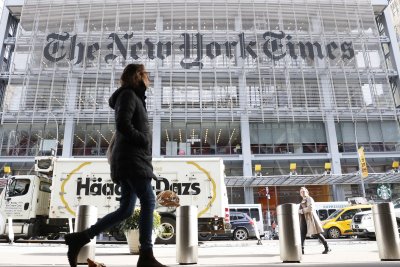
Judge Paul Friedman of the U.S. District Court for the District of Columbia ruled in favor of The New York Times, which sued the Department of Defense over the policy. Friedman ruled that the policy is unconstitutional and ordered the department to give back the credentials of the seven Times journalists who cover the Pentagon.

Though he didn’t order the restoration of other reporters’ credentials, he voided the policy that they refused to sign, allowing them to get credentialed again.

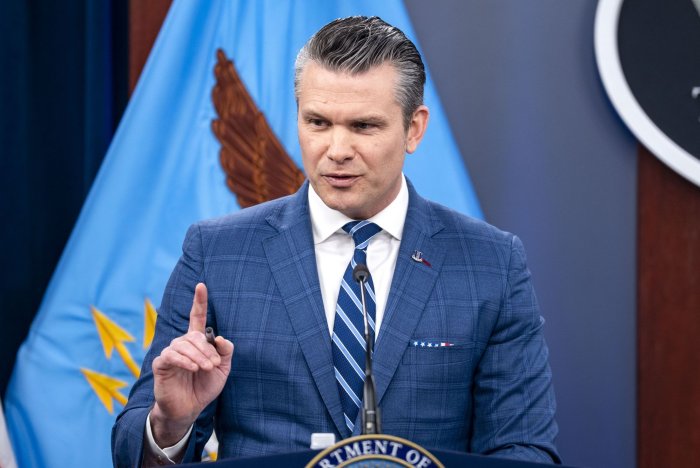
Pentagon spokesperson Sean Parnell wrote on X: “We disagree with the decision and are pursuing an immediate appeal.”

In October, the Defense Department required that all credentialed journalists sign the policy. Signing it gave the Pentagon the ability to label the journalists “security risks” and revoke their credentials if the department decided they had endangered national security. They had to pledge to only publish approved information.

Most news outlets refused to sign, losing their press passes and desks inside the Pentagon. They were replaced with news outlets and people friendly to the administration. The Times then sued the department over its First Amendment rights.

“A primary purpose of the First Amendment is to enable the press to publish what it will and the public to read what it chooses, free of any official proscription,” Friedman wrote in his opinion.

“Those who drafted the First Amendment believed that the nation’s security requires a free press and an informed people and that such security is endangered by governmental suppression of political speech,” Friedman added. “That principle has preserved the nation’s security for almost 250 years. It must not be abandoned now.”

First Amendment attorney Theodore Boutrous, who is representing The Times in the suit, told CNN: “The district court’s decision is a powerful rejection of the Pentagon’s effort to impede freedom of the press and the reporting of vital information to the American people during a time of war.”

“The district court’s opinion is not just a win for The Times, [Times reporter] Mr. [Julian E.] Barnes, and other journalists, but most importantly, for the American people who benefit from their coverage of the Pentagon,” Boutrous said.

Friedman also agreed with the Times that the policy violated its due process rights because it was vague and could be accidentally violated by reporters. Part of the policy prevented reporters from asking certain questions.

“A primary way in which journalists obtain information is by asking questions,” he wrote. “Under the policy’s terms, then, essential journalistic practices that the plaintiffs and others engage in every day — such as asking questions of department employees — could trigger a determination by the department that a journalist poses a security or safety risk.”

First Amendment advocates said they support the decision.

“The court affirmed that our security and liberty rely on the press’s freedom to publish and the public’s ability to access news about government affairs free from state control,” said Gabe Rottman, vice president of policy at the Reporters Committee for Freedom of the Press, in a statement.

Seth Stern, chief of advocacy at Freedom of the Press Foundation, said the ruling is especially important right now.

“It’s unfortunate that it took this long for the Pentagon’s ridiculous policy to be thrown in the trash. Especially now that we are spending money and blood on yet another war based on constantly shifting pretexts, journalists should double down on their commitment to finding out what the Pentagon does not want the public to know rather than parroting ‘authorized’ narratives,” Stern said in a statement.

Source link

140 U.S. troops wounded in Iran war, Pentagon says

The remains of six U.S. soldiers killed in an Iranian drone strike in Kuwait are returned to the U.S. during a dignified transfer at Dover Air Force Base, Delaware, on Saturday. The six members of the Army Reserve died March 1 when a drone hit a command center in Port Shuaiba, Kuwait, one day after the U.S. and Israel launched a military campaign against Iran. Photo by Leigh Vogel/UPI. | License Photo

March 10 (UPI) — The U.S. Department of Defense estimates that about 140 U.S. troops have been wounded since the United States began its military operation against Iran last month.

The injuries are in addition to seven U.S. service members who have been killed in retaliatory strikes by Iran. Pentagon spokesperson Sean Parnell said in a statement that a “vast majority” of those wounded have suffered “minor” injuries.

Of about 140 injured, 108 returned to duty.

“Eight service members remain listed as severely injured and are receiving the highest level of medical care,” Parnell said.

White House Press Secretary said earlier Tuesday that about 150 troops have been injured in combat.

President Donald Trump said Tuesday that he expects the war to end “very soon” but added that he seeks to “end this long-running danger once and for all.”

“We’re achieving major strides toward completing our military objective,” Trump said Monday.

In the two days after the United States launched its first strike on Iran, the Pentagon spent $5.6 billion worth of resources. Secretary of Defense Pete Hegseth said Tuesday morning that “Today will be, yet again, our most intense day of strikes inside Iran.”

Source link

Hegseth cuts military ties with Ivy League schools, multiple think tanks

Secretary of Defense Pete Hegseth, pictured in February at the White House, announced in a memo that the Defense Department is ending its senior officer fellowship programs with 22 institutions — including Ivy League schools — after alleging that they do not measure up the armed forces’ requirements. File Photo by Samuel Corum/UPI | License Photo

March 1 (UPI) — The Defense Department is ending its relationships with several Ivy League universities and think tanks that service members are permitted to attend.

Secretary of Defense Pete Hegseth has ended graduate school fellowships at 22 institutions starting with the 2026-2027 academic years, including the Massachusetts Institute of Technology, Yale, Princeton, the Center for Strategic and International Studies and The Brookings Institution, according to a memo released by the DOD.

The memo follows a Feb. 7 announcement that the DOD would end stop sending officers to Harvard as part of its Senior Service College Fellowship programs, which Hegseth said in the memo is being retooled and offered list of institutions that offer equivalent programs.

Like Harvard, the expanded list of institutions the department is removing from its SSC programs are alleged to be “woke” and no longer meet requirements for officers in the armed forces.

“Our Professional Military Education institutions are among our most sacred and essential means to restore and maintain the warrior ethos within the [DOD],” Hegseth said. “It is imperative that our war fighter education system forges strategic senior leaders who are trained to think critically, free of bias and influence.”

In a press release, Pentagon spokesman Sean Parnell said the “Aligning Senior Service College Opportunities with American Values” memo directs the DOD to focus SSC fellowships away from institutions that “diminish critical thinking, have significant adversary involvement or fail to deliver rigorous education grounded in realism.”

Universities that are replacing the Ivy League schools include three senior military colleges and three DOD or U.S. government programs, as well as 15 other universities, including Liberty, George Mason, Tennessee, Michigan, Iowa State and Hillsdale College.

Currently enrolled DOD personnel will be permitted to finish their courses of study, but the new policy and list of acceptable institutions applies to all personnel starting this fall, Hegseth said.

Senate Majority Leader John Thune, R-S.D., speaks during a press conference after the weekly Republican Senate caucus luncheon at the U.S. Capitol on Wednesday. Photo by Bonnie Cash/UPI | License Photo

Source link

Trump bans U.S. government use of Anthropic AI products

Feb. 27 (UPI) — President Donald Trump announced he was directing all federal agencies to stop using Anthropic’s artificial intelligence solutions even as it’s the only one being used in the military’s classified systems.

Trump lashed out on his social media network Truth Social Friday.

“THE UNITED STATES OF AMERICA WILL NEVER ALLOW A RADICAL LEFT, WOKE COMPANY TO DICTATE HOW OUR GREAT MILITARY FIGHTS AND WINS WARS! That decision belongs to YOUR COMMANDER-IN-CHIEF, and the tremendous leaders I appoint to run our Military,” he posted.

“The Leftwing nut jobs at Anthropic have made a DISASTROUS MISTAKE trying to STRONG-ARM the Department of War, and force them to obey their Terms of Service instead of our Constitution. Their selfishness is putting AMERICAN LIVES at risk, our Troops in danger, and our National Security in JEOPARDY,” he wrote.

But an unnamed source told Axios that despite the president’s post, Anthropic and the Pentagon were still negotiating ahead of the 5:01 p.m. deadline that Defense Secretary Pete Hegseth set.

Undersecretary of Defense for Research and Engineering Emil Michael called Anthropic CEO Dario Amodei a liar on X. “It’s a shame that @DarioAmodei is a liar and has a God-complex. He wants nothing more than to try to personally control the U.S. Military and is OK putting our nation’s safety at risk,” he posted on X. “The @DeptofWar will ALWAYS adhere to the law but not bend to whims of any one for-profit tech company.”

Trump’s post continued: “Therefore, I am directing EVERY Federal Agency in the United States Government to IMMEDIATELY CEASE all use of Anthropic’s technology. We don’t need it, we don’t want it, and will not do business with them again! There will be a Six Month phase out period for Agencies like the Department of War who are using Anthropic’s products, at various levels. Anthropic better get their act together, and be helpful during this phase out period, or I will use the Full Power of the Presidency to make them comply, with major civil and criminal consequences to follow,” the president said.

“WE will decide the fate of our Country – NOT some out-of-control, Radical Left AI company run by people who have no idea what the real World is all about.”

Anthropic’s AI model Claude was used to capture Venezuelan president Nicolas Maduro and could be used in Iran, if needed. Axios reported that defense officials praised Claude’s abilities and one admitted that it would be a “huge pain in the ass” to stop using it.

Anthropic faced a 5 p.m. EST deadline to comply with the Pentagon and allow it to use the company’s artificial intelligence system without restraint.

If Anthropic declines, Hegseth has said he will have the company labeled a “supply chain risk” or invoke the Defense Production Act to force it to agree.

In July, Anthropic signed a $200 million contract with the Pentagon, but Amodei insists that its AI model Claude not be used for mass surveillance in the United States or for autonomous weapons without human approval.

The Defense Department has said it doesn’t plan to use the tools in that manner, but that Anthropic doesn’t get to make those decisions. It says the U.S. government can use tools “for all lawful purposes.”

“Legality is the Pentagon’s responsibility as the end user,” a senior Pentagon official told NPR.

On Thursday, Amodei said the company wouldn’t agree to the Pentagon’s terms.

“I believe deeply in the existential importance of using AI to defend the United States and other democracies and to defeat our autocratic adversaries,” he wrote in a statement. “Anthropic understands that the Department of War, not private companies, makes military decisions. We have never raised objections to particular military operations nor attempted to limit use of our technology in an ad hoc manner.

“However, in a narrow set of cases, we believe AI can undermine, rather than defend, democratic values. Some uses are also simply outside the bounds of what today’s technology can safely and reliably do. Two such use cases [domestic surveillance and autonomous weapons] have never been included in our contracts with the Department of War, and we believe they should not be included now.”

Amodei acknowledged Hegseth’s threats to blacklist the company or force it to comply.

“These threats do not change our position: we cannot in good conscience accede to their request,” Amodei wrote. “But given the substantial value that Anthropic’s technology provides to our armed forces, we hope they reconsider.”

Pentagon spokesperson Sean Parnell said on X Thursday: “Here’s what we’re asking: Allow the Pentagon to use Anthropic’s model for all lawful purposes. This is a simple, common-sense request that will prevent Anthropic from jeopardizing critical military operations and potentially putting our warfighters at risk. We will not let ANY company dictate the terms regarding how we make operational decisions. They have until 5:01 p.m. ET on Friday to decide. Otherwise, we will terminate our partnership with Anthropic and deem them a supply chain risk for DOW [Department of Defense].”

Geoffrey Gertz, a senior fellow at the Center for a New American Security, told NPR that both measures the Pentagon threatened are unusual and contradictory.

“It’s this funny mix where they both are such a risk that they need to be kicked out of all systems, and so essential that they need to be compelled to be part of the system no matter what,” he said.

Lauren Kahn, a senior research analyst at Georgetown’s Center for Security and Emerging Technology, told CNBC: “There are no winners in this. It leaves a sour taste in everyone’s mouth.”

Senate Majority Leader John Thune, R-S.D., speaks during a press conference after the weekly Republican Senate caucus luncheon at the U.S. Capitol on Wednesday. Photo by Bonnie Cash/UPI | License Photo

Source link