Weekly insights and analysis on the latest developments in military technology, strategy, and foreign policy.
Driven by a race to get ahead of quickly evolving enemy capabilities, the U.S. Navy is now aiming to enter the next step of contracting for its 6th-generation crewed fighter – known as F/A-XX – by August. Despite intervention from Congress, the next-generation carrier-based fighter has remained in limbo since the Pentagon moved to effectively shelve the program last year.
That’s according to Chief of Naval Operations (CNO) Adm. Daryl Caudle, who spoke with reporters Monday at the Sea-Air-Space 2026 exposition near Washington, D.C. In response to a question from TWZ, Caudle acknowledged the uncertainty that has kept F/A-XX in a holding pattern, even as the Air Force’s future fighter, dubbed the F-47, has forged ahead. The current competitors for the F/A-XX are Boeing, which is also the F-47’s prime contractor, and Northrop Grumman.
A rendering of Boeing’s proposed F/A-XX design. Boeing
“One of the challenges we’re seeing is, not only [are] our peer competitors improving their capability for anti-air, either air-to-air or surface-to-air, but the lower cost of entry of very capable weapons is also making more players on the field in which that level of stealth and technology is required,” Caudle, the Navy’s top officer, said. “So this is not about the need for a peer adversary. This is just having an aircraft that can operate with a level of uncertainty and with the acceptable level of risk.”
This is in line with arguments Caudle made in favor of moving ahead of F/A-XX in January, where he cited growing threats posed by smaller nation-state adversaries, including Iran, as well as non-state actors.
Today, Caudle again emphasized that he nevertheless had been “very vocal” on the need for a carrier-based next-generation fighter, and had expressed “many times” to Deputy Secretary of War Steve Feinberg that the service had to secure the aircraft. It’s important, Caudle said, for both the future carrier air wing and collaboration and planning with the MQ-25 Stingray, the Boeing-made carrier refueling drone set to reach initial operational capability later this year.
“It ties to our MQ-25 for stealth refueling. It ties to our reach. It ties to the work we’re doing for making the carrier air wing something that remains very effective into the future based on the range in which you can operate safely,” Caudle said. “So the need’s clearly there.”
MQ-25A Stingray first taxi test
While it was recently reported that the Navy, bolstered by funding from Congress for the new F/A-XX, planned to award a contract for the program by year end, Caudle said August was now the likely timeframe.
As noted, the Pentagon had moved to essentially shelve F/A-XX in its Fiscal Year 2026 budget request, with the Navy only requesting a relatively meager $74 million for the program. U.S. officials said at the time this decision had been driven largely by concerns about the ability of the U.S. industrial base to support work on two sixth-generation fighters, the other being the F-47, simultaneously.
“We’ve got a lot of airframes out there. We’ve got an F-35 program. We’ve got a F-47 program. You know, we’re still building the [F/A-18 Super Hornet] … there’s a lot of airplanes being built,” Adm. Caudle said today. “The Air Force has got a lot of demand on the system. The Navy’s got a lot of demand … One of the contractors who would make this plane for us is in a place where they really can’t deliver in the timeframe we need it. So there was, you know, a check twice, cut once, kind of mentality here on this decision. And now there, I think we’re all on the same page on the reason why the hard look needed to be done. I’m good with it.”
A rendering of the US Air Force’s F-47 sixth-generation fighter. USAF
As noted, Boeing and Northrop Grumman are in competition to produce the F/A-XX, a program that first took shape as a Navy request for information in 2012. An earlier down-select reportedly eliminated Lockheed Martin in March 2025. Last August, Northrop Grumman released a rendering of its concept for the aircraft, showing a streamlined nose and landing gear on the front of a carrier with the tagline, “Project Power Anywhere.” Boeing’s concept, released the same month, drew visual comparisons to its F-47 Next-Generation Air Dominance fighter for the Air Force.
Citing classification, Adm. Caudle said today he couldn’t provide any information on design or payload details that give the Navy confidence in pursuing F/A-XX despite the adversary threats he mentioned. However, he suggested speed was increasingly essential to having a chance at maintaining overmatch.
“We monitor very closely, red-team that very hard, and assess that threat with a predicted trajectory of whether or not the existing designs we’ve seen will still overmatch that,” he said. “So I think we’re okay there, but we do know that our existing airframes could become vulnerable to some of those threats by the time [it’s fielded] … because it takes time to deliver that, that our existing airframes could be vulnerable to some of those threats, and we want to make sure the air wing of the future can still participate.”
Despite Caudle’s comments today, it should be remembered that this is not the first time that major progress on the Navy’s next-gen fighter has supposedly been imminent. Last October, Reuters reported the program had been greenlighted by Secretary of War Pete Hegseth, with a contract expected to follow in short order.
Aside from funding moves from Congress to ensure the survival of the F/A-XX program, no public steps have been taken to advance the program since.
The U.S. Navy’s Undergraduate Jet Training System (UJTS) competition to replace the T-45 Goshawk is accelerating toward one of the most consequential training decisions in decades. The Navy has now issued its eagerly-anticipated Final Request For Proposals – an inflection point in the long-running effort to field 216 modern jet trainers for the next generation of naval aviators.
Amid this pivotal moment, SNC is leading a powerhouse team that has developed the only clean-sheet design in the running: the Freedom Trainer. Built specifically to address the Navy’s evolving carrierborne training needs, the Freedom Trainer aims to deliver modern capability at significantly reduced lifecycle cost.
An artist rendition of two SNC Freedom Trainers. SNC
SNC is partnering with Northrop Grumman, General Atomics Aeronautical Systems, Inc., and CAE, leveraging advanced production, manufacturing, and synthetic training expertise to create a comprehensive, integrated family of training systems.
“SNC’s Team Freedom brings the agility of a disruptor and the reliability of our well-established defense partners to bear so that we can deliver what the Navy wants, on the aggressive timeline it set,” says Jon Piatt, executive vice president at SNC.
Why the Navy’s training model is changing
Core requirements for the T-45 replacement have shifted dramatically. Advances in automated carrier landing technologies and increasingly capable simulation environments have altered the Navy’s perspective on how student naval aviators should be trained. The service has already removed carrier qualifications from the T-45 syllabus, one of the most significant training changes in decades, and plans for UJTS could further reshape how training occurs ashore.
A major driver of this debate centers around Field Carrier Landing Practice (FCLP), the land-based surrogate for shipboard carrier landings. Traditionally performed to touchdown, these aggressive, un-flared landings, or “bouncing,” replicate the forces and precision required aboard the carrier. But for UJTS, the Navy has removed the requirement for FCLP-to-touchdown, instead calling only for FCLP-to-wave off.
The Freedom Trainer is designed to be able to fly FCLP-to-touchdown. SNC
This change dramatically broadens the aperture for competitors. Trainers designed for land-based operations can meet wave-off profiles without requiring the structural upgrades typical of Navy aircraft. But this also introduces concerns about the long-term impact on aviator proficiency, and whether foundational carrier skills can be taught effectively without actual touchdown repetition.
The FCLP equation and its implications for the fleet
FCLP has long been considered essential for preparing student naval aviators for the demands of carrier aviation. A Navy spokesperson reaffirmed to TWZ in August 2025 that “Field Carrier Landing Practice landings ashore are still required for graduation,” though did not specify whether touchdown was still necessary.
Touchdown landings impose tremendous structural loads on an aircraft, particularly landing gear and associated components. Removing this requirement opens the competition to off-the-shelf trainers such as the T-7 Red Hawk, Korean-built TF-50N, and the Italian M-346N. These jets can perform FCLP-to-wave-off but not repeated unflared touchdowns without extensive structural reinforcement.
SNC argues that this shift elevates readiness and cost risk. “FCLP-to-touchdown is a tried and trusted method to train naval aviators,” says Derek Hess, vice president of strategy at SNC. “Not performing carrier qualification or FCLPs-to-touchdown essentially defers that training to the fleet replacement squadrons with their 4th-, 5th-, and soon, 6th-generation fighters which would be a very expensive use of those precious assets.”
In other words: the Navy can remove the requirement, but the fleet will still pay the bill.
Why a clean-sheet matters
The Navy’s decision not to mandate touchdown capability fundamentally changes the nature of the competition. Legacy trainers can now be offered at lower upfront cost, but at the expense of performance characteristics essential to naval aviation.
SNC is blunt on this point: the Freedom Trainer is the only aircraft in the field that can perform FCLP-to-touchdown without major modification because it is purpose-built to meet Navy training standards. SNC believes this is the defining advantage of a true naval trainer.
Where its competitors adapt land-based jets for a naval training mission, the Freedom Trainer is engineered from inception for the pounding, the control margins, and the durability required for FCLPs-to-touchdown.
A view of the Freedom Trainer’s tandem cockpit arrangement. SNC
Clean-sheet means a whole new approach
The Freedom Trainer offers improvements over the T-45, while delivering dramatically lower lifecycle costs. Hess explains that lifecycle economics are central to SNC’s approach: only about 10 percent of lifecycle cost is tied to research, development, test and evaluation (RDT&E) and 30 percent for procurement, while roughly 60 percent stems from operations and sustainment.
“From a business perspective, you can pay more in the RDT&E phase and still dramatically reduce your lifecycle costs,” Hess says. “We’re employing a more businesslike approach to training that balances training costs holistically across the lifecycle of the aircraft.”
To achieve this, SNC leverages advanced digital engineering to reduce risk and ensure real-world fidelity. “Digital engineering has evolved significantly over the last 10 years,” Hess says, pointing to Northrop Grumman’s work on the B-21 Raider as a benchmark for its modeling environment.
The Freedom Trainer’s mission systems architecture is built using Model Based Systems Engineering (MBSE) and is delivered with full technical and data rights – ensuring the Navy retains long-term control and interoperability.
Designed for the mission: performance and durability
The aircraft’s design reflects a deliberate choice to provide representative fighter performance at dramatically lower cost. The Freedom Trainer’s design reflects a deliberate philosophy: deliver the handling qualities and durability of a fighter‑representative aircraft without imposing fighter‑level sustainment costs. Rather than itemizing features in a list, SNC emphasizes that the jet’s airframe, engines and performance envelope all work together to meet the Navy’s demanding syllabus.
The Freedom Trainer is designed to provide fighter-like performance at lower cost. SNC
At its core, the Freedom Trainer is built around a 16,000‑hour airframe that’s engineered to withstand up to 35,000 carrier‑style landings. This level of durability is essential for repetitive FCLP operations, especially un-flared touchdowns that impose loads far more intense than standard runway operations. By designing the structure from day one to accept these stresses, SNC ensures the aircraft can train pilots to full carrier‑representative standards while avoiding the costly structural fatigue associated with modifying older, land‑based designs.
Power comes from a pair of Williams FJ44‑4M engines, selected not only for reliability but also for their lower operating cost compared to legacy trainer engines. These efficient turbofans help reduce support burdens by an estimated 40 percent relative to the T‑45, while enabling longer sorties on less fuel than the competition.
Performance‑wise, the Freedom Trainer provides the maneuvering capabilities student naval aviators must master before transitioning to fleet aircraft. With a −3 to +8 G envelope and angles of attack (AoA) reaching up to 27 degrees, the aircraft exposes students to the high‑AoA handling characteristics relevant to modern 4th‑ and 5th‑generation fighters. Yet SNC deliberately designed the jet to avoid the transonic regime, which typically demands larger thrust margins and higher fuel consumption to accomplish the same training maneuvers. By staying sub‑transonic, the aircraft maintains fighter‑representative handling qualities while keeping lifecycle costs far below those of high‑performance jets.
“You don’t need a fighter to learn how to fly a fighter,” Hess notes. “You need a trainer engineered for Navy training missions that create graduates who are ready for FRS training and beyond.”
The Freedom Trainer features twin Williams FJ44-4M engines. SNC
LVC: The synthetic backbone of modern training
Live, Virtual, and Constructive (LVC) training is now central to the Navy’s future training enterprise. The service intends to offload many carrier operations scenarios into synthetic environments as part of its modernization journey.
The Freedom Trainer’s LVC environment, developed with CAE, includes synthetic radar, targeting pods, and augmented reality tactical scenarios that replicate beyond visual range (BVR) and within visual range (WVR) engagements. Hess notes that many mission training functions can be downloaded from frontline squadrons, producing far more capable pilots at much lower cost.
“Ultimately, flying 4th- and 5th-gen fighters with modern flight control systems isn’t hard these days,” Hess says. “The tough part is employing the aircraft. That’s where we excel with our LVC capabilities.”
Turning clean-sheet into reality: timeline and industrial base
The final RFP envisions Engineering and Manufacturing Development (EMD) beginning with up to two contract awards in 2027, delivering four EMD aircraft followed by seven low-rate production jets beginning in 2032. The goal is initial operating capability in 2035.
Hess is confident SNC can meet the timeline. With a restructured Navy acquisition enterprise and strong industrial partners, the Freedom Team argues it is well positioned to deliver a future-focused foundation for Navy training.
“Our primary focus is to deliver a trainer that meets the demanding needs of naval aviation with zero compromise,” Hess says. “We believe the next-generation navy trainer must enable efficient sortie generation, evolve with technology, and strengthen the nation’s industrial base.”
The bottom line: improving training while reducing cost
SNC positions the Freedom Trainer as a solution that protects naval aviation’s most critical training standards while delivering significant lifecycle savings. The company argues that deferring essential skills like FCLP-to-touchdown to the fleet imposes an unnecessary cost and readiness burden.
The Freedom Trainer is designed to lower lifecycle costs for the Navy. SNC
“If aviators aren’t learning these key skills while they’re earning their Wings of Gold,” Hess says, “they will have to learn it in a much more complex, more expensive, and more scarce resource – frontline gray jet fleet fighters.”
A compelling candidate for the future fleet
The Navy’s next trainer will shape every aviator who enters the fleet for generations to come. The Freedom Trainer’s clean-sheet approach positions it as a contender capable of improving Naval training capabilities while reducing cost.
For a decision as consequential as UJTS, SNC’s argument is clear: choose a trainer designed for the Navy’s mission – not adapted to it.
Weekly insights and analysis on the latest developments in military technology, strategy, and foreign policy.
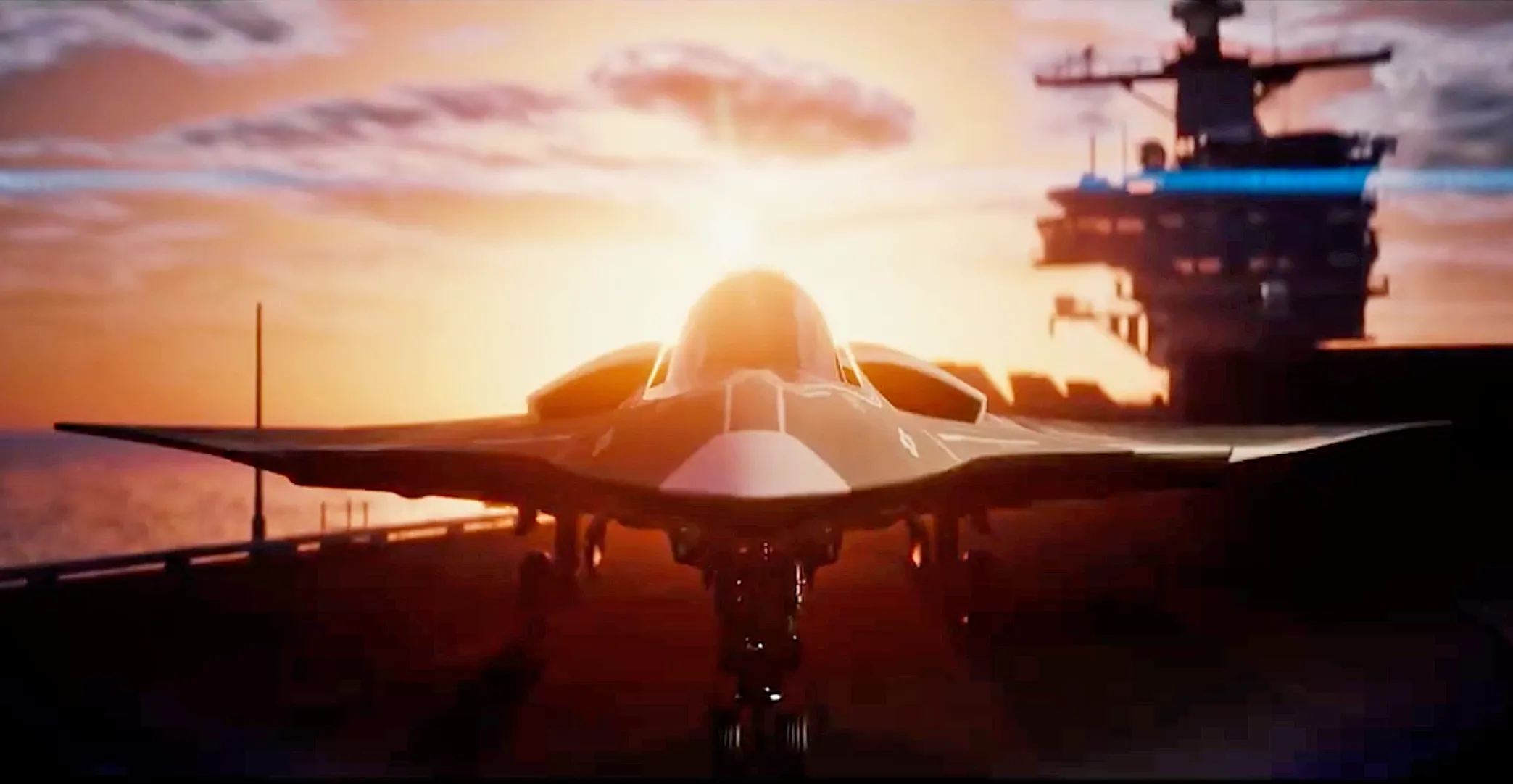
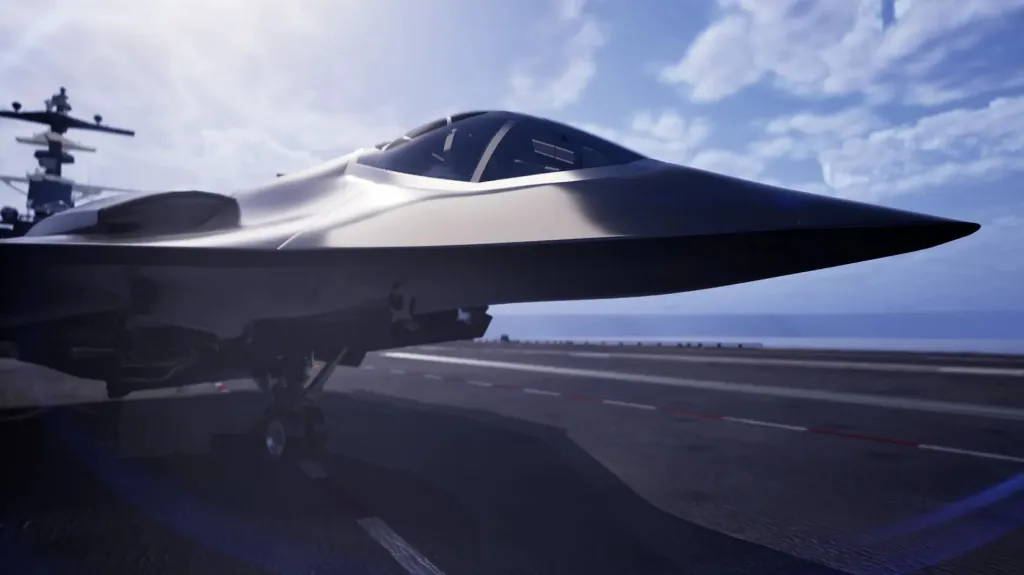
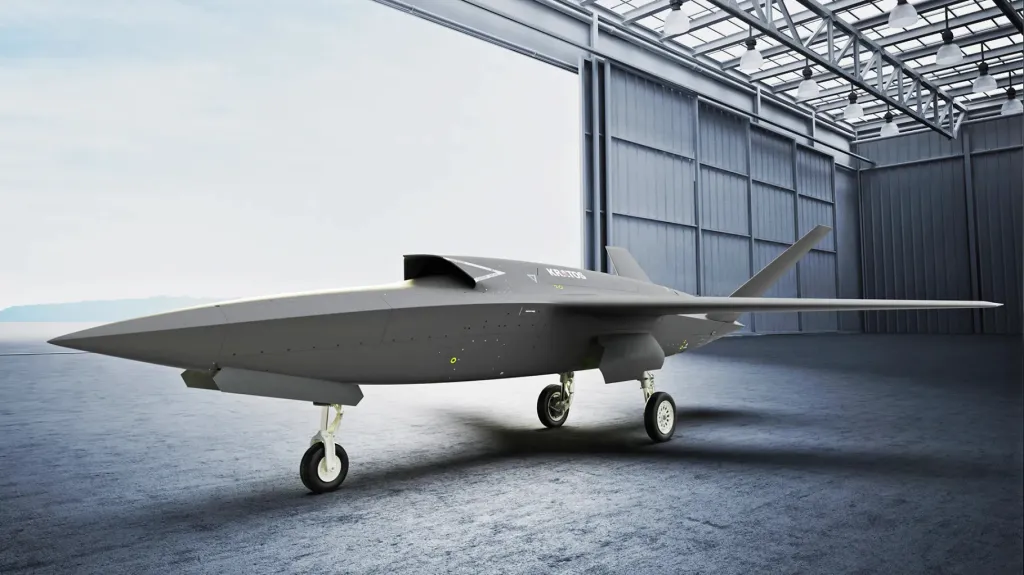
On the same day that the Chief of Naval Operations answered our question about the future of the F/A-XX sixth-generation naval fighter program, stating a final selection between the offerings from Boeing and Northrop Grumman will be coming in August, the latter of the two firms has released a new teaser video. Previously, we only had one rendering of Northrop’s notional F/A-XX concept. Now we have a more detailed panning video and a new head-on perspective view.
The video clip, posted on Northrop Grumman’s X account this evening, as seen below, states: “We’re bringing tomorrow’s horizon into focus, faster, stronger, and ready when the warfighter needs it.”
What we see in the clip is the same general design we saw in the still image earlier, but much more of it. This includes a head-on shot, showing the aircraft’s stealthy and efficient tailless design and rear-set dorsal inlets, as well as its very broad nose and canopy.
Northrop Grumman capture
The aircraft in the new stylized video clip has some interesting proportions. The size of the landing gear and especially the canopy give it something of a smaller overall appearance than what one would expect from a heavy sixth-generation naval fighter that will be stuffed with fuel and weapons. Of course, this could be due to the somewhat ‘cartoonish’ nature of this new glitzy clip, and how accurate this rendering is to the actual Northrop Grumman F/A-XX is still unknown. At the very least, some of the aircraft’s features (such as its inlets) will have been significantly changed for security issues pertaining to its sensitive design elements.
We also see the wings, which look like they have a bit of camber on the outer sections and possibly a bit of ‘crank’ too. We also see the wings folded in the first part of the clip.
Screenshot
What could be a weapons bay with its doors open is also visible in some of the angles seen in the clip. At first glance, this appeared to be for the jet’s very stout-looking landing gear, but they are curved inward. There are additional doors on the centerline, as well, pointing to two separate bays.
Overall, because of the size of the canopy, it is hard to tell if this is a single-seat or a two-crew aircraft. The canopy is so large in these renders that a side-by-side crew arrangement may even be possible, although that seems unlikely.
Once again, we don’t know how close this computer-generated model is to the real thing, but considering this aircraft will have to carry a sizable weapons load and have something approaching a combat radius of 1,000-miles, while still fitting well within the confines of a supercarrier, it should be firmly in the heavy fighter class.
Maybe Northrop Grumman will share more on its F/A-XX at the annual Sea-Air-Space convention in Washington this week, and we will be ready to report it from the scene if they do.
We have reached out to Northrop Grumman with questions, and we will update this post if we hear back.
Weekly insights and analysis on the latest developments in military technology, strategy, and foreign policy.
Northrop Grumman CEO Kathy Warden says she is confident in her company’s ability to deliver next-generation carrier-based fighters to the U.S. Navy if it is picked as the winner of the F/A-XX competition. The U.S. Navy’s top officer said yesterday that the goal was to award the F/A-XX contract by August of this year, but also that one unnamed contractor in the running “really can’t deliver in the timeframe we need it.”
Chief of Naval Operations (CNO) Adm. Daryl Caudle offered his latest comments on F/A-XX yesterday in response to a direct question from TWZ at a roundtable on the sidelines of the Navy League’s Sea-Air-Space 2026 exposition. The Pentagon had tried to put the Navy’s future fighter ambitions on hold last year, arguing that the U.S. industrial base did not have sufficient capacity to support work on two sixth-generation combat jets simultaneously. Boeing won the contract to build what is now called the F-47 for the U.S. Air Force in March 2025. Boeing is the only other company known to be in the running now for F/A-XX. Last year, it was reported that Lockheed Martin had been eliminated from the competition.
Late yesterday, Northrop Grumman also released a new computer-generated F/A-XX promotional video, seen below. You can read our analysis of what is seen therein here.
“We do expect the Department [of the Navy] to make an award selection in the third quarter,” Northrop Grumman’s Warden said during a routine earning call today in response to a direct question about Adm. Caudle’s remarks. “We are confident in our ability to deliver our solution to the Navy.”
She did not explicitly confirm or deny that the CNO had been referring to Northrop Grumman when he mentioned a contractor’s inability to meet the Navy’s schedule needs on F/A-XX.
“We and our suppliers are prepared to bring the workforce and infrastructure that’s needed to execute the program, and our track record on B-21 demonstrates that ability to deliver a complex aircraft on schedule,” Warden added. “Regarding the financials, we’d expect upside to the sales and earnings from our current guidance, if we are entrusted to build the F/A-XX, and it would be a top priority for our company to do so.”
Another F/A-XX rendering Northrop Grumman released last year. Northrop Grumman
It’s also worth remembering that Northrop Grumman withdrew in 2023 from the Air Force competition that would lead to the F-47. The company framed the decision at the time as a voluntary one.
“I’ll just say that, when I noted we have other opportunities we are pursuing, I won’t disclose at this point exactly what those are until a little more information comes out,” Warden, who was also CEO at that time, said when announcing the withdrawal, which was widely seen as a reference to F/A-XX. “You could assume that if we feel we’re well-positioned, and the government is appropriately balancing risk and reward, as I said that that would be a program we would pursue.”
Former top Air Force officials subsequently said that Northrop Grumman’s bid had been on the verge of getting cut.
As mentioned, industrial base capacity questions have swirled around F/A-XX. The Pentagon had tried to effectively shelve the Navy’s next-generation fighter program in its proposed budget for the 2026 Fiscal Year. At the time, a senior U.S. defense official explicitly said that the decision was “due to our belief that the industrial base can only handle going fast on one program at this time, and the presidential priority to go all in on F-47, and get that program right.”
A rendering of the F-47 that the Air Force has previously released. USAF
Congress later intervened to appropriate some $1.69 billion in funding to keep F/A-XX moving ahead in the 2026 Fiscal Year.
“I will tell you, we, Northrop Grumman, are ready to execute F/A-XX,” Tom Jones, President of Northrop Grumman’s Aeronautics Systems sector, had also told TWZ and other outlets in response to a question about industrial base capacity in relation to the program back in December. “We’re looking to try and make sure that the customer community knows that we believe that we’re ready to go and we can execute it.”
Boeing Defense and Space CEO Steve Parker had also pushed back on the assertion that the U.S. industrial base could not support F-47 and F/A-XX at the same time last year. The company’s pitch for the Navy’s program appears to be a navalized adaptation of the F-47.
A rendering of Boeing’s proposed F/A-XX design. Boeing
“The Air Force has got a lot of demand on the system. The Navy’s got a lot of demand,” Adm. Caudle had also said yesterday. “So there was, you know, a check twice, cut once, kind of mentality here on this decision. And now there, I think we’re all on the same page on the reason why the hard look needed to be done. I’m good with it.”
Questions about the overall future of F/A-XX do remain, despite clear support from top Navy leaders like Caudle and Congress. The Navy looks set to request just over $140 million for the program in Fiscal Year 2027. This is a very meager sum, especially for a program of this magnitude. In contrast, the Air Force is seeking $5 billion in additional funding for F-47. Billions of dollars have already been appropriated for the Air Force’s next-generation fighter effort.
The Pentagon and the individual services are rolling out more details about their annual budget proposals today, which could offer more insights into the plans now for F/A-XX in the coming years. Securing the contract to build the Navy’s next-generation fighter is still likely to be an important win for whichever company the service selects in the end.
UPDATE: 4/22/2026 –
The U.S. Navy has issued a statement regarding Adm. Caudle’s comments earlier this week, which is as follows:
“During a question-and-answer session at the Sea-Air-Space Exposition, Chief of Naval Operations Admiral Daryl Caudle was asked about the Navy’s sixth-generation strike fighter program (F/A-XX). Adm. Caudle emphasized that the Navy’s priority is ensuring through due diligence the selected vendor can deliver the required capability on the timeline needed by the fleet while also considering broader industrial base capacity. Any reference to ‘a specific offeror’ was intended as a general anecdotal comment and was not directed at any vendors currently under consideration.”
Leonardo DRS has for the first time shown its Maritime-Mission Equipment Package (M-MEP) integrated on an autonomous unmanned surface vessel (AUSV). The M-MEP is a platform-agnostic suite of systems that are collectively designed to protect vessels from attacks involving single or multiple small to medium-sized unmanned aerial systems (UAS). M-MEP was demonstrated on a Sea Machines Stormrunner USV at the Navy League’s Sea Air Space 2026 trade event just outside Washington D.C.
Leonardo DRS has adapted its range of ground-based Counter-UAS (C-UAS) systems for sea-based operations under the M-MEP project. The modular design, coupled with an open system architecture, allows for the integration of multiple kinetic and non-kinetic effectors, software-definable sensors, and communication packages. Leonardo DRS says this flexibility ensures that the M-MEPs remain platform-agnostic, capable of being configured across a range of small-to-large USVs of varying sizes from 14 feet in length. The C-UAS sensors and effectors are designed to complement existing naval capabilities.
The M-MEP system utilizes active and passive radars and electro-optical/infrared (EO/IR) systems, with situational awareness facilitated through real-time data processing and threat assessment, enabling faster decision-making and response. Leonardo DRS says that M-MEP employs a range of non-kinetic electronic warfare systems for the active disruption and neutralization of UAS guidance systems, while integration of machine learning and artificial intelligence (AI) is intended to help predict and mitigate emerging threats.
TWZ‘s Jamie Hunter spoke with Bo Mancuso from Leonardo DRS about the M-MEP program.
Weekly insights and analysis on the latest developments in military technology, strategy, and foreign policy.
Secretary of the Navy John Phelan says his service is looking to wrap up a review of its aircraft carrier plans within the next month or so. The Navy has been taking a deep look at the design and capabilities, and associated costs, of the Ford class as compared to the older Nimitz class. The question has been raised about whether this might point to a major shift in the service’s carrier acquisition strategy on the horizon, including the potential cancellation of planned orders for more Ford class ships and even a transition to a new design.
Phelan talked about the carrier review yesterday at a roundtable on the sidelines of the Navy League’s Sea Air Space 2026 exposition. When asked, Phelan said that there was nothing in particular about the Ford class that prompted the Navy to take a new comprehensive look at the program and that the service is looking for ways to cut costs and be more efficient across the board.
A key question the review has been focused on is “are we getting the appropriate bang for our buck, i.e., how superior is the Ford [class] to the older Nimitz class, etc,” the Navy’s top civilian leader said. “To be honest, we’re reviewing every program, so it’s – carriers [are] just one of them.”
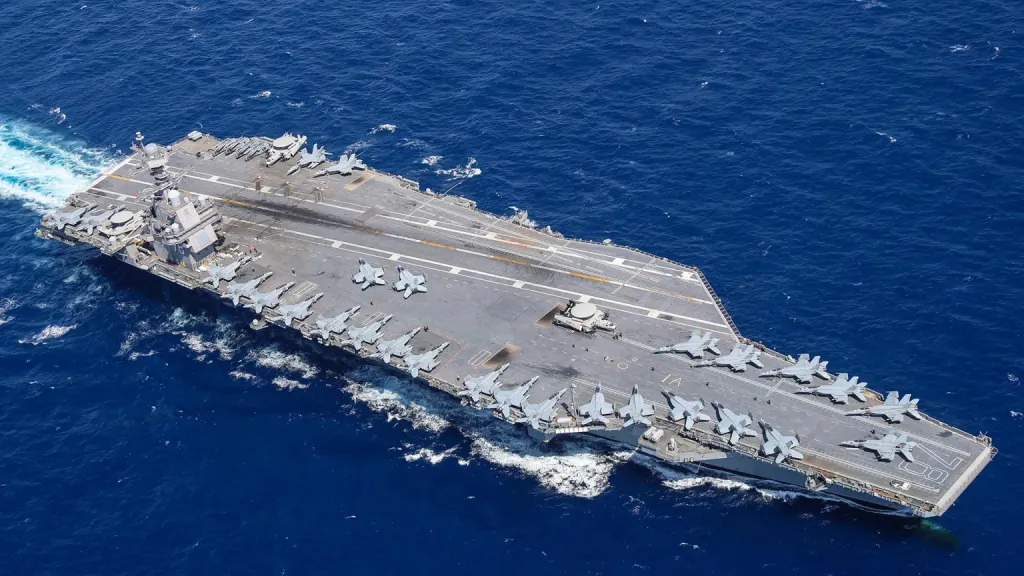
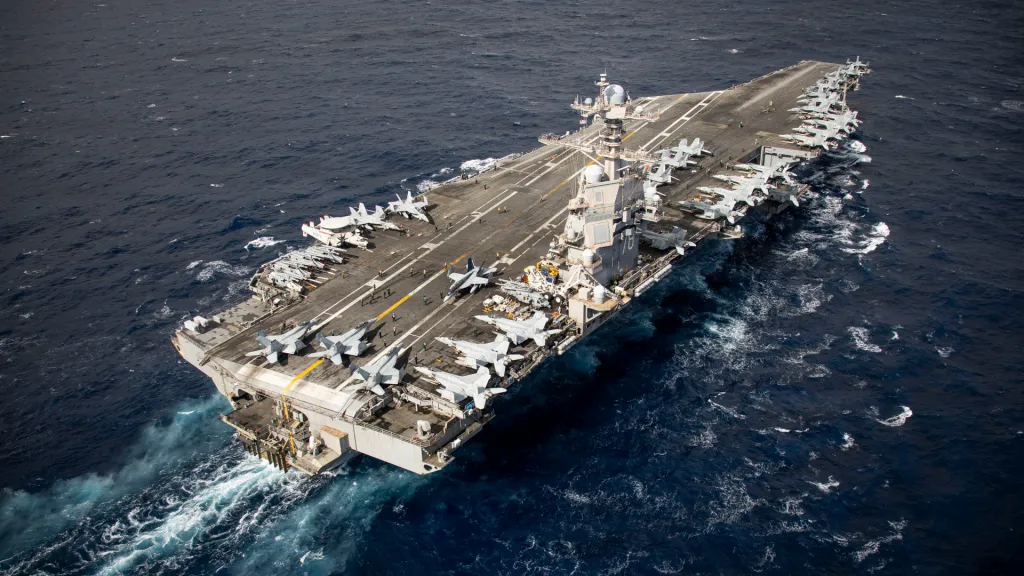
A stock picture of the USS Gerald R. Ford. USN
That being said, President Donald Trump has been a vocal critic of the Ford class, and its electromagnetic catapults (also known as the Electromagnetic Aircraft Launch System, or EMALS) and weapons elevators in particular, which have faced serious reliability and maintenance issues. Last October, he pledged to sign an executive order that would compel the Navy to go back to using steam-powered catapults and hydraulic elevators on new aircraft carriers, which has yet to materialize. Two months later, in announcing plans for the Trump class “battleship,” the President also said that “we have the Ford class. We’re going to be upping that to a different class of aircraft carrier,” but did not elaborate.
Electromagnetic Aircraft Launch System (EMALS)
Watch the Advanced Weapons Elevators on the aircraft carrier Gerald R. Ford
Phelan’s comments yesterday about the ongoing review were prompted, in part, by a question about whether the Navy has actually been looking at acquiring a new class of aircraft carrier. There is no indication that this is the case currently. The service has explored alternatives to the Ford class, including smaller designs, on several occasions in the past decade or so.
“What I would say on the carriers is, we are looking at [CVN-]82 and [CVN-]83 to review the costs, the designs, the systems, to make sure that they make sense and they have all the systems and requirements that we want going forward,” Phelan explained. “I think it’s a prudent and practical thing for us to do, given the costs of them, as a percentage of the budget, and how we are thinking about the force design and our needs going forward.”
CVN-82 and CVN-83 are the hull numbers assigned to a pair of future Ford class aircraft carriers currently set to be named the USS William J. Clinton and the USS George W. Bush. Construction has not begun on either of those ships, and the Navy has not even awarded contracts yet to order them. The service is asking for advance funds to support the future procurement of CVN-82 in its newly released budget request for the 2027 Fiscal Year. The budget documents also still show plans to seek funding for CVN-83 in the coming years.
The USS Gerald R. Ford is the only member of its class currently in service. It is now in the midst of a marathon deployment that has lasted some 10 months already, the longest for any carrier since the Vietnam War. In its time at sea so far, the ship and its air wing took part in the mission to capture Venezuelan dictator Nicolas Maduro, and more recently supported operations against Iran. Ford suffered a fire in March, underscoring concerns about strains on the ship and its crew, as you can read more about here.
There are three more Ford class carriers in various stages of being built. The second ship in the class, the future USS John F. Kennedy (CVN-79), left port for the first time for initial sea trials in January and is set to be formally delivered to the Navy next year.
John F. Kennedy (CVN 79) Successfully Completes Builder’s Sea Trials
Kennedy and all subsequent ships in the class are already set to have notable differences from Ford, including AN/SPY-6(V)3 radars in place of the design’s original Dual Band Radar (DBR). The immensely troublesome DBR is just one of a laundry list of issues that Ford has had to contend with over the years. The Navy has been trying to leverage lessons learned from those experiences to streamline work going forward.
However, Kennedy, as well as the next two ships in the class after that, the future USS Enterprise (CVN-80) and USS Doris Miller (CVN-81), have all continued to suffer further delays. As of last year, the estimated total procurement costs for Kennedy, Enterprise, and Doris Miller were nearly $13.2 billion, almost $14.25 billion, and just over $15.2 billion, respectively, according to the Congressional Research Service.
This, in turn, has created complications for Navy plans to begin retiring Nimitz class carriers. In May, the service announced it was extending the USS Nimitz‘s service life into 2027, in line with the latest delivery schedule for Kennedy.
The USS Nimitz seen underway in the Eastern Pacific Ocean in April 2026. USN
“So the President knows we’re reviewing it [the carrier plans], and want [sic] us to put in a review,” Phelan said. “And I think, like any businessman, he’s – okay, make sure you look at all these programs, understand the capabilities and what they’re doing.”
The Secretary of the Navy was asked what metrics the service might be looking at in order to assess the comparative capabilities of the Ford class and the preceding Nimitz class. Phelan was given, as an example, statements the Navy has made in the past about the new EMALS catapults offering improved sortie generation rates and reducing wear and tear on aircraft during launches.
“I think you’ll see the sortie rate come out and it will be eye-watering,” Navy Rear Adm. Ben Reynolds said just yesterday at the Pentagon during the rollout of the service’s proposed budget for the 2027 Fiscal Year, according to USNI News. “The capability is just absolutely incredible.”
Reynolds is currently serving as Deputy Assistant Secretary of the Navy for Budget and Director of the Fiscal Management Division within the Office of the Chief of Naval Operations.
USS Ford Launches, Recovers Fighters With Electromagnetic Aircraft Launch System (EMALS)
“So these are all things you’ve heard. These are all the same things I’ve heard,” Phelan said at the roundtable at Sea Air Space. “I go to the Ronald Reagan School of trust, but verify. That’s what I’m doing.”
“Trust me, we measure and monitor a lot of things in the Navy, including that – the airframes and how that works. So I think it’s a function of just understanding it, for example, is the sortie rate generation that much greater? And then what are the cost implications of this electric catapult, and did it really generate the savings?” Phelan continued. “You know, the Navy would like to say we’ve saved $5 billion in terms of savings in number [sic] of men and maintenance. I just need to check that back up, and that’s what I mean by that.”
“I think, like anything, it’s both understanding the cost-benefit analysis of it, because we really want to make sure we’ve got a good handle on the costs,” the Navy Secretary added. “I think one of the things we have to do a better job of in the Navy is kind of what I call total cost of ownership. So what does it really cost to sustain and maintain these things? I think we do a reasonable job at that, to be honest. But the infrastructure needs on these are also costs you have to understand going in.”
Another stock picture of the USS Gerald R. Ford. USN
As Phelan noted, the Navy has been conducting reviews of major programs across the service. The Navy Secretary has also shown a willingness to curtail high-profile, but seriously underperforming efforts despite high sunk costs. Last November, the service axed the Constellation class frigate program, long touted as a major priority, but which had become mired in delays and at risk of ballooning costs. Earlier this month, the Navy finally abandoned plans to return the Los Angeles class attack submarine USS Boise to active service, closing out a more than 10-year-long saga that had already cost it $800 million.
Yesterday, Phelan was also asked whether the Ford class could be curtailed as a result of the ongoing review. The possibility of truncating the program has been raised in the past.
“It’s too early to say, but we will have carriers. So, carriers are an important component to [sic] the force, and we will need that,” the Navy Secretary said. “I think it’s more, how do we figure out – like, again, this comes back to every program we’re looking at. What can we do to cut costs? What can we do to make this more efficient? What can we do to make the design more simple [sic]? What are the areas where we think we can save or not save?”
Even just cancelling future orders for Ford class ships would have major downstream impacts, including on the shipbuilding industrial base and its many suppliers. At the same time, the Navy’s shipbuilding priorities also now include the Trump class “battleships,” the first of which may cost $17 billion, according to the latest official estimates. If that price point holds, these large surface combatants will be more expensive than a Ford class aircraft carrier.
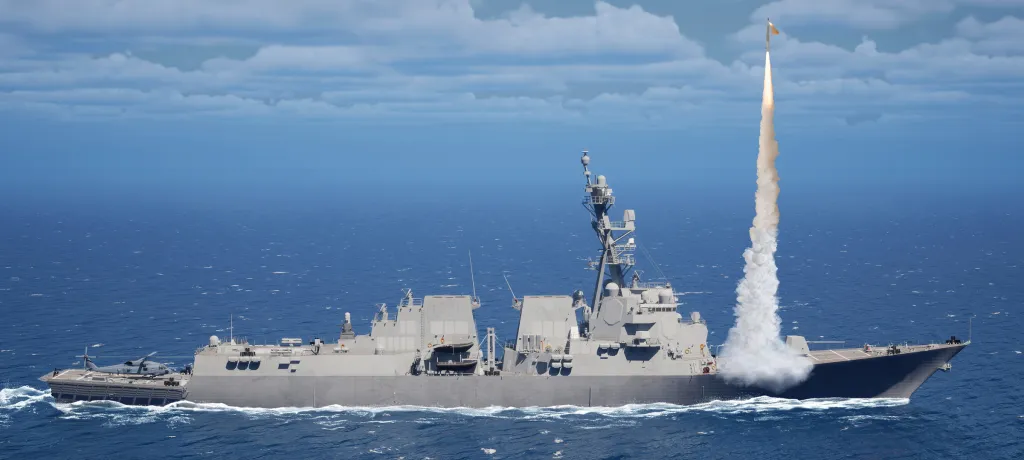
A rendering of the first Trump class large surface combatant, set to be named the USS Defiant, depicted firing various weapons. USN
“These are very important decisions to be made, and you’re locking into very big contracts and very big platforms that are going to be around for a long time. And so I just think we’re trying to make prudent decisions across everything,” he added. “I think what I found a little bit is, I have a lot of people who know how to do finance. I don’t have a lot of people who necessarily understand finance, understand incentives and deal structures, and that’s something we just need to fix.”
How the Navy’s plans for the Ford class, and aircraft carriers in general, may evolve going forward will likely become clearer after the current review is completed.
U.S. Navy Helicopter Sea Combat Squadron (HSC-21) “Blackjacks” gave TWZ a personal tour of one of its MH‑60S Seahawk helicopters and filled us in on some of key capabilities during the Dubai Air Show in November 2025.
The U.S. Navy operates both the MH-60S and the MH-60R variants of the H-60 and the two share a common airframe, General Electric T700 powerplants and many avionics, enabling streamlined logistics, maintenance and training across the fleet while allowing each variant to be customized for distinct operational roles. The MH-60R is primarily configured for anti-submarine warfare (ASW) but it too has anti-surface warfare (ASuW) capabilities and has been used to shoot down drones.
The MH-60S features a modern glass cockpit, twin General Electric T700‑GE‑401C engines and a flexible, modular, mission‑systems suite that supports interchangeable payloads, internal fuel tanks, and advanced mission packages.
“Sikorsky is leveraging its global MH-60R and MH-60S Seahawk users to constantly iterate while we operate, ensuring the aircraft is mission ready and evolves. This commitment to production, sustainment and modernization enables the MH-60R to stay ahead of emerging threats and maintain its position as the premier global ASW platform,” the company commented to TWZ.
Check out the full MH-60S walk-around video below:
U.S. Navy MH-60S Pilot Talks Multi-Mission Roles Of The Seahawk
Weekly insights and analysis on the latest developments in military technology, strategy, and foreign policy.
The Navy’s top leadership says they are working hard to avoid serious issues that have plagued previous shipbuilding efforts when it comes to the Trump class “battleship” program. Senior officials have focused, in particular, on the need to have a very firm design before any work on the large surface combatants, the first of which could cost a whopping $17 billion, actually begins. A lack of a finalized design, along with repeated changes to it along the way, contributed heavily to the demise of the Constellation class frigate last year.
Editor’s note: As this story was being written, the Pentagon announced that the Secretary of the Navy “is departing the administration, effective immediately,” and that Undersecretary Hung Cao will take over as Acting Secretary of the Navy. No reason for the change in leadership was immediately given.
Chief of Naval Operations (CNO) Adm. Daryl Caudle and Secretary of the Navy John Phelan both discussed the Trump class battleship, also known as the BBG(X), at separate roundtables on the sidelines of the Navy League’s Sea Air Space 2026 exposition this week. President Donald Trump had officially rolled out plans for the Trump class, the first of which is currently set to be named the USS Defiant, last December.
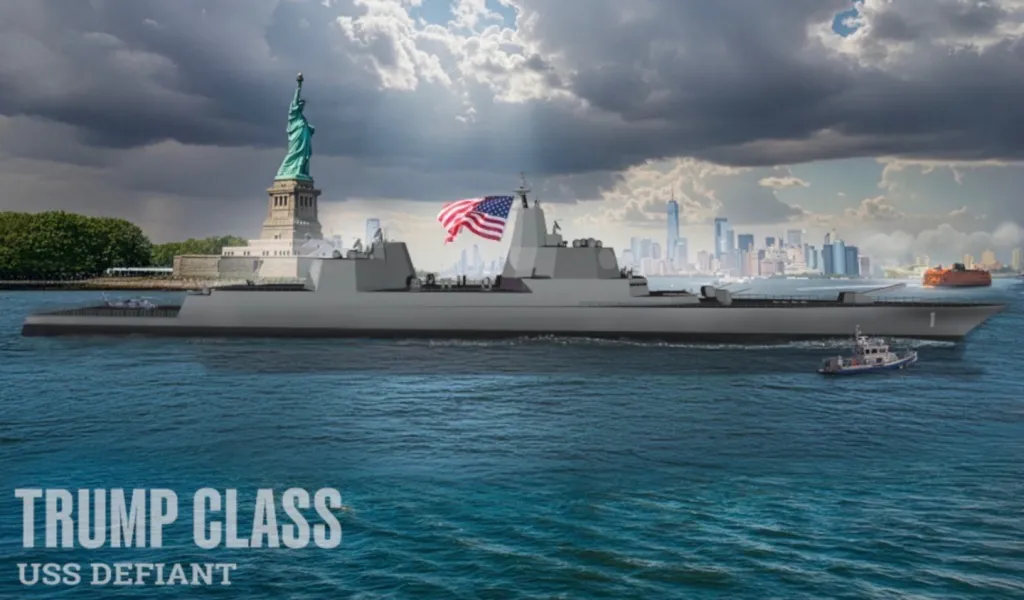
A previously released rendering of the Trump class battleship, the first of which is set to be named USS Defiant. White House/USN
“I think it is a necessary element to the force,” and “I think it provides real flexibility to the force,” Secretary Phelan said about the BBG(X) effort at his roundtable.
From what the Navy has shared so far, the Trump class warships will displace approximately 35,000 tons, very roughly three times that of the newest Flight III subvariant of the Arleigh Burke class destroyer. They will also be between 840 and 880 feet long, have a beam (the widest point in the hull) between 105 and 115 feet, and be able to reach a top speed greater than 30 knots. The armament on each of the ships will include a mix of nuclear and conventional missiles, including hypersonic types, loaded into large vertical launch system (VLS) arrays. They will also have an electromagnetic railgun, a pair of traditional 5-inch naval guns, laser directed energy weapons, and various additional weapons for close-in defense.
An annotated graphic highlighting various capabilities set to be found on the Trump class design. Note that the mention here of “28 Mk 41 VLS” cells appears to be a typo, as other official information from the US Navy says the ships will have 128 such cells. USN via USNI NewsA graphic detailing the current expected specifications of the Trump class design. USN via USNI News
Navy officials also provided additional details about the costs and production schedule associated with the Trump class during yesterday’s rollout of the service’s proposed budget for the 2027 Fiscal Year. As it stands now, the Navy is looking to order the first of three of these large surface combatants in Fiscal Year 2028, at an estimated cost of $17 billion. The Navy is currently projecting it will spend $43.5 billion on the program, overall, across the next five years. As a point of comparison, the estimated total procurement costs of each of the next three Ford class aircraft carriers range from roughly $13 to $15 billion.
The $17 billion figure “is the early initial estimate. We’ll see where we really settle down as we get through that and start to rationalize some of the costs,” Secretary Phelan noted at his roundtable at Sea Air Space. “So, let’s see where we land on that first ship, and then what the economies of scale get us to as we move through it.”
The Navy has already started “talking to two different vendors” about actually building the Trump class warships, he added. “Then it’ll be a function of how we get through that design process with them, and then their capacity in their yards, what we think they can do. Because we’re looking to really get moving on this and lay the keel in [20]28.”
A model of the Trump class design, also known as BBG(X), on display at the Surface Navy Association’s (SNA) annual symposium in January 2026. Eric Tegler
The Secretary of the Navy and CNO Caudle have made clear that the BBG(X) design is still in the very early stages of being formulated. The ships are also set to incorporate a host of advanced capabilities, many of which, such as the railgun and laser directed energy weapons, have yet to be fully proven out, despite years of relevant work the Navy has done already.
“The ship needs to be designed. So, I got to put money toward the research and design of it,” Adm. Caudle said during his roundtable at Sea Air Space. “It’s really the design and how much pull-through I can do from previous efforts, like things that we already have on Arleigh Burke and DDG(X) designs that were already in the works.”
The Navy has previously confirmed that BBG(X) is a direct successor to the DDG(X) next-generation destroyer program. The service has also said that the new large surface combatant addresses shortcomings that had emerged with the previously planned DDG(X) design, which we will come back to later on.
A previously released graphic detailing aspects of a largely notional DDG(X) design. USN
“So all that has to go into a form factor in which we’re fundamentally changing the capacity, [the] vertical capacity of it, [and] the electrical plant and electrical generation for future large-scale directed energy [weapons] and other munitions that require a lot of power, like railgun,” Caudle continued. “So all that’s being baked into that design. And, because we’re taking it so seriously, we want to make sure that we have the right resources applied to the design.”
One of the “mistakes that we’ve done before, quite frankly,” is “we’ve started to build before the design is mature enough,” the CNO added. “And we want to make sure that we’re at [sic] least a very, very high level – I won’t try to give a percentage, but you can think like 80% or more design – before the first weld is done.”
Caudle did not explicitly mention the Constellation class frigate, but the design of that ship was still being finalized as of April 2025, nearly five years after the initial contract award. Work had already begun on the lead ship at that time. This was all despite the Navy having explicitly chosen a derivative of an in-production frigate – Franco-Italian Fregata Europea Multi-Missione (FREMM) – specifically to help reduce risk and keep the program on track. Needless to say, that did not happen, as you can read more about here.
A rendering of a Constellation class frigate. USN
The Navy has also deliberately utilized a process known as “concurrency,” which entails starting production without having a validated design in place, on other shipbuilding projects. Concurrency has been presented in the past as a cost and time-saving measure, but has often produced exactly the opposite results. It has had notably negative impacts on the Navy’s newest operational aircraft carrier, the USS Gerald R. Ford, and both classes of Littoral Combat Ships (LCS).
“Look, we were doing work on railguns. We kind of abandoned it. We do have some directed energy [weapons] we are testing out right now,” Secretary Phelan also pointed out in terms of work the Navy has already done to develop key capabilities for the Trump class. “These are all things we have to get better at and need to do. So I think it’s just making sure that we’ve got the design down in an appropriate fashion, pretty locked down, and then making some trade-offs as we decide where to build that ship, when, how.”
At his roundtable at Sea Air Space this week, Phelan said that there are discussions ongoing about the possibility of the Trump class warships being nuclear-powered, though he said that was “unlikely” to be the case. Nuclear propulsion would have major impacts on the complexity and cost of the ships. Navy budget documents say the plan currently is for the BBG(X) to use a combined conventional propulsion system that includes diesel generators and gas turbines.
The Navy is also still fleshing out how it plans to employ the Trump class battleships operationally, which will also have impacts on the final design. This ties back into the aforementioned issues with DDG(X) that the service has cited in the past. The Navy has said it had previously arrived at a place with the next-generation destroyer program where it was considering building two subclasses with different armament configurations. This, in turn, had prompted questions about the limits that course of action would have imposed on the operational flexibility of the class as a whole.
“It’s something we’re trying to understand all the proper trade-offs, and then think about it as a Battleship Strike Group, Carrier Strike Group, how do they work in which different theaters,” Phelan said. “Look at how we’re deployed today, and ask yourself, how a ship like that, what it could do for us. If I had a ship like that today, I could park that off the coast of Venezuela, and I don’t need a ton of DDGs [Arleigh Burke class destroyers] to support it, and I can relieve some of the pressure on those.”
The USS Jack H. Lucas, the US Navy’s first Flight III Arleigh Burke class destroyer. USN
The Secretary’s comments here are in line with how the Navy’s latest budget request describes the current operational concept behind BBG(X).
“Adding capability at the highest end of the Golden Fleet high-low mix, the Battleship’s primary role is to deliver high-volume, long-range offensive fires and serve as a robust, survivable forward command and control platform. The expanded size and energy density of the new Battleship provide critical advantages for future naval warfare, offering a future-proof platform with distinct capabilities that enhance deterrence,” the line item for the program says. “Its advanced systems will enable true long-range strike with hypersonic weapons housed in new, larger vertical launch systems. Vastly increased power generation, managed by a sophisticated integrated power system with high-capacity energy storage, will support mission-critical directed energy weapons like high-output lasers and electromagnetic railguns, reducing reliance on costly single-use munitions.”
“Furthermore, its advanced naval gunfire offers cost-effective options for strike and defense, and its capacity to embark a fleet command staff enhances survivability by putting commanders closer to the fight. As a flexible command-and-control platform for both manned and unmanned platforms, the Battleship can lead a Surface Action Group, integrate with a Carrier Strike Group, or operate autonomously to secure critical sea lanes,” it continues. “To overcome the capacity limits of the Arleigh Burke class destroyer and the capability compromises of the previously planned DDG(X), the Battleship is designed specifically to accommodate these advanced weapon systems.”
TWZ has previously raised detailed questions about the actual ability of a warship like the Trump class design to conduct independent operations, as well as the general utility of employing it in this way. These questions are compounded by the Navy’s plans, at least right now, to only acquire a very small number of these ships, which can only be in one place at one time. They would also be top targets for adversaries in future conflicts. With the plan now to order the first of these ships in Fiscal Year 2028, the decision about whether to proceed at all could fall to a new administration, as well.
Another Trump class battleship rendering. USN
The service does not appear to have ever put out a firm target for how many of the smaller DDG(X)s it expected to buy, but there had been talk of acquiring between 30 and 50 of those ships in the coming decades.
There are also industrial base and affordability concerns around acquiring such an expensive class of new large surface combatants amid the Navy’s other shipbuilding priorities. Naval shipbuilding capacity, or lack thereof, in the United States has been of growing concern for years, especially when contrasted with China’s industrial might in this regard.
“What we’re looking at more is this distributed ship building in modular [sic; modules], and I think that is a way to tackle that issue,” Phelan said at his roundtable in response to a direct question about these issues. “We’re going to need to really improve our ability to build ships.”
With TWZ and other outlets at a separate event earlier this year, Adm. Caudle also touted the importance of a greater focus on modular shipbuilding methods, which are not new. At that time, CNO was talking about how that could be used to help accelerate work on new FF(X) frigates that the Navy is now looking to acquire in place of the abortive Constellation class.
A rendering of the FF(X) frigate. USN
“An innovative strategy is guiding the new Battleship’s design and construction, centered on a state-of-the-art digital workflow. This utilizes modern digital engineering, AI-enabled design, and advanced production practices to reduce cost and schedule risk. Adopting best practices from Korean and Japanese shipbuilding, the approach emphasizes high design maturity before construction begins, precision modular construction, and tight integration between design and production teams,” according to the Navy’s Fiscal Year 2027 budget request. “This digital-first, modular approach allows for distributed construction across the industrial base, with U.S. shipyards focusing on final assembly and integration. The strategy is designed to stabilize the workforce, increase industrial resilience, and deliver the new capability more predictably and affordably.”
With the Navy now pushing to order its first Trump class battleship in Fiscal Year 2028, and insisting it won’t start work without a very firm design in place, more details about these warships are likely to continue to emerge in the coming months.
“Epic Fury has been a PhD course in logistics,” said Robert Hein, Director of Maritime Operations for the Navy’s Military Sealift Command (MSC), said during the Sea-Air-Space 2026 (SAS) exposition near Washington, D.C.
“So traditionally, for 25 years, we’ve been at war in the Middle East and that war was effectively fought in the parking lot of a giant gas station,” Hein explained. “Iran has effectively shut down that gas station. So we’ve had to come up with really creative ways of, ‘how do we replenish the fleet?’”
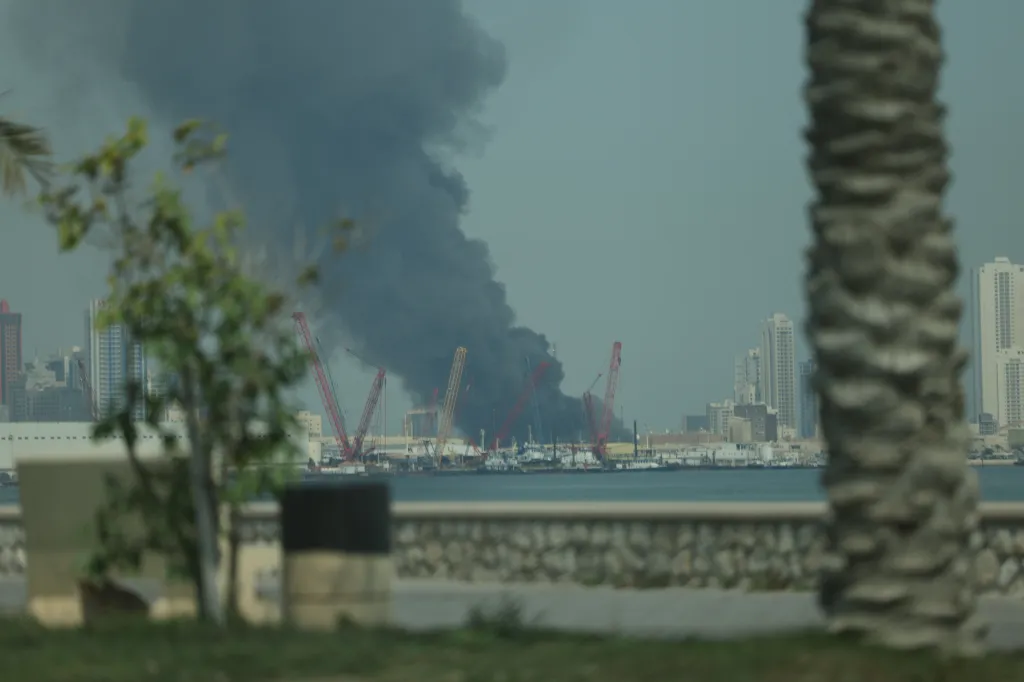
Smoke rises after Iran carried out a missile strike on the main headquarters of the U.S. Navy’s 5th Fleet in Manama in retaliation against US-Israeli attacks, in Bahrain February 28, 2026. (Photo by Stringer/Anadolu via Getty Images) Anadolu
The answer was shifting from having fleet oilers call on ports to executing at-sea replenishment of those oilers by using consolidated cargo operations (CONSOL) tankers – vessels leased by MSC that are specially equipped to offload fuel at sea. The concept isn’t new. After shifting away from using chartered ships to refuel oilers at sea in favor of conducting the transfers at port facilities, MSC reintroduced the CONSOL process in 2015, “as a way to utilize a flexible platform that allows MSC to operate worldwide in a variety of missions,” according to the Navy. Having a CONSOL tanker provide fuel to oilers means they don’t have to return to a port, reducing costs and increasing time on station to support the fleet. During a time of conflict, that can also mean less risk to the oiler, which is a critical asset that would be in very high demand.
The way the chartered tankers have been used in the Middle East during Epic Fury has taken this process to a new level.
The Navy created what Hein called a system of “tanker treadmills” at sea with “tankers cycling in and out” to replace the fixed infrastructure no longer available due to Iranian attacks.
“There are no more logistics hubs they’re going to,” Hein proffered. “All those nodes are now remaining at sea.”
In addition to the CONSOL tankers’ ability to refuel oilers at sea, “we’re putting an additional fuel delivery system on those tankers so they’ll be able to replenish destroyers and ships other than oilers,” Hein added. He did not provide details about what kind of system, however, the Navy has previously discussed developing what is called a Modular CONSOL Adapter Kit (MCAK).
“By installing it on the deck of a tanker, it can refuel other ships through the receiving ship’s fuel delivery hoses,” the Navy explained.
Military Sealift Command (MSC) dry cargo ship USNS Matthew Perry (T-AKE 9) connects fuel lines with MSC chartered ship motor tanker Badlands Trader during a consolidated cargo (CONSOL) replenishment operation in the vicinity of Okinawa, Japan, Dec. 15. (Courtesy photo) Grady Fontana
There are currently 15 CONSOL tankers available to the Navy worldwide. Rear Adm. Chris Stone, Director of Strategic Plans, Policy, Logistics and Warfighting Development for U.S. Transportation Command, said that’s not enough.
“If there’s one thing that I had the power to stroke a check on today, it would be to create more CONSOL tankers – those consolidated cargo replenishment at sea vessels,” he said at the same SAS panel.
“We probably need something more than 15, because when there’s a crisis or a conflict around the world, the first thing that a geographic combatant commander asks TRANSCOM for is a CONSOL vessel, and we don’t have enough of them today without trade offs that create risk in other areas.”
Off the coast of Southern California Military Sealift Command’s long-term chartered motor tanker ship Empire State (T-AOT 5193) conducted connected at-sea refueling operations (CONSOL) with three MSC Combat Logistics Fleet ships July 11-14. (USN). Sarah Cannon
“We’ve proven CONSOL capability during Operation Epic Fury,” Stone added. “We have a treadmill of vessels where one is on the front line, one is topping off, and they’re continually rotating to ensure that we’ve got support for the warfighter.”
CONSOL tankers, Stone posited, “are no longer supply ships. They’re not logistics ships. They’re force projection platforms that support our warfighters. They allow us to support the joint force and refuel them underway. It extends our operational reach and endurance, while reducing the reliance on predictable, vulnerable port visits. In less than two years, we’ve increased the capacity dramatically, and we’ll continue to do so.”
Henry J. Kaiser class underway replenishment oiler USNS Yukon, right, prepares to conduct a consolidated loading (CONSOL) with commercial tanker MT Empire State. (U.S. Navy photo by Mass Communication Specialist 1st Class Patrick W. Menah Jr./Released) Petty Officer 2nd Class Patrick Menah
While a boon to the system, the CONSOL tankers are not without their issues. The main one being time. It takes about two hours for an oiler to refuel a destroyer, said Hein, while it takes about six hours for a tanker to get the job done.
“Unlike a quick trip to the gas pumps for a car, CONSOLing can take hours to complete,” the Navy noted in a story about the tankers. “This creates a unique set of challenges for the ships conducting the operations. CONSOLing is a dance between two ships. Each must maneuver alongside the other, and maintain a consistent speed and course. Because of their size, tanker maneuverability becomes a challenge.”
“We simply do not maneuver like the [oilers] do. They are graceful, gliding through the water,” said Capt. Michelle Laycock, Maersk Peary’s master. “There’s not a lot of ‘grace’ to a fully loaded tanker. We don’t glide, we plow through the water.”
Military Sealift Command (MSC) dry cargo ship USNS Matthew Perry (T-AKE 9) connects fuel lines with MSC chartered ship motor tanker Badlands Trader during a consolidated cargo replenishment operation in the vicinity of Okinawa, Japan, Dec. 15. (Courtesy photo)
The increased time and effort is worth it, Hein said.
“This is a capability that is needed that will help mitigate the lack of oilers right now,” Hein suggested.
He wants to take the concept a step further.
“So while we can CONSOL for fuel, I’d like to get to a point where you CONSOL for food as well,” he stated.
While CONSOL has provided a lifeline for vessels during Operation Epic Fury, its utility would be dramatically magnified during a war in the vast Pacific, one where ports at much farther distances would be under threat as would ships of all kinds over huge swathes of that theater. There have been consistent concerns about the size of the oiler fleet being a point of weakness for the Navy’s ability to project power in a near-peer conflict. Doubling-down on CONSOL and giving those vessels the ability to directly refuel surface combatants, carriers and amphibious warships could go a long way to buying down risk and fortifying operational planning.
Weekly insights and analysis on the latest developments in military technology, strategy, and foreign policy.
The U.S. Navy has shared details about what looks to be a previously undisclosed effort to rapidly arm ships in two carrier strike groups with radar-guided Longbow Hellfire missiles to protect against drones. This reflects a larger push to expand shipboard defenses against uncrewed aerial threats, which now includes four Arleigh Burke class destroyers sailing with new launchers to fire Coyote interceptors. TWZ was first to report on the appearance of one of these launchers on the USS Carl M. Levin, with Naval News subsequently sharing more information.
“Supplemental funding was provided to rapidly field CUAS [Counter-Unmanned Aerial Systems] solutions for the Gerald R Ford Carrier Strike Group (CSG) which included the procurement of Longbow Hellfire launchers, Coyote launchers, and the installation/integration work,” according to a line item in the Navy’s 2027 Fiscal Year budget request, which the service rolled out in full earlier this week. “Funding was also provided to rapidly field CUAS solutions on the Theodore Roosevelt CSG to include Longbow Hellfire Launchers, Coyote launchers, and the installation/integration work.”
A stock picture of the Navy’s supercarrier USS Gerald R. Ford. USN
“FY2024 and FY2025 [Fiscal Years 2024 and 2025] funding utilized to rapidly field CUAS solutions for the Gerald R Ford Carrier Strike Group (CSG) and the Theodore Roosevelt CSG, which included the procurements of Longbow Hellfire launchers, procurements of Coyote launchers, installations, and integration work,” the newly released budget documents also note.
The same line item is present in the Navy’s proposed budget for the 2026 Fiscal Year, but makes no mention of the Hellfire or Coyote integration efforts. An early type of naval launcher for Coyote was first seen on Arleigh Burke class destroyers assigned to the Gerald R. Ford Carrier Strike Group last year, and we will come back to developments on that front later on.
The Navy’s latest budget documents do not say which ships in the Gerald R. Ford and Theodore Roosevelt CSGs may have received the Longbow Hellfire launchers, or whether they are currently installed. TWZ has reached out to Naval Sea Systems Command (NAVSEA), as well as the Long Hellfire’s prime contractor, Lockheed Martin, for more information about this integration work and what it has entailed to date.
The millimeter-wave radar-guided Longbow Hellfire, which also carries the designation AGM-114L, has a demonstrated counter-drone capability, as well as the ability to strike targets on land or at sea. The Navy previously announced modifications to its Freedom class Littoral Combat Ships (LCS) to allow them to engage uncrewed aerial threats with AGM-114Ls fired from launchers specifically designed for those vessels. However, LCSs are not a component of a typical carrier strike group. On the surface, Navy carriers are usually escorted by a mix of Ticonderoga class cruisers and Arleigh Burke class destroyers.
The Freedom class Littoral Combat Ship (LCS) USS Milwaukee fires an AGM-114L Longbow Hellfire. USN
In June 2025, Naval News did report that two Arleigh Burke class destroyers – the USS Jason Dunham and USS The Sullivans – had previously been involved in testing of various new capabilities, including Longbow Hellfire in the counter-drone role. Neither of those ships were assigned to the Gerald R. Ford or Theodore Roosevelt CSGs at that time. No specific details were available then about what the integration of AGM-114L had consisted of, either.
In March, Lockheed Martin did unveil a containerized Hellfire launcher called Grizzly, development of which started last year. At the time, the company said Grizzly could be adapted for shipboard use.
A picture showing a test of Lockheed Martin’s Grizzly containerized Hellfire launcher. Lockheed Martin
As an aside, the Navy has talked about a containerized counter-drone launcher able to hold up to 48 Hellfires as being a future armament option for its forthcoming FF(X) frigates. There has been no indication, though, that this is an operational capability now.
Lockheed Martin has also been developing a ship-based launch capability for its AGM-179 Joint Air-to-Ground Missile (JAGM), which is derived from the laser-guided AGM-114R variant of the Hellfire. For more than a year now, the company has been publicly displaying a model of an Arleigh Burke class destroyer fitted with six four-cell JAGM Quad Launchers (JQL; pronounced jackal). At the same time, there have been no signs so far that the Navy is actively moving to field those launchers on ships of this class.
A close-up look at the JQLs on Lockheed Martin’s Arleigh Burke class destroyer model, as seen at the Navy League’s Sea Air Space 2026 exposition. Jamie Hunter
With all this in mind, it is not surprising that Longbow Hellfire in some configuration would be an attractive immediate option for the Navy to help bolster shipboard defenses against ever-growing drone threats.
As the Navy’s latest budget documents note, the service has also been working to add other counter-drone interceptors to its ships, such as the combat-proven Coyote. The USS Carl M. Levin, as well as the USS John Paul Jones, the USS Paul Hamilton, and the USS Decatur, have all now received new eight-cell Coyote launchers. All of those warships are currently assigned to the Harry S. Truman Carrier Strike Group. This builds on the integration of the earlier four-cell launchers on at least two other ships in the class, the USS Bainbridge and the USS Winston S. Churchill.
An annotated image highlighting the new eight-cell Coyote anti-drone interceptor launcher as seen on USS Carl M. Levin. USN Another annotated image highlighting the earlier Coyote installation as seen on the USS Bainbridge. A stock image of a Coyote Block 2 interceptor is also seen at top right. USN
“This is the first deployment of this launcher which increases the cell count from four to eight and provides increased marinization,” a Navy spokesperson told TWZ when asked for more information after Carl M. Levin emerged with the new Coyote capability. “We are working [on] plans for future carrier strike group deployments to install these and potentially other containerized launchers.”
“This is a non-permanent change; launchers can be removed after the completion of a deployment and transferred to other ships—accelerating the deployment of advanced capabilities throughout the Fleet,” that spokesperson added.
Roadrunner successfully deploys from prototype launch enclosure.
In 2024, @DIU_x selected Anduril to develop cUAS for the @DeptofWar’s Counter NEXT program. Today, we’ve been awarded additional funding to move into the next phase of development and ultimately deliver these… pic.twitter.com/PAScfvIRHZ
Zone 5 White Spike Counter UAS drone interceptor flight tests
Navy plans for additional shipboard counter-drone capabilities go beyond physical interceptors, as well. Just this week, the service disclosed a live-fire test of a palletized version of the AeroVironment LOCUST laser counter-drone system onboard the Nimitz class aircraft carrier USS George H.W. Bush. You can read more about that test, which occurred in October 2025, here.
Demand within the Navy, as well as the rest of the U.S. military, for an array of layered counter-drone capabilities is likely to remain high for the foreseeable future. As noted, these threats are not new and are continuing to expand in scale and scope, driven now in large part by advances in artificial intelligence and machine learning. Automated targeting and fully networked swarming capabilities are not only proliferating, but the barrier to entry, even for non-state actors, is low.
More launchers for counter-drone interceptors, whether they are loaded with Longbow Hellfires, Coyotes, or something else, are only likely to continue appearing on Navy warships as the service works to further address this threat.
Weekly insights and analysis on the latest developments in military technology, strategy, and foreign policy.
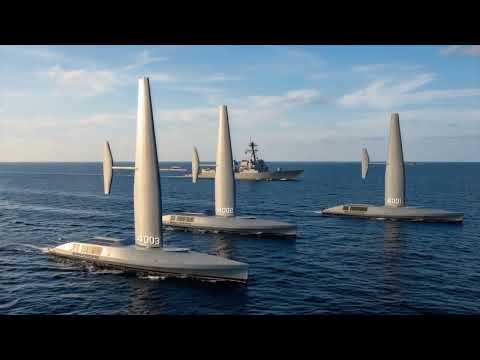
A collaboration between relative military newcomer Saildrone and defense contracting giants Lockheed Martin and Fincantieri has resulted in Spectre, a 170-foot drone boat capable of traveling nearly 35 miles per hour and optimized for anti-submarine warfare.
Saildrone Spectre: A new class of unmanned surface vessel
The Navy’s work with far smaller Saildrone platforms dates to 2021. In the Middle East, the 33-foot Voyager, specializing in persistent surveillance, has been at the heart of testing and experimentation by the service’s Task Group 59, focused on unmanned capabilities and teaming.
In the U.S. 4th Fleet area of responsibility, which includes the Caribbean and Central and South America, solar-powered Voyagers have been the USV of choice for Operation Windward Stack. This is an effort to integrate uncrewed systems into the work of apprehending drug trafficking and illegal fishing.
A Saildrone Explorer unmanned surface vessel operates alongside U.S. Coast Guard fast response cutter USCGC Emlen Tunnell (WPC 1145) in the Arabian Gulf, Nov. 29, during Digital Horizon 2022. The three-week unmanned and artificial intelligence integration event involves employing new platforms in the region for the first time. (U.S. photo by Sgt. Brandon Murphy) Sgt. Brandon Murphy
The Spectre design, which was unveiled Monday at the Sea-Air-Space Exposition near Washington, D.C., at which TWZ was in attendance, is the result of two years of work. It precedes the Navy’s current competition for a family of Medium Unmanned Surface Vessels, which formally launched last month. However, company executives said they now plan to enter Spectre.
“We didn’t fit to that. We didn’t change our course,” Saildrone founder and CEO Richard Jenkins said. “Now it’s changed, MUSV … it actually fits perfectly. We meet 100% of all the specs.”
Spectre comes in two variants. One is the Silent Endurance variant with the trademark sail, or “wing.” The other is the Stealth Strike variant that relies totally on its more powerful internal propulsion. While the sail-equipped variant is more focused on anti-submarine warfare and surveillance, it too can be equipped with modular VLS cells or other “concealed payloads.” The Stealth Strike variant possesses “higher-speed” and is capable of “low observable missions,” according to the company.
(Saildrone)
Powered by a 5,000-horsepower Caterpillar diesel engine, the Stealth Strike variant is designed to cruise at around 25 knots, or just under 29 miles per hour. The 30 knot, or around 35-mile-per-hour, speed that the company cites as the maximum for Spectre is likely reserved for brief “sprints” that the Stealth Strike variant may execute during operations.
The Silent Endurance variant is optimized for “infinite endurance,” Jenkins said, with an electric engine that can maintain speeds of 12 knots, or about 14 miles per hour, or the signature wing, a 43-meter composite structure made by yacht racing team American Magic Services that can harness the wind for propulsion “without any engine at all.”
(Saildrone)
Tony Lengerich, vice president of Naval Programs at the United Kingdom-based Thales Defense and Security, which made the active sonar for Spectre, described the drones as a forward lookout presence for conventional Navy ships.
“We’re looking forward to bringing that capability in active sonar … to the Navy fleet, particularly in the theater ASW context, where you really need a vessel that can take a sensor far out ahead of the battle group, if you will, loiter there, deploy the sensor and then move again,” he said. “That’s exactly what Saildrone brings to the table, and it’s exactly what we think the Navy needs.”
Paul Lemmo, vice president and general manager for sensors, effectors & mission systems (SEMS) at Lockheed Martin, called the drones a cost-effective way of “putting more players on the field.”
“The Chief of Naval Operations [Navy Adm. Daryl Caudle] has said it’s an important thing, so you’ve got more shooters on a fairly inexpensive platform instead of a multi-billion dollar destroyer,” he said.
From an ASW perspective, Lengerich said, the platform works for clearing and assessing “broad ocean areas” before moving a manned battle force in.
“This provides that capability to take an active sonar source forward – ping, if you will, and then your shooters … pick up the ping and identify where you have an adversary in an area that you eventually want to move the force to. So we think of this as a theater asset, one that means far ahead of the force, both in time and space, and then advances the ability for the battle force to move in and be certain of what’s waiting for them.”
The unit price of Spectre is around $40 million, Jenkins said. That’s compared to about $7.5 million for the unarmed, much smaller 20-foot Surveyor.
(Saildrone)
The Navy has struggled to get its arms around what it wants out of its drone ships and how exactly they will integrate with the manned fleet. One of its earliest unmanned surface vessel test articles, Sea Hunter, was christened a decade ago. Navy officials announced earlier this year that Sea Hunter, a medium-sized USV, and its sister ship, Seahawk, would finally leave experimental status in 2026. One of these vessels, reportedly Seahawk, is expected to deploy this year with a carrier strike group.
Last year, the Navy unveiled plans for a family of uncrewed Modular Surface Attack Craft (MASC), emphasizing containerized missile launchers and highly configurable payloads. The service replaced this strategy last month, however, with what it called a “marketplace” for MUSVs, giving would-be competitors a matter of weeks to submit proposals for mature vessels that could be fielded in Fiscal Year 2027. Core requirements were laid out for seakeeping, long range and endurance, and cargo capabilities, as you can read more about here. The need to be able to carry two forty-foot equivalent unit (FEU) containerized payloads is a key demand, though the Navy has not yet specified publicly what might go in them.
(Saildrone)
“Honestly, inside you could have a sensor, you could have repair equipment for ships,” Rebecca Gassler, the Navy’s Portfolio Acquisition Executive for Robotic and Autonomous Systems (PAE RAS), told TWZ and other outlets during a press call in March. “You could have any number of payloads inside those, and you basically are able to just swap them on.”
Navy officials have said they want 11 operational MUSVs by next year, and have projected that half the surface fleet will be uncrewed by 2045.
Saildrone has plans to demonstrate the ability of Surveyor to carry a JAGM launcher at the joint Rim of the Pacific exercise in July. Lemmo said the team plans to demonstrate the same capability on Spectre soon. The company says construction on Spectre is about to begin shortly, with sea trials for the first vessel set for early next year.
Weekly insights and analysis on the latest developments in military technology, strategy, and foreign policy.
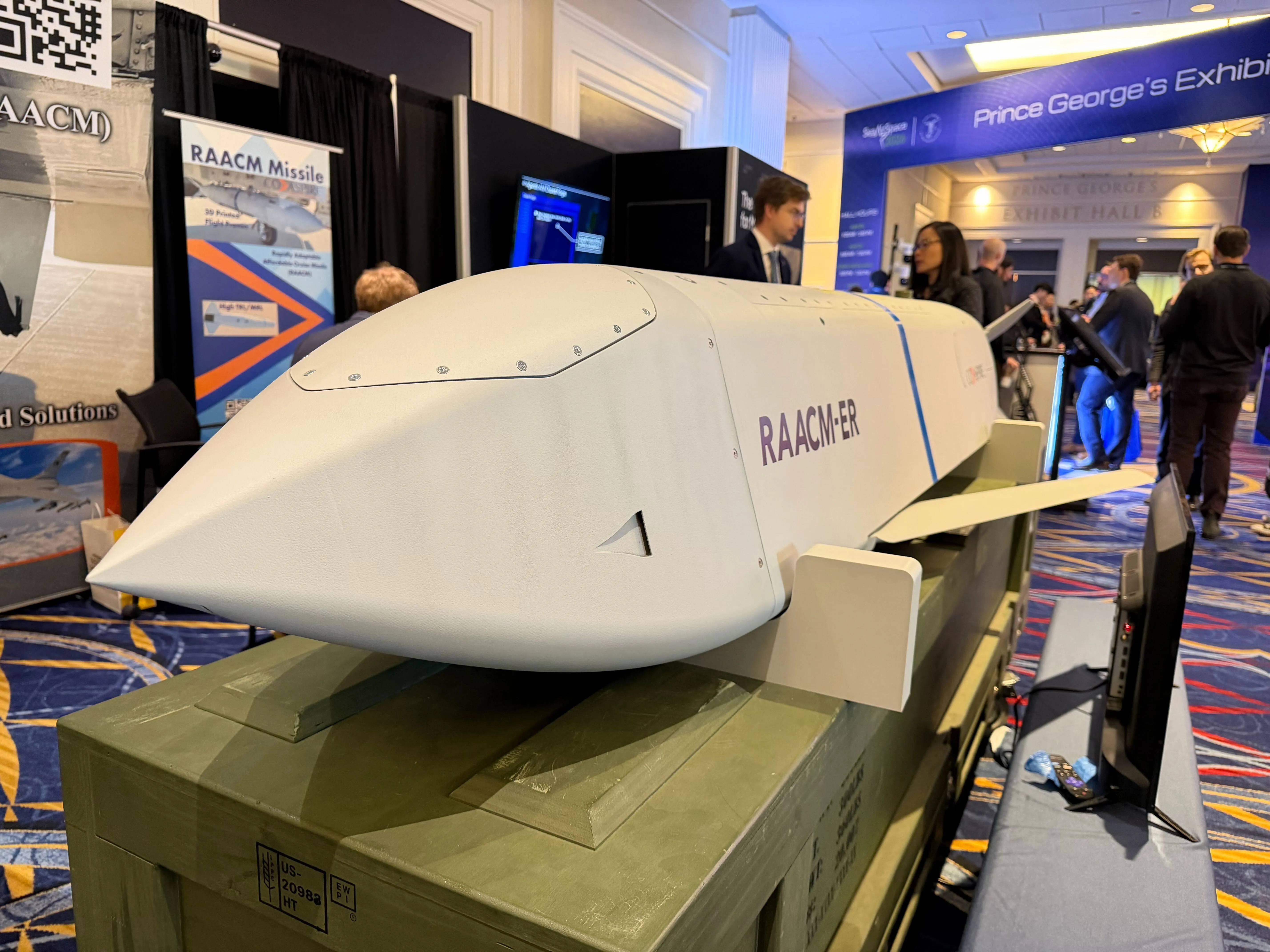
A new, longer-range version of the Rapidly Adaptable Affordable Cruise Missile (RAACM) has been unveiled by CoAspire at the Sea-Air-Space 2026 exposition near Washington, D.C. The development comes just days after the U.S. Air Force launched market research for its Family of Affordable Mass Missiles — Beyond Adversary’s Reach (FAMM-BAR), reflecting the service’s interest in low-cost, long-range strike weapons, specifically for anti-surface warfare.
Jamie Hunter of TWZ spoke about the RAACM-ER (RAACM pronounced ‘rack-em;’ ER for Extended Range) with Doug Denneny, founder, CEO, and owner at CoAspire.
A frontal view of the RAACM-ER. Jamie Hunter
First off, it’s worth looking at the original RAACM, a modular, low-cost cruise missile that leverages 3D printing to bring down cost and enable rapid production ramp-up.
“When we designed the original RAACM, we knew that it was going to be the size of a GBU-38,” Denneny said, referring to the 500-pound version of the Joint Direct Attack Munition (JDAM), which is 92.6 inches long and has a wingspan of 14 inches.
An official video promoting the original RAACM:
RAACM Rapidly Adaptable Affordable Cruise Missile
“When you go to that size, there are great reasons to do it, but it doesn’t go as far as a larger variant could do,” Denneny continued. “We really wanted to take everything we learned and now have an extended-range version. And what’s beautiful about the additive manufacturing that we use is that we can really optimize fuel tank volume, which means this can go very far.”
According to the manufacturer, the RAACM-ER has a range greater than 1,000 nautical miles.
This is especially remarkable considering the relatively compact size of the weapon. Indeed, when it comes to anti-ship missiles, the only weapon in the U.S. inventory that comes close is the BGM-109 Block V Maritime Strike Tomahawk (MST). This can be launched from destroyers, submarines, and the U.S. Army’s Typhon system. Like the RAACM-ER, it is subsonic, but a single round costs $3.64 million, according to the Navy. While the RAACM-ER clearly has a degree of low observability, it is not to the same degree as on the MST.
A full battery set of four Typhon launchers, as well as the trailer-based command post. U.S. Army
Like RAACM, the extended-range model is designed for launch from aircraft, as well as from the ground and from naval vessels. For surface-launched applications, the RAACM-ER adds an additional rocket booster behind its turbojet, meaning it can be propelled out of its launch canister.
Despite the nomenclature, the RAACM-ER is a new design, rather than a modification of the RAACM.
Denneny explained: “Our engineers came to us and said, ‘Hey, if we’re going to make a bigger one, should we make it look just the same?’ I mentioned earlier that RAACM was made that shape just to ease integration. We’re an engineering company, so we said, ‘Let’s optimize fuel volume, let’s optimize survivability features, let’s optimize physics so that this thing can go as far as possible and take the sensors needed. That’s why it’s in this slightly different shape.”
The RAACM-ER is somewhat reminiscent of the AGM-158 Joint Air-To-Surface Standoff Missile (JASSM), in terms of appearance and capabilities, but Denneny is keen to avoid direct comparisons.
Stealthy AGM-158 JASSMs loaded onto an F-15E. U.S. Air Force/Photo by Airman 1st Class Susan Roberts Stealthy AGM-158 JASSMs loaded onto an F-15E. JASSM uses an imaging infrared seeker — seen in the hexagon-shaped window on the missile’s nose — to match the target in its databank and fine-tune its terminal attack run. (Photo by Airman 1st Class Susan Roberts)
“Physics is physics,” he added. “When people look at shapes, they look similar, but just like an Airbus looks like a Boeing, but what they have different inside is really what matters, and that’s how we differ in many ways.”
In terms of sensors, the RAACM-ER is currently fitted with a GPS navigation system, suitable for air, ground, and surface launch.
“Both our RAACM and our RAACM-ER also have a long-wave infrared sensor in the nose,” Denneny continued, “so we have the opportunity to search and find targets as well.”
Unlike the JASSM and similar cruise missiles, however, the RAACM-ER, like the RAACM before it, is optimized for low cost.
For Denneny, “the most important thing is affordable mass. [This] means keeping the cost down, so that the nation and our allies can purchase these at scale. That’s number one. Number two is to use as many commercial off-the-shelf parts, so that we’re we are not locked into a single supplier for anything. The final thing is to have something that can survive enemy countermeasures, and also hit the target, whether it’s stationary or moving. Those are the main requirements.”
Jamie Hunter
When it comes to price point, CoAspire has optimized mass rather than the highest-end capabilities. This is a reflection not only of the sheer number of targets that the U.S. military and its allies would face in a potential conflict with China, but also the fact that a considerable proportion of missiles won’t make it to their targets anyway. Still, as recent conflicts have shown, the ability of lower-end drones, especially, to overwhelm adversary air defenses when fielded in large numbers is significant. After all, quantity has a quality all of its own.
Denneny confirmed that CoAspire plans to test-fly the RAACM-ER “very soon.”
The original RAACM has already undergone flight trials aboard a contractor-operated A-4. CoAspire is now under contract to the U.S. government for RAACM, and the weapon is in production at the company’s plant in Manassas, Virginia.
In the past, we’ve learned that both the Air Force and the Navy have funded work on the RAACM project. It has also been reported that CoAspire is one of two companies producing Extended Range Attack Missiles (ERAM) for Ukraine — this may well involve the RAACM or a related weapon.
Two candidate weapon prototypes competing for the US Air Force’s Extended-Range Attack Munition program 👇. Both Coaspire and Zone 5 Technologies were awarded contracts late last year in support of the #ERAM program. Both are expected to enter testing this year. https://t.co/9cGBuB9z3spic.twitter.com/gc3ZDtX54m
As for the RAACM-ER, this was unveiled only a week after the Air Force launched market research for its Family of Affordable Mass Missiles — Beyond Adversary’s Reach (FAMM-BAR).
“The potential procurement objective is to produce an inventory for the [U.S.] Government and Foreign Military Sales. The expectation is that the annual production orders will range from 1,000 to 2,000 units per year for five years (procurement numbers will vary by year),” the Air Force says in the request for information.
The FAMM-BAR program lists five desired attributes for the potential weapon: a range of at least 1,000 nautical miles, a speed of at least 0.7 Mach, the option of palletized delivery from a cargo aircraft, the ability to receive midcourse navigation updates, and the manufacturing capacity to produce more than 1,000 rounds annually. The main target set for the weapon is “slow-moving maritime” vessels.
A video showing a demonstration of the Rapid Dragon air-launched palletized munitions concept, using surrogate weapons delivered from the cargo holds of a C-17A and an EC-130J:
Rapid Dragon Flight Test
This requirement reflects the growing focus on anti-surface warfare as the U.S. military plans for a high-end conflict in the Pacific, especially against China. The U.S. military is increasingly investing in a diverse mix of anti-ship capabilities, part of a broader strategic shift driven by China’s growing maritime power. At the same time, real-world operations have exposed how rapidly missile stockpiles can be depleted, intensifying concerns that sustaining the massive volumes of anti-ship fires required in a China conflict will demand significant expansion of U.S. production capacity and inventories.
At the same time, the RAACM-ER would be useful for striking static land targets during an Indo-Pacific war, too. With such a considerable range, the weapon will also be better able to deal with increasingly far-reaching air defenses, something that the Pentagon is increasingly concerned about, including the likelihood of enemy missiles that can target its aircraft at ranges as great as 1,000 miles.
It should be noted that there are already other FAMM programs underway, namely the FAMM-Palletized and FAMM-Lugged cruise missiles for the Air Force. However, these require ranges of 250-500 nautical miles.
At this point, the low-cost, long-range strike weapon field is becoming increasingly crowded. Other contenders include designs from Anduril, General Atomics, and Zone 5 Technologies. From the last of these companies, the Rusty Dagger recently underwent release tests from an Air Force F-16 as part of the FAMM-L effort.
A U.S. Air Force F-16 takes off carrying a Rusty Dagger, from Zone 5 Technologies, as part of the Family of Affordable Mass Munition — Lugged tests. U.S. Air Force photo by Tech. Sgt. Thomas M. Barley
Global Technical Systems is also pitching a cruise missile with a range of 1,200 nautical miles and an anti-ship warhead.
However, with the original RAACM already in production, and proven in flight tests, the new RAACM-ER looks well-positioned to go far — figuratively and literally — in the FAMM-BAR program.
General Atomics is positioning the MQ-9B SeaGuardian unmanned aerial system (UAS) as an ideal partner for the U.S. Navy’s P-8 Poseidon maritime patrol aircraft. The SeaGuardian features an expanding suite of anti-surface warfare, anti-submarine warfare and situational awareness-enhancing capabilities. These can be employed to complement existing platforms or to provide a complete solution on their own for long-endurance over-water missions.
The modular payload and open architecture MQ-9B is designed to carry a huge range of systems that enable it to sense and observe things that come or go on land, sea, in the air, and even beneath the waves. The aircraft can also collect signals intelligence or take on a number of other roles by using many specialized payloads. This is in addition to the aircraft’s ability to strike targets of many kinds, with long-range weapon integration now planned.
SeaGuardian packed with sonobuoy dispensers and sensors. (General Atomics) GA-ASI
The MQ-9B has the ability to deploy sonobuoys to listen for and track submarines – a highly valuable feature considering what lurks below the surface in increasingly strategic but remote areas, like deep in the Pacific and across the the frigid Arctic. General Atomics has flight-tested sonobuoy dispensing system (SDS) pods as part of a broader demonstration of anti-submarine warfare (ASW) capabilities for the SeaGuardian.
TWZ‘s Jamie Hunter spoke with Doug Hardison of General Atomics at the Sea-Air-Space 2026 trade event to get the low-down on how the company is progressing with the huge range of capabilities that SeaGuardian intends to bring to the table, and how teaming it with the P-8 presents an especially attractive opportunity.
General Atomics Explains How U.S. Navy Could Use MQ-9B SeaGuardian To Complement P-8 Poseidons
Weekly insights and analysis on the latest developments in military technology, strategy, and foreign policy.
The U.S. Navy has handed Lockheed Martin a formal contract to integrate the Patriot PAC-3 Missile Segment Enhancement (MSE) surface-to-air missile with the Aegis Combat System. The Navy’s main Aegis-equipped ships today are its Arleigh Burke class destroyers. The service is also seeking just over $1.73 billion to order its first-ever tranche of PAC-3 MSEs, 405 in total, as part of its proposed budget for the 2027 Fiscal Year.
A rendering of an Arleigh Burke class destroyer firing a PAC-3 MSE missile. Lockheed Martin
Lockheed Martin announced it had received the PAC-3 MSE/Aegis integration contract, said to be a multi-million dollar deal, earlier today, around the Navy League’s annual Sea Air Space exposition, at which TWZ is in attendance. The Navy has separately shared more details about its PAC-3 MSE acquisition plans as part of the full rollout of the Pentagon’s budget request for Fiscal Year 2027, which also occurred today.
Per the Navy’s Fiscal Year 2027 budget request, the service sees PAC-3 MSE integration with Aegis as providing an additional means of intercepting “a wide range of threats, including tactical ballistic missiles, air-breathing threats, cruise missiles, and unmanned aerial systems.” As mentioned, Arleigh Burke class destroyers make up the vast majority of American warships equipped with the Aegis Combat System today. There are also a steadily shrinking number of Ticonderoga class cruisers with this combat system.
PAC-3 MSE has been in full-scale production since 2018. Pairing it with Aegis “has been in the works, I probably think, close to 10 years,” Chandra Marshall, Vice President and General Manager of the Multi-Domain Combat Solutions business unit within Lockheed Martin’s Rotary and Mission Systems division, told our Jamie Hunter on the floor of Sea Air Space. She added that the goal now is for the Navy to achieve initial operational capability (IOC) with this combination in approximately 18 months, or by the end of 2027 if the clock starts now.
A briefing slide offering a general overview of the PAC-3 MSE missile, as well as its improvements over the previous PAC-3 CRI surface-to-air interceptor. Lockheed Martin An overview of the improvements found on the PAC-3 MSE variant over its predecessors, including a “New LE [lethality enhancer].” Lockheed Martin
“So, there’s two pieces of it. So the PAC-3 missile, there’s a small update to it to be able to communicate with S-band radar. So, currently it communicates with X-band [radars]. So, now with this update, it will be able to communicate both with S and X-band,” Marshall explained. “And then we have to integrate PAC-3 as a missile type with the Aegis Combat System.”
“We have a very open architecture [with Aegis], so the way that we componentize everything, we feel like it’s a very short putt for the Aegis integration of the PAC-3 missile,” she added. “So, it’ll just be another missile in the inventory for the Navy to be able to diversify based on the threat.”
You can read more about the Aegis Combat System and how it has evolved to adopt a modular, open architecture approach, specifically to make it easier to add new capabilities and functionality, in this previous TWZ feature. Lockheed Martin has already demonstrated the ability of a modular and scalable version of the system, called the Virtualized Aegis Weapon System, to fire a PAC-3 MSE from a containerized Mk 41-based launcher on land.
Aegis: Capable. Proven. Deployed.
No changes to the Mk 41 VLS – another Lockheed Martin product – are planned or required as part of the PAC-3 MSE integration. Work has been ongoing on adapting the interceptors into launch canisters, allowing them to slot right into existing Mk 41 cells. At just over 17 feet long, PAC-3 MSE should fit in shorter so-called tactical length versions of the Mk 41, as well as one with longer strike-length cells.
A graphic showing existing missiles compatible with tactical and strike-length versions of the Mk 41 VLS. Lockheed Martin A graphic showing various missiles already compatible with the tactical and strike-length versions of the Mk 41. Lockheed Martin
Lockheed Martin has said in the past that each canister will contain a single PAC-3 MSE missile. At around 11 inches wide, the PAC-3 MSE is just over half the maximum diameter available in a Mk 41 cell. This raises the question of whether future canisters could be designed to hold multiple interceptors, which would give ships valuable additional magazine depth.
From a capability standpoint, PAC-3 MSE is generally discussed in comparison to SM-2 surface-to-air missiles in the Navy’s arsenal today. In terms of missiles that can be fired via the Mk 41, SM-2 is a middle-tier anti-air capability that sits between shorter-range RIM-162 Evolved Sea Sparrow Missiles (ESSM; which can also be quad-packed into a single cell) and upper-tier SM-6s and SM-3s. The SM-6 is a multi-purpose weapon that can also be employed against targets on land and at sea. SM-3s, of which there are multiple variants in service today, are specifically designed as anti-ballistic missile interceptors.
“A lot of places the Navy has said ‘I got red or yellow challenges that I can’t deal with.’ This missile does a really good job at that. When you marry them all together, it is very complimentary to SM-6,” Chris Mang, Vice President of Strategy & Business Development at Lockheed Martin’s Missiles and Fire Control, told TWZ at last year’s Sea Air Space conference. “You’d always want a layered defense, right? I’ll pick the longest shot I can get, but then at a certain point, MSE really starts to outperform in certain envelopes.”
An SM-6 seen at the moment of launch. USN
For the Navy, PAC-3 MSE also presents important logistics, cost, and supply chain benefits. The latest conflict with Iran has only underscored now long-standing concerns about U.S. munition expenditure rates, especially when it comes to anti-air interceptors. A large-scale, high-end fight with a near-peer adversary like China would put much more pressure on munition stockpiles and the U.S. industrial base working to restock them. As such, it would be a boon for the Navy to have an additional stream of interceptors to arm its warships.
As noted, the Navy is already moving to buy hundreds of what documents currently refer to as the “PAC-3 MSE / Navy” missile, as well as launch canisters. The service’s Fiscal Year 2027 budget request puts the unit cost for each missile at $4.05 million. The canister adds another $200,000 to the price tag. The Army’s Fiscal Year 2027 proposed budget says the unit cost for standard PAC-3 MSEs has risen now to $5.3 million. The exact reasons for the cost discrepancy between the Army and Navy versions are unclear.
A PAC-3 MSE missile seen being fired from a ground-based launcher. US military A Patriot launcher fires a newer PAC-3-series missile during a test. DoD
“Both quantities and unit cost are estimates based on U.S. Army contract pricing. Both quantities and unit cost will adjust based on award of DoN CLINs [Department of Navy Contract Line Item Numbers] on ARMY contract in execution and final cost of the Navy components (radio, canister, etc),” per the Navy’s latest budget request.
At $4.05 million, the Navy’s PAC-3 MSEs will be slightly cheaper per missile than the Block IA version of the SM-6. The service’s latest budget request puts the unit cost of the latter missiles at $4.348 million. The cost of a current-generation Block IIICU variant of the SM-2 is unclear, given that they have often been procured as upgrades of existing Block IIICs rather than new-production missiles. Historically, the average price point for an SM-3 Block IIIC has been around $3.6 million.
“By leveraging the high-volume Army PAC-3 MSE production contract, the Navy achieves significant cost avoidance through economies of scale, as unit price decreases with larger quantities,” the Navy’s latest budget documents also note.
Lockheed Martin announced in January that it had reached an agreement with the U.S. government to ramp up annual PAC-3 MSE production, for domestic and foreign customers, from 600 to 2,000 missiles. Last week, the company received a contract to help further accelerate production of these missiles. This could all help drive down the unit cost of the missiles going forward, as well as speed up their delivery.
Lockheed Martin Receives Contract to Accelerate PAC-3® MSE Production
It is worth pointing out here that PAC-3 MSE’s performance in the Middle East, as well as in Ukraine in recent years, has also prompted a significant increase in demand from the U.S. Army, as well as foreign Patriot operators. The overall Patriot user base is also expanding.
Adding the Navy to the mix will add to that demand, even with the production ramp-up, and could add to already growing concerns about production backlogs now. Integrating PAC-3 with Aegis and the Mk 41 VLS could also spur additional interest from other navies globally that have ships with that combat system and/or launchers.
Reutersreported just last week that U.S. officials had informed allies and partners in Europe that deliveries of unspecified munitions could now be delayed due to American needs in relation to the war with Iran. When it comes to PAC-3 MSE, the budget documents the Army released today, at least, do not appear to show any changes to the delivery schedule for foreign customers.
🇺🇸 Is the US re-sequencing scheduled PAC-3 MSE deliveries away from FMS customers to the US Army’s inventory?
The J-books say no. In fact, FMS customers are scheduled to receive the majority of production.
Weekly insights and analysis on the latest developments in military technology, strategy, and foreign policy.
Shield AI and General Electric have revealed more details about X-BAT, the jet-powered autonomous stealth ‘fighter’ drone designed to take off vertically and land the same way, tail first, after completing its mission. With the extremely ambitious aircraft concept planned to start vertical takeoff and landing (VTOL) testing before the end of this year, the companies have also shown off a roughly half-size model that includes significant design changes.
The new details came when officials — J.J. Cummings and Armor Harris from Shield AI, and Steve Russell from GE’s Edison Works — spoke with reporters, including The War Zone, at the Sea-Air-Space 2026 exposition near Washington, D.C.
Make sure to get up to speed on everything we previously knew about X-BAT in our exclusive feature from when the aircraft was unveiled, linked here, as well as its forthcoming flight testing here.
A major redesign
When we discussed the X-BAT in our in-depth coverage of the program in the past, the drone had a ‘cranked kite’ planform, which has now given way to a straight leading edge with a more dramatic sweep as part of a distinctive arrowhead-shaped profile. We saw the same on the Boeing X-45C Phantom Ray UCAV prototype, and it has since been adopted by the Chinese GJ-11 Sharp Sword, among others. This new configuration looks better optimized for higher-speed flight.
According to X-BAT’s chief designer, Armor Harris, “We’ve taken an iterative approach to development and made improvements to the design based on test data.”
A scale model of the X-BAT on display at the Sea-Air-Space 2026 exposition near Washington, D.C, this week. Jamie HunterThe original planform design featured a cranked-kite like arrangement. Shield AI
Raiding the past to realize the future
Of all the new details we received about X-BAT, where the jet’s critical thrust vectoring capability will come from is perhaps the most intriguing. GE says that the engine nozzle is the Axisymmetric Vectoring Exhaust Nozzle (AVEN), which comes from a specialized thrust-vectoring F-16 that was tested out of Edwards Air Force Base, California, back in the 1990s. The AVEN nozzle — taken direct from the warehouse, “Indiana Jones-style,” according to the officials — will be used for the initial testing.
F-16 MATV Axisymmetric vectoring in the early 1990’s.
Multirole platform: including tanker
Officials confirmed that the X-BAT can be operated as a tanker, making use of its two external hardpoints. Both of these are plumbed to the internal fuel tanks, so they can support ‘buddy’ refueling pods, which trail a hose and drogue.
The companies stress that aerial refueling tanker is “definitely not a primary mission,” but this option does reflect the multirole nature of the platform. Meanwhile, drone tankers are a growing area of interest for different U.S. military services, with efforts currently spearheaded by Boeing’s MQ-25 Stingray, although, since it is larger than the X-BAT, this would also offer much greater internal capacity.
For expeditionary operations, in particular, drone tankers are seen as a viable solution, although by no means the only one. X-BAT acting as a launch tanker could be especially of interest for tactical jets that require long runways. This would allow them to takeoff in short distances with heavy weapons loads and get fuel immediately from the X-BAT tanker before heading on their missions. X-BAT tankers could also act as unpredictable refueling platforms that are forward deployed for enroute combat aircraft, launching from virtually anywhere to refuel jets making their way from longer distances to their target areas. These are just some of the less traditional theoretical ways a tanker-configured X-BAT could be used.
Interestingly, based on the current concept of operations, Shield AI sees less interest in having the X-BAT take on fuel while airborne itself, although there is a “holding place” for a refueling probe in the nose, if required.
Overall, and beyond tanking, the X-BAT’s multirole capability implies “significant air-to-ground capability, maritime strike capability, and electronic warfare capability,” Shield AI says.
GE F110 engine
Last year, TWZ broke the news that General Electric was working with Shield AI on the powerplant side of the X-BAT, specifically its F110 turbofan, the same as used in many F-16s and F-15s. The choice of the F110 was driven by size and thrust requirements, including the demanding VTOL cycle that’s at the heart of the X-BAT concept.
As well as offering what Shield AI describes as the best power-to-weight ratio in its class, the F110 was selected for its fuel economy. The engine is also widely available. With roughly 3,400 in the world, several “certified pre-owned engines” have been obtained for the program, as well as new-build ones.
While the partnership between Shield AI and General Electric was announced relatively recently, they have been working together for longer, with “tremendous progress on adapting the F110 engine” made in the last six to 12 months, according to officials.
Payload and range
According to Shield AI, X-BAT is around twice the size of all the other CCAs that are on the market today, which allows it to have a pair of payload bays that are roughly the same size as those found on the F-35. This means that any store that fits in an F-35 can theoretically also be accommodated internally in an X-BAT. These presently include 2,000-pound-class weapons.
At the same time, the X-BAT “goes twice as far” as an F-35, meaning double the combat radius. The drone’s manufacturers give a combat radius figure of 1,000 nautical miles. In the past, Shield AI told TWZ that the drone would also have a maximum range of 2,000 nautical miles and a service ceiling of around 50,000 feet.
Of course, the aircraft’s weight is a major factor in providing range. Company officials say they are “not really doing anything super-novel on the design of the air vehicle” in terms of weight reduction. However, with no landing gear and no auxiliary power unit (X-BAT uses an external lithium-ion battery pack to start the engine), and with other items moved from the air vehicle to the trailer-based launch recovery vehicle, all of this helps make the drone lighter.
Jamie Hunter
VTOL flight profile
For vertical takeoff, the F110 engine is put into afterburner to get the required thrust-to-weight ratio needed for takeoff, although the aircraft returns to land on military power (without afterburner).
Various modifications are needed to the F110 for use in a vertical takeoff application: as a tail-sitting aircraft, the X-BAT spends a lot of its time in this attitude. As such, the engine has been exposed to significant subscale and full-scale testing at GE facilities. Shield AI says it plans to build the prototype aircraft at a facility in Frisco, Texas, this summer.
An F110 engine from an F-16 jet in max power during a test at Hill Air Force Base, Utah. U.S. Air Force photo by Alex R. Lloyd
Interestingly, one important part of the tests so far has been to explore just how far the F110 can be throttled back for the delicate VTOL and transition phases. Previously, the limits were set by the cabin pressurization requirements of crewed aircraft: essentially, how much fan speed was needed to generate enough bleed air to pressurize the cabin for the pilot. Since the X-BAT is uncrewed, the F110 can be throttled back farther and operate in different regimes.
Thrust-vectoring nozzle
While the aforementioned AVEN nozzle will be used for the initial testing, the companies are meanwhile working on redesigning and updating the design and building more nozzles. The control system and software are also completely different from those used on the original AVEN and are tweaked to work with today’s F110.
“It actually has worked really well,” Steve Russell says of the nozzle. “We’ve done testing where we’ve reversed it, we’ve integrated it, we’ve run the control system … you put all those things together and put it into such a cool platform that’s really going to present a unique dilemma for our potential adversaries.”
So far, testing has shown that the rigors of VTOL actually result in less fatigue and vibration compared to a typical F-16 profile.
A mockup of the X-BAT in its original configuration. Shield AI
The current nozzle doesn’t have low-observable (LO) attributes, but that is something that will be introduced after prototype testing. There is also the possibility of the X-BAT vectoring its nozzle in forward flight to increase its agility. The companies stress that this capability will depend on customer requirements, but the nozzle will be fully vectorable across the flight regime.
The focus for now is more about actuation and integration of the F110 with the Shield AI airframe and flight control system. A key factor is mitigating against exhaust gas ingestion and ensuring the engine is fed with clean air during the transition phases of flight. However, this is not something the developers are overly concerned about, and the F110 is also judged particularly stall-resistant.
Air intakes and blast deflector
Shield AI’s air intake system is specifically engineered to handle these demanding phases of flight and includes an auxiliary inlet on the back of the aircraft. This is concealed beneath a panel when the aircraft is not in VTOL mode.
Just as important is the engine exhaust, especially when it comes to mitigating the risk of foreign object damage (FOD) and kicking up debris that could damage other assets on the ground during VTOL operations. This would be especially critical on the tight confines of a ship’s flight deck.
The air intake system under test. Shield AI
For the launch, a blast deflector built into the X-BAT’s custom trailer is designed to direct the exhaust plume away rather than recirculating it back to the engine. The fact that the aircraft is suspended relatively high in the air for takeoff means that the issue of rocks and other debris being kicked-up at the aircraft is reduced. The deflector also channels the blast in a known direction.
For the landing phase, the aircraft’s approach profile helps avoid FOD and exhaust gas ingestion. Instead of coming straight down to land, the X-BAT approaches the launch-recovery trailer from the side, makes contact with it, and then powers up into a latch that secures it. The aircraft also leans slightly into the incoming airstream to help ensure the intake is always being fed with cleaner air.
A close-up of the blast deflector for X-BAT. Jamie Hunter
Open system architectures
With open system architectures baked into the design, it should also be easier to upgrade the X-BAT than previous aircraft, meaning it is getting “a lot closer to plug and play.” Shield AI talks about swapping in and swapping out different radiofrequency and infrared sensors for upgrades or potentially for different missions.
The companies remain generally tight-lipped about the electronic warfare (EW) packages that will be installed in the X-BAT. They did say that the EW gear will be unique to this aircraft and that they were able to leverage a lot of the sixth-generation systems that have been developed for the NGAD programs, in both their Air Force and Navy iterations.
Testing pathway
Looking in more detail at what comes next for the program, Shield AI and General Electric confirm that the first stage of testing is already underway, using the adapted F110 on GE test stands. Step two will see the propulsion system integrated into the prototype aircraft. It will then be run horizontally and then vertically, while still attached to the launch-recovery trailer.
An earlier mock-up of the cranked-kite X-BAT on its launch trailer. One of Shield AI’s V-BAT drones is also seen at left. Shield AI
The next step will involve a very large crane, which will hold the aircraft vertically, with engine tests being run while the X-BAT is tethered for safety. This phase will see the propulsion system tested in proximity to the ground, in proximity to the launch and recovery trailer, and under different inlet conditions.
The final step will see the tether taken off, allowing the X-BAT to perform free flights. The aircraft will take off from the launch and recovery trailer, go up, come around, and reattach to it, all in vertical mode. If things go well, company officials say, this milestone will be targeted before the end of 2026.
In the process, Shield AI and General Electric are realistic about the possibility of mishaps in what is really groundbreaking technology. Company officials describe a “hardware-rich approach to test,” which means building several prototype test aircraft that will be pushed to the limit. They “fully expect to lose one in testing,” since the program is stressing the delivery of capability to the operators as quickly as possible. In this respect, zero failures mean the program is going too slow, the officials say.
Market prognosis
Shield AI and General Electric confirm that there is “tremendous interest internationally” in the X-BAT, across all regions.
Their business case rests on the X-BAT providing “fifth and sixth-gen type capabilities” at a price point much cheaper than an equivalent crewed combat jet. Part of the cost equation also relates to the VTOL flight mode, which means operators can “delete a lot of the lifecycle cost associated with having a conventional air force.” With no conventional airbase required, there is no need for expensive airbase defenses or hardened aircraft shelters. The concept of operations involves a much-reduced need for tanker support, since the X-BAT can be forward stationed and has a large combat radius. Of course, there is also no conventional pilot-training pipeline. Shield AI and General Electric officials describe the resulting air power employment, in life-cycle terms, as costing around a tenth that of an equivalent fifth or sixth-gen type.
Earlier concept artwork showing three X-BATs, with the original planform, launching with external weapons fitted. Shield AI
Compared to those fifth/sixth-gen platforms, the lower cost of the X-BAT means that it doesn’t have to be as survivable. Shield AI and General Electric talk about the aim of having an aircraft that is “just survivable enough that you can do the mission.” Meanwhile, it should avoid the “exponential costs for incremental return” that are inevitable in other, more exquisite platforms. Instead, the companies are looking at the possibility of an operator buying 10 to 20 X-BATs for the price of something like a B-21. The Air Force previously specified an average unit cost of roughly $550 million for the B-21.
With this in mind, Shield AI is sizing a factory that will be able to produce 150 X-BATs annually, with employees working single shifts.
Clearly, the ambition of creating a vertical takeoff and landing ‘autonomous fighter’ that is capable of countering an adversary’s air defenses at a fraction of the price of a crewed platform is incredibly bold. Some would even call it outright far-fetched. Yet the comparisons to Space-X and how they disrupted the space access market by doing something many thought would not work — also a VTOL solution — also can’t be denied.
With testing of the X-BAT and its F110-based propulsion system now well underway, and first flights planned before the end of the year, we are getting closer to seeing whether this radical vision can actually be realized.
Weekly insights and analysis on the latest developments in military technology, strategy, and foreign policy.
A U.S. warship striking another vessel with its deck gun is very rare occurrence in modern times. When the Arleigh Burke class guided missile destroyer USS Spruanceopened fire on the Iranian cargo shipTouska on April 19th with its 5-inch MK 45 gun, it marked the first time in almost four decades something like that had happened. In fact, the prior incident took place almost exactly 38 years ago to the day in the same general vicinity against the same enemy.
“From what we are tracking, the last known irrefutable instance of a Navy ship firing its deck gun at another ship was on April 18, 1988 during Operation Praying Mantis,” a U.S. Navy official told us, referring to a duel between the U.S. and Iranian navies in the Persian Gulf.
That’s when the Belknap class guided missile cruiser USS Wainwright, Knox class destroyer escort USS Bagley and the Oliver Hazard Perry classguided missile frigate USS Simpson all fired upon the Iranian Karman class fast attack ship IRIS Joshan.
Aerial view of the Iranian frigate IS Alvand burning after being attacked by aircraft of Carrier Air Wing 11 from USS Enterprise. (USN)
In addition to launching anti-ship missiles at the Iranian ship, the Wainwright and Bagley engaged the Joshan with 5-inch deck guns while the Simpson used its 3-incher, the official noted. The three ships belonged to what was then known as Surface Action Group (SAG) Charlie.
Praying Mantis was part of the much larger Operation Ernest Will, which began in 1987 when Iraqi and Iranian forces increased attacks on merchant ships in the Persian Gulf during latter stages of the Iran-Iraq War.
Ernest Will involved reflagging Kuwaiti oil tankers under the American banner, allowing them to be escorted by U.S. Navy ships. In July, 1987, during the first such escort, one of those ships struck a mine, setting off a chain reaction of events that led to Praying Mantis. That operation was in response to the Oliver Hazard Perry class guided missile frigate USS Samuel B. Roberts striking an Iranian mine.
USS Samuel B. Roberts underway after the ship struck an Iranian mine on April 14, 1988. (USN)
The mine’s detonation against the Roberts “blew an immense hole in the ship’s hull,” according to a Navy history of the incident. “Ten Sailors from Samuel B. Roberts sustained severe injuries. Four were seriously burned. Commander Paul X. Rinn was hurt as well. The ship should have sunk, but thanks to an extraordinary damage control effort by all hands of an extremely well-trained crew, Samuel B. Roberts was kept afloat.”
A view of damage to the hull of USS Samuel B. Roberts while in dry dock in Bahrain. The damage was sustained when the ship struck a mine while on patrol in the Persian Gulf on April 14, 1988 (USN)
“The U.S. response was fierce,” the Navy history continued. “Operation Praying Mantis was the largest of five major U.S. Navy surface actions since World War II. It was the first, and so far only, time the U.S. Navy has exchanged surface-to-surface missile fire with an enemy, and it resulted in the largest warship sunk by the U.S. Navy since WWII.”
At 10:48 a.m. local time, “an approaching Iranian frigate, Joshan, was identified,” according to Defense Media Network. “The Joshan ignored three warnings issued from the Wainwright, and launched a Harpoon missile that narrowly missed the cruiser.”
The vessels in the U.S. Navy’s surface action group returned fire with SM-1 and Harpoon missiles, heavily damaging the Joshan. The burning frigate was then sunk with gunfire.
The Joshan wasn’t the only Iranian asset hit that day.
“In the one-day operation, the U.S. Navy destroyed two Iranian surveillance platforms, sank two of their ships, and severely damaged another,” according to a Navy history of the event.
A view of an Iranian oil platform after being strafed by US forces. Marines raided the platform to gather intelligence data and military equipment used by Iranians. The platform was later destroyed by gunfire from US destroyers in retaliation for the Iranian mining of the guided missile frigate USS Samuel B. Roberts in the Persian Gulf (USN)
Praying Mantis helped change the course of events.
While the Spruance attack on the Touska is the Navy’s first use of a deck gun on another ship since then, there are more differences than similarities between these engagements.
The Touska is an unarmed civilian cargo vessel that tried to evade the Navy’s blockade on Iranian ports. While the Spruance’s gun blew a hole in Touska’s engine room, the ship didn’t sink, but was instead boarded and seized. The vast majority of Iran’s navy has been destroyed during Epic Fury, leaving an array of small attack craft, but nothing the size of the Joshan still afloat.
You can see video of the Touska being hit with a 5-inch gun below:
US Navy seizes an Iran-flagged ship near the Strait of Hormuz
Here is a file video of a Arleigh Burke class destroyer firing its 5-inch gun:
5-inch 62-caliber Mk 45 Naval Gun Live Fire – Arleigh Burke-class Destroyer
The Touska encounter didn’t seem to have the same effect on Iran as Praying Mantis. If anything, as we previously noted, for at least certain factions within the fragmented Iranian power structure, it hardened the resolve not to enter a second round of negotiations to end the war. Though Trump has extended the deadline for a ceasefire, Iran has yet to indicate it will return to the bargaining table.
Iran, calling the Touska incident an act of piracy, has demanded the return of the ship and its crew and has threatened retaliation. However that has yet to happen.
Regardless, now we know the last time the U.S. Navy has used one of its main deck guns against another ship in anger was 38 years ago.
Weekly insights and analysis on the latest developments in military technology, strategy, and foreign policy.
The U.S. Navy has disclosed the test of an AeroVironment LOCUST laser counter-drone system, which has been in the news recently, aboard the Nimitz class aircraft carrier USS George H.W. Bush. As far as TWZ is aware, this looks to be the first time a laser weapon has been fitted to a carrier. Earlier this year, Chief of Naval Operations Adm. Daryl Caudle, the Navy’s top officer, said his goal was for directed energy weapons to eventually be the go-to choice for the crews of American warships when facing close-in threats.
The Navy has shared three pictures of the LOCUST system onboard USS George H.W. Bush, seen at the top of this story and below. They were all taken on October 5, 2025, but released today. This coincides with the start of the Navy League’s annual Sea-Air-Space exposition, at which TWZ is in attendance.
An AeroVironment LOCUST laser counter-drone system aboard the USS George H.W. Bush during a test in October 2025. USN
The captions to each of the images include the following: “During the live-fire event, [the] LOCUST LWS [laser weapon system] effectively detected, tracked, engaged, and neutralized multiple unmanned aerial vehicles marking a milestone toward fielding operational directed energy capabilities.”
TWZ has reached out to the Navy for more information.
Another view of the LOCUST system on USS George H.W. Bush’s flight deck during the test last year. USN/Chief Petty Officer Brian Brooks
“The successful demonstration of its palletized LOCUST Laser Weapon System (LWS) aboard the USS George H.W. Bush (CVN-77) in October 2025″ was conducted “in collaboration with the U.S. Navy and the U.S. Army Rapid Capabilities and Critical Technologies Office (RCCTO),” according to a press release from AeroVironment.
A stock picture of the supercarrier USS George H.W. Bush. USN
“During the live-fire event, the Palletized High Energy Laser (P-HEL) system tracked, engaged, and neutralized multiple target drones – marking a major milestone toward fielding operational directed energy capabilities across all domains and platforms,” the release adds. “This achievement validates that the LOCUST LWS is truly platform-agnostic, seamlessly transitioning from fixed-site and land-based mobile platforms, such as the Joint Light Tactical Vehicle (JLTV) and Infantry Squad Vehicle (ISV), to the dynamic and demanding environment of a maneuvering aircraft carrier.”
A P-HEL version of LOCUST seen during US Army testing in 2022. US Army
The central element of LOCUST is a laser directed energy weapon in a turret, which also includes built-in electro-optical and infrared video cameras for target acquisition and tracking. Tertiary sensors, including small-form-factor high-frequency radars and passive radio frequency signal detection systems, can also be used to cue the laser. The JLTV and ISV-based configurations mentioned in AeroVironment’s release both feature small radars.
A JLTV-based LOCUST system. AeroVironment LOCUST mounted on an ISV. US Army
LOCUST’s power rating is generally understood to be in the 20-kilowatt range at present. When it comes to laser directed energy weapons, this is at the lower end of the power spectrum, fully in line with a system intended to defeat smaller drones. LOCUST has also been demonstrated with a 26-kilowatt power rating, but how much more it could be scaled within the existing form factor is unclear.
The U.S. Marine Corps has also moved to acquire JLTV-based LOCUST systems in the past. In addition to appearing to be the first instance of a laser-directed energy weapon going aboard a carrier, last year’s test aboard USS George H.W. Bush also looks to be the first known instance of the Navy even evaluating LOCUST for use on ships or in any other context.
Quadcopter-type drones seen after being hit by the P-HEL version of LOCUST in testing. US Army
In general, lasers like LOCUST offer the promise of functionally unlimited magazine depth, which could be exceptionally valuable in the counter-drone role when faced with large volumes of incoming threats. The dangers that uncrewed aerial systems pose are only set to increase as artificial intelligence and machine learning-driven capabilities, including automated targeting and fully networked swarming, continue to improve while the barrier to entry steadily drops.
Palletized and containerized systems like the P-HEL version of LOCUST can also be employed with more flexibility on a wide variety of ships, as long as sufficient deck space and available power. The test aboard USS George H.W. Bush involved simply lashing the system to the flight deck. This also means the systems can be installed and/or removed more readily depending on mission requirements. The Navy also has a demand for counter-drone capability on land to protect key facilities and assets abroad and at home, where LOCUST would also be relevant.
LOCUST Laser Weapon System
At the same time, especially when it comes to employing lasers on ships, there are also potential pitfalls. As TWZ has previously written:
“A single laser can only engage one target at once. As the beam gets further away from the source, its power also drops, just as a result of it having to propagate through the atmosphere. This can be further compounded by the weather and other environmental factors like smoke and dust. More power is then needed to produce suitable effects at appreciable distances. Adaptive optics are used to help overcome atmospheric distortion to a degree. Altogether, laser directed energy weapons generally remain relatively short-range systems.”
“In addition, laser directed energy weapons, especially sensitive optics, present inherent reliability challenges for use in real-world military operations. Shipboard use adds rough sea states and saltwater exposure to the equation. There is also the matter of needing to keep everything properly cooled, which creates additional power generation and other demands.”
A rendering depicting the first planned Trump class “battleship,” to be named USS Defiant, firing its lasers and other weapons. USN
“My thesis research at [the] Naval Post Graduate School was on directed energy and nuclear weapons,” Adm. Caudle told TWZ and other outlets at a roundtable back in January. “This is my goal, if it’s in line of sight of a ship, that the first solution that we’re using is directed energy.”
In particular, “point defense needs to shift to directed energy,” the admiral added, emphasizing that “it has an infinite magazine.”
“What that does for me is it improves my loadout optimization, so that my loadout, my payload volume is optimized for offensive weapons,” Caudle added at the time. Furthermore, “as you increase power, the actual ability to actually engage and keep power on target, and the effectiveness of a laser just goes up.”
Laser directed energy weapons with higher power ratings could potentially defend ships against other threats, including certain types of incoming missiles.
Whether or not the Navy decides to acquire and field LOCUST operationally on its ships, the service’s general demand for more counter-drone capabilities across the board does not look set to decrease any time soon.
Weekly insights and analysis on the latest developments in military technology, strategy, and foreign policy.
The U.S. Marine Corps says it is making good progress toward fielding Collaborative Combat Aircraft (CCA) type drones, starting with a landing gear-equipped version of Kratos’ XQ-58 Valkyrie. The service sees those aircraft, and potentially other CCAs, paired with its F-35s as a “bridge” to an entire family of next-generation air combat capabilities, which could include a sixth-generation crewed fighter.
Marine officials discussed the service’s CCA plans and broader future aviation vision during a panel discussion at the Navy League’s Sea Air Space 2026 exhibition, at which TWZ is in attendance. The Corps’ CCA efforts currently fall under a program called Marine Air-Ground Task Force (MAGTAF) Uncrewed Expeditionary Tactical Aircraft (MUX TACAIR). The MAGTAF is the primary organizing concept around which the service deploys air and ground forces.
“So, with the MUX TACAIR effort, I think we’re meeting our testing goals. I would say that it’s on track,” Marine Col. Dan Weber, the Unmanned Aerial Systems Branch Head in the office of the Deputy Commandant for Aviation, said. “From a funding and demand power perspective, I think we’ve got great support. We’ve got good partners. We’ve got good relationships right now to keep that program on track, and I expect that we’re going to meet all of our milestones and goals.”
A landing gear-equipped version of Kratos’ XQ-58 Valkyrie, like one seen rendered here, is set to be the Marine Corps first operational CCA-type drone. Kratos
“From the F-35 side, the vision ultimately is we want the F-35 to be a quarterback with CCAs as attritable mass, as enablers to ensure the MAGTAF can project power, the sensing, the lethality, [and] all of the intangibles that kind of go along with that,” Marine Col. Thomas Bolen, the Tactical Aviation (TACAIR) Branch Head, another one of the panelists, also said. “How we integrate with CCAs is going to be extremely important, and that will bridge us down the road to kind of the sixth-generation family of systems.”
One of the “main things in our portfolio that will be enduring and developing over the next couple years” is “man-unmanned teaming,” Marine Col. Richard Rusnok, head of the Cunningham Group, who was also on the panel, added. “We’re laying the foundation for that with our first foray into Collaborative Combat Aircraft, the MQ-58.”
The Cunningham Group, which also falls under the office of the Deputy Commandant for Aviation, is charged with plotting out the overarching future vision for Marine Corps aviation.
A Marine XQ-58 flies together with a pair of US Air Force F-35As during a test. USAF
Marine Valkyries will have built-in landing gear, unlike the original version of the drone, but will still be capable of making rocket-assisted takeoffs from static launchers. This means the uncrewed aircraft will retain a valuable degree of runway independence, but that there will also be tradeoffs, as TWZ has previously explored here.
In January, Kratos told TWZ it was hoping to see the first flight of a landing gearing-equipped Valkyrie in early 2026, but there has been no official announcement yet of that milestone being reached. The Marine Corps’ unclassified 2026 Aviation Plan presents the MQ-58 as a capability arriving in the 2026 to 2030 timeframe.
The Marine Corps included this graphic in its 2026 Aviation Plan showing general timelines for various planned capabilities, including multiple tranches of MUX TACAIR drones. USMC
The Marines have also said previously that they expect the MQ-58 to be just the first in a planned series of CCA “increments,” which might entail the future acquisition of completely different types of drones. The service has said in the past that MUX TACAIR, broadly speaking, “will enhance Marine Corps Aviation’s lethality and ability to support the Stand-in Force (SiF) by delivering air-to-ground, reconnaissance, and Electronic Warfare (EW) capabilities.”
The Corps has also already chosen to use General Atomics’ YFQ-42A Dark Merlin at least as a surrogate to test new autonomy technologies and other mission systems under the umbrella of the MUX TACAIR program. The YFQ-42A is also one of two drones under development as part of Increment 1 of the U.S. Air Force’s CCA program. Dark Merlins have been flying since August 2025, but General Atomics announced an indefinite pause in flight activities earlier this month after one of the drones suffered an accident on takeoff.
A YFQ-42A seen during a flight test. General Atomics
Speaking on the panel today, Col. Thomas Bolen did not elaborate on what the Marine Corps’ “sixth-generation family of systems” might consist of. However, Marine Lt. Gen. William Swan, the Deputy Commandant for Aviation, said his service was beginning to explore what it might want in a future sixth-generation crewed combat jet during a press roundtable last week, as first reported by Breaking Defense.
“Last year’s Av[iation] Plan didn’t have six-gen on there, and I made the team put it on, because we need to think about that,” Swan said at that time. “We’re not there yet. We’re fast following with the Air Force, right? They got the F-47. The Navy’s looking at F/A-XX, and they’re just starting on that. So we are going to watch.”
A rendering of Boeing’s submission for F/A-XX. Boeing is also the prime contractor for the US Air Force’s F-47. Boeing
“We want to be an all Block 4 F-35 fleet, and that’s probably going to take another 10 years. So we’re probably five to 10 years away from ultimately making that decision. And we’ll see what they have, see what the threat looks like,” Swan continued. “I think right now, if you had to say, ‘hey, what is it going to look like?’, I think it’ll look a lot more like what the Navy’s doing, because we still fly off the carriers, we’re part of the Department of the Navy.”
“I don’t know that we’re going to get high-end, and that’s really not a Marine Corps mission; it’s the Air Force,” he added. “So I think if I had to – if you said, make a decision right now, it would be yes, some amount to augment the fifth-gen [F-35] force, and it would probably look something like the F/A-XX, or whatever the Navy ends up being [sic; acquiring].”
A rendering of Northrop Grumman’s F/A-XX proposal. Northrop Grumman
Lt. Gen. Swan, who served as the moderator for today’s panel at Sea Air Space, as well as Col. Bolen, again stressed the importance of the Block 4 upgrades for the F-35, including for future teaming with CCAs. The Block 4 effort has been mired in delays and cost growth, even after a revision in the fielding strategy last year to focus first on a truncated portion of the planned capability improvements. The full package for all three Joint Strike Fighter variants is eventually expected to include a new AN/APQ-85 radar and electronic warfare suite, replacements for the AN/AAQ-37 Distributed Aperture System (DAS) and Electro-Optical Targeting System (EOTS), and a host of other improvements. A particular point of concern now is that new production F-35s might soon start being delivered without any radars at all, as a result of issues tied to the development of the APG-85.
As the Marine’s top aviation officer noted last week, it could be 10 years before his service at least sees all of its F-35s fully upgraded to the Block 4 standard. That, in turn, could have serious impacts on the service’s broader plans to acquire and field new crewed and uncrewed aircraft.
A view of the F-35 production line. Lockheed Martin
Marine Corps interest in whatever the Navy chooses for F/A-XX could be an important factor for the future of that program, as well. In response to a question from TWZ at a roundtable on the sidelines of Sea Air Space this morning, Chief of Naval Operations Adm. Daryl Caudle said he is now hoping to see the selection of the winning design in the F/A-XX competition by August. The program has been in bureaucratic purgatory since the Pentagon moved to effectively shelve it indefinitely last year, with Congress subsequently intervening to keep it funded. How the Navy’s next-generation carrier-based fighter plans will proceed now still very much remains to be seen.
If nothing else, the vision the Marines have put forward today clearly frames Block 4 F-35s ‘quarterbacking’ fleets of CCAs as a key stepping stone to the service’s next-generation aviation capabilities.