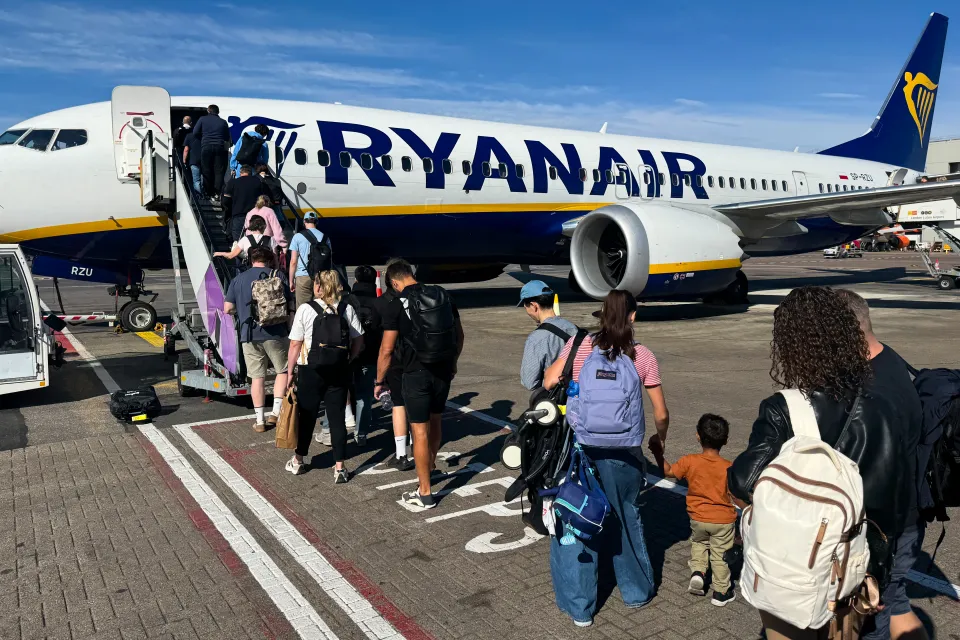
scrap

Greece backtracks over plans to scrap queue-causing rules for Brits

BRITS will have to follow the new EES rules in Greece this summer – despite previously saying they WON’T have to.

Called the Entry/Exit System, the new biometric scans required from Brits has already caused problems across Europe.

Departure terminal of Zakynthos Dionysios Solomos Airport with people entering the building and cars parked outside.
Brits will not be able to skip the new biometric checks in Greece, in huge u-turn Credit: Alamy

This has seen queues as long as six hours at some airports due to the time each takes, with some families even missing their flights.

Last month, Greece said that Brits would be able to skip these queues in an attempt to ease fears.

The Greek Embassy said “As of April 10, 2026, British passport holders are exempt from biometric registration at Greek border crossing points.”

This was backed by the director of the Greek National Tourism Organisation in the UK, who said Brits will “no longer need to undergo additional EES biometric procedures, ensuring a smoother and more efficient arrival experience in Greece”.

GO SEA IT

Beautiful island with cheap hotels & NO EES checks is 26C next week


QUEUE KNEW!

I avoided dreaded EES airport chaos in Spain – how I skipped the mega queues

However, in a u-turn, officials have now said that Brits will not be exempt and will have to follow the new EES rules.

The Greek Foreign Ministry said they have not received any information that “specific nationalities are temporarily exempt from the relevant procedure,” according to local media.

Instead, the rules will only be temporarily paused if there are high volumes of passengers at once, caused by a number of planes landing at the same time.

This won’t just affect Brits, but any non-EU nationals that have to go via the biometric scanners.

And queues have already started to cause problems – one passenger told local media it took “nearly two and a half hours to get through [passport control] in Athens” while island airports like Zante were facing similar wait times.

One source warned it was “just the beginning,” with summer seeing as many as 15,000 passenger a day travel through Athens, the busiest airport in Greece.

Departure terminal of Zakynthos Dionysios Solomos Airport with people entering the building and cars parked outside.
Huge queues have already been reported across Athens and Zante ahead fo summer Credit: Alamy

If you want to try and avoid the chaos, make sure your plane doesn’t land between 12pm and 2pm, they warned, as that’s when a huge number enter Athens at one point.

Portugal is also another country struggling with huge queues, with one expert saying a family waiting more than six hours because of the EES waits.

It was hoped that both Portugal and Italy would suspend the EES rules until after summer, but they have also echoed Greece in saying this would only be during busy passenger periods.

Ryanair has called on airlines to pause the roll out of the new rules – which started last week – until after summer.

Here are all of the countries where the EES rules are in place.

And here is how one person managed to avoid the long queues in Europe – with two clever hacks.

Source link

Ryanair threatens to scrap all flights at another popular European airport

RYANAIR is considering cancelling all flights to another airport in Europe over a dispute in airport fees.

The airline is reportedly set to close its base at Makedonia Airport later this year.

A plane taking off over the sea with a city and mountain range in the background, Thessaloniki, Greece.
Ryanair is reportedly considering closing its base in Thessaloniki Credit: Alamy
Aerial view of Thessaloniki Airport, a plane on the runway, and coastal suburbs along the Thermaic Gulf, Greece.
Thessaloniki is considered an entryway to spots like Mount Olympus Credit: Alamy

Follow The Sun’s award-winning travel team on Instagram and Tiktok for top holiday tips and inspiration @thesuntravel.

Ryanair currently operates three aircraft from its base in Thessaloniki, but is considering shutting it down from October 2026.

Reports have been linked to issues related to a 15 per cent increase in airport charges.

However, no official announcement has been made by the airline.

With the airline considering leaving the city, there are growing concerns about tourism within Thessaloniki – a place where tourists visit to see Mount Olympus and the beautiful beaches of Halkidiki.

The news has prompted Thessaloniki Mayor Stelios Angeloudis to call an emergency meeting with regional tourism officials to assess the situation.

A tourism representative told local media that the “priority for everyone is and must be the interest of the city.

“If the reason for the possible closure is the high increases, then Fraport should reconsider its pricing policy.”

Sun Travel has approached Ryanair for comment.

This isn’t the first time Ryanair has closed a base due to the rising cost of airport fees.

The budget airline confirmed last year they would be cutting 1.2million seats across Spain and closing bases in the likes of Valladolid and Santiago de Compostela.

The airline also recently announced that it would be reducing its flight schedule to and from Berlin by 50 per cent.

When it comes to flights being affected, this means Ryanair passenger numbers will fall from 4.5million to 2.2million by next year.

This will affect flights from the UK which includes routes from LondonManchesterBirmingham and Edinburgh.


Source link

Two more European countries to SCRAP hated new EES travel rules for Brits after massive airport queues & missed flights

TWO more countries in Europe are set to ignore the new entry rules that have caused chaos at airports.

The new Entry/Exit System (EES) now requires all non-EU citizens to undergo biometric checks at the border.

Passengers queueing at check-in at Reus Airport, Reus, Province of Tarragona, Catalonia, Spain
More airports are ditching the EES rules to avoid massive queues Credit: Alamy

Including Brits, this has resulted in queues as long as four hours and people even missing their flights.

However, Italy is expected to scrap the requirements by the May holidays in a bid to avoid the chaos, continuing to stamp passports instead.

And Portugal, while not scrapping entirely, has temporarily paused the EES rules if queues are too long.

Both Faro and Lisbon Airport have been some of the worst affected by massive waits.

QUEUE KNEW!

I avoided dreaded EES airport chaos in Spain – how I skipped the mega queues


ALL CHANGE

Greece SCRAPS dreaded EES airport tests for Brits after seeing 3-hour queues

Yet passengers have said they are being waved through to ignore the biometric machines when there are huge crowds.

It comes after Greece also scrapped the rules ahead of summer.

The Greek embassy confirmed last month: “In the framework of the implementation of the Entry/Exit System, as of 10 April 2026, British passport holders are exempt from biometric registration at Greek border crossing points.”

Eleni Skarveli, the director of the Greek National Tourism Organisation in the UK, added: “The Greek National Tourism Organisation remains committed to ensuring a seamless and welcoming journey for all visitors from the UK.”

Airlines such as Ryanair are calling on other countries to pause the rules too, with fears of more problems during the busy summer holidays.

Countries including Spain and France are yet to confirm if they will follow suit.

Here’s everything you need to know about the EES system.

And our Deputy Travel Editor revealed how to avoid the huge EES queues this summer.

Source link

China pushes EU capitals to scrap ‘Made in Europe’ law or face retaliation

Published on Updated

China has called on EU member states to revise the bloc’s proposed “Made in Europe” legislation, according to Suo Peng, trade and economy minister at China’s mission in Brussels.


ADVERTISEMENT


ADVERTISEMENT

The European Union is currently debating the draft, which was unveiled by the European Commission in March and aims to impose stricter conditions on foreign companies seeking access to EU public procurement and investment opportunities.

The proposal — widely interpreted as targeting Chinese firms — has already drawn a warning from Beijing. Earlier this week, China’s commerce ministry said it would consider retaliatory measures if the EU proceeds without significant changes.

“Chinese embassies in EU member states have conveyed China’s comments and suggestions to the governments of their hosting countries,” Peng told journalists in Brussels.

He added that if the EU “insists on this punishment and treats China’s enterprises in a discriminatory manner,” Beijing would be forced to respond with countermeasures.

Public procurement rules and investment limits

The so-called Industrial Accelerator Act would, if adopted by EU governments and the European Parliament, prioritise European-made products in public procurement in sectors considered strategic, including automotive, green technologies, and energy-intensive industries such as aluminium and steel.

It would also place conditions on foreign direct investment exceeding €100 million in areas such as batteries, electric vehicles, solar panels and critical raw materials.

Companies from countries with more than 40% global market share in a given sector could be required to form joint ventures with European partners and transfer technology. At least half of jobs in such projects would also need to go to EU workers.

China has criticised the measures as discriminatory, with Peng accusing the EU of double standards on technology transfer rules. He pointed to a 2018 joint statement with the United States and Japan opposing forced technology transfers.

Divisions within the EU

EU member states remain split over the proposal. France is pushing for stricter local content requirements, while Germany and others are calling for a broader approach that includes cooperation with like-minded partners.

Some countries have also warned that the rules could increase costs and limit access to innovation.

The proposal includes a reciprocity principle in public procurement, meaning the EU would only open its market to countries that grant similar access to European firms.

China, which does not currently have such an agreement with the EU, says it is open to a bilateral deal on government procurement. Peng urged Brussels to respond “as soon as possible”.

Otherwise, he warned, the plan “will seriously damage the actual interests of Chinese and European companies.”

Source link

California governor debate: Candidates scrap over gas tax, homelessness

The top candidates for California governor clashed over the high costs of gas, housing and homeowner’s insurance in a testy debate Tuesday evening, a fiery exchange that may finally draw voter attention as the June 2 primary election fast approaches.

Former U.S. Health and Human Services Secretary Xavier Becerra, whose campaign blossomed after former Rep. Eric Swalwell dropped out amid sexual assault and misconduct allegations, came under persistent attack during the 90-minute debate but also went on the offensive.

Former Fox News host Steve Hilton, a Republican who leads all candidates in the most recent opinion polls, ripped Becerra for promising to declare a state of emergency to address rising homeowner’s insurance rates, saying the governor lacks that constitutional authority.

“We can’t have a governor who doesn’t understand how the government works,” Hilton said.

Becerra, who served as California attorney general before joining the Biden administration, quickly defended himself, saying he knows the law better than Hilton does.

“We don’t need a talking head from Fox News to tell us how the government works,” he said.

And that was after Becerra got in an early dig at Hilton, who has been endorsed by President Trump, by referring to Trump as “Hilton’s daddy.”

The debate was broadcast and livestreamed by CBS stations around the state. Hundreds of people watched from Pomona College’s historic Bridges Auditorium, a Renaissance Revival-style landmark with Art Deco flourishes that was once among the premier performance venues in Southern California.

With eight major candidates from both parties participating, CBS moderators billed it as “the largest and most inclusive debate of the election.” Becerra and Hilton were joined by Republican candidate Riverside County Sheriff Chad Bianco and Democratic candidates San José Mayor Matt Mahan, former Orange County Rep. Katie Porter, billionaire Tom Steyer, state Supt. of Public Instruction Tony Thurmond and former Los Angeles Mayor Antonio Villaraigosa.

Some takeaways from the debate:

Candidates didn’t shy away from the top issues

Moderators set the theme for the first half-hour of the debate as “affordability,” a top concern among California voters, and almost immediately the candidates began sniping and talking over one another.

Almost all of them vowed to accelerate home construction in California, pivotal to reducing the state’s high cost of housing.

There was no shortage of ideas for other ways to ease the financial burdens facing Californians, but few specifics on how they would deliver on those promises given the state’s complex and arduous legislative process.

Hilton promised to cap the price of gas at $3 per gallon, and Mahan vowed to suspend the state gas tax. Bianco said Democrats have long overregulated and overtaxed Californians, and the state’s supermajority Democratic Legislature would have to get in line with him and end those things if he’s elected.

Becerra said he would reduce prescription drug prices. Thurmond said he would provide down-payment assistance grants to those trying to own their first home.

Barbs traded over climate-caused emergencies

Anchors and reporters from local CBS stations moderated the debate, including Los Angeles anchor Pat Harvey, Sacramento anchor Tony Lopez, Bay Area anchor Ryan Yamamoto and national investigative correspondent Julie Watts. They were joined by Sara Sadhwani, an assistant professor of politics at Pomona College and a member of California’s independent redistricting commission.

Moderators pointed to the surge in catastrophic wildfires across the state in recent years due to climate change, as well as the threat of earthquakes, and asked the candidates how they would respond to future emergencies.

As he did throughout most of the debate, Bianco responded by bashing California’s Democratic leadership, which he said created most of the ills facing the state.

Bianco said the root causes of fire disasters in the state are “not because of climate change” but due to “failed environmental activist policies” that prevented fire departments from clearing highly flammable brush around communities for years.

Mahan, after touting his actions as a Silicon Valley mayor during emergencies, quickly pivoted to take shots at Becerra and his role as U.S. Health and Human Services secretary during the pandemic.

He said Becerra had “never met a crisis that he couldn’t ignore” and accused Becerra of failing to deal with COVID-19, monkeypox and the surge of unaccompanied minors at the U.S.-Mexico border during the Biden administration.

Becerra responded by saying that his agency dealt with the crises by working with all 50 states and the federal government to quickly roll out vaccines and other resources.

“You’re not wearing a mask, are you, Matt? You’re not worried about catching monkeypox, right?” Becerra said.

Steyer also came under attack when he starting discussing his plans to “make polluters pay” for the effects of climate change. Porter criticized the former San Francisco hedge-fund founder for making millions off the oil and gas industry, and using those profits to fund his campaign for governor. Steyer has spent more than $143 million of his own money on his campaign, according to fundraising disclosures filed with the California secretary of state’s office.

“How about profiteers pay? You pay the lowest tax rate on this stage, and yet you made the billions that you’re using to fund your campaign off fossil fuels,” Porter said to Steyer.

Steyer responded that he is a “change agent” candidate opposed by special interests and pointed to campaign committees funded by utility and other industry groups opposing his bid. PG&E, the California Chamber of Commerce and the California Assn. of Realtors have put more than $29 million into a pair of committees to fund attack ads against the billionaire.

Republicans focus on blaming Democrats

Just weeks before the June 2 primary, the race to replace term-limited Newsom remains wide open, with many voters still undecided.

Republicans Hilton and Bianco have led numerous public opinion polls while the large field of Democrats have split the vote, leading to fears among Democrats that the party could get shut out of the general election, despite outnumbering Republicans nearly two-to-one among the state’s registered voters. In California’s open primary, the top two finishers advance to the general election, regardless of party affiliation.

The two Republicans avoided overtly attacking each other at the debate but were regularly the targets of other candidates on the stage.

Becerra, speaking about federal healthcare funding cuts approved by President Trump and congressional Republicans last year, referred to the president’s endorsement of Hilton. “The first thing we have to do is stop Steve Hilton’s daddy,” Becerra said.

Hilton responded jokingly that his father, who was the goalie for the Hungarian national ice hockey team, hadn’t weighed in on the race. And he said Becerra’s comment pointed to what is wrong with California politics — a fixation on Trump despite Democrats controlling the state for more than a decade.

“We’ve had the same people in charge for 16 years now, and it’s such a disaster and such a high cost of living for everyone, and the highest poverty rate in the country and the highest unemployment rate in the country, and the worst business plan,” Hilton said. “All these things going wrong, they can’t do anything except blame Trump. Let’s see how many times you hear that tonight.”

Bianco grew visibly frustrated several times over the debate’s format and his opponents’ answers. At different points, he compared the event to “The Twilight Zone” and called it “the hour and a half that [viewers] are never going to get back.”

Pressed on what he would do differently if elected, the Riverside sheriff also focused on criticizing Democrats and accusing them of lying.

“We have a group of of 20-ish-year-old kids and we’re just sitting here lying to them about broken Democrat policies in California for the last 20 years, and we’re going to sit here and blame a president who’s been president for a year. This is absolutely ridiculous,” he said.

Hilton has seen a bump in his polling numbers since he was endorsed by President Trump earlier this month. A CBS News/YouGov poll of more than 1,400 registered voters released Monday showed Hilton leading with 16%, followed by Steyer with 15%, Becerra with 13%, Bianco with 10%, Porter with 9%, Mahan and Villaraigosa with 4% and Thurmond with 1%. The largest group of voters — 26% — was undecided.

Nixon reported from Sacramento and Mehta reported from Claremont. Times staff writers Kevin Rector, Dakota Smith and Blanca Begert contributed to this report.

Source link