BLAINE, Wash. — The Trump administration’s top border official defended plans to build a wall and other infrastructure in Texas’ Big Bend region despite mounting opposition against the project and a court-ordered pause on construction, saying his goal of fortifying the country’s borders was “non-negotiable.”
In an exclusive interview with the Associated Press, Customs and Border Protection Commissioner Rodney Scott argued that the $46-billion wall project was justified despite a bipartisan coalition of landowners, local businesses and environmentalists who view it as a waste of taxpayer money that could be destructive to a region with historically low migrant crossings.
“Our No. 1 goal right out the gate is we have to know who and what is coming into the United States,” Scott said on Thursday. If the Big Bend region were left without a wall or other border infrastructure while other areas along the border get those fortifications, he said, “I am 100% convinced it will be completely overrun and destroyed.”
The fight over Big Bend has become a major test for how far the Republican administration is willing to go for the border wall, President Trump’s signature infrastructure project.
Scott, a former Border Patrol agent, was tapped by Trump to complete it.
His agency is responsible for executing a plan funded last summer by Republicans in Congress to line the roughly 2,000-mile border with Mexico with a mixture of 30-foot-tall steel walls, vehicle barriers, new roads and surveillance technology to prevent illegal immigration and smuggling.
The Trump administration says it is building about 12 miles a week. Scott, who gets daily progress updates, said it will be complete by the end of Trump’s second term. The primary border wall — some areas also get a secondary layer — will be done by the end of December 2027.
“We’re actually ahead of schedule,” Scott said.
1
2
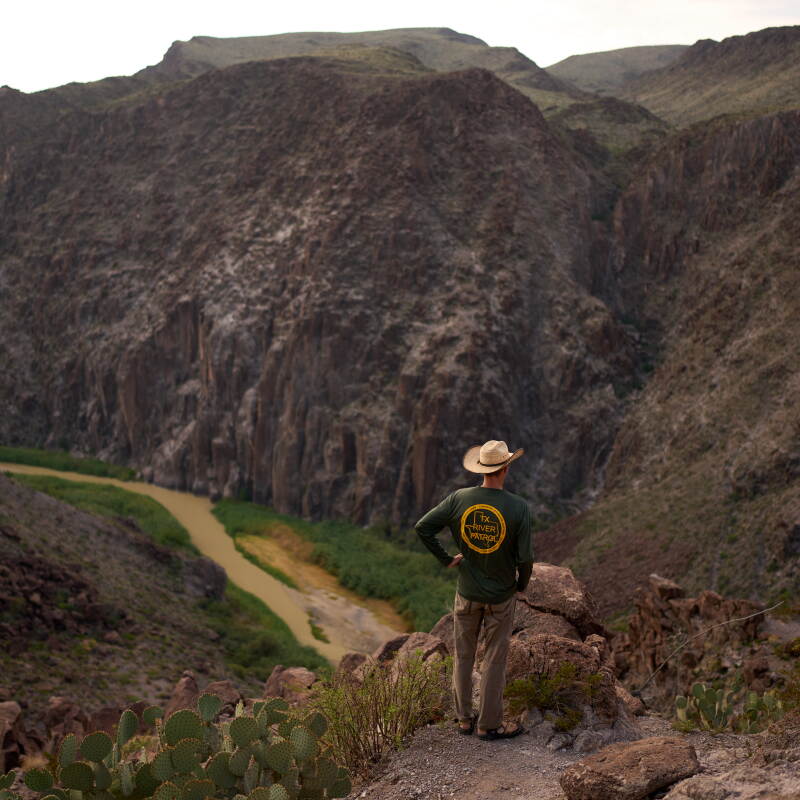
1.Charlie Angell stands on an overlook of the Rio Grande river2.Pamela Priddy, center, holds up signs with others during a weekly protest against barriers along the border in the Big Bend region, Saturday, Sept. 26, 2026, in Study Butte, Texas.(John Locher / Ap Photo/john Locher)
Big Bend is a test for the Trump administration’s plans for the wall
The wall plan has run into resistance in places like Big Bend. The Trump administration was dealt a major setback earlier this month when a judge ordered a pause on border wall construction in the region, citing what could be a likelihood that plaintiffs “will suffer serious, irreparable harm without an injunction.” The administration has asked the Supreme Court to lift the order.
The ruling included any construction in Big Bend National Park, an area that has seen a loud bipartisan outcry, including from some Republican lawmakers.
After bulldozers were spotted in the park tearing up ground in August, Scott ordered a pause on all construction-related activity there while he went to talk to people in the region. He said the agency is making other outreach to locals to discuss how to build projects so they don’t mar the park.
“We’re talking through and figuring out what is the right solution for that area,” he said.
Scott said he can’t get into specific details on what the agency’s plans are for the park because of the numerous ongoing lawsuits, but he reiterated that the project won’t include tall steel walls.
He also said that the agency’s stated goal of protecting the country and knowing what’s coming in and going out is “non-negotiable.”
He said the region’s formidable natural barriers were not enough to prevent people from entering the country illegally through other more navigable points. And he expressed concern that cartels that control smuggling from Mexico into the U.S. would exploit any opening.
CBP has come under fire for immigration enforcement tactics
Scott leads an agency of 67,000 employees responsible for controlling who and what comes into the country through official border crossings like airports or seaports and stopping illegal smuggling and migration outside those official border crossing points.
The agency came under heavy scrutiny last year when its officers were sent into cities deep inside the country to help carry out Trump’s immigration crackdown alongside Immigration and Customs Enforcement.
Agents with the Department of Homeland Security, which includes Immigration and Customs Enforcement, Border Patrol and Customs Enforcement patrol in a neighborhood after apprehending a person on Jan. 31 in St. Paul, Minn.
(Eric Thayer/Los Angeles Times)
As protests against an operation rocked Minneapolis, a Border Patrol officer and a CBP officer both fired shots in an encounter that killed a U.S. citizen, Alex Pretti. The shooting eventually prompted the Trump administration to wind down high-profile city-based crackdowns. A CBP officer who was the face of the missions, Gregory Bovino, who led a helicopter raid at a large apartment building and used chemical agents to confront demonstrators, retired earlier this year.
Scott said while CBP still helps ICE, it’s now less involved in immigration enforcement far from the country’s borders because ICE has since hired more officers to its ranks. Scott wouldn’t comment on the investigation into the Pretti killing, saying that it was being handled by the FBI and was ongoing. And when asked about Bovino’s tactics, he said the officer didn’t report to him during the operations.
Scott spoke to the AP just outside the border with Canada, where he met with border security representatives from other countries to share information about threats and trends. During his trip, he visited an operations center where he said Canadian and American law enforcement work together.
That border has far fewer threats than the U.S. border with Mexico. Scott said cartels in Mexico are increasingly sending drones into the United States to move contraband and keep tabs on Border Patrol agents. In Mexico, the cartels have been using drones to attack each other or Mexican law enforcement.
The Department of Homeland Security, which includes CBP, recently announced temporary flight restrictions targeting unauthorized drone activity in a zone extending a mile north of the U.S.-Mexico border as a way to counter cartels.
“We want to make sure,” Scott said, “that threat does not come into the United States.”
Mohammed Annour spent much of his youth living in a flimsy shelter in a dusty, overcrowded refugee camp in east Africa, where the days were long, the food was poor and the future nonexistent.
“Go to the army and fight. That’s one option,” said Annour, who fled war in Sudan for the refugee camp in Chad when he was 9. “The other one is you stay there. But you don’t have a future.”
If he had stayed, Annour, now 33, has little doubt how his story would have ended.
“Probably,” he said, “I’m dead.”
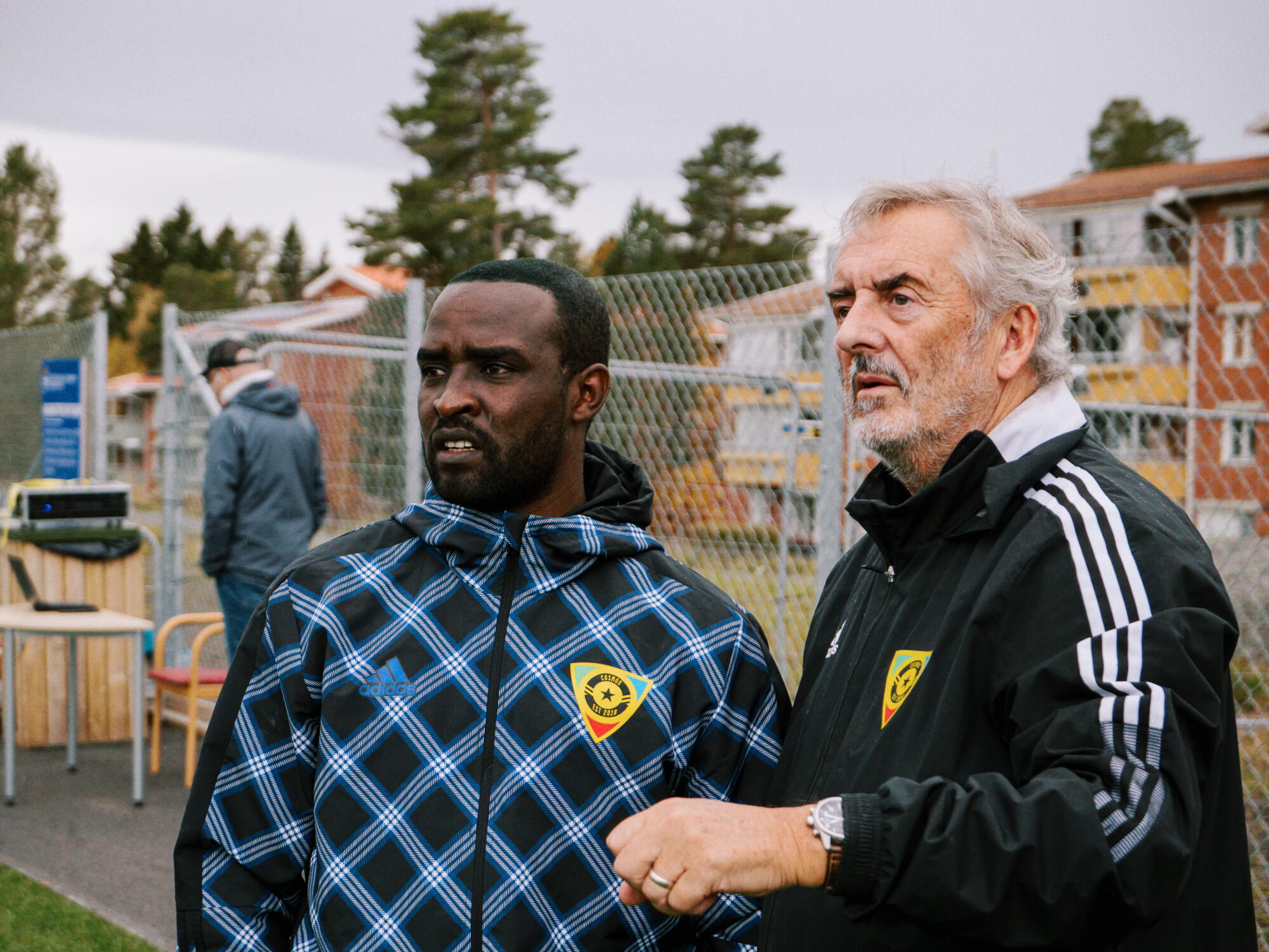
Mohammed Annour, a refugee soccer player who became a coach, and Alan Barker, chairman of the Mighty Cosmos, look across a field in Sweden.
(Courtesy of Darren Hamlin)
Instead, he’s in Sweden, raising two boys, working as a quality control inspector for a textile company and playing amateur soccer for a team in the country’s fifth division. And the only thing that separates his experience from the tens of thousands of desperate people he left behind in the camp is the fact someone believed in him enough to give him a chance.
“Everybody needs a chance,” Annour said. “Don’t throw people out. People just need a chance in life.”
“And we got that chance,” he continued, “because of Katie-Jay and Gabriel.”
Scott and Stauring founded the humanitarian group iACT largely to respond to the crisis in Darfur, a semi-desert plateau in western Sudan that has known nothing but war this century. But unlike many of the dozens of other similarly minded people and groups working in Africa, Scott and Stauring came not to preach, but to listen. They came with questions, not answers.
And what they were told was that the children in the camps needed more than food and shelter. They needed a routine, they needed recreation, they needed joy and they needed hope.
Founders of iACT Gabriel Stauring, left, and Katie-Jay Scott hold up gifts they received after a training session in the Central African Republic. Stauring and Scott were killed in a car crash in 2021, but their nonprofit continues to support refugees.
(Courtesy of iACT)
In other words, they needed soccer.
“Many organizations came into the camps. They just came around and took some pictures and then they leave,” said Annour, a slight man with a serious countenance. “I think [Scott and Stauring] understood us as humans, not just these kids or these people who need food or shelter.
“They saw another side. They saw these people that can make something in life.”
“They were so kind, careful,” Annour said. “Listening to everyone. It didn’t matter where you came from, which color you are. They were open and gave time to everyone they met.”
“Honestly, I didn’t know they were going to change my life or anything,” added Moubarak Abdallah, another refugee introduced to soccer by Scott and Stauring. “I saw them as other people who just come and go. But they were quite special people.
Grace Tanda, of the Mighty Cosmos, strikes the ball during a match. The soccer team in Sweden is comprised of refugees.
(Courtesy of Darren Hamlin)
“They wanted to help our ideas shine, to [give] other people hope. They were listening to what I needed.”
Today, there are more than 5,000 children participating in iACT soccer academies in Chad, the Central African Republic, Cameroon and Mexico. Another 1,800 children are enrolled in the group’s Little Ripples preschool program, which also served 475,000 meals to students and staff last year.
But the organization, like many similarly focused humanitarian groups, is fighting for its survival amid a global backlash against refugees and migrants.
The hostility has been especially strong in the U.S., where the second Trump administration has sharply restricted immigration and asylum access and drastically cut congressionally approved spending for life-sustaining programs previously funded through USAID. Many European countries have followed that lead, adopting a stauncher approach to border enforcement and deportations and slashing support for development assistance by 13.8% in 2025, the largest cut in a decade.
This summer, violent anti-immigrant protests in South Africa forced more than 178,000 people to flee to Zimbabwe, Malawi, Nigeria and other countries, reversing a trend that has seen the region’s richest country welcome migrants to work on farms, in construction and other low-paid jobs. Public sentiment toward refugees and migrants has also hardened elsewhere, creating a crisis for nonprofit aid groups.
The Office of the United Nations High Commissioner for Refugees, or UNHCR, this month warned the gap between humanitarian needs and donor contributions is widening, leading to deep cuts and forcing aid groups to fight one another for the shrinking dollars that remain — all at a time when conflicts in Syria, Gaza and Ukraine have swelled the number of refugees worldwide to nearly 42 million; another 69 million people are displaced.
That’s more than 1 out of every 70 people on Earth, according to the UNHCR.
Annour and his family were once part of that wave, fleeing their home in Sudan in 2003, stepping around dead bodies and witnessing unimaginable horror, to escape one in a series of continuing civil wars that have given way to genocide. More than 15 million people have been displaced in the 23 years of fighting, with more than 1.3 million still stranded in teeming refugee camps in eastern Chad.
Annour said he would have perished there if not for Stauring and Scott, who introduced soccer to their camp. Three years after the pair arrived, an international tournament for stateless players, the CONIFA World Football Cup, was held and iACT entered a 20-man team comprised of players from 12 camps. Annour, a left back, made the cut as did Abdallah, a physical midfielder with a perpetual smile who would become the team captain.
“No one is thinking this [is] going to be life-changing,” Abdallah remembers thinking. “You know, there was like a small chance but it became big dreams for us.”
The team, Darfur United, was outscored 39-0 in its two games in Ostersund, Sweden, but most of the players chose to stay in Ostersund rather than return to their camps and were welcomed by the Swedish government. They received asylum and eventually formed an integration team, the Mighty Cosmos, that advanced as high as the fifth division of Swedish soccer.
Abdallah is a natural leader, said Alan Barker, chairman of the Mighty Cosmos, and the kind of person who receives total respect from the other players.
Mugenyi Ngabu, left, cheers during the Mighty Cosmos’ match in Sweden. The team is comprised entirely of refugees.
(Courtesy of Darren Hamlin)
“He is a sort of guy you can rely on 100%,” Barker said. “Personally, I would trust him with my life. He is a doer, not a talker. A problem solver not a problem creator. And he always wants the best for everybody.”
Annour, he added, has been troubled by knee injuries on the field but remains “a strong and quiet yet forceful personality of the group.”
“He is a passionate believer in fair play and honesty and has no room for dishonesty or deception in any aspect of life,” Barker continued. “Maybe that’s a reflection of his childhood in the refugee camps and Chad, where there was no time for such things. He’s a sort of guy whose name would be first on the team sheet. The team sheet of football and life.”
More important is the fact that the players, teenagers or young adults when they arrived in Sweden, have married, had children of their own, become citizens and integrated into the local community, where their civic work was this year recognized with one of Sweden’s most prestigious awards.
“I never dreamed to be in this position when I was a kid. I was trying to survive, to live day by day,” said Annour, who is working three jobs to support his sons, aged 1 ½ and 4.
“I’m here. I can provide for my family. Moubarak provides for his family. It’s like saving a generation, not just me and Moubarak.”
“It’s about the chances,” agreed Abdallah, 35, who also lives in Sweden where he coaches the Mighty Cosmos while raising a 5-year-old son.
“The door has to open. That’s all.”
iACT offered a way to open those doors when it first rolled that battered soccer ball onto a dirt lot. Without that, “these guys wouldn’t be here, wouldn‘t have the lives they have,” said Darren Hamlin, a British filmmaker who has started a Kickstarter campaign to fund a documentary on the refugee players.
By focusing on single players and their game and not the vastness of the sprawling global refugee crisis, Hamlin says the film has the power to redefine these former refugees not as obscure numbers but as flesh-and-blood people with dreams and talents and aspirations. That was what inspired Scott and Stauring when they founded iACT.
“Football has this power to transcend sports. It becomes an emotional thing,” said Hamlin, who is behind on his goal of raising $66,000 by the end of the month to expand work on the documentary. “It doesn’t matter how many stats or things we put in front of people; they don’t really pay attention.
“But football kind of goes deeper sometimes. Football is kind of the vehicle that delivers the message.”
Getting that message out, however, is becoming increasingly difficult. As government funding for refugee programs around the world has dried up, groups like iACT have found themselves fighting for the same slice of a much smaller funding pie.
“Fundraising at all levels has become more difficult with the gutting of USAID, especially with the increase in larger NGOs [non-government organizations] applying for foundation grants,” said Merri Weir, a retired teacher and iACT board member since 2016. “It is becoming harder and harder because we’re competing with larger NGOs. The funding stream has become tighter.”
At the same time, the need has swelled.
“The refugee camps in Chad are still very unstable,” said Weir, who has visited the camps multiple times. “The current war has not ended and shows no sign of ending. Refugees are still coming across the border, which has more than doubled the number of Sudanese refugees.
“It is critical that we are able to sustain our current refugee-led programs.”
In response, Weir’s group, which will hold its annual fundraising event in Manhattan Beach next month, has considered everything short of a corner lemonade stand and selling chocolate door to door to make up for the lost financial backing it needs to continue what Scott and Stauring started.
“In the past, it is our uniqueness and our innovation and our refugee-led action [that] set us apart,” said Weir. “It was very appealing.”
The Trump administration complicated things even further in June 2025 when it instituted a travel ban and entry restriction list on Chad, leading the Chadian government to retaliate by revoking visas for American citizens, including aid workers. That means fewer children playing soccer and attending preschool, fewer meals being served — and fewer success stories like the ones told by Abdallah and Annour.
“I spent 12 years in a refugee camp,” Abdallah said. “People just hope to get a meal for the day. [iACT] brought the footballs and then just brought the idea. A chance to change our lives. Opportunity.
“There’s a lot of people in the refugee camps [that] could be pilots, doctors, better football players. Maybe there is the next Lionel Messi, Cristiano [Ronaldo], Lamine Yamal in the camp. But they don’t have any opportunity to get out.”
“The world is crazy. It’s just war everywhere,” added Annour, who is about to begin a college course on sports science. “Those people who don’t like refugees, who don’t want the United Nations to bring more refugees, they need to put themselves in our shoes.
“People are so naive to think they can just ignore what’s going on. It’s getting bigger every day.“
Abdallah and Annour may have left the camps, but the camps have not left them. The work they have done in Sweden includes the construction of a community sports and culture center, addressing crime prevention and mental health, refugee resettlement, and fundraising efforts that support the work of iACT and other groups working with the people they left behind.
“My mom is still in the same camp, so I’ve been back three times now with a lot of footballs, football boots and football equipment,” Abdallah said.
Scott and Stauring, who lived in Redondo Beach before the fatal car crash, thought they were bringing soccer to the camps in Africa, but what they really brought was hope and proof that if someone just opens the door, you might be surprised what you find on the other side.
Harry Kane is close to signing a new deal at Bayern Munich, Arda Guler has agreed a new contract with Real Madrid and Liverpool are leading the race for Bournemouth‘s Alex Scott.
England striker Harry Kane, 33, has agreed a new deal in principle with Bayern Munich, who are finalising the paperwork on a contract extension until summer 2029. (Sky Sports), external
Premier League clubs are keeping tabs on 22-year-old Italy midfielder Issa Doumbia, who joined Sporting from Venezia in the summer for 26m euros and has an 80m euro release clause in his contract. (Tuttomercatoweb – in Italian), external
A number of Premier League clubs watched Austria’s 19-year-old midfielder Jacob Hodl at Vitality Stadium on Thursday as Sturm Graz played Bournemouth. (Football Insider), external
Leeds United striker Lukas Nmecha, 27, is yet to agree a new deal as the German, who is out of contract in the summer, wants more playing time. (Teamtalk), external
Wrexham boss Phil Parkinson is under increasing pressure at the Championship club and ex-Liverpool captain Steven Gerrard is open to the role should a vacancy arise. (Talksport), external
AC Milan are looking at Bournemouth‘s Alex Scott, Bayern Munich have held fresh talks with Manchester United‘s JJ Gabriel and Liverpool are interested in Barcelona defender Jules Kounde.
Bayern Munich have held fresh talks with 16-year-old Manchester United attacking midfielder JJ Gabriel but they have not made him an offer as there is a feeling he is leaning towards a move to Spain, with Barcelona and Real Madrid favourites to sign him. (Sky Sports Germany), external
Porto have increased the release clause in the contract of 20-year-old Brazil forward William Gomes to 100m euros (£85m) amid interest from Liverpool.(A Bola – in Portuguese), external
Chelsea remain interested in a move for Monaco midfielder Lamine Camara, 22, after missing out on him in the summer but the Blues will not pay the Ligue 1 club’s 70m euro (£59m) valuation for the Senegal international. (Goal), external
Manchester City made an approach to sign 17-year-old USA forward Mathis Albert from Borussia Dortmund in the summer. (Goal), external
And you probably figured Freddie Freeman would get it going. You had faith in playoff risers Max Muncy, Kiké Hernández and Teoscar Hernández — and in the Dodgers’ playoff-proven offense overall.
You were not, however, so bullish on the bullpen.
That was the proverbial, annual question mark entering the best-of-five National League Division Series against the Atlanta Braves, whom the Dodgers vanquished with a 4-1 victory Wednesday at Truist Park to set up an NL Championship Series rematch with the Milwaukee Brewers.
Edwin Díaz, the Dodgers’ purported closer, had a disastrous, injury-marred first season with the team — or he was having one.
That left Tanner Scott — last season’s purported closer — handling the bulk of the ninth-inning duties this season, and he finished with a career-high 25 saves. But you were going to have to see him sustain that in the postseason to believe in Scott, whose first season with the Dodgers also was so disastrous that he wasn’t even included on the playoff roster.
The Dodgers are paying Díaz $69 million and Scott $72 million. A steep price and a sign of how badly the team wants to avoid having to turn to starting pitchers to finish off important postseason games, as they have in the past with Julio Urías, Walker Buehler and, last season, Yamamoto.
But until now, the Dodgers haven’t had much but frustration to show for their investment in Scott or Díaz — who were two names among four, including Roki Sasaki and Evan Phillips, that manager Dave Roberts suggested could close games in the playoffs.
It was a tangled trust tree that needed lots of water.
Or how about champagne? Maybe ice-cold beer?
Because after Alex Vesia, Edgardo Henriquez, Scott and Díaz combined to get the final 13 outs of Game 4 without giving up a run, they helped lead the charge in the clubhouse afterward, dousing one another to celebrate.
In the series, the Braves went one for 23 (.043) with runners in scoring position. That, according to OptaStats, is the second-lowest such batting average in a postseason series in history — and it doesn’t happen without a bullpen being locked in; the Braves went 0 for 13 with runners in scoring position against the Dodgers’ relief pitchers.
In the deciding Game 4, Vesia took the baton from Glasnow with two outs and two runners on in the fifth, got the inning’s final out on one pitch and came back out in the sixth. He gave up a double but got Drake Baldwin to line out before handing the ball to the hard-throwing Henriquez, who hit 100 mph or higher on 11 of his 15 pitches, retired five of six batters and earned his first postseason win.
Then Scott had the inning of his Dodgers career in the eighth — sitting down the Braves’ 3-4-5 hitters with a nasty array of sliders and fastballs. He punctuated his performance with a fastball on the corner that ended the inning and wound up costing Atlanta its final ABS challenge.
And, finally, in closing, Díaz.
Share via
He earned his second consecutive save with an efficient, eight-pitch, 1-2-3 inning. He isn’t the closer, not officially. But, darn, is he important: “For us to win the World Series,” Roberts said, “he’s got to be a relevant part of this equation … I’ve got to trust him.”
The way Díaz is dealing, why wouldn’t he? Díaz has given up just one hit in three postseason innings. And he’s feeling good.
“The last two nights it’s been amazing,” Díaz said. “That’s why I came here, to win games and close games like this one. So I’m really happy.”
Andrew Friedman, the Dodgers’ president of baseball operations, raved about Díaz’s resilience, referencing the roller coaster of a season that included an 8.68 earned-run average, neck and elbow injuries, a stint on the injured list and in triple A.
“He would say, ‘Hey, I’m ready to come back,’” Friedman said. “And it was like, ‘Hey, we need to see more, we need to see this really lock in.’ And at every turn, he said, ‘Whatever you guys need … anytime you want me to pitch, I’ll be ready.’
“It was never a question of the heartbeat and his ability to handle these moments. It was about just getting him right mechanically and getting back to the stuff that we’ve all seen over the years.”
Vesia is similarly impressed with his friend Scott’s resurgence.
“Going back to last year with ups and downs and adversity and all that stuff, we definitely leaned on each other,” said Vesia, who missed the World Series after the October death of his newborn daughter, Sterling Sol.
“And, you know, for this year to watch [Scott] really take off and have a great year, it’s been awesome, you know? It’s really awesome. With the closing role being undefined and all that stuff, he stepped up. Every year, there’s always guys that step up.
“Now, we got eight more.”
Eight more wins to three-peat, and no weak links anywhere.
Scotland midfielder Scott McTominay has returned to training at Napoli following his recent heart surgery.
The 29-year-old’s ablation procedure – a minimally invasive operation to correct irregular heart rhythms – took place in Manchester last month and was described as “a complete success”.
And Napoli said: “On Wednesday, Scott McTominay underwent further diagnostic tests, which showed that he is fit to play.
“The Napoli player therefore resumed training with the rest of the team after the period spent training separately.”
McTominay was substituted after 56 minutes of Napoli’s 2-1 Serie A defeat by Como in August. A mild benign arrhythmia was discovered, prompting the corrective treatment.
According to the NHS,, external an arrhythmia is when the heart beats too quickly or too slowly, or the heartbeat is not steady.
The British Heart Foundation explains, external that a cardiac arrhythmia ablation involves using heat or cold energy to create tiny scars in the heart to block faulty signals and restore a typical heartbeat.
During his absence, McTominay missed four Scotland fixtures, including Tuesday’s Nations League defeat by Slovenia.
The Scots’ next games are against Switzerland and North Macedonia in November.
One is Catholic, the other Jewish. One was a star linebacker for a private high school, Loyola, the other a star receiver for a public high school, Newbury Park. Both wear the same jersey number at UCLA, No. 20.
Scott Taylor and Shane Rosenthal became roommates last year and based on their many smiles, witty comeback lines and football success, it’s clear they’ve become best friends and best teammates.
“It’s cool,” Rosenthal said.
“We just get along really well,” Taylor said.
They share an apartment with two other UCLA players, punter Lennox Miller and defensive back Kuron Jabari.
Whatever initial concerns or perceived stereotypes they may have had quickly vanished after learning about their similar upbringings, goals and expectations to be good students and good people.
“I hosted him on his official visit,” Taylor said. “Hosted him for dinner, took him to Westwood. We have a lot of the same priorities, doing the right things, eating the right food, going to bed at the right time. Little things.”
Said Rosenthal: “We’re on the same timing for everything. He plays defense. I play offense. We’re able to watch film together, talk about football, talk about what he sees from the defense, talk about what I see from the offense and how we go at each other in practice.”
Taylor, a 6-foot-4, 241-pound sophomore who’s never seen a steak he didn’t want to eat, “is a damn good cook,” said his grandfather, Bill Thomason, a former Loyola principal and basketball coach. Thomason once bought his grandson Omaha Steaks as a birthday gift.
“They were so good,” Taylor said.
He sometimes drives home on Sundays to cook steaks for family members. And he eats them, too.
In the competition for who cleans the room the best, Rosenthal wins in a landslide.
“He might be the cleanest guy in the country,” Taylor said. “He might be an All-American cleaner.”
Said Rosenthal: “I definitely feel like I’m the cleanest guy in the apartment.”
As for washing clothes, both said there are no irons in sight. They learned how to do laundry at home but it appears parents are always welcome to help.
Taylor is dating a girl who’s Jewish but Rosenthal gets no credit as a matchmaker since they’ve been seeing each other well before Rosenthal arrived. “There’s usually two Jews in the apartment,” Rosenthal said.
Taylor has become a key pass rusher for the 4-0 Bruins going into Saturday’s game against Oregon. Rosenthal, also a sophomore, has received playing time as a gunner on punts while being a backup receiver. He’s the state-record holder in high school football with 24 career interceptions, so tackling on special teams is something he does well while waiting for the opportunity to show his receiving skills.
Taylor has used weight training to build up his body and give himself an NFL-like stature. It started back during the pandemic when he was 13. He decided to walk down the street to the local fitness center that was allowing kids to use the equipment for free — as long as they were 15. Somehow, he convinced them he was 15. When the business started charging him, he got his mom’s credit card, became a paid member and the rest is history. He has the talent to be on par with former UCLA linebacker Carson Schwesinger.
He also possesses the ability to comfortably talk in public. He was the only UCLA player chosen to answer questions from the media after Bob Chesney was introduced as head coach last December. On Tuesday, Taylor welcomed a group of middle school students touring Spaulding Field with high-fives and fist-pumps.
Taylor remembers his first impression of Chesney addressing the team.
“He’s a great communicator to you guys,” Taylor said of Chesney. “He’s also a great communicator to us. Everything’s crystal clear about what we’re supposed to do, what our role is since Day 1. He showed up and said, ‘If you guys choose to stay here’ and … this is before the portal even opened. ‘If you guys choose to stay here, we’re gonna do something special, so if you choose to stay, be ready to work, be ready to compete.’”
Taylor said the foundation of strong relationships within the team is important.
“It’s really special the connection we have,” he said. “And I think that speaks to who we are as a team because it’s really easy to play hard for each other when we’re so close off the field.”
If Chesney ever decides to host a team barbecue, Taylor is ready to lend his steak-cooking skills, with Rosenthal at his side.
He felt the issue prior to the match, but played 70 minutes in central midfield alongside Elliot Anderson before being substituted.
Arsenal defender Ezri Konsa has also been ruled out of the fixture at Wembley as a precautionary measure, with the 28-year-old to return to the Premier League champions for treatment on an injury.
Bournemouth are due to play nine games between 10 October and 8 November.
Alongside their weekend Premier League commitments, they will play on Wednesday or Thursday for four consecutive weeks, facing Sturm Graz, AC Milan and Sparta Prague in the Europa League and Aston Villa in the fourth round of the Carabao Cup.
England coach Thomas Tuchel was effusive in his praise for Scott after the Croatia match.
“First start and what a start, what a performance,” said Tuchel. “He is so smooth on the ball, his decision making is at the highest level.
“He plays with so much confidence. He is so active, so confident. The work rate off the ball.
“He is just the complete package. He gave us a lot of mobility and a lot of variety and work rate in the centre of the pitch.”
Scott made his England debut in a 2-0 win over the Czech Republic in Prague on Tuesday, before his full debut four days later.
He joins French forward Eli Junior Kroupi on Bournemouth’s injury list, with the 20-year-old still unavailable after sustaining a foot problem in pre-season.
The Cherries are 17th in the Premier League and are winless after five matches, drawing three times and losing twice.
They return to Premier League action at Chelsea on Saturday (15:00 BST) and play Sunderland, Manchester United, Leeds and Ipswich prior to the November international break.