Why family businesses that built Hollywood are closing
For Vince Gervasi, chief executive of Triscenic Production Services, it was yet another body blow.
His company, a leading supplier of set and scenery storage and transportation for the film industry, was poised for a turnaround after nearly three years of losing money.
Then, last week, he said a line producer on “Shark Tank,” one of his long-standing clients, called him to say the hit ABC reality show was relocating production from the Sony Pictures Studios lot in Culver City to Atlanta.
“They said it was too expensive here to do anything,” Gervasi recalled being told. “I said, ‘Are you kidding me?’ This show has money.’”
For the last six years, Triscenic had dedicated a 70,000-square-foot warehouse at its Santa Clarita facility to store the show’s items, transporting them in 30 custom made semitrucks between seasons.
Battered by the pandemic, the dual labor strikes, economic downturns and consolidations, Gervasi told The Times in 2024 that he had laid off 78 of his 85 employees and winnowed down his once-buzzing operations that housed sets and scenery across 2 million square feet in 41 buildings to half that, with the expectation that things would bounce back.
Like many other local film industry veterans, he is still waiting.

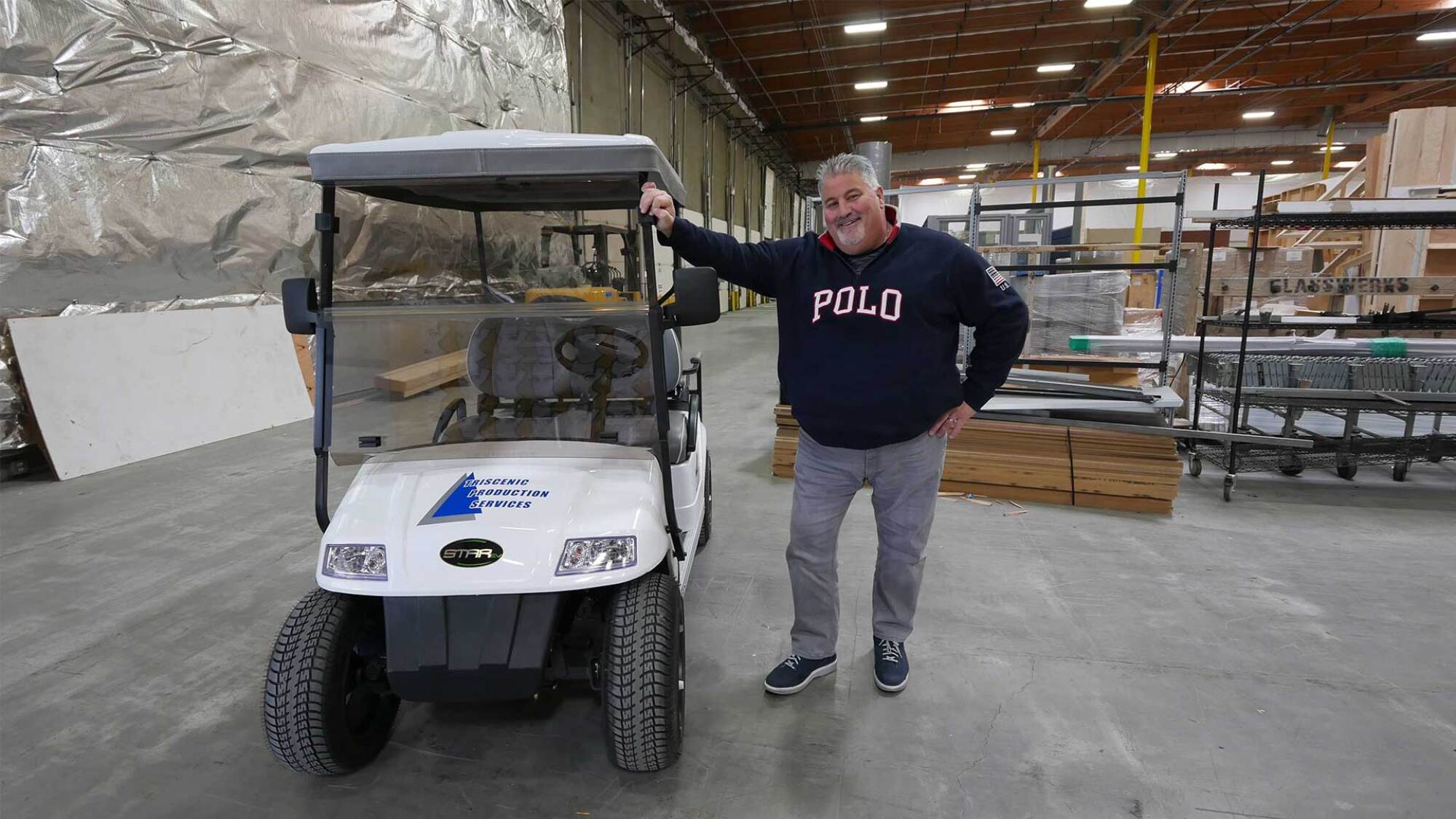
Vince Gervasi, at Triscenic Production Services, in Santa Clarita.
(Bob Doyle)
“I’ve been doing this for 41 years. I’ve seen the good and the bad — this is a complete decimation. It’s unprecedented.”
From florists to prop rentals to catering and beyond, production services and craft businesses are the hub and spoke of L.A.’s film and TV industry. But many of these businesses — some of which have been family-operated for generations — are struggling to weather a post-pandemic slump in film activity deepened by runaway production, media consolidation and the end of the streaming boom.
Film shoot days in the Los Angeles region have fallen nearly 50% since 2019, according to FilmLA data reviewed by The Times. Employment in Los Angeles County’s motion picture and sound recording industry has similarly plummeted, with a loss of some 57,000 jobs in the last four years, federal labor data show.
The slowdown has become a major issue in the L.A. mayoral race as evidence mounts of the economic toll on the city.
Just last month major industry vendor Quixote — whose Star Waggons trailers were once ubiquitous on the streets of L.A. — announced that it was winding down most of its sound stage business in Los Angeles, closing its operations in Atlanta and laying off 70 employees.
In a note to its clients and partners, Hudson Pacific Properties Inc., Quixote’s parent company, said that “we have persisted through the prolonged and ongoing slowdown in commercial, television and film production. But ultimately, industry conditions have forced difficult decisions.”
Between 2022 and 2025, more than 80 such businesses across Los Angeles have closed down, according to a list compiled by the ACME Directory, a production resource that connects TV and film professionals with specialized products and services.
“It’s, in many ways, a much bigger reflection of the contraction we’re seeing in the industry right now,” said Kevin Klowden, a senior fellow at the Milken Institute, focused on entertainment and technology. “The surge in demand for streaming and the consequential demand to catch up on content hid the fact that the industry was shrinking.”

Last October, the family-run Costume Rentals Corp. began liquidating its inventory after dressing film and television characters for 50 years. The North Hollywood firm provided costumes for “Forrest Gump,” “Apocalypse Now,” “Fast and Furious” and, more recently, the 2024 Bob Dylan biopic, “A Complete Unknown.”
A year earlier, Valentino’s Costume Group closed its doors after two decades in business and sold off its 400,000 items. At the time, Shon LeBlanc, the North Hollywood shop’s last owner standing, said he had endured a “perfect storm” of calamities and was drowning in debt following the cancellation of 15 shows in a single week.
Even the legendary Western Costume, which has been in business since 1912, has been hurt by the slowdown. During the 2023 strikes by writers and actors, Western Costume furloughed 43 employees, or about two-thirds of its staff. Recently, the North Hollywood costume mecca, which has supplied such classic films as “Gone with the Wind,” “The Wizard of Oz,” “The Sound of Music” and the TV series “Mad Men,” furloughed an unspecified number of its workers, said two people familiar with the matter who were not authorized to speak publicly.
A representative of Western Costume did not respond to a request for comment.
Marc Meyer, the owner of Faux Library Studio Props, had strained to stay in business through the pandemic shutdown and the 2023 labor strikes — laying off 11 of his 13 employees.
By the start of 2024, Meyer, a set decorator who was credited with inventing the fake movie book, was drastically behind on rent, owing $500,000, he said.

Marc Meyer, closed the doors on Faux Library Studio Props in North Hollywood after almost 25 years in business.
(Mel Melcon/Los Angeles Times)
Meyer’s landlord had given him a week to come up with more than $100,000 in unpaid rent or vacate the 89,000-square-foot warehouse in North Hollywood filled with props, books, antique furniture and other items that have decorated such film and TV sets as “Angels & Demons” and “The X-Files” for almost a quarter-century.
Meyer came up with $45,000 to mollify his landlord, garnering a month’s reprieve. A GoFundMe was set up during the strikes and a host of industry colleagues such as “Top Gun: Maverick” set decorator Jan Pascale stepped up, buying props to help fill his coffers.
A year later, Meyer was out of business, selling off Faux Library for parts in a massive auction. He died last July at 77.
“The change in our city is palpable,” said writer and director Sarah Adina Smith, a co-founder of Stay in LA’s, a grassroots campaign aimed at increasing film and television production in Los Angeles. “It’s not just that so many crafts and artists are out of work, but you see small businesses, too. In L.A., we’re an ecosystem fed in large part by creative jobs, and that is quickly vanishing.”

Marlon Gilbert still waxes nostalgic about the days his Commerce-based company, Gilbert Production Service, stored and transported scenery and props for TV shows including “Dancing with the Stars” and feature films like “Batman.” At one time, he said, he was handling seven active TV shows in a single season.
“When it was still on Fox, the ‘American Idol’ finale, we had like 20 semitrucks going in and out. Money was flowing like crazy,” he said. “But eventually times got hard for them, and they cut back on their production stuff.”
By last year, Gilbert was down to just three clients. “It wasn’t sustainable,” he said.
In December, after three decades, the family-owned business filed for Chapter 11 bankruptcy and shut down too.
“I couldn’t pay rent on our warehouse lease, I blew through my savings and my 401(k),” he said. After his wife was hospitalized following multiple strokes in 2023, he said, “I didn’t have the energy to beat the bush for new business.”
“I would’ve liked to have gone out with more panache and made a big splash and money selling the business. But there was nothing left to sell.”

Scott Niner, president and owner of Dangling Carrot Creative, checks on a robotic machine as it fabricates at his shop in North Hollywood.
(Jason Armond/Los Angeles Times)
Scott Niner, president and owner of Dangling Carrot Creative, offers a case study in how production service businesses have navigated the tidal wave of upheavals.
After 18 years in business creating graphic signage, custom flooring and wallpaper to make sets look exactly as art directors dreamed up, the company filed for Chapter 11 bankruptcy last April.
Before the pandemic, Niner’s Valencia-based business was thriving.
In 2014, he opened a Georgia satellite office to service the film and TV productions that had migrated to take advantage of the state’s generous tax credits. He steadily expanded his workforce to 32 employees in L.A. and Georgia.
Production was so plentiful that he even branched into the bakery business in 2018, delivering graphics and cupcakes in the same order. At its peak, Dangling Carrot generated $800,000 a month.
When the pandemic shutdown hit, Niner’s monthly revenue dropped to $50,000, he said. He kept his workers employed by making face shields that he donated to hospitals.
“I hung in there, and it was painful,” said Niner, who received some government assistance.
During the strikes in 2023, he drained his 401(k) and his union pension to keep his shop open and his workers employed.
Niner said he deployed a strategy of “pivoting and praying.” He shifted his business to focus more on fabrication, making giant 3-D-printed items for movie premieres, 25-foot-long, 8-foot-tall and 8-foot-deep ammo chests for a “Call of Duty” promotion and even graphics at airports.
Last last month, Niner sold off his Georgia business as filming in that state shifted to the U.K. He downsized his home and moved his business from Valencia to a much smaller building in North Hollywood. He is now down to 11 employees.
“I have a very bright outlook on the future, especially because we’re getting phone calls from people who never would have called us because all the other guys are out of business,” he said. “There’s something to be said about the last man standing. But I’m the last man standing on $2 million in debt. I’m more like lying down.”
The industry got a reprieve last week when CBS announced that it was relocating its hit drama “Tracker” to Los Angeles from Vancouver, Canada, after receiving a $48-million tax credit. Many view such moves, however, as small wins over comprehensive ones.
“There’s been a fundamental change happening here over the past five years,” said Cale Thomas, a makeup artist who has worked on “Guardians of the Galaxy 3” and the recent biopic “Michael.”
Thomas, who is a member of Stay in LA, acknowledges that California’s step last year to double its tax incentives has helped to spur an uptick in local production, but that has not stopped the outflow of productions or resolved a host of restrictions and costs that have hampered the industry.
He worked on “The Mandalorian” and other Lucasfilm series that stream on Disney+ for five years. “We shot in Manhattan Beach Studios,” he said, but noted that Lucasfilm has since moved one show to the U.K. and produced two others there.
“This has been devastating for our industry,” he said. “Hundreds of generational family businesses aren’t being used anymore.”
The pain points are not confined to Hollywood.
Last year, Marvel Studios — which had made Georgia, known as Hollywood of the South, its primary filming center for such major franchises as “Avengers: Infinity War” — relocated much of its production to the U.K.
The impact has meant even fewer domestic productions causing an even bigger ripple effect.
Among the high-profile casualties was Hackman Capital Partners, which aggressively snapped up studios, acquiring $10 billion in assets under management before production activity plummeted nationwide.
In January, the company defaulted on its $1.1-billion mortgage on Radford Studio Center, the historic lot where “Seinfeld” and “Gunsmoke” were filmed and which gave Studio City its name.

Earlier this year, Hackman Capital Partners defaulted on its $1.1-billion mortgage on Radford Studio Center, the historic lot where “Seinfeld” and “Gunsmoke” were filmed.
(Gary Coronado/Los Angeles Times)
Three months later, lender Deutsche Bank filed a foreclosure complaint on the also-historic Kaufman Astoria Studios in Queens, N.Y., home to “Sesame Street” and “Succession.”
Kaufman, also owned by Hackman Capital Partners, defaulted on an outstanding loan balance of $359 million that was due to be paid last fall, according to CRE Daily.
Gregg Bilson sold ISS Props, the Sunland-based company his father founded in 1977, to Manhattan Beach Studios, part of Hackman Capital Partners, five years ago, staying on as CEO to help run and expand the company.
After 40 years in the business, he retired last August with a little more than a year and a half left on his contract.
Bilson now sees himself as a Hollywood relic.
“Many of my contemporaries and I have had conversations where we say we saw the best of the film and TV industry when it was an art form,” Bilson said. “It will never be the same.”