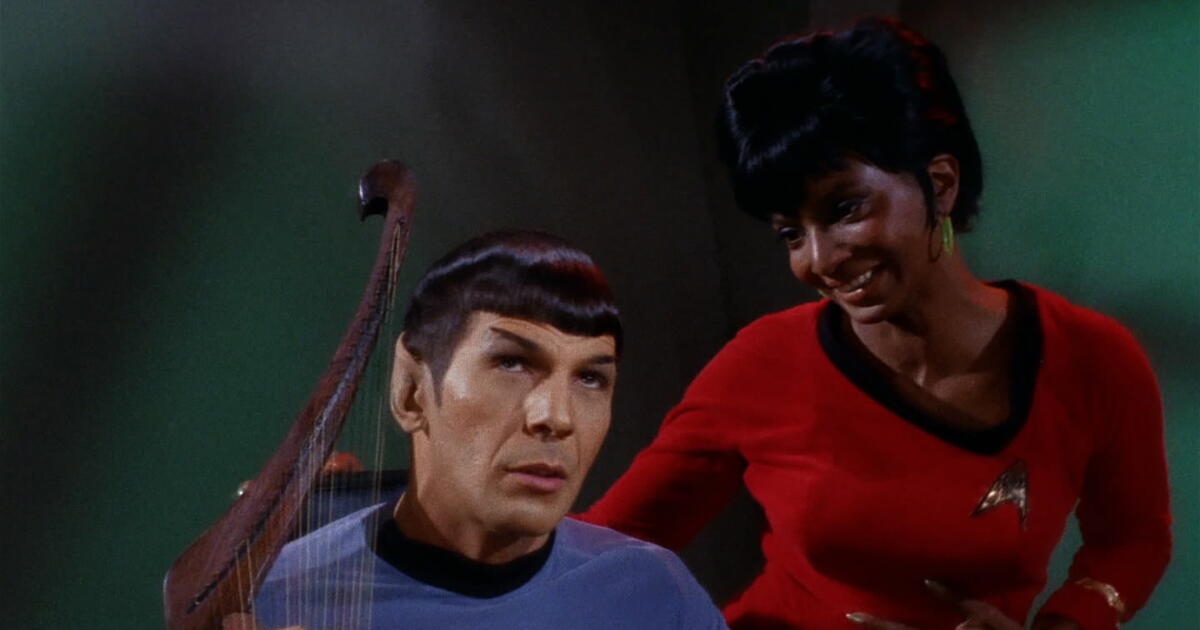
Contributor: We need more of the hopeful sci-fi that ‘Star Trek’ gave us 60 years ago
A few years ago, I received a call I’ll never forget. Jeanette Epps, an astronaut aboard the International Space Station, Zoomed into my living room from 250 miles above Earth. During our conversation, she told me that one of the reasons she chose her career was a television show my father created in 1966.
She wasn’t alone. I’ve heard versions of that same story from countless people over the years. Engineers. Scientists. Astronauts. People who saw possibility on a television screen before they ever saw it in the real world.
They credit “Star Trek” for showing them a future they wanted to help build. That’s an extraordinary thing for a television series to accomplish. It didn’t just entertain millions of people. It gave many of them a direction.
And I don’t think that was because of the ships, the gadgets or the aliens. It was because, underneath all of it, was a profoundly human belief that we are capable of becoming something better.
There was a time when science fiction made a bet on humanity. A bet that humanity was worth rooting for. We need storytellers willing to make that bet again.
I don’t think we have an innovation problem. We have an inspiration problem.
We talk a lot about what we’re leaving the next generation. The debt. The climate. The geopolitical mess. But there’s another inheritance we don’t talk about enough: what we show them is possible.
Today, many visions of the future are dominated by collapse, dystopia and fear. Those stories can have value. But conflict doesn’t always have to come from destruction. It can come from discovery. Two minds encountering an idea neither had considered. A crew facing the unknown with curiosity instead of fear. That kind of conflict doesn’t leave you feeling like the world is ending. It leaves you feeling like it’s just beginning.
Most storytelling holds a mirror up to who we are. Our flaws, our failures, our contradictions. But there is another kind. Stories built around characters a step or two ahead of where humanity is. Not perfect. But people who have learned how to cooperate, how to lead, how to stay curious and how to put something larger than themselves first. Characters you don’t just recognize. Characters you want to become one day.
That distinction changes what a story asks of you. And what you walk away believing is possible.
This year, “Star Trek” celebrates its 60th anniversary.
That’s not a milestone you reach by accident. Franchises built on spectacle fade. Ones built on something people actually needed tend to stick around.
The engineers who built Silicon Valley, the astronauts who went to space, the scientists pushing the edges of medicine and artificial intelligence — many of them trace a line back to this show. That wasn’t the plan. Nobody set out to build an innovation pipeline out of a television series. But that’s exactly what happened. When you give people a future worth believing in, they go build it — or sometimes they get inspired to imagine other hopeful destinations and lead us toward them. That’s not nostalgia. That’s a model.
One thing my dad understood that I think gets overlooked: “Star Trek” wasn’t going out into the galaxy to find aliens that looked different. It was going out to find aliens that thought different.
Diversity of perspective is how a species grows. My father gave that idea a name: IDIC. Infinite Diversity from Infinite Combinations. It didn’t mean you had to abandon your own point of view. It meant staying open to someone else’s. Because that’s how you grow. That idea has never been more relevant. And it has never been more achievable.
For the first time in history, a creator anywhere in the world can tell a story that reaches everyone, and now it can come from anywhere. The future belongs to everyone. The stories that shape it should too.
That astronaut who called me from space didn’t just watch a television show. She saw a future worth dedicating her life to.
Every generation needed something to build toward before they ever picked up a tool. A vision. A direction. A story that made the future feel worth the work. And right now, we’re not building enough of that.
We need stories that don’t just entertain us, but also become our compass. We need the kind of storytelling that doesn’t ask what could go wrong, but asks what could go right.
Rod Roddenberry, founder of the Roddenberry Foundation and son of “Star Trek” creator Gene Roddenberry and actor Majel Barrett Roddenberry, is an executive producer on current “Star Trek” television shows.
Insights
L.A. Times Insights delivers AI-generated analysis on Voices content to offer all points of view. Insights does not appear on any news articles.
Perspectives
The following AI-generated content is powered by Perplexity. The Los Angeles Times editorial staff does not create or edit the content.
Ideas expressed in the piece
-
The article argues that optimistic science fiction can do more than entertain: it can give audiences a constructive vision of the future and inspire people to pursue careers in science, engineering and space exploration. “Star Trek” is presented as an example of storytelling that made human progress feel attainable.
-
It contends that contemporary culture is overly saturated with collapse, dystopia and fear. Although such stories can be useful, the article suggests that narratives centered on discovery, cooperation and curiosity can encourage audiences to imagine what might go right rather than merely anticipate disaster.
-
The piece maintains that aspirational characters—people who have learned to cooperate, remain curious and serve purposes larger than themselves—can function as moral examples. In this view, fiction should not only reflect present flaws but also depict people and societies worth becoming.
-
It further argues that “Star Trek’s” emphasis on cultural and intellectual diversity remains especially relevant. The franchise’s principle of “Infinite Diversity in Infinite Combinations” is presented as a model for learning through different perspectives, while the series’ enduring influence is cited as evidence that hopeful stories can shape real-world ambitions.[1][2]
Different views on the topic
-
A contrasting perspective holds that dystopian and cautionary science fiction serves an essential purpose by exposing the consequences of reckless behavior, political failure and technological overreach. Recent commentary argues that many influential works were intended as warnings or satire, not as blueprints for an attractive future.[3]
-
Feminist dystopian fiction offers another counterpoint: bleak speculative narratives can make systemic problems—including misogyny, violence against women, gender inequality and threats to reproductive rights—more visible. From this perspective, darkness is not simply pessimism; it can be a way to represent harms that already exist and demand attention.[4]
-
Critics also caution that “Star Trek’s” hopeful vision can obscure tensions within its own world. The franchise combines ideals of cooperation and equality with armed exploration, alien conflict and interventionist politics, making it both an image of peaceful progress and a vehicle for examining militarism and political failure.[2]
-
Consequently, the strongest science fiction may not choose between hope and warning. Utopian stories can provide direction, while dystopian stories can identify dangers and test whether an envisioned future genuinely addresses exclusion, power and conflict. Treating either mode as sufficient on its own risks producing either inspiration without scrutiny or criticism without a constructive destination.[3][4]