The humans were left far behind as smartphone maker Honor’s humanoid robot shattered the men’s world record in China.
Published On 19 Apr 202619 Apr 2026
A humanoid robot competing against flesh-and-blood runners has broken the world record at a Beijing half-marathon, showcasing the rapid technological advancements achieved by Chinese makers.
Spectators lined the roads in Yizhuang in the capital’s south on Sunday to watch the machines and their human rivals race, each group in a separate lane to avoid accidents or collisions.
Recommended Stories
list of 4 itemsend of list
Some of the robots were highly agile, moving like famous runners such as Usain Bolt, while others had more basic capabilities.
The winning humanoid, equipped with an autonomous navigation system and running for Chinese smartphone maker Honor, completed the roughly 21km (13-mile) course in 50 minutes and 26 seconds, at an average speed of about 25km/h (15.5mph), according to state broadcaster CCTV.
That was far faster than the top human in Sunday’s race, while also surpassing the current men’s world record of 57:20, held by Ugandan runner Jacob Kiplimo.
The result represented spectacular progress from last year, when robot-runners fell repeatedly, and the best took more than two hours and 40 minutes to finish.
The number of humanoid entries jumped from about 20 last year to more than 100, according to organisers, a sign of the sector’s growing popularity.
A humanoid robot runs alongside human competitors in the second Beijing E-Town Half Marathon and Humanoid Robot Half Marathon in Beijing [Haruna Furuhashi/Pool via Reuters]
‘Pretty cool’
Han Chenyu, a 25-year-old student who watched the race from behind a safety barrier, barely had time to take out her phone and snap a picture of the leading robot as it whizzed past.
She told the AFP news agency she was enthusiastic about such leaps in technology and thought the event was “pretty cool”.
But, she added, “as someone who works for a living, I’m a little worried about it sometimes. I feel like technology is advancing so fast that it might start affecting people’s jobs”, particularly with artificial intelligence (AI) growing increasingly sophisticated.
Humanoid robots have become a common sight in China in recent years, in the media as well as in public spaces.
Xie Lei, 41, who watched Sunday’s race with his family, said robots could “become part of our daily lives” within several years, potentially used for “things like housework, elderly companionship or basic caregiving” or “dangerous jobs, even firefighting”.
The humanoid half-marathon aims to encourage innovation and popularise the technologies used in creating and operating such machines.
In a sign of the industry’s strength, investment in robotics and so-called embodied AI amounted to 73.5 billion yuan ($10.8bn) in China in 2025, according to a study by a government agency.
“For thousands of years, humans have been at the top on planet Earth. But now, look at robots. Just in terms of autonomous navigation, at least in this specific sport event, they’re already starting to surpass us,” Xie said.
“On one hand, it does make you feel a little bit sad for humanity. But at the same time, technology, especially in recent years, has given us so much imagination.”
Modern warfare has dramatically changed as we have seen from the Russia-Ukraine war, conflicts involving Gaza, India and Pakistan, and the recent US-Israeli strikes on Iran. At the centre of this shift is a surging global reliance on drone and missile technology as well as advanced air defence systems.
Turkiye, one of the largest military powers in the Middle East, is increasingly positioning itself as a major supplier in the global defence sector. Central to this effort is Roketsan, a company founded in 1988 to supply the Turkish Armed Forces, which has since evolved into the country’s primary manufacturer of missile and rocket systems.
Recommended Stories
list of 3 itemsend of list
Currently exporting to approximately 50 countries, the firm is one of the fastest-growing defence companies globally.
So how did Roketsan secure a large share of the global arms trade?
Bypassing Western embargoes
Turkiye’s defence expansion was largely accelerated by restrictions placed upon it. Western embargoes aimed at halting its military advancement meant Ankara could not acquire the necessary technical systems or components.
In 2020, the United States imposed Countering America’s Adversaries Through Sanctions Act (CAATSA) restrictions on Turkiye – a key member of the transatlantic military alliance NATO. These sanctions targeted Turkiye’s military procurement agency, its chief Ismail Demir, and three other senior officials. Washington also ejected Ankara from the F-35 stealth jet programme in July 2019.
The measures came after Ankara purchased Russia’s S-400 missile defence system, which was seen as a potential threat to NATO security. The European Union also prepared limited sanctions and discussed restricting arms exports following energy exploration disputes in the Eastern Mediterranean.
To circumvent this, the country built an integrated, domestic defence ecosystem. Today, Turkiye relies on a vast supply chain of nearly 4,000 small and medium-sized enterprises (SMEs) scattered across the country. As a result, the Turkish defence industry now operates with a local production rate exceeding 90 percent.
Türkiye’s defence industry now operates with a local production rate exceeding 90 percent, bypassing long-standing Western embargoes [Al Jazeera]
This shift has yielded significant financial returns for Ankara. In 2025, Turkiye’s defence industry reported $10bn in exports. Roketsan’s General Manager Murat Ikinci told Al Jazeera that the company currently ranks 71st among global defence firms, with ambitions to break into the top 50, then the top 20, and ultimately the top 10.
To support this expansion, Turkish President Recep Tayyip Erdogan inaugurated several large-scale facilities last week, including:
Europe’s largest warhead facility.
new research and development (R&D) centre housing 1,000 engineers.
the “Kirikkale” facility dedicated to rocket fuel technology.
new infrastructure for the mass production of ballistic and cruise missiles.
These projects represent a $1bn investment, with the company planning to inject an additional $2bn to expand mass production capabilities.
The ‘Tayfun’ and modern warfare
Roketsan’s R&D strategy – which employs 3,200 engineers and makes the company the third-largest R&D institution in Turkiye – is heavily influenced by data gathered from ongoing global conflicts.
According to Ikinci, the war in Ukraine highlighted the impact of cheap, first-person view (FPV) and kamikaze drones supported by artificial intelligence. In response, Roketsan developed air defence systems like “ALKA” and “BURC,” alongside the “CIRIT” laser-guided missile.
The regional landscape was further complicated during the US-Israel war on Iran, as cheap Iranian-designed Shahed drones – recently upgraded by Russia with “Kometa-B” anti-jamming modules – overwhelmed defences and even struck a British base in Cyprus in March 2026. During the same month, NATO air defences were forced to intercept three Iranian ballistic missiles that entered Turkish airspace.
Meanwhile, the recent conflict between Israel and Iran showcased the use of complex attacks combining ballistic missiles with “swarms” of kamikaze drones designed to overwhelm air defences. This environment makes hypersonic technology a critical asset.
This brings the Tayfun (Typhoon) project into focus. Tayfun is a developing family of long-range ballistic missiles. Its most advanced iteration, the Tayfun Block 4, is a hypersonic missile engineered to penetrate advanced air defence systems by travelling at extreme speeds.
When Al Jazeera asked for specific details regarding the Tayfun’s exact operational range, Ikinci was elusive. “We avoid mentioning its range; we just say its range is sufficient,” he noted.
Similarly, historical Western sanctions have pushed Turkiye to form new cooperation initiatives, effectively accelerating an “Eastern shift” away from Western defence dependence. Turkish drones are now being used by a growing number of countries, including by Pakistan during its war against India last May.
Based on these threat assessments, Roketsan has prioritised five key areas of production:
long-range ballistic and cruise missiles.
air defence systems, including the “Steel Dome”, Hisar-A, Hisar-O, and Siper.
submarine-launched cruise missiles, utilising the AKYA system to leverage Turkiye’s large submarine fleet.
smart micro-munitions designed specifically for armed drones.
long-range air-to-air missiles, a need highlighted by the brief India-Pakistan skirmish.
A strategic export model
Unlike traditional arms procurement, Turkiye is marketing its defence industry to international buyers as a strategic partnership.
“Our offer to our partners… is as follows: Let’s produce together, let’s develop technology together,” Ikinci stated.
Rokestan’s General Manager Murat İkinci, right, emphasises that Roketsan’s international strategy is based on ‘partnership models’ rather than simple sales [Al Jazeera]
By establishing joint facilities and R&D centres in allied nations across the Middle East, the Far East, and Europe, Turkiye is attempting to secure long-term geopolitical alliances rather than purely transactional sales. Ikinci highlighted Qatar as a prime example of this model, describing it as a benchmark for technological, military, and security cooperation in the region.
Filling the global stockpile gap
This rapid expansion comes at a critical time for the global arms trade. Ongoing wars have severely depleted the stockpiles of advanced weapon systems worldwide.
During the recent US-Israel war on Iran, Washington relied heavily on multimillion-dollar Patriot and Terminal High Altitude Area Defense (THAAD) systems to intercept cheap Iranian drones targeting US assets across Qatar, Kuwait, Bahrain, Saudi Arabia, and the United Arab Emirates. With growing concerns that US interceptor supplies could run low, Gulf states – which have collectively detected over 1,000 drones in their airspace – are actively seeking alternative defence technologies, creating a highly lucrative opening for Turkiye’s missile industry.
Defence analyses indicate that even military superpowers like the US will require significant time to replenish their current air defence inventories due to the complexity and massive infrastructure required to build them.
Turkish defence officials view this shortage as a strategic opening. Having localised its supply chain, Turkiye claims it can manufacture and export these highly sought-after complex systems independently.
As global demand for air defence and ballistic technologies rises, Roketsan is aggressively reinvesting its revenues into production infrastructure to expand its footprint in the international arms market.
NASA’s Artemis II astronauts were seen being helped across the deck of a US navy recovery ship, after splashing down on Earth from their mission around the moon.
The Artemis II crew landed in the Pacific Ocean under parachutes after a high-speed re-entry that tested its heat shield.
Published On 11 Apr 202611 Apr 2026
NASA’s Artemis II astronauts have safely splashed down on Earth, completing a landmark mission that carried humans around the Moon and back for the first time in more than 50 years.
The crew successfully completed a parachute landing on Friday in the Pacific Ocean, after a high-speed re-entry through Earth’s atmosphere. Recovery teams were off the coast of California, waiting to retrieve them after their arrival at 5:07pm Pacific time (00:07 GMT).
Recommended Stories
list of 3 itemsend of list
The four astronauts will now undergo medical checks before returning to NASA’s Johnson Space Center in Houston.
NASA crew members Reid Wiseman, Victor Glover and Christina Koch, together with Canadian astronaut Jeremy Hansen, began a 10-day voyage from Florida’s Kennedy Space Center last week, travelling farther into space than any human ever has.
They looped around the far side of the moon, testing equipment in deep space, before propelling back to Earth on Friday.
Their mission was the first to the moon since the 1972 Apollo 17 mission, and their return caps a mission packed with technical milestones.
A new perspective on Earth
Artemis II is widely seen as a critical test flight for future Moon missions, particularly Artemis IV, which aims to land astronauts on the lunar surface for the first time since the Apollo era.
Engineers will now analyse key data from the mission, including the performance of the Orion capsule’s heat shield as well as navigation systems and life-support technology, all essential for safely carrying humans deeper into space.
The return also included one of the most challenging phases of the journey: a brief communication blackout during re-entry, caused by intense heat building up around the spacecraft.
But on top of its record-setting distance, the mission also marked other historic firsts. Glover became the first person of colour to travel around the moon, Koch the first woman, and Hansen the first non-American.
During their journey, the crew reported in vivid detail features of the lunar surface and later witnessed a solar eclipse as well as meteorite impacts.
Mission commander Wiseman reflected that “what we really hoped in our soul is that we could, for just a moment, have the world pause — and remember that this is a beautiful planet in a very special place in our universe”.
“We should all cherish what we have been gifted.”
Every morning since the astronauts’ departure, NASA has sent a song to Artemis II to start the day. On Friday, the astronauts awoke to the tune of Live’s song Run to the Water and the country hit Free, by Zac Brown Band.
Artemis II Commander Reid Wiseman shares a picture of Earth taken from the Orion spacecraft’s window on April 2, 2026 [EPA/NASA]
NASA has successfully launched the Artemis II mission, marking the first crewed mission to the moon’s vicinity since the Apollo programme ended in 1972.
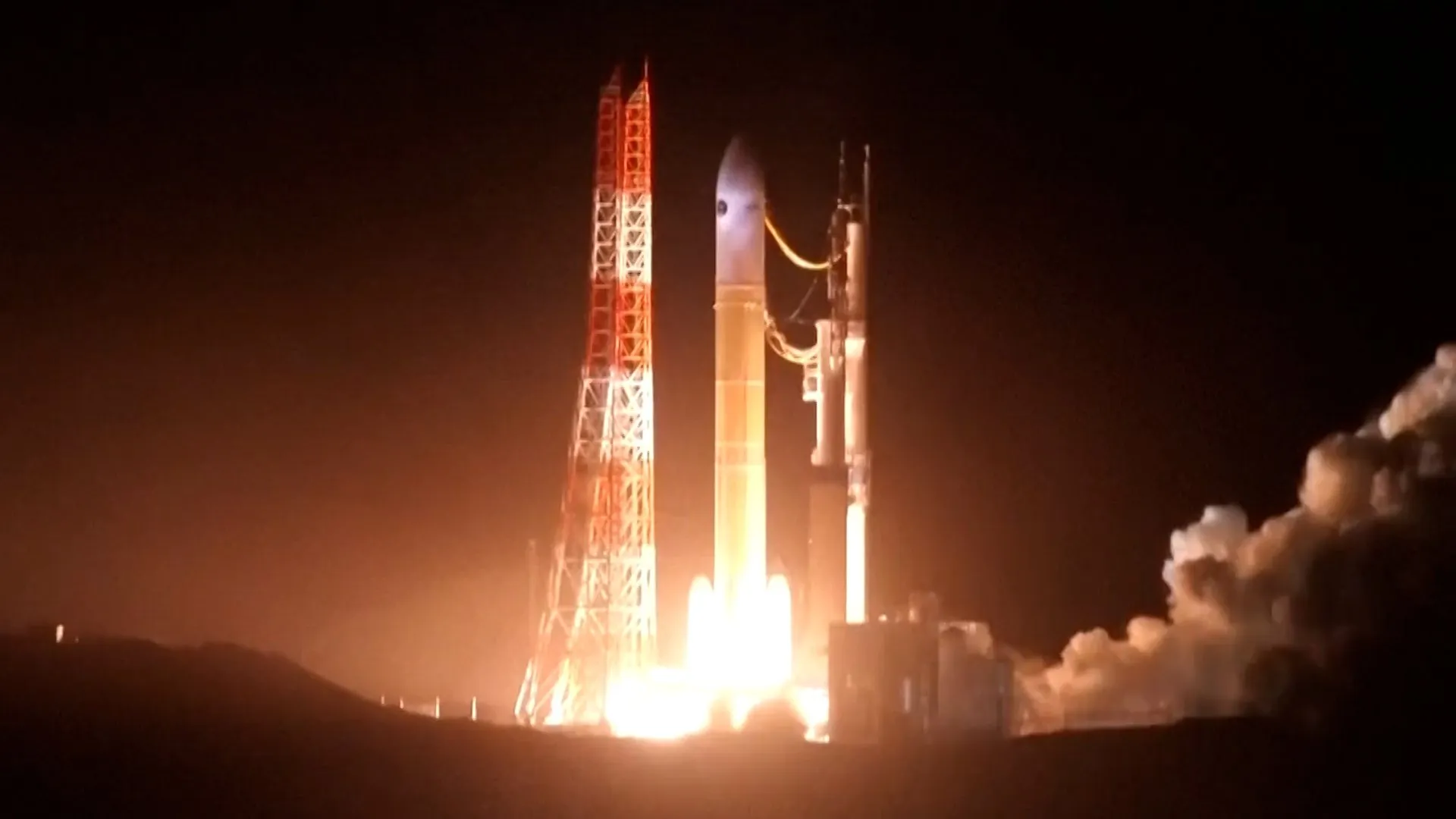
The 322-foot Space Launch System (SLS) rocket lifted off at 6:35pm ET (22:35 GMT) on Wednesday from Cape Canaveral, Florida, sending the Orion crew capsule on a 10-day journey.
Recommended Stories
list of 3 itemsend of list
While Artemis II will not land on the moon, it will fly a “free-return” trajectory that swings around it to prove the spacecraft can sustain a crew on future missions.
The idea is to descend to the surface of the Earth’s only natural satellite again on Artemis IV in 2028.
“We have a beautiful moonrise,” said Reid Wiseman, the NASA astronaut serving as mission commander, about five minutes after the launch. “We’re heading right at it.”
Here is what we know:
What happened?
The Artemis II mission launched successfully from the Kennedy Space Center in Florida, sending four astronauts on a historic journey around the moon, the first crewed mission beyond low-Earth orbit in more than 50 years.
The launch followed a tense countdown, as engineers worked through several technical issues. Teams closely monitored the rocket during fuelling due to hydrogen leaks that had delayed the mission in the past, but no major leaks were detected on launch day.
Engineers also resolved last-minute problems involving battery sensors and the rocket’s flight termination system, a critical safety system used to destroy the rocket if it goes off course, before clearing the mission for liftoff.
The 32-storey rocket lifted off in the early evening in front of large crowds gathered near the launch site. The crew are now on a mission that will take them around the moon and back to Earth.
The launch had been planned for as early as February 6, and then March 6, until a hydrogen leak prompted NASA to roll the rocket back to its vehicle assembly building for scrutiny.
It had earlier been scheduled for November 2024, but NASA announced a delay due to technical investigations, particularly into the Orion’s heat shield.
Who is part of the Artemis II mission?
All three NASA astronauts are veterans of Earth-orbit science expeditions to the International Space Station, while the lone Canadian joining them on a voyage around the moon and back is a spaceflight rookie.
Reid Wiseman, 50, commander: The NASA veteran and former International Space Station commander is leading the Artemis II mission. A test pilot-turned-astronaut, he has leadership and deep spaceflight experience.
Victor Glover, 49, pilot: The US Navy aviator is the first Black astronaut assigned to a lunar mission and flew on SpaceX Crew-1.
Christina Koch, 47, mission specialist: The record holder for the longest single spaceflight by a woman at 328 days is a veteran of multiple spacewalks and has scientific and deep-space mission expertise.
Jeremy Hansen, 50, mission specialist: The first Canadian set to travel to the moon is a former fighter pilot. His presence represents international collaboration in deep space exploration.
(Al Jazeera)
When will the mission reach the moon?
If the mission goes as planned, the capsule is expected to reach the moon on about April 6, the sixth day of the mission.
The crewed Orion capsule will then fly around the moon, reaching its closest point before beginning the journey back to Earth, with splashdown expected on April 10, 2026.
What is the mission plan for the next 10 days?
The Artemis II mission is expected to last about 10 days and follows this general outline:
Days 1-2 high Earth orbit : The crew will spend their first one to two days in high Earth orbit conducting extensive checks on the spacecraft’s systems.
Once those checks are complete, Orion’s propulsion system will perform a “translunar injection”.
A translunar injection is a critical manoeuvre performed by the Orion spacecraft’s propulsion system. Occurring after the crew completes their initial systems checks in high Earth orbit, this manoeuvre propels the spacecraft out of Earth orbit and sets it onto a direct trajectory towards the moon.
Days 3-4 translunar transit: As they transit to the moon over the next several days, the astronauts will continue monitoring Orion’s systems.
The spacecraft will then pass behind the moon on a “free-return” trajectory, a strategic path that naturally swings the capsule back towards Earth without requiring any additional propulsion.
Day 5 lunar sphere of influence: Orion enters the moon’s gravitational pull, which becomes stronger than Earth’s.
The astronauts will spend the first several hours of the day testing their spacesuits, including practising how quickly they can put them on, pressurising them and strapping into their seats.
Day 6 lunar flyby: This is the day the crew fly by the moon.
The spacecraft reaches its closest approach, approximately 4,000-6,000 miles (6,450-9,650km) above the lunar surface.
Day 7-9 Return journey: Following the flyby, Orion remains on its free-return trajectory. The crew conducts deep-space science, including medical monitoring through programmes like ARCHER.
Day 10 Re-entry and splashdown: Orion separates from the service module and re-enters Earth’s atmosphere at roughly 25,000mph (40,230km/h). The mission concludes with a splashdown in the Pacific Ocean.
What’s NASA’s next mission?
Artemis III is the next mission and is currently planned for 2027.
It will involve the Orion spacecraft docking in Earth orbit with at least one of NASA’s lunar landers, either Blue Origin’s Blue Moon system or SpaceX’s Starship.
The docking manoeuvre is intended to demonstrate how the landers will collect astronauts in orbit before transporting them to the moon’s surface.
The mission is a major step in NASA’s plan to return humans to the moon and eventually send astronauts to Mars.
Published On 1 Apr 20261 Apr 2026
The Artemis II space mission has blasted off from the US state of Florida, sending four astronauts on a historic journey around the moon and marking the first time humans have travelled beyond low-Earth orbit in more than 50 years.
The mission, which launched on Wednesday, is a major step in the US space agency NASA’s plan to return humans to the moon and eventually send astronauts to Mars.
Recommended Stories
list of 1 itemend of list
The 32-story rocket rose from NASA’s Kennedy Space Center where tens of thousands gathered to witness the lift-off.
The Artemis II crew – NASA astronauts Reid Wiseman, Victor Glover and Christina Koch, and Canadian Space Agency astronaut Jeremy Hansen – are set for a nearly 10-day journey around the moon and back, taking them farther into space than humans have travelled in decades.
“On this historic mission, you take with you the heart of this Artemis team, the daring spirit of the American people and our partners across the globe, and the hopes and dreams of a new generation,” said Charlie Blackwell-Thompson, the launch director. “Good luck, Godspeed Artemis II. Let’s go.”
Five minutes into the flight, Wiseman, the commander, saw the team’s target: “We have a beautiful moonrise, we’re headed right at it,” he said from the capsule.
Kano, Nigeria – On a bustling day in northern Nigeria, Marian Shammah made her way to the Sabon Gari Market, one of the largest electronics hubs in Kano state.
The 34-year-old cleaner was in need of a refrigerator, but with rising costs and a meagre income, she saw the second-hand appliances sold at the market as a lifeline.
Recommended Stories
list of 3 itemsend of list
After locating the one she wanted, she paid the vendor 50,000 naira ($36) and took it home. But just a month later, the freezer collapsed.
“Only the top half of the refrigerator was working, and the freezer wasn’t working,” said Shammah.
Her food spoiled, her savings disappeared, and she was soon back in the market searching for another appliance.
Although Shammah could have bought a new local appliance for just over 30,000 naira ($30) more, she – like millions of Nigerians – believes second-hand products from America and Europe “last longer” than new products sold in Nigeria.
Observers say this trend is part of a larger crisis. Nigeria has become a major destination for the developed world’s discarded electronics – items often near the end of life, sometimes completely dead, and frequently toxic because they contain hazardous materials. When they break down, they add to landfills, worsening an already dire e-waste crisis on the African continent.
Around 60,000 tonnes of used electronics enter Nigeria through key ports each year, with at least 15,700 tonnes already damaged upon arrival, according to the United Nations.
The trade in used electronic goods is powered largely by foreign exporters. A UN tracking study between 2015 and 2016 showed that more than 85 percent of used electronics imported into Nigeria originated from Germany, the United Kingdom, Belgium, the Netherlands, Spain, China, the United States, and the Republic of Ireland.
Many of these imports violate international restrictions, like the Basel Convention, an environmental treaty regulating the transboundary movement and disposal of hazardous electronic waste to developing countries with weaker environmental laws.
Across West Africa, the Basel Convention’s “E-Waste Africa Programme”, a project focused on strengthening e-waste management systems across the continent, estimates that Benin, Ivory Coast, Ghana, Liberia, and Nigeria collectively generate between 650,000 and 1,000,000 tonnes of e-waste annually – much of it the result of short-lifespan second-hand imports.
A man sorts out iron and plastic to sell while a bulldozer clears the garbage and birds surround it in a dump site in Lagos, Nigeria [File: Sunday Alamba/AP]
Health risks
The United Nations describes e-waste as any discarded device that uses a battery or plug and contains hazardous substances – like mercury – that can endanger both human health and the environment. Several of the toxic components commonly found in e-waste are included on the list of 10 chemicals of major public health concern maintained by the World Health Organization (WHO).
According to the WHO, used electrical and electronic equipment (EEE) presents a growing public health and environmental threat across Africa, with Nigeria at the centre of the trade.
“Much of the equipment shipped as used electronics is close to becoming waste,” said Rita Idehai, founder of Ecobarter, a Lagos-based environmental NGO, warning that devices imported and sold as affordable second-hand goods often fail shortly after arrival and quickly enter the waste stream.
The consequences are far-reaching. Many imported fridges and air conditioners, for instance, still contain CFC-based and HCFC-based refrigerants such as R-12 and R-22 – chemicals banned in Europe and the US for causing ozone depletion or being linked to cancer, miscarriages, neurological disorders, and long-term soil contamination. These gases live for 12 to 100 years, meaning leaking equipment adds to a multi-generational environmental burden.
After these imported items stop working or fall apart, informal recyclers then dismantle the electronics with their bare hands, Al Jazeera observed. In Kano, the recyclers inhale poisonous fumes and manage the heavy metals without protection. Their work earns them a meagre 3,500–14,000 naira ($2.50-$10) per week, they said, and the after-effects linger – including persistent coughing, chest pain, headaches, eye irritation, and breathing difficulties after long hours of burning cables and dismantling electronic devices.
The health crisis extends into Kano’s communities.
Among casual recyclers and residents who live close to e-waste dumps, many report symptoms that range from chronic headaches and skin irritation to breathing issues, miscarriages and neurological concerns, according to health surveys done by the International Journal of Environmental Research and Public Health. These ailments are consistent with longtime toxic exposure, the researchers said.
Recent field assessments conducted by Nigeria’s Federal University Dutse also stressed that in and around Kano state, where the Sabon Gari Market is located, there are rising levels of heavy metals in soil and drainage channels.
Dr Ushakuma Michael Anenga, a gynaecologist at the Benue State Teaching Hospital and second vice president of the Nigerian Medical Association, warned that toxic exposure from informal e-waste recycling poses grave health risks to communities in Kano.
“Exposure to heavy metals and refrigerant gases in e-waste causes extreme brief and long-term health issues, generally affecting the breathing and renal organs,” he told Al Jazeera.
“Common casual practices like exposed burning and dismantling result in direct, high-level exposure for workers and nearby residents. Children and pregnant girls are particularly inclined due to the fact that those toxicants can disrupt development or even skip from mother to unborn baby, [while] recyclers who work without defensive equipment face repeated, frequently irreversible damage.”
Old computer monitors discarded as electronic waste are pictured at a recycling facility in Lagos, Nigeria [File: Temilade Adelaja/Reuters]
Profits over protection
In Sabon Gari Market, second-hand electronics are advertised as less costly lifelines for households and poor business owners burdened by inflation.
Many customers say foreign-used home equipment appears sturdier and seems like better value for money than new imports from the developing world. Meanwhile, others are just looking for cheap options in difficult economic times.
“I usually go for second-hand or foreign-used electronics because brand-new ones are too expensive for me,” Umar Hussaini, who sells used electronics at the market, told Al Jazeera.
“Sometimes you can get them for half the price of new ones, and they look almost the same, so it feels like a good deal at the time.”
But the last refrigerator he bought stopped cooling after just three months. With no warranty or guarantee, the seller refused responsibility.
“For weeks, we couldn’t store food properly at home, and we ended up buying food daily, which was more expensive,” he said. “However, I have to buy another one again.”
For small business owners like Salisu Saidu, the losses can be even more devastating. He bought a used freezer for his shop, believing it had been serviced. Within weeks, it failed.
“I lost a lot of frozen food, which meant I lost money and customers,” he told Al Jazeera.
Around his neighbourhood, broken electronics are often dumped out in the street, sometimes emitting smoke or sparks.
“There’s also a lot of electronic waste piling up around,” he said, calling for tighter import controls, proper certification, and mandatory warranties to protect buyers from being sold what he described as “damaged goods disguised as fairly used”.
Umar Abdullahi’s second-hand electronics shop in Kano, Nigeria [Abdulwaheed Sofiullahi/Al Jazeera]
Bought as bargains, sold as burdens
At Sabon Gari Market, another vendor, Umar Abdullahi, is surrounded by imported refrigerators, air conditioners and washing machines stacked tightly together.
The products in his shop are advertised as “London use” or “Direct Belgium”, while he negotiates the sale of a double-door fridge for 120,000 naira ($87).
Abdullahi’s store is where Shammah returned after the refrigerator she bought failed. But he admits that much of what he sells to customers arrives unchecked.
“We buy them untested from suppliers in Europe, and we also sell them untested so we can make our profit,” he told Al Jazeera.
This despite the fact that international rules under the Basel Convention, as well as Nigerian environmental regulations, prohibit the shipment of material considered e-waste – with penalties including fines and jail terms.
Nwamaka Ejiofor, a spokesperson for Nigeria’s National Environmental Standards and Regulations Enforcement Agency (NESREA), said the country does not permit the import of e-waste. However, the entry of used electronics is allowed under regulated conditions.
“The importation of used electrical and electronic equipment is regulated and may be allowed only where such equipment meets prescribed conditions, including functionality and compliance requirements,” she told Al Jazeera.
“Nigeria applies a combination of regulatory, administrative and enforcement measures to ensure that imported used electronics comply with national law and the country’s international obligations,” she added, listing out measures including environmental regulations, cargo inspection and verifying that imported equipment is “functional”.
However, despite this, some traders find loopholes in the system, including declaring cargo they plan to sell as personal belongings or second-hand household goods to avoid scrutiny.
Although NESREA says enforcement has improved, critics say the steady flow of mediocre goods continues largely unchecked. Even dealers at Sabon Gari Market acknowledge that most appliances are sold “as is”, without certification or guarantees.
Baban Ladan Issa’s worker washes a second-hand fridge before selling it to a customer [Abdulwaheed Sofiullahi/Al Jazeera]
‘Loopholes’
Behind the second-hand electronics trade is a network of collectors and exporters who source discarded appliances across Europe.
Baban Ladan Issa, who ships used electronics from Ireland to Nigeria, said items are gathered from weekend markets, private homes that are replacing old gadgets, and contractors clearing out equipment from offices, hotels and hospitals.
“Some suppliers mix working and damaged goods together,” he told Al Jazeera, noting that while he tries to avoid faulty items, not all buyers do the same.
Once assembled, shipments worth millions of naira are sent to Lagos through ships then down to sellers in the market in Kano state, sometimes packed in containers or hidden inside vehicles to reduce inspection risks.
Shipping records seen by Al Jazeera showed consignments labelled as “personal effects”, a classification that can limit detailed checks at ports.
Chinwe Okafor, an environmental policy analyst based in Abuja, said the problem is systemic.
“Exporting nations regularly take advantage of loopholes by means of labelling nonfunctional e-waste as ‘second-hand goods’ or ‘for repair,’” she told Al Jazeera. “In some instances, research estimates that over 75 percent of what arrives in developing countries is truly junk.”
“This permits wealthy countries to keep away from highly-priced recycling at home while pushing unsafe materials into nations with weaker safeguards.”
Ibrahim Adamu, a programme officer with the NGO Ecobarter, added that mislabelling, poor inspection technology and corruption at ports make enforcement difficult.
“The highest profits are captured by exporters and brokers who arbitrage the gap between disposal costs in Europe or Asia and the strong demand for ‘tokunbo’ goods in Nigeria,” he said, using the local name for used imported electronics.
To forestall this, he said Nigeria “must reinforce border inspections” and implement a policy whereby producers and manufacturers bear financial responsibility. At the same time, “the international network has to adopt binding bans that [hold] manufacturers and exporters responsible”, Adamu said.
People shop at a market in Nigeria [File: Sodiq Adelakun/Reuters]
Little oversight, mounting risks
Although Nigeria has regulations governing the import of electrical and electronic equipment, enforcement gaps keep exposing markets like Kano’s Sabon Gari to ageing and near-end-of-life appliances, locals say.
Ibrahim Bello, a used electronics importer with a decade in the business, said many shipments that arrive from Europe are in less-than-ideal condition.
“Around 20 to 30 percent of the items we receive have issues when they arrive,” he told Al Jazeera. “Some are already damaged, while others stop working after a short time because they are old.
“That’s just part of the business.”
Retailer Chinedu Peter gave similar estimates. “From what I’ve experienced, maybe 40 percent of the electronics have some fault as they come,” he said, adding that environmental and protection checks don’t happen as they are meant to.
“Such a lot of items enter without special checks.”
Both men feel that clearer rules and certified testing systems will improve trust. But until then, thousands of ageing, unsuitable products will continue to flood Nigeria.
Shammah, back at Sabon Gari Market just weeks after her refrigerator broke, was once again searching through rows of stacked appliances, hoping her next purchase might last longer than the last.
“I don’t really trust these fairly used appliances again, but I still have to buy something because we need it at home,” she told Al Jazeera.
“This time I’m thinking … I can buy a new one from a proper shop, even if it takes longer, because I don’t want to lose my money again.”
A California jury found Alphabet’s Google and Meta liable for $3m in damages in a landmark social media addiction lawsuit that accused the companies of being legally responsible for the addictive design of their platforms.
The decision was handed down by a Los Angeles-based jury on Wednesday after more than 40 hours of deliberation across nine days, and more than a month after jurors heard opening statements in the trial.
Recommended Stories
list of 4 itemsend of list
Among those who testified in the case were Meta CEO Mark Zuckerberg and Instagram head Adam Mosseri, although YouTube chief executive Neal Mohan was not called to testify.
The plaintiff in the case, referred to as KGM or Kaley, was awarded $3m in damages. The 20-year-old said she became addicted to social media at a young age, which exacerbated her mental health issues. She began using YouTube at age six and Meta-owned Instagram at age nine.
Kaley’s legal team alleged that the social media giants used designed features intended to hook young users, including notifications and autoplay features.
“Today’s verdict is a historic moment — for Kaley and for the thousands of children and families who have been waiting for this day. She showed extraordinary courage in bringing this case and telling her story in open court. A jury of Kaley’s peers heard the evidence, heard what Meta and YouTube knew and when they knew it, and held them accountable for their conduct. Today’s verdict belongs to Kaley,” lawyers for the plaintiff said in a statement shared with Al Jazeera.
Jurors were instructed not to consider the content of the posts and videos Kaley saw on the platforms. That is because tech companies are shielded from legal responsibility for user-posted content under Section 230 of the 1996 Communications Decency Act.
Meta consistently argued that Kaley had struggled with her mental health separate from her social media use, often pointing to her turbulent home life. Meta also said, “not one of her therapists identified social media as the cause” of her mental health issues in a statement following closing arguments. But the plaintiffs did not have to prove that social media caused Kaley’s struggles — only that it was a “substantial factor” in causing her harm.
YouTube focused less on Kaley’s medical records and mental health history and more on her use of the platform itself. The company argued that YouTube is not a form of social media, but rather a video platform, akin to television, and pointed to her declining use as she got older.
According to company data, she spent about one minute per day on average watching YouTube Shorts since its inception. YouTube Shorts, which launched in 2020, is the platform’s section for short-form, vertical videos that include the “infinite scroll” feature that the plaintiffs argued was addictive.
“We disagree with the verdict and plan to appeal. This case misunderstands YouTube, which is a responsibly built streaming platform, not a social media site,” Jose Castaneda, a spokesperson for Google, told Al Jazeera.
Meta did not respond to Al Jazeera’s request for comment.
Snap and TikTok were previously named in the suit but settled with the plaintiff for undisclosed terms before the trial began.
Shifting momentum
The verdict is the latest in a wave of lawsuits targeting social media companies. There is a looming federal social media addiction case slated to begin in June in Oakland, California.
On Tuesday in New Mexico, a jury found that Meta violated state law by misleading users about the safety of Facebook, Instagram, and WhatsApp, and by enabling child sexual exploitation on those platforms.
This case has been closely watched by legal experts, who say the verdict will shape future litigation.
“The fact the jury found Meta and Google liable represents that these cases have real exposure to the social media giants, and are going to frame how future litigation will proceed. Although this case will certainly be appealed, I would not be surprised if Meta and Google are already making changes within their platform to reflect the real exposure, and hopefully, the states will start to enact laws regulating social media in a manner congruent with the ruling,” entertainment lawyer Tre Lovell told Al Jazeera.
Professor Eric Goldman, associate dean for research at the Santa Clara University School of Law, echoed Lovell’s assessment.
“The Los Angeles jury verdict is the first of three bellwether trials in Los Angeles, with more bellwether trials to follow in summer, in the federal case. As such, today’s verdict is just one datapoint about liability and damages. The other trials could reach divergent outcomes, so this jury verdict isn’t the final word on any matter.”
Despite the ruling, Meta’s stock has not taken a hit, as it came the same day CEO Mark Zuckerberg was appointed to a new White House advisory council. The stock is up 0.7 percent. Alphabet’s stock, however, is trending downward in midday trading on the heels of the verdict, down 1 percent.
The agency will increase robotic missions to the moon and launch a spacecraft called Space Reactor 1 Freedom.
Published On 24 Mar 202624 Mar 2026
NASA has unveiled a major overhaul of its moon and Mars strategy, scrapping plans for a lunar-orbit space station and instead committing $20bn over the next seven years to build a base on the moon’s surface, while also advancing plans to send a nuclear-powered spacecraft to Mars.
NASA Administrator Jared Isaacman outlined the changes on Tuesday during a meeting in Washington, DC, with partners, contractors and government officials involved in the Artemis programme, saying the agency will increase robotic missions to the moon and lay the groundwork for nuclear power on the lunar surface.
Isaacman, appointed by US President Donald Trump and who took charge in December, said the changes form part of a broader overhaul of NASA’s long-term Moon-to-Mars strategy.
The planned moon base is intended to support long-term human presence on the lunar surface, with robotic missions expected to help prepare the site, test technologies and begin building infrastructure before astronauts return later this decade.
The agency also disclosed plans to launch a spacecraft called Space Reactor 1 Freedom before the end of 2028, a mission designed to demonstrate nuclear electric propulsion in deep space on the way to Mars.
The spacecraft will deliver helicopters on the Red Planet, similar to the Ingenuity robotic test helicopter that flew with NASA’s Perseverance rover, a step the agency said would help move nuclear propulsion technology from laboratory testing to operational space missions.
The Ingenuity helicopter was the first aircraft to achieve powered, controlled flight on another planet. It travelled to Mars attached to NASA’s Perseverance rover and landed in February 2021.
Pausing the Lunar Gateway station
The Lunar Gateway station, a planned space station in lunar orbit being developed with contractors including Northrop Grumman and international partners, was meant to serve as a base where astronauts could live and work before heading to the Moon’s surface.
But NASA now plans to repurpose some Gateway components for use on the surface instead.
Repurposing Lunar Gateway to create a base on the moon’s surface leaves uncertain the future roles of Japan, Canada and the European Space Agency in the Artemis programme, three key NASA partners that had agreed to provide components for the orbital station.
“It should not really surprise anyone that we are pausing Gateway in its current form and focusing on infrastructure that supports sustained operations on the lunar surface,” Isaacman said.
The changes to NASA’s flagship Artemis programme are reshaping billions of dollars’ worth of contracts and come as the United States faces growing competition from China, which is aiming to land astronauts on the moon by 2030.
The Artemis programme, begun in 2017 during Trump’s first term as president, envisions regular lunar missions as NASA’s long-awaited follow-up to its first moon missions in the Apollo programme that ended in 1972.
The US defence secretary designated the AI company a ‘supply chain risk’ after it refused to remove guardrails on its technology.
Published On 18 Mar 202618 Mar 2026
The administration of United States President Donald Trump has said in a court filing that the Pentagon’s blacklisting of Anthropic was justified and lawful, opposing the artificial intelligence company’s high-stakes lawsuit challenging the decision.
The administration made its comments in a court filing on Tuesday.
Recommended Stories
list of 3 itemsend of list
Defense Secretary Pete Hegseth designated Anthropic, the maker of popular AI assistant Claude, a national security supply chain risk on March 3 after the company refused to remove guardrails against its technology being used for autonomous weapons and domestic surveillance.
The Trump administration’s filing says Anthropic is unlikely to succeed in its claims that the US government’s action violated speech protections under the US Constitution’s First Amendment, asserting that the dispute stems from contract negotiations and national security concerns, not retaliation.
“It was only when Anthropic refused to release the restrictions on the use of its products — which refusal is conduct, not protected speech — that the President directed all federal agencies to terminate their business relationships with Anthropic,” the administration’s legal filing said. The filing, from the US Justice Department, said that “no one has purported to restrict Anthropic’s expressive activity”.
Anthropic’s lawsuit in California federal court asks a judge to block the Pentagon’s decision while the case plays out. Some legal experts say the company appears to have a strong case that the government overreached.
In a statement, Anthropic said it was reviewing the government’s filing. The company said that “seeking judicial review does not change our longstanding commitment to harnessing AI to protect our national security, but this is a necessary step to protect our business, our customers, and our partners.”
The White House did not immediately respond to a request for comment.
Supply chain risk
Trump has backed Hegseth’s move, which excludes Anthropic from a limited set of military contracts. But it could damage the company’s reputation and cause billions of dollars in losses this year, according to its executives.
The designation came after months of negotiations between the Pentagon and Anthropic reached an impasse, prompting Trump and Hegseth to denounce the company and accuse it of endangering American lives with its use restrictions.
Anthropic has disputed those claims and said AI is not yet safe enough to be used in autonomous weapons. The company said it opposes domestic surveillance as a matter of principle.
In its March 9 lawsuit, Anthropic said that the “unprecedented and unlawful” designation violated its free speech and due process rights, while running afoul of a law requiring federal agencies to follow specific procedures when making decisions.
The Pentagon separately designated Anthropic a supply chain risk under a different law that could expand the order to the entire government.
Anthropic is challenging that move in a second lawsuit in a Washington, DC, appeals court.