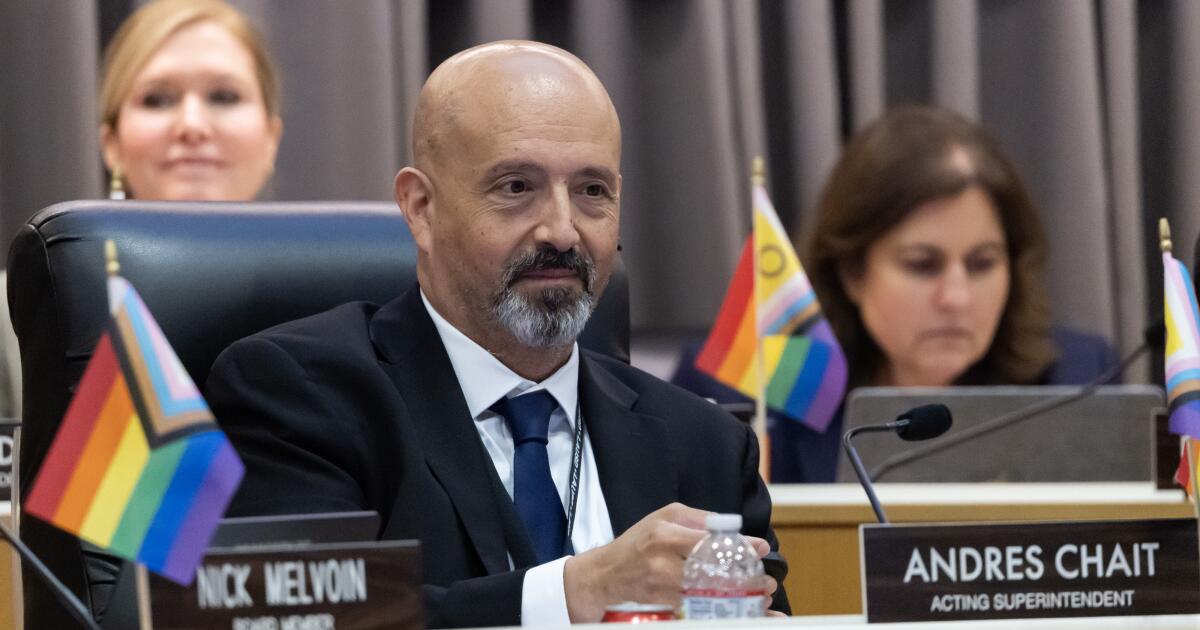
Andres Chait named new LAUSD superintendent following Alberto Carvalho resignation
Andrés Chait has been named superintendent of the Los Angeles Unified School District three days after the resignation of Alberto Carvalho in a lightning-speed transition that elevates a well-liked insider to the top of the nation’s second-largest school system.
The Board of Education announced its unanimous decision Wednesday, which was made official during the board’s last scheduled meeting before August.
“I firmly believe in leading with gratitude and never taking the work and support of others for granted,” Chait said after the announcement. “So I begin today in that spirit of gratitude. Thank you to the board for your faith in me and for this opportunity.”
“I have always known that there is no greater accelerator of change and opportunity than the school house, and that is still true today,” Chait added. “Throughout my career in various roles, that has remained my focus. How I can be of service and support to our students and families in accessing these opportunities. Please know that commitment has not changed.”
Chait had been serving as acting superintendent since Feb. 27, two days after the FBI raided the home and office of his predecessor, Carvalho. Law enforcement sources have confirmed that the ongoing investigation includes a review of Carvalho’s actions related to a company hired to create an ill-fated AI chatbot. Carvalho has not been charged and maintains that he is innocent of wrongdoing.
Chait’s style and background stands in sharp contrast to Carvalho‘s, who had 14 years of experience leading one of the nation’s largest school systems in Miami.
Carvalho carefully curated his appearances — before and during his L.A. tenure he maintained a high national profile as a sought-after voice in education. In 2018, he had accepted the job leading the school system in New York City before changing his mind and staying in Miami. He was a familiar face in national conclaves on education and among national leaders. He took charge in L.A. in February 2022.
Chait is a district parent who started off as a kindergarten teacher at Queen Anne Place Elementary School and rose gradually through the ranks. He has never worked in another school system, although his experience in L.A. Unified included a variety of roles, including elementary school principal, regional superintendent. Most recently he served as director of operations — a non-academic function — for the entire school system.
Chait was not among the phalanx of senior officials who sat directly behind the school board on the elevated stage during board meetings. Instead, Chait’s was stationed in the back next to the audiovisual equipment, where he was off camera and frequently able to joke and interact with other district staff and community members. He’d also sometimes deal directly with a community member or employee who brought forward a personal problem or issue during the public hearing portion of a board meeting.
Over the last two years, Chait has presented periodically at board meetings, including over such issues as school safety.
The announcement was made by school board President Scott Schmerelson after the board emerged from a closed session.
“This board’s decision reflects the confidence in Mr. Chait’s leadership, his decades of service to Los Angeles Unified, and his demonstrated ability to guide the district during this period of transition,” Schmerelson said. “Throughout his career, and most recently as acting superintendent, he has shown deep commitment to our students, families, employees, and school communities.”
The decision to offer the job to Chait was not entirely a surprise because he already had taken on key tasks typically handled by a long-term superintendent. These included finishing up a four-year strategic plan and selecting administrators to fill key senior positions.
The Board of Education approved a four-year strategic plan Tuesday with academic targets and measures of college, career and social-emotional readiness.
Chait also received good marks from board members and union leaders during a trial-by-fire experience with a labor dispute that came within hours of a three-union strike that would have shut down the school system.
Chait was a key participant in getting to a deal, along with Mayor Karen Bass.
“It was wonderful to have the cooperation from the leadership of the district, from the superintendent, from the school board, from the entire school board, all of that … made a difference,” Bass said in a City Hall news conference, referring to Chait, after the all-nighter.
Leaders of the three unions each praised Chait at the time.
“I want to give you a thanks, Superintendent Chait, for showing humanity. Humanity. Humanity for seeing us, seeing the workers, and believing that you can get it across the finish line,” said Cecily Myart-Cruz, the outgoing president of United Teachers Los Angeles.
Last week, Myart-Cruz said in an interview that Carvalho needed to be replaced and that Chait appeared to have the skills needed to take over — although she said she would prefer a formal selection process that included input from labor leaders and others.
Max Arias, executive director of Service Employees International Union Local 99, also praised Chait after the contract was settled.
“I want to appreciate you … for coming into a very difficult situation and stepping in and showing leadership,” Arias said. “We are ready, our members are ready, to always give a chance to building relationship or partnership.”
Interviewed last week, Arias said Chait should be offered the job outright — that a search process was unnecessary.
Also praising Chait during that April gathering in City Hall was Maria Nichols, president of Associated Administrators of Los Angeles, which represents schools principals and assistant principals among others.
“Thank you so much for listening,” Nichols said. “I know the acting superintendent’s style — collaborative, listens. He takes action. He’s humane, and he wants the best for our students, because he’s a parent and has students in LAUSD.”
The deals accepted by Chait also have critics, who contend is it more than the district can afford.
This $20.6-billion spending plan that was approved Tuesday incorporates the layoffs of up to several hundred workers with due-process rights and perhaps 1,000 more without job protections. Over the next three years, officials project thousands of additional layoffs.
The spending plan for the 2026-27 school year is nearly $2 billion higher than last year’s figure of $18.8 billion. The district’s projected revenue is $18.6 billion, although that figure could rise based on promising state tax revenues.
In the meantime, the district will cover the shortfall with reserves, which may or may not be exhausted over the next two to three years. The increased spending results largely from significant salary increases, maintaining health benefits amid rising costs and expanding the number of part-time employees eligible for benefits.
Also straining the budget has been the expiration of COVID-relief funds, inflation surpassing state funding increases and steadily declining enrollment. L.A. Unified, with about 390,000 students in transitional kindergarten through 12th grade, is about half as large as in the early 2000s.
The board did not immediately release details of the new superintendent’s contract, including the length of the term, on the grounds that is not yet in final form.
Chait’s salary as acting superintendent was $395,867. He also has received $250 per month for expenses and the use of a district car and driver for work-related activities. In his previous job as chief of school operations, which he held for about 20 months, Chait had earned $278,205.
Carvalho’s salary was $440,000 per year with an additional $50,000 paid annually into a retirement annuity. District officials have so far declined to say if Carvalho received a severance package.
Carvalho’s predecessor as permanent superintendent, Austin Beutner, was paid $350,000 per year.