Times of Troy: For USC football, a best-case scenario season includes a fleet of star freshmen
Welcome back to the Times of Troy newsletter, where I am thrilled to announce that the start of the USC football season is here. And a week before the rest of college football, no less!
We’ve reminded you enough by now that this is a make-or-break season for USC and for its head coach, Lincoln Riley. With a new defensive coordinator who’s in the College Football Hall of Fame, a new, state-of-the-art football facility and the nation’s top recruiting class in tow, USC has given Riley everything he needs to succeed.
So what if … he actually does?
Last week, we walked you through the worst-case scenario for USC’s 2026 slate. So this week, let’s put on our cardinal-and-gold colored glasses and consider what this season might look like if everything actually goes right. Because there’s certainly a world in which USC earns a place in the College Football Playoff. Maybe even wins a game or two (or three?).
That picture-perfect scenario, however, hinges in my mind on how fast USC’s stellar freshman class rounds into form.
Imagine for a minute a Trojans defense with Luke Wafle, the nation’s top prospect in 2026, screaming off the edge a la the Bosa Bros at Ohio State. Or what about “Boobie” Feaster, the Trojans’ 17-year-old stud wideout, taking a tunnel screen to the house through the teeth of Oregon’s defense?
USC hasn’t had this much talent on the roster since I started covering the team in 2019. And while it’s fair to be hesitant about relying on so many freshmen, what if, when push comes to shove, they’re just the best players on the team?
It’s not hard to envision that being the case at wide receiver, at tight end and even along the defensive line. Freshmen could even be starting, at some point, on the offensive line, at linebacker and in the defensive backfield. (OK, this might not sound like a best-case yet, but bear with me here …)
USC has the first three weeks of its season to let the freshmen figure it out, followed by a trip across the country to Rutgers, and with no redshirts to worry about, I’d venture to say we’ll see the full breadth of freshmen Trojan talent over those four games. If USC can emerge from that stretch with the confidence of its young players soaring, then it should have a shot when Oregon comes to town.
If there’s one game that could decide the direction of USC’s season, it’s this one. It’s a critical moment for quarterback Jayden Maiava, who had his worst game of the year a season ago in Eugene. Any world in which USC makes a playoff run must include a major leap from Maiava. This is his time to prove that he’s taken that last step in his game, the one that could truly separate him as a first-round NFL draft pick. He has the talent, and in this case, he’ll have to show every bit of it.
Meanwhile, USC’s defense could cast some doubt on the potential of the Ducks’ own quarterback with a promising performance here. Dante Moore has yet to face a ranked team in a true road environment as Oregon’s starter. And the Coliseum is going to be rocking that night. I could see him slipping up on the road.
If Maiava can play to his potential and the defense can rise to the occasion, USC can beat Oregon for the first time in a decade. And if it does, a world of possibilities open up for USC.
With the confidence of its fabulous freshmen soaring, USC rolls through Washington at home. A trip to Penn State, during what’s sure to be a White Out game, marks the second moment in which the Trojans’ young stars could be seriously tested. But who’s to say that the Nittany Lions, under Matt Campbell, have anywhere close to the talent the Trojans will bring to State College. And without its usual pass rush, I could see Maiava picking Penn State apart.
Wins over Maryland and on the road at Wisconsin are locks in this scenario, as is a stomping of crosstown rival UCLA and new coach Bob Chesney.
So what about Ohio State and Indiana, our last two national title winners? The more winnable of those two, in my opinion, is the Halloween home game with Ohio State, considering the questions on the Buckeyes’ defense. But Ohio State is still the deeper, more talented team, and by that point in the season, injuries will have surely affected USC’s roster.
As for Indiana, well, not only have the Hoosiers not lost at home under Curt Cignetti, but they’ve allowed just 10 points per game over Cignetti’s 15 home games as coach. USC has to slip up somewhere in the schedule, and my bet would be Bloomington.
Ten wins would surely secure USC its first-ever Playoff spot, delivering the statement that Riley so desperately needed in his fifth season. And if by this point, its fleet of freshmen just happen to be peaking, then there’s no telling how far this team could go from there.
Thanos down

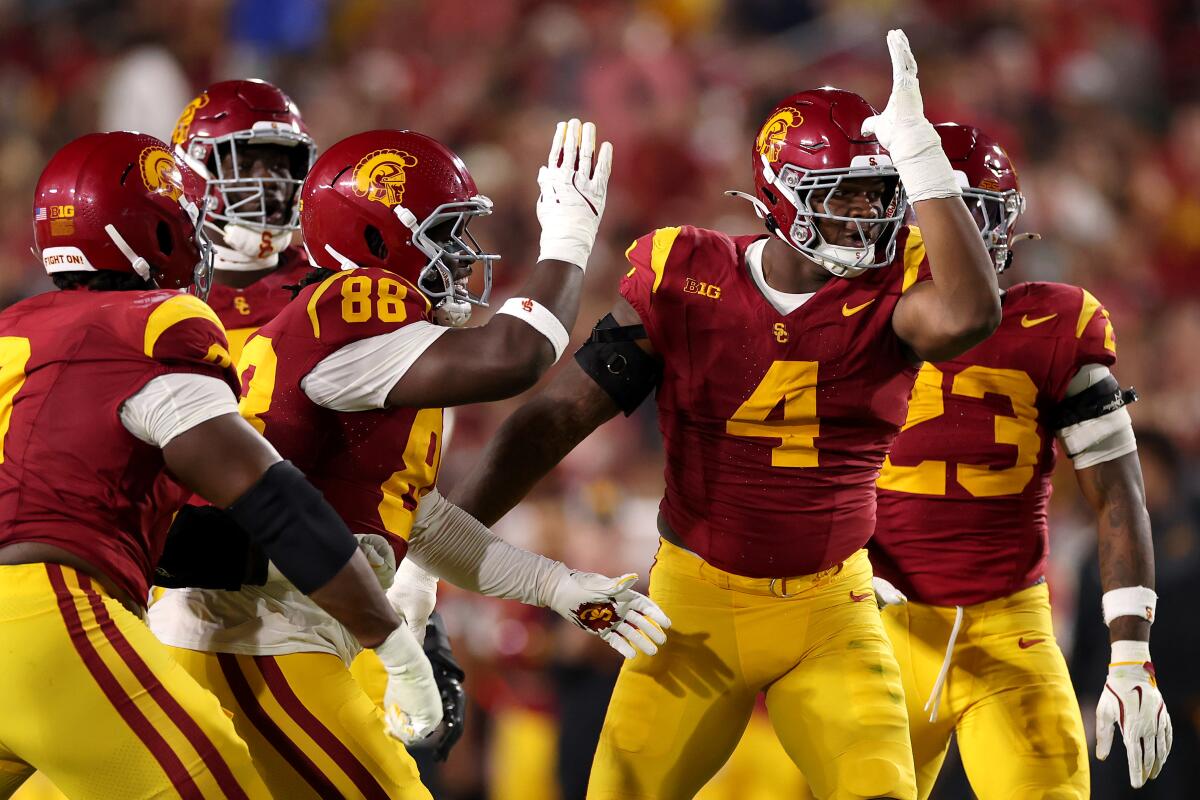
Jahkeem Stewart (4) reacts against the Michigan State Spartans last season.
(Luke Hales / Getty Images)
In a brutal twist of fate for USC, just ahead of its Week 0 opener, defensive tackle Jahkeem Stewart is now likely to miss the nonconference slate with a foot injury.
It’s terrible news for the sophomore standout and for USC, which needs all the talent it can get along the defensive line. Stewart’s participation throughout camp had been a bit inconsistent already, presumably in an effort to keep him fresh for the season.
The fact that he’s likely to miss the first three games isn’t so much the main concern here. It’s that foot injuries are notoriously tricky. We don’t have much information on whether this was a aggravation or an entirely new problem, but a source downplayed the current injury’s severity. Still, it’s not a great sign for a player that was expected, at least by me, to be all-conference caliber this season.
Does Riley have any interest in adding old Trojans to the roster?
A court ruling bafflingly cleared the way last week for players who have already signed with NFL teams to gain some added college eligibility. And while no one has been added to the mix yet, USC’s coach said this week he wasn’t against adding under the right circumstances.
“Addition doesn’t always mean necessarily making you better, right?” Riley said. “And we feel very strongly about the group that we’ve put together, we feel very strongly about the kind of culture and attitude and vibe of this team right now, and so first and foremost, we’re going to protect that.”
Other than at linebacker, where USC would have to add someone new from the transfer portal midseason, or because of injuries, I don’t see a scenario in which it would really make sense. Anthony Lucas or Lake McRee just don’t move the needle at this point.
Class of ‘26 power rankings: Week 0
USC signed the top-ranked class last recruiting cycle, so as they finally hit the field, the Times of Troy will keep tabs on their progress by doing what we do best: Ranking their performance! In this case, we’ll rank them based on the freshmen we most expect to make a difference when USC kicks off against San José State.

Trent Mosley at USC spring football practice.
(Robert Gauthier / Los Angeles Times)
1. Luke Wafle, DE … the No. 1 overall prospect in 2026 should get plenty of run coming off the edge in these first few games. I wouldn’t be surprised if, over that stretch, he makes it impossible to keep him on the bench.
2. Trent Mosley, WR. Seemingly locked into a starting job since the spring, Mosley is 20 years old and much further along than most freshmen when it comes to football IQ. He could lead the team in targets if all breaks right.
3. Mark Bowman, TE. Bowman was in and out of practice through camp, which might be the only thing keeping him from the No. 1 spot on this list. Don’t be surprised if the breakout doesn’t come right away as he gets into the swing of things.
4. Kayden Dixon-Wyatt, WR. A standout of camp with Tanook Hines sidelined, Dixon-Wyatt should be thrust into a big role right away. He’s a big play waiting to happen, and of all the freshmen position players, he’s the one I’d expect to wow us first.
5. Elbert “Rock” Hill, CB. Another standout of camp, Hill is behind two surefire starters in Jontez Williams and Chasen Johnson. But from what we’ve seen and heard, the freshman cornerback is way ahead of schedule.
6. Boobie Feaster, WR. Feaster is so young — just turned 17 — but his talent is undeniable. He has the potential to be the No. 1 guy on this list by season’s end.
7. Tomuhini “Tom Tom” Topui, DT. Stewart’s injury could open the door for more young guys on the interior, including Topui, who really impressed me in the scrimmage and has been receiving rave reviews from teammates.
8. Talanoa Ili, LB. In a linebacker room with shallow depth, don’t be surprised if Ili emerges early. I like what I’ve seen.
9. Madden Riordan, S. One of the bigger surprises in the class, Riordan added critical weight and now should play a part in the defensive back rotation. Being 20 already helps.
10. Breck Kolojay, OG. Kolojay was a major standout of spring, then cooled in camp while dealing with injuries. He’s likely a next-man-up option on the offensive interior.
11. Tron Baker, WR. Baker has a lot of other freshman wideouts ahead of him on this list, but we’ve heard his name a lot listed among young players who impressed.
12. Deshonne Redeaux, RB/KR. I really like Redeaux’s smooth, effortless running style, and while he’s down the depth chart at running back, he could right away be the kick returner.
Poll results
We asked, “What is the fewest number of wins you’d accept from Riley and USC without calling for a change?”
After 1,507 votes, the results:
Nine wins, 35.6%
10 wins/playoff appearance, 27.9%
Eight wins, 24.6%
Seven wins, 8.8%
Six wins, 3.1%
Olympic sports spotlight
Jane Alukonis was named the Big Ten women’s soccer coach of the year in 2024, but the Trojans trudged their way to a 7-7-3 finish in 2025 and have a lot to prove as their 2026 season begins.
Lucky for Alukonis, she brings in the No. 1-ranked recruiting class in the nation according to Prep Soccer, a class highlighted by forward Jordan Hill, the No. 3 overall prospect, and defender Rhiannon Mahon, the No. 5 overall prospect.
But the Trojans were still picked in the preseason to finish seventh in the Big Ten. And with losses to Duke and Brigham Young already, USC is already facing an uphill climb to start the season.
What I’m Watching This Week

Anne Hathaway as Andy Sachs in “The Devil Wears Prada 2.”
(Macall Polay / 20th Century Studios)
No one told me before I watched “The Devil Wears Prada 2” on a plane last weekend that it was a journalism movie! But even aside from commiserating about the state of journalism through the screen with Anne Hathaway, I enjoyed this second go-round.
So what if it was a blatant cash grab? Put Hathaway, Meryl Streep, Emily Blunt and Stanley Tucci in a room, and I’d probably watch whatever they come up. Tucci, in particular, was a standout for me in this sequel.
In case you missed it
How Boobie Feaster became one of the USC playmakers to watch at age 17
Ohio State and Oregon lead AP top 25 preseason college football poll; USC also ranked
Until next time …
That concludes today’s newsletter. If you have any feedback, ideas for improvement or things you’d like to see, email me at ryan.kartje@latimes.com, and follow me on X at @Ryan_Kartje. To get this newsletter in your inbox, click here.