Sasakis

Roki Sasaki’s recent dominance is proving the Dodgers right

Long-term experiments demand resources, which is why the Dodgers’ lab is perfect for the Roki Sasaki project.

Funding is no issue. Time is no object. Pressure is a privilege and so is patience.

And when the Dodgers set out to prove a hypothesis — Roki Sasaki can be a “Cy Young-caliber” starting pitcher, as general manager Brandon Gomes has suggested — they did it with the luxury of seeing the project all the way through, until they’ve been proved right.

And most everyone else, wrong.

No, Sasaki didn’t need to be moved to the bullpen.

No, Sasaki didn’t need to be sent back down to the minor leagues.

No, Sasaki wasn’t going to be a bust.

Yes, the Dodgers knew exactly what they were doing by continuing to trot out the 24-year-old right-hander, providing him with the big league education they promised.

Thursday’s test ran 5⅓ innings, and Sasaki — with his bigger glove and harder splitter — held the Seattle Mariners at bay until the sixth inning, when they scored their only two runs in a game the Dodgers won 6-2.

For the fourth straight start, Sasaki performed like the pitcher who was promised when he picked the Dodgers 18 months ago, trusting them to develop him into a starting star.

Tack on another win to three consecutive he’d previously recorded, against the Colorado Rockies, New York Yankees and New York Mets.

In his past four starts, Sasaki (5-5) has struck out 26 batters, walked seven and has a 2.25 ERA and 3.44 FIP in 24 innings.

Man alive, the Dodgers have done it! “The Monster of the Reiwa Era” is breaking out. And the rest of baseball should probably be terrified.

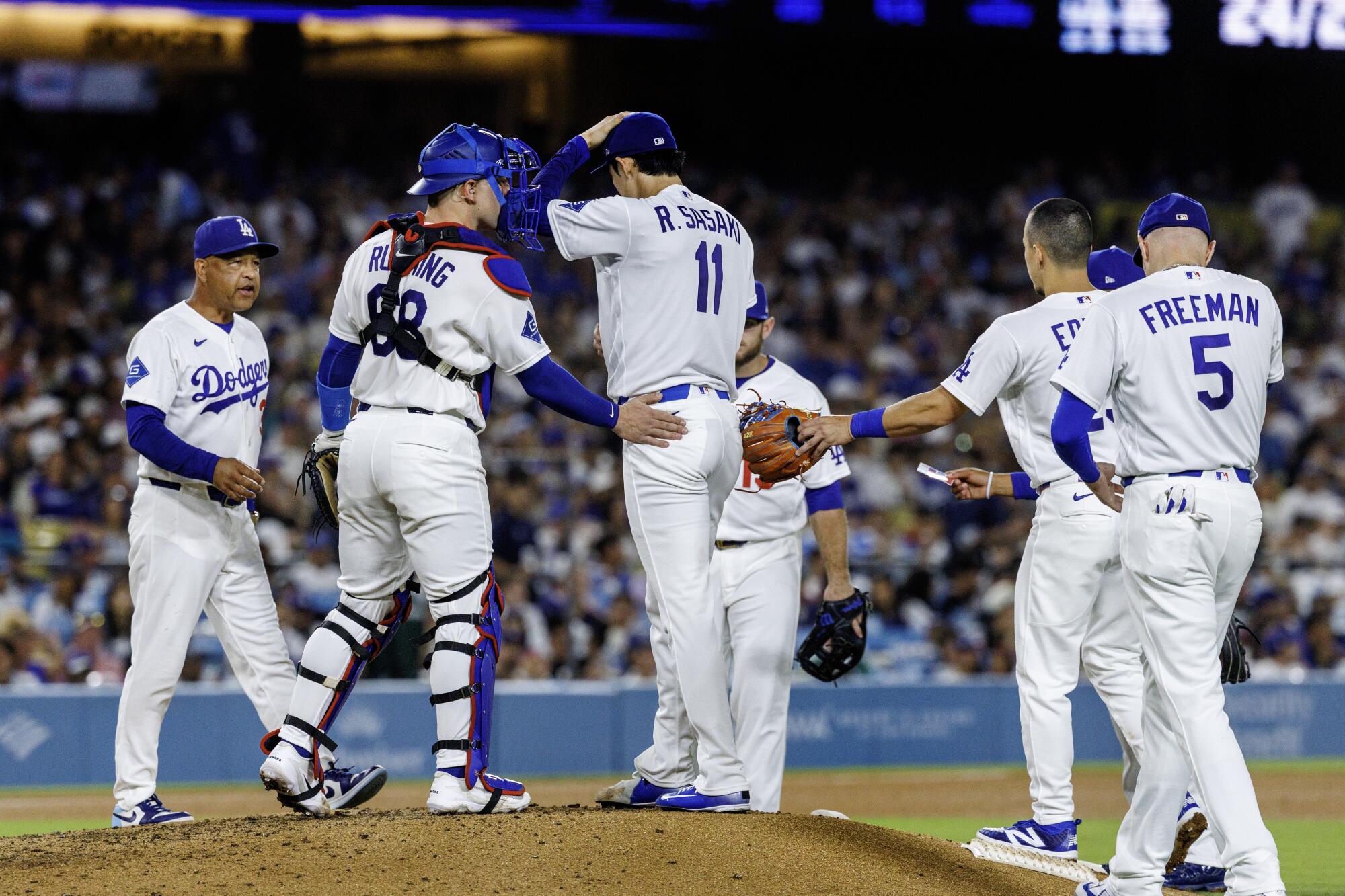
Teammates congratulate Roki Sasaki as he's pulled from the game.

Teammates congratulate Roki Sasaki as he’s pulled from the game by Dodgers manager Dave Roberts in the sixth inning Thursday against the Seattle Mariners.

(Gina Ferazzi / Los Angeles Times)

“This is a tough league,” catcher Dalton Rushing said. “You have to have confidence and if you don’t have confidence, it’s hard to be successful. I think that’s all it was. He lacked a little bit of confidence early on. And as soon as he had that runway to kind of allow himself to be himself, you’ve seen the best out of him.”

Progress isn’t linear. But it’s been undeniable.

As a much-hyped rookie last season, Sasaki didn’t step right in as a permanent part of the Dodgers’ starting rotation. He had health issues and crises of confidence. And he had to acclimate to a culture far from his home in Japan, and to do it with his baseball-mad country following along closely.

All while playing under the Dodgers’ high-powered microscope. (Ask Kyle Tucker, a 29-year-old, English-speaking American, how challenging it’s been.)

Then, in the postseason, Sasaki became a not-so-secret secret weapon out of the bullpen in the Dodgers’ successful World Series defense. A step forward in relief, and then, as a sophomore starter, several steps back.

This spring training, Sasaki posted a 15.58 ERA and allowed 15 walks in 8⅔ innings. He looked lost — like, I thought, someone whose too-often dejected body language told us the glare of Dodger Stadium’s bright lights would do more damage than help.

I felt bad for the young man, felt he should get to fix his issues in the minors. I doubted his fortitude.

To start the regular season, Sasaki was shaky. He struggled with command. Failed to get out of the fifth inning in his first three starts. And the appeals began for the Dodgers to sign Sasaki up for duty in the ‘pen.

But the Dodgers (69-40) didn’t seem to consider it.

Why would they? They’re incentivized to see this trial all the way through, because of what it says about them as a developmental destination. As the club that pushes the right buttons. That can figure out how to help top talent figure it out.

A lower-half mechanical change over the All-Star break helped the 6-foot-2 Sasaki’s retooled splitter regain its movement and his fastball its heat; he hit or eclipsed 100 mph six times Thursday.

Also, a noticeably larger glove seems to have helped him curb his habit as an overly generous tipper. They thought he might have been inadvertently cluing in opponents with his movements on the mound — now they’ve found a way to better hide them, though neither Sasaki nor manager Dave Roberts want to credit the leather for this recent breakthrough.

“It’s not the glove,” Roberts said. “I think it’s just more of even the second half, when he came out that first start, you just saw that I think he just kind of decided that it’s time to go and finish strong. It’s a new half, it’s a new beginning. And you’ve seen a different player, you know, to be quite honest.

“There’s a lot more confidence … I use that word ‘conviction’ a lot, and there’s a lot of conviction.”

Because it’s not the size of a glove on a man, right? It’s his heart.
Source link

Dodgers overcome Roki Sasaki’s poor performance to rout Padres

Roki Sasaki’s abysmal appearance faded away in the Dodgers’ 12-7 win over the San Diego Padres after Los Angeles rose from a catatonic first inning. The Dodgers roared back from a 6-0 deficit as Andy Pages skirted a tying double down the left-field line, and Mookie Betts and Max Muncy each drove in runs to give them the lead in a four-run fourth inning. All of which sent the sellout crowd into jubilant celebrations, some jumping, others breaking out World Cup chants.

“I don’t know,” manager Dave Roberts said of the team’s ability to turn the game around. “Thankfully, it played out the way I didn’t expect, or the way it started.”

By the time the game ended, Sasaki’s three-inning start seemed like a murky nightmare the Dodgers awoke from in a sweat. Except the Dodgers weren’t dreaming, and the team hadn’t done much to assuage the concerns with Sasaki.

The problem with Sasaki isn’t his stuff. On his best nights, when the velocity and command combine, Sasaki blows past batters with a triple-digit fastball and cutting off-speed pitches. The problem has been how to tick the radar without making the strike zone look like a Jackson Pollock painting — and recently, it has.

Sasaki’s June swoon, impervious to the calendar change, continued into Thursday’s series opener against the Padres, in which the right-hander gave up three home runs and seven hits before Roberts called it quits going into the fourth inning.

“They were on everything,” Roberts said. “You could see it.”

One possible concern? Tipping pitches. While Roberts and catcher Dalton Rushing said the team would need to do some more research into Sasaki’s start, both left the door open to this answer.

“That would be a big explanation as to how they felt like they were on every pitch,” Rushing said.

As San Diego chugged through its lineup, Sasaki struggled to keep up. With his first pitch, he gave up a double to Fernando Tatis Jr., who scored on Manny Machado’s home run that left center fielder Pages staring at the ball’s path as it plopped down on the other side of the blue outfield fence.

The inning was only a preview of the Padres’ power. Each of the nine San Diego batters got his chance against Sasaki in the second, and the team quickly dug the Dodgers into a six-run hole. He surrendered two home runs in the second inning. First, Jackson Merrill blasted a ball to left-center field, and, two outs later, Jake Cronenworth drove in two runs with a shot to right-center.

Sasaki said through interpreter Kensuke Okubo that he felt like he needed work on his command to improve, but he felt like his fastball was good.

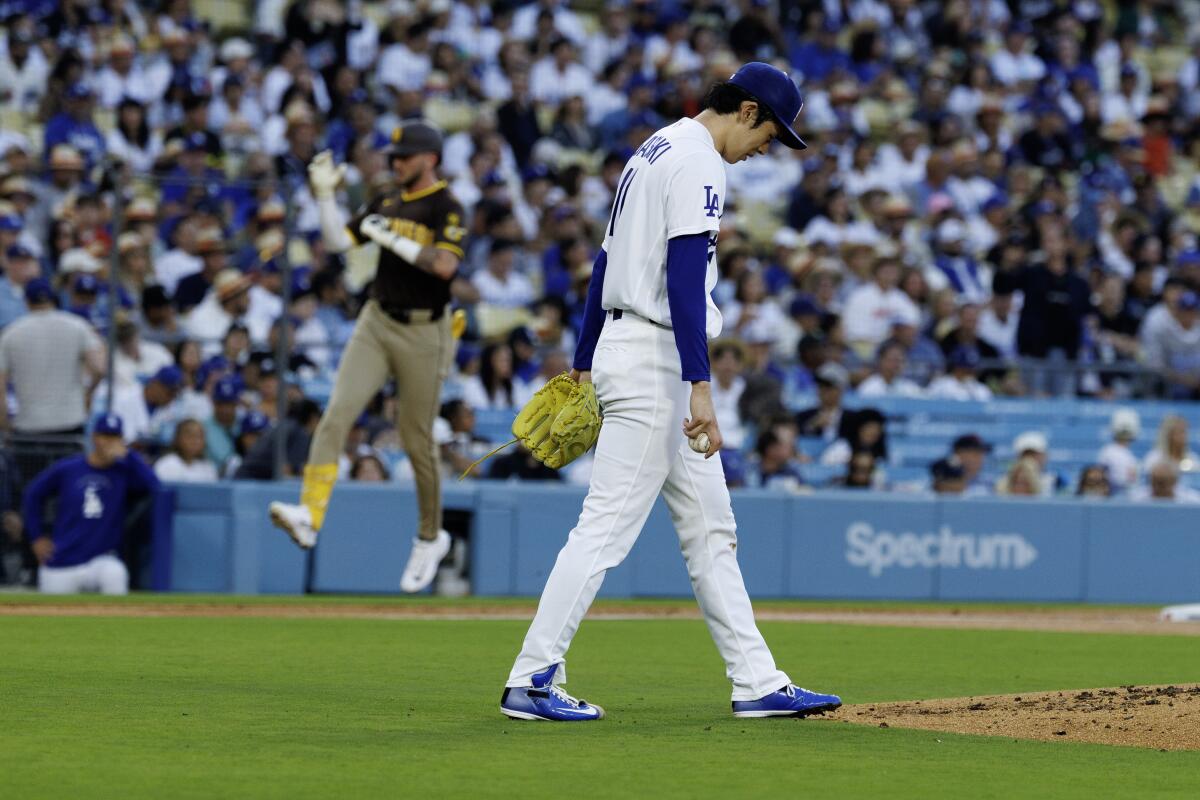
Roki Sasaki has his head down after giving up a solo homer to Jackson Merrill in the second inning.

Roki Sasaki has his head down after giving up a solo homer to Jackson Merrill in the second inning.

(Gina Ferazzi / Los Angeles Times)

“I don’t think my stuff was bad today,” Sasaki said. “Overall, it wasn’t great but a lot of things evolved.”

Part of Sasaki’s issue lies with his approach. Roberts said he wants the second-year pitcher to be aggressive, to play the cat-and-mouse game required to beat batters in the box. But when given the opportunity, Sasaki has shrunken in recent outings, struggling with his command and his ability to pitch deep into games.

“We had a great May, so let’s just get back to competing and making pitches,” Roberts said.

When reliever Will Klein walked out to the mound in the fourth to the aggressive, rambunctious clamor of the Dropkick Murphys’ “I’m Shipping Up to Boston” and collected two scoreless, one-hit innings, the relief was immediate: The Dodgers took the lead.

The lineup already was revving, as Dalton Rushing homered in the second inning while Sasaki was still in the game, and both Kyle Tucker and Max Muncy drove in runs in the third, cutting the deficit to two. The Dodgers broke through against the Padres’ bullpen to score six runs in the fourth and fifth innings.

“The bullpen was fantastic tonight, and then the offense came up big,” Roberts said.

A late catch by Pages helped close out the game after he gloved a ball despite ramming into the padding of the center field wall. A combined effort by Paul Gervase and Tanner Scott shut down San Diego’s ninth-inning momentum after it pushed across a run.

“Turned back around, was able to find the ball and make a really good catch right there,” Tucker said. “That was a huge out.”

The Dodgers (57-31) beat their division rivals for the fifth time in seven games to open a 13-game lead over both San Diego and Arizona. The Padres, meanwhile, have given up 65 runs over the last six days, the most in such a span in franchise history.

But San Diego’s flaws don’t negate the Dodgers’ as they burned through six relievers in their win. So, while the Dodgers crawled out of the hole with a season-high 17 hits, the steep cost heightens the pressure on the rest of the rotation the rest of the series.

Source link