Mainstream California Democrats survived election night, but their brand remains challenged
When Nithya Raman stepped up to a podium on the night of L.A.’s mayoral primary election, she thanked her supporters for standing up to the “powerful interests” who spent millions of dollars trying to “preserve this city’s broken and unjust status quo.”
“At a time when so many people have written Los Angeles off or have lost hope in the future of this incredible city,” the democratic socialist L.A. mayoral hopeful said, “you are proof that Angelenos are hungry for change.”
But as election results rolled in, the movement for change was underwhelming, or at least divided. Incumbent Mayor Karen Bass was in the lead, advancing to the November runoff. That left Raman locked in a battle for a second spot with Republican former reality TV star Spencer Pratt.
Bass is one of several high-profile establishment Democrats to emerge on top. In California’s gubernatorial race, centrist Xavier Becerra, a veteran of the Biden Cabinet, advanced to the runoff after being challenged from the left by billionaire green activist Tom Steyer and Democratic former U.S. Rep. Katie Porter. Steyer is now behind Steve Hilton, a Republican, and battling to make the runoff.
Still reeling from the rise of Donald Trump, Democrats in California and beyond are struggling to figure out the future direction of the party.
Some progressives, inspired by Zohran Mamdani’s New York mayoral victory, saw 2026 as an opportunity to move the city further left. But the results have been mixed in key races, with veteran Democrats like Bass and Becerra eking out leads even as polls show dissatisfaction with status quo politics in California.
“This was supposed to be a change revolution, but voters clearly said no to the revolution,” said Sara Sadhwani, a politics professor at Pomona College. “Voters want change,” she noted, “but it doesn’t appear right now that there has been an appetite for a major shift in the ideology of the city or the state.”

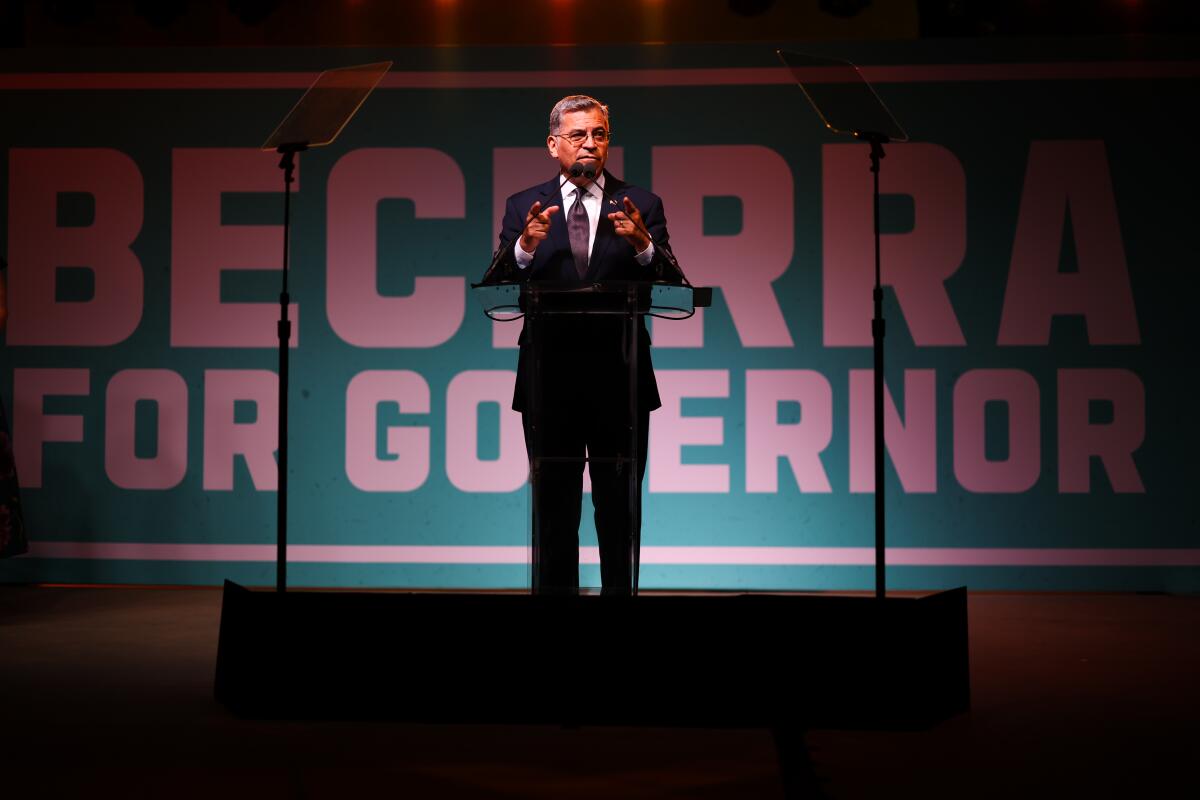
Xavier Becerra speaks during an election night event in downtown Los Angeles on Tuesday.
(Eric Thayer/Los Angeles Times)
Becerra emerged as the Democratic favorite late in the election and won support from many establishment party leaders. Pundits said after a wild primary that included the implosion of Democratic U.S. Rep. Eric Swalwell’s campaign amid sex assault allegations, Becerra emerged as a “safe” choice.
Some opponents attacked his moderate views and his willingness to accept campaign donations from big oil companies like Chevron. But that did not stop his rise.
Bass was also beset with challenges, being an incumbent in a city beset with problems.
For her, election night marked a “victory with an asterisk,” Sadhwani said, noting that Bass is first incumbent L.A. mayor in more than two decades to face a runoff. “It would be wrong for Karen Bass to think that this victory … is a ringing endorsement of the work she is currently doing.”
The results underscore Bass’ unpopularity as an incumbent, garnering just 35% of the vote so far. If Raman can catch up and eventually surpass Pratt in the vote count, she could pose a considerable challenge to Bass as more young voters come to the polls in November.
Mike Bonin, a former L.A. City Council member who leads the Pat Brown Institute for Public Affairs at Cal State L.A., said if Bass exceeded expectations it was because they were very low.
“Coming in first in a runoff isn’t a huge victory for an incumbent mayor,” he said. “Two-thirds of the city did not vote for her. That’s not a position of strength.”
James Adams, a political science professor at UC Davis, said that Becerra and Bass coming through indicates the centrist Democratic candidates were in a stronger short-term position than their rivals. But problems loom ahead, he said, as the longtime Democratic establishment that’s been governing California for the last 15 years failed to make notable progress in solving problems with affordable housing, homelessness, public transportation and education.
“I think the Democrats’ prospects are very bright in 2026 given the California Republicans’ dysfunctionality and a complete backlash against Donald Trump,” Adams said. “But I have much bigger concerns about the California Democrats long term, because it seems to me they’re setting a record for most consecutive years of failing to fix the state’s problems while getting reelected anyway.”
Democrats in California, he said, were suffering from being in power too long.
“Whenever one party gets into a long-term, dominant position, usually because the other party is just in the midst of self-destructing … the whole thing ends in tears, because the party that is in a dominant position, they don’t have to be that good.”
As the vote count continues in the mayor’s race, democratic socialists in Los Angeles already have some wins down-ballot.
“We are gaining momentum,” said Leslie Chang, a co-chair of the 5,000-member L.A. chapter of the Democratic Socialists of America, a decentralized anti-capitalist group that advocates for rental protections and defunding the police. Over the last six years, Angelenos have elected four DSA-backed City Council members and a DSA-recommended city controller.
The DSA did not officially endorse Raman, because she entered the race after the group had issued endorsements and another DSA candidate was also running for mayor. However, three of the six DSA-backed candidates for citywide office were projected to win outright.
DSA Councilmembers Hugo Soto-Martinez and Eunisses Hernandez were reelected by such large margins they avoided runoffs. In the city attorney’s race, DSA-endorsed Marissa Roy was in the lead and the mainstream Democratic incumbent became the first city attorney ousted in a primary in nearly a century. City Controller Kenneth Mejia, a progressive anti-establishment candidate who is not a DSA member but an ally of the group, led by nearly 20 percentage points.
When Chang knocked on doors, she said, some voters asked: “Well, what’s the difference between Nithya and Karen Bass?”
A few voters told her that after reviewing Bass’ and Raman’s websites, they found their platforms similar. Chang was surprised. She thought Raman articulated a clear and novel strategy for how to get L.A. out of the housing crisis, but she said some on the left took issue with her working with housing developers to reduce red tape.
Neel Sannappa, chair of the California Democratic Party’s progressive caucus, said Raman was stymied by getting into the race late and having only a few months to campaign. It also didn’t help that a more left-wing challenger, Rae Huang, already had some momentum — not enough to win, but enough to split the left.
“Nithya does represent something real and growing in Los Angeles,” Sannappa said. “There is a hunger for more progressive, left-leaning candidates that want to make sure that we’re investing in people and not so much investing in just police … and being able to build things that are new and innovative.”

Supporters watch election results come in on their phones during Nithya Raman’s election night party at Boomtown Brewery on Tuesday.
(Gina Ferazzi/Los Angeles Times)
Some have criticized Raman’s coalition-building, noting she was not endorsed by her fellow DSA-backed City Council members. Others said the MIT and Harvard graduate, who has been a councilmember for six years, performed tepidly in a May televised debate and suffered from Pratt’s attempts to tie her to the establishment.
“If you’re a part of the institution, which she is,” Sadhwani said, “then you can’t exactly claim that you’re going to bring massive change.”
Sadhwani said that California’s left, in contrast to New York’s, appears to have a charisma deficit. While Pratt and Hilton had an advantage with their television backgrounds, they also spoke “in plain terms about the real problems that the state faces.”
Part of Bass’ success can also be attributed to assembling a coalition that included the L.A. County Federation of Labor, the L.A. police officers union, the L.A. County Democratic Party and immigrant rights groups.
In the mayoral race, Sadhwani said, “the dominant political coalition still has power, money, the organization.”
“If you can garner the support of the unions, then having a broader message, maybe it’s less important,” she said. “You don’t have to work quite so hard, because the unions have the base machine.”

People attend Mayor Bass’ election party for the California 2026 primaries at the LINE Hotel on Tuesday.
(Carlin Stiehl/For The Times)
Yusef Robb, a longtime Democratic strategist who is an advisor to Bass, attributed the mayor’s lead to her campaign’s success in building a broad coalition and communicating across the political spectrum. Most voters, he said, tend to think less about ideology — and whether a Democrat was mainstream or DSA-supported — than candidates’ positions on bread and butter issues.
“Mayor’s races are first and foremost about what people see outside of their front doors, when they walk their kids to school, when they drive to work,” he said. “At the end of the day, the voters look at the field and say, ‘OK, who do I trust to keep my kids from having to skip around a tent on the way to school?’ ‘Who can I trust to hire more officers?’ … and ‘Who can I trust to fight back against ICE in court through executive action and even in the streets?’ And that’s Karen Bass.”
For Democrats in this robustly blue state, part of the challenge in figuring a path forward is that every candidate — even those already in power — pitches themselves as a bona fide progressive against the status quo.
“We have led a grassroots campaign because we want to bring change to our city,” Bass said on election night. “And that’s what we’ve been doing, and that’s what we’re going to continue to do.”
Raman also tried to tout herself as a change candidate. Articulating her platform in broad strokes rather than bread-and-butter detail, Raman said she wanted L.A. to be a place “where government actually functions and delivers every day on this city’s beautiful bighearted values, where we stand up against ICE, where we show up for our gay and trans siblings.”
But as she talked of neighborhoods “full of trees and shade … and people and good food,” she seemed low-key and equivocal. Her message was a far cry from the pressing one U.S. Sen. Bernie Sanders (I-Vt.) put forward in his presidential campaigns, highlighting the millions of Americans working for “starvation wages” and a young single mother in Nevada struggling on $10.45 an hour.
Ultimately, the fight between Bass and Raman, as a struggle between mainstream and progressive Democrats, is complicated by the fact that Bass came up through the progressive wing of the Democratic Party, founding the grassroots Community Coalition in South L.A. in the 1990s.

Campaign worker Khai Dombroe prepares balloons before Nithya Raman’s election night party.
(Gina Ferazzi/Los Angeles Times)
And even though Raman is a DSA member, she has tacked to the center during the campaign, distancing herself from past calls to defund the police by saying she did not want the LAPD to lose more officers.
While Raman and Bass have much in common, the most significant difference between them is on homelessness, Sannappa said. Even though Bass comes from a political tradition of not wanting to criminalize the unhoused, he said, she understood her voters include people wanting to move homeless people off the streets.
“Brass tacks is that we need people that are going to be willing to fight for mental health services,” Sannappa said.
“I think Nithya more so represents the direction where the Democratic Party is going to have to go.”
As L.A. becomes less affordable and homeownership becomes out of reach for many Angelenos, young renters have become a rising political constituency — a shift that many say will likely propel the city leftward.
Bonin said he expected the next new rising Democratic coalition in L.A. to be a labor-renter coalition. He cited Councilmember Soto-Martinez, a renter and union organizer, as probably the best avatar of that.
But as the middle-class splinters along generational lines, other political experts warn that many ordinary Angelenos feel increasingly shut out of L.A. politics.
“Once upon a time the Democratic Party was the party of the working class, and today it has become the party of the educated elites,” Sadhwani said. “Perhaps one of the gifts that Donald Trump has given to Democrats is to force them to contend with the everyday issues of voters, which they seem to have distanced themselves from.”
As many Angelenos feel worse off now than four years ago, Chang said Bass was not directly responsible for every problem. Still, she said, she could have done more to move the city in the right direction.
Delaying the wage boost tied to the 2028 Olympics, she said, was a move that failed working people at a time when many are struggling to make ends meet.
“My fear, of course, is people pivot away from corporate Democrats and they choose the MAGA Republican, because that is the most visible fight,” Chang said. “Or because they think, ‘Oh, well, a democratic socialist running on the Democratic Party line, this is just more of the same status quo.’ ”