It’s understandable that the P.A. announcer at St. John Bosco High on Friday night misspoke after seeing Mosley’s brother, Grant, catch a 49-yard touchdown pass for Santa Margarita and run like Trent in a showdown game between the No. 1 Eagles and No. 2 Braves.
“Pretty good,” Trent, USC’s star freshman receiver, said on the sideline when asked about Grant’s touchdown. “He’s healthy.”
As if unbeaten Santa Margarita (8-0) didn’t have enough weapons, the return of Grant Mosley after two seasons of dealing with a shoulder injury means it’s time for opponents to start feeling very uncomfortable.
“I’m back,” Grant announced afterward.
Santa Margarita won its 15th consecutive game in defeating St. John Bosco 21-7.
“He looked great,” coach Carson Palmer said.
“We knew when as he got healthier, he was going to be a threat,” St. john Bosco coach Jason Negro said. “He’s a dynamic player like his brother.”
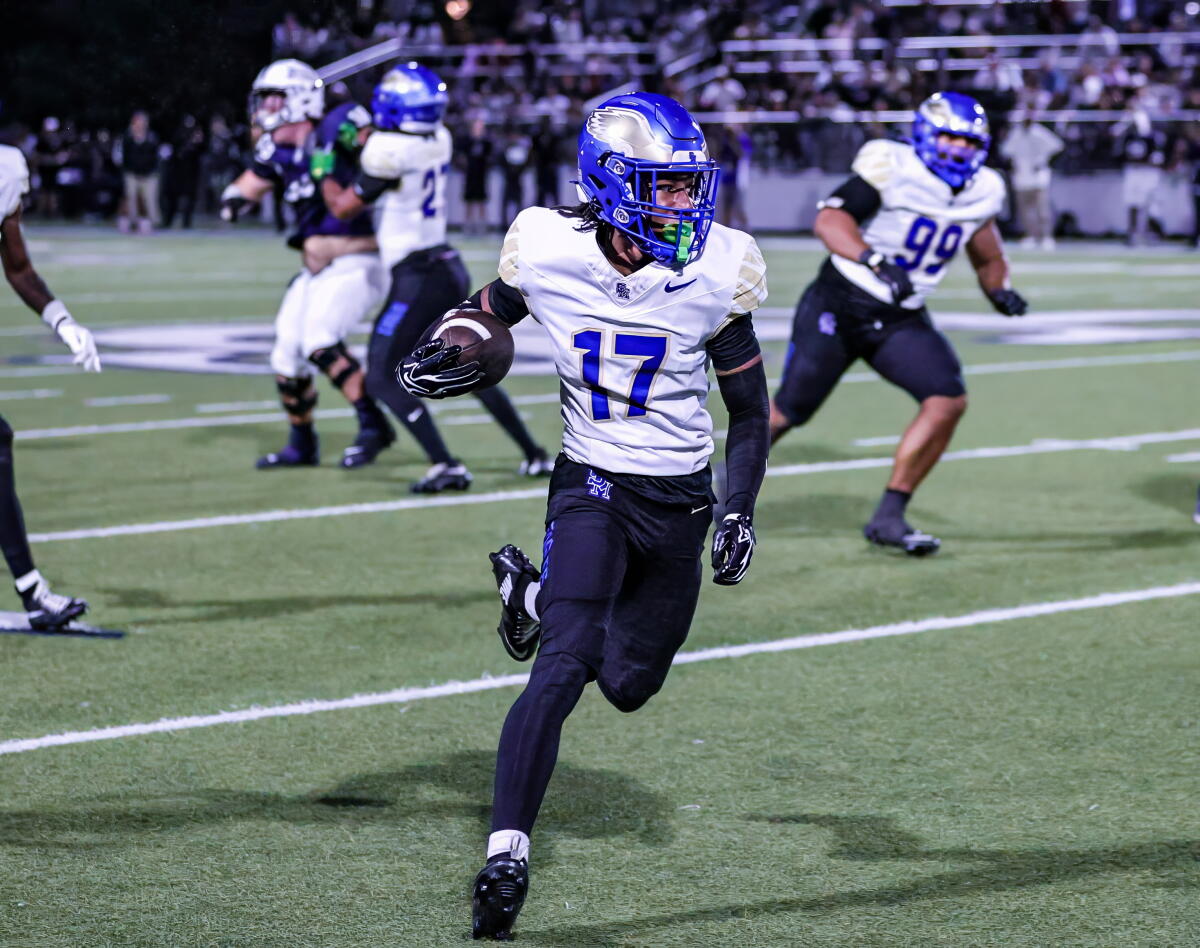
Santa Margarita High sophomore Rayshawn Brandon returns an interception 51 yards for a touchdown Friday night against St. John Bosco.
(Craig Weston)
The touchdown pass happened during a trick play, in which quarterback Fletch Palmer handed the ball to Adrian Petero, who lateraled the ball back to Palmer, who threw a perfect spiral down the middle to Mosley. That play was Santa Margarita royalty at its best — a Mosley catching a touchdown pass from a Palmer, the son of the head coach.
It gave Santa Margarita a 21-7 lead in the third quarter.
“What a pass,” Carson Palmer said. “What execution. What protection.”
Santa Margarita came up with two interceptions in the first half leading to two touchdowns and a 14-7 halftime lead.
After St. John Bosco (6-2) had taken a 7-0 lead on a 28-yard touchdown catch by Kuika Moaalii, sophomore Rayshawn Brandon picked off a pass by quarterback Koa Malau’ulu, who was rolling to his left under pressure, and returned it 51 yards for a touchdown. Then Ca’ron Williams came up with another interception deep in Braves territory, leading to a one-yard touchdown run by Petero.
At the end of the half, Jaion Smith of Santa Margarita deflected a possible third-down touchdown pass in the end zone and Jake Martin followed by blocking a St. John Bosco field-goal attempt.
Jaion Smith comes through with the defensive play with six seconds left on third down. Then Santa Margarita blocks field goal attempt. Halftime Santa Margarita 14, St. John Bosco 7. Jake Martin block. pic.twitter.com/tmsbW9n7EG
If anything was learned about Santa Margarita last season in its first year under Palmer, it’s that the Eagles have one of the best coaching staffs in the state and keep improving each week. By the end of the 2025 season, Santa Margarita was 35 points better than its closest opponent.
Could a similar situation be occurring now?
Dash Fifita and Trent Mosley out supporting Santa Margarita after playing golf. Trent apparently can hit a 5 iron 200 yards. Need to confirm. pic.twitter.com/ggqMIPms51
“I just feel we have the best staff in the nation,” Grant Mosley said. “So every week, we’re just developing. And we’re still not at our highest state. Once we get to the playoffs, that’s when we’ll be at our best.”
With Trinity League wins over St. John Bosco and Mater Dei, the Eagles have moved into the driver’s seat to win the league title.
Before the game, Carson Palmer was walking around the field feeling excited and confident.
“We’re ready,” he said.
He wasn’t kidding.
As for his brother getting initial credit for the touchdown, Grant said, “Oh well.”
“I’m still not even at my full state yet,” Grant said.
That’s scary coming from a brother with the Mosley genes.
Anyone have a helicopter available for Friday night?
This is the weekend when high school football fans and sportswriters across the Southland need air transportation or multiple screens on a computer or cellphone or at a sports bar to watch the many top games during Week 8.
It doesn’t get any better than No. 1-ranked Santa Margarita (7-0) playing at No. 2 St. John Bosco (6-1) in a Trinity League game that will feature big-boy football at its best. The NFHS Network will be streaming the game.
It’s not the only game you’ll want to see.
Let’s review the choices so you can use Google Maps or a TV remote control or just never let go of your phone on Friday night.
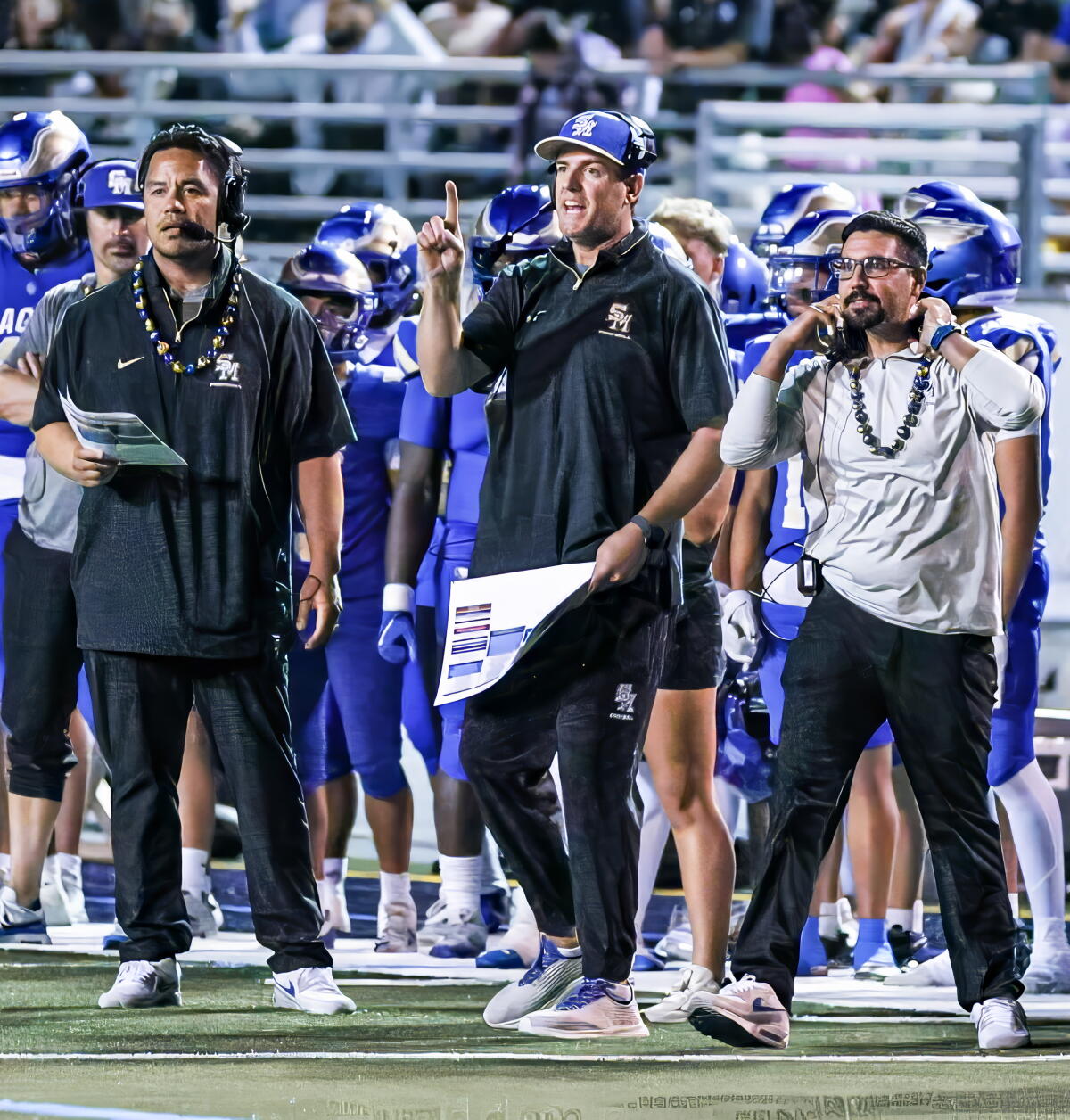
Santa Margarita coach Carson Palmer, center, with offensive coordinator Lenny Vandermade, left.
(Craig Weston)
Santa Margarita at St. John Bosco, 7 p.m.
Last week, St. John Bosco avenged last year’s stunning Southern Section Division 1 first-round playoff loss to Orange Lutheran, a team it beat 48-0 in the regular season. This week, the Braves finally get to play Santa Margarita, the school that won the state Open Division championship because St. John Bosco was nowhere to be found. Santa Margarita has a 13-game winning streak since losing to the Braves last October.
This isn’t the same Santa Margarita team. Trent Mosley is now at USC, where he looks like a Heisman Trophy candidate when not injured. The Trojans are off this week, so look for Mosley to be on the sideline supporting brother Grant, an Eagles receiver. Santa Margarita’s strength is running the ball with undersized Adrian Petero (5 feet 5, 175 pounds) to set up the pass for quarterback Fletch Palmer, son of coach Carson Palmer.
St. John Bosco has become more of a running team with Maliq Allen, but quarterback Koa Malau’ulu remains a dangerous weapon with receivers DJ Tubbs and Kuika Moaalii. This game likely comes down to a chess match each play, testing defensive coordinators Steve Fifita (Santa Margarita) and Chris King (St. John Bosco). Both have great respect for each other. Turnovers, penalties and special teams must be watched closely. The pick: St. John Bosco.
Bishop Amat (6-1) at Sherman Oaks Notre Dame (7-0), 7 p.m.
Spectrum 1 chose to televise this game, which will decide who gets to finish second in the Mission League behind Sierra Canyon. Notre Dame is a surprise being unbeaten at this point, but Tahj Skinner has proven to be one of the best athletes at quarterback, and the Knights are filled with fast players on both sides of the field from their successful track program. Bishop Amat must worry about Notre Dame’s speed, but Notre Dame must deal with the Lancers’ physicality. The pick: Bishop Amat.
Mission Viejo (6-1) at San Clemente (7-0), 7 p.m.
Home-field advantage matters in this annual rivalry game in the recently renamed Alpha League. Mission Viejo’s offensive line is elite. Receiver Jack Junker got to play running back last week and showed his big-play skills. San Clemente has its own versatile star in receiver/safety Jaxson Rex. In the end, it’s about which young quarterback can avoid mistakes, with Mission Viejo relying on sophomore Brett Burnor and San Clemente turning to junior Preston Beck. The pick: San Clemente.
King/Drew (4-3) at Crenshaw (5-2), 7 p.m.
King/Drew has been the upstart trying to win the Coliseum League with Crenshaw always standing in the way. Quarterback Gerald Torres has put together a strong season, passing for 1,363 yards and 13 touchdowns. Crenshaw struggled against Palisades’ passing attack this season, so the Cougars’ defense will be tested. Crenshaw has added more balance on offense with quarterback Ethan Grant. The pick: Crenshaw.
Hamilton (3-4) at Palisades (3-3), 7 p.m.
There should be more than 100 passes attempted in a game that will decide the Western League title. Have ice available afterward for the elbows of quarterbacks Robert Holohan III of Palisades and Thaddeus Breaux of Hamilton. The pick: Hamilton.
Families staying in Center Parcs in the run-up to Christmas can book an “unforgettable” experience in the comfort of their own lodge, but the price tag has led to criticisms from fans of the holiday park
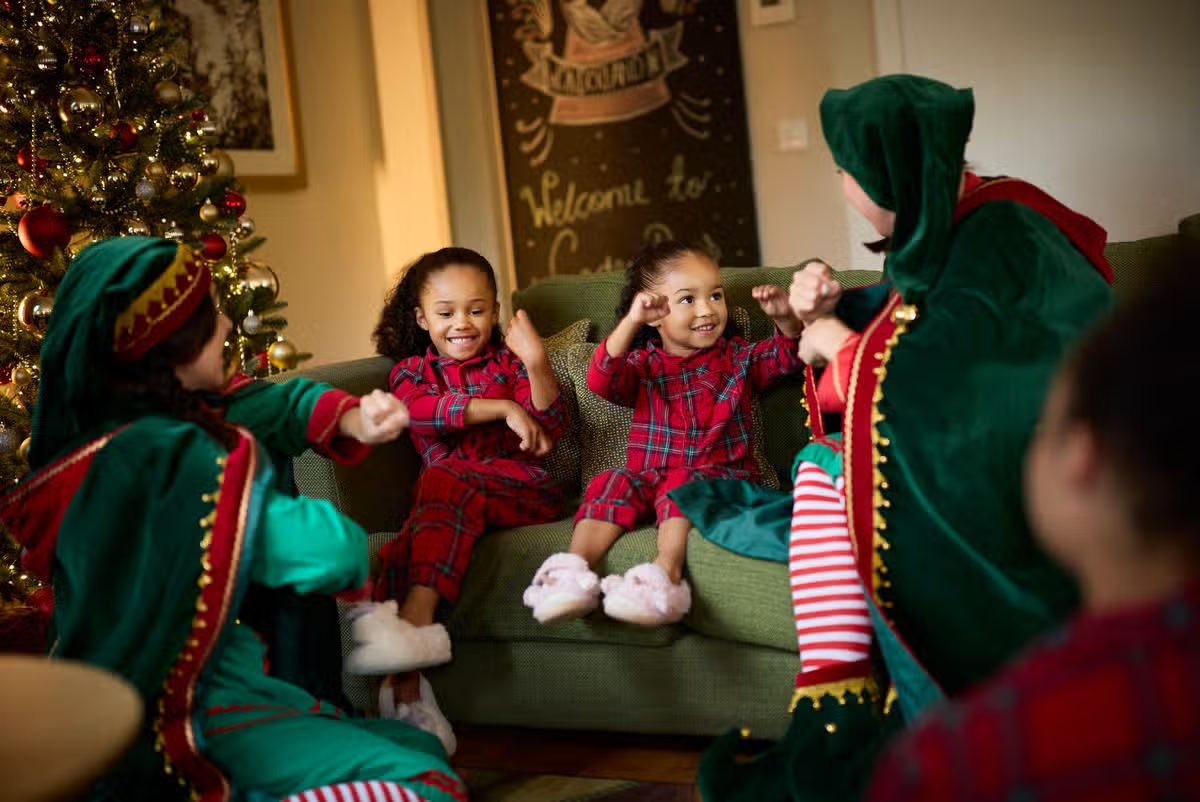
The experience takes place in your own lodge and includes personal touches(Image: Center Parcs)
Center Parcs has always had a premium image, which comes with premium prices. However, fans of the lakeside holiday parks have taken to social media to complain about one of its new activities on offer for the festive season.
The Twilight Elf Visit is billed as “New and exclusive, an unforgettable Christmas experience awaits” on Center Parc’s website. It goes on to describe the experience: “As dusk begins to settle over the forest, gather in the comfort of your lodge for a surprise visit from two magical elves. Bringing an enchanting tale to tell, they’ll lead your family on a truly personal Christmas adventure filled with storytelling, festive surprises and magical moments.”
One Center Parcs guest, who was considering booking the experience, took to a Facebook page to question the price. They asked: “Has anyone seen on the website the new Twilight Elf visit to your lodge…. Surely no one is paying that sort of price £300+ for just one child!?!” She went on to post a screenshot of the prices she’d been quoted for the elf visit on Thursday, December 22. For one child, the activity costs £310, £360 for two, £410 for three, and £460 for four kids.
Do you have a travel story to share? Email webtravel@reachplc.com
When contacted about the cost of the activity, a spokesperson for Center Parcs said: “This is a private, personalised Christmas experience, with two elves visiting the family’s own lodge for 45 minutes. The visit brings a festive adventure into the place where families are spending their holiday together, with stories inspired by and tailored to the guests themselves and opportunities for children to become part of the magic.
“Throughout the experience, the elves reveal the special connection between the forest and the North Pole through storytelling, interactive moments and festive surprises. Children also create a Christmas wish to send to Santa, and families have the opportunity to capture photos with the elves.
“What makes Twilight Elf Visit special is the combination of time dedicated exclusively to the family, personal touches woven into the storytelling, and the intimacy of having the experience brought to their own lodge, so each experience for our guests is unique to them. It goes beyond a traditional festive meet and greet, giving children an active role in a story that feels personal to them, with the whole family sharing the experience in our unique forest setting.
“It’s a new, optional addition to our wider Winter Wonderland programme, which also includes favourites such as Santa’s Parade and the Enchanted Light Garden. We want families to have a choice of ways to enjoy the season together, with Twilight Elf Visit offering something particularly personal for those who choose it.”
The cost of the experience also includes a “beautifully engraved wooden family keepsake box filled with exclusive mementos to treasure long after your adventure ends. From a cuddly toy carrying each child’s Christmas wish to magical keepsakes inspired by your visit, each item is thoughtfully chosen to help your family relive the wonder of the season for years to come.”
But not everyone was convinced the activity would be worth the money. One poster noted: “This has to be the most expensive activity I have ever seen at [Center Parcs] …and I’ve been going years.” Another wrote: “This has to be a wind up?”. While a third commented: “That’s disgusting.”
However, many posters defended the cost of the experience. One said: “Yes, It’s a lot of money but I don’t see why everyone is so outraged about it, it’s obviously a very luxury thing they are offering, like the treehouses, If someone can afford them then they can afford the cost for the private elf visit.”
Others pointed out that other premium Christmas activities with kids can be just as expensive. “To be honest, people who go to Lapland UK are paying £300 sometimes more. So yes, there are people who will pay it.”
Have a story you want to share? Email us at webtravel@reachplc.com
Santa Margarita High football coach Carson Palmer said special teams is the Eagles’ best phase of play. Not the elite defense, which had seven sacks and held Mater Dei to seven points on Friday night. Not the offense led by his son Fletch, who completed 65% of his passes for 155 yards.
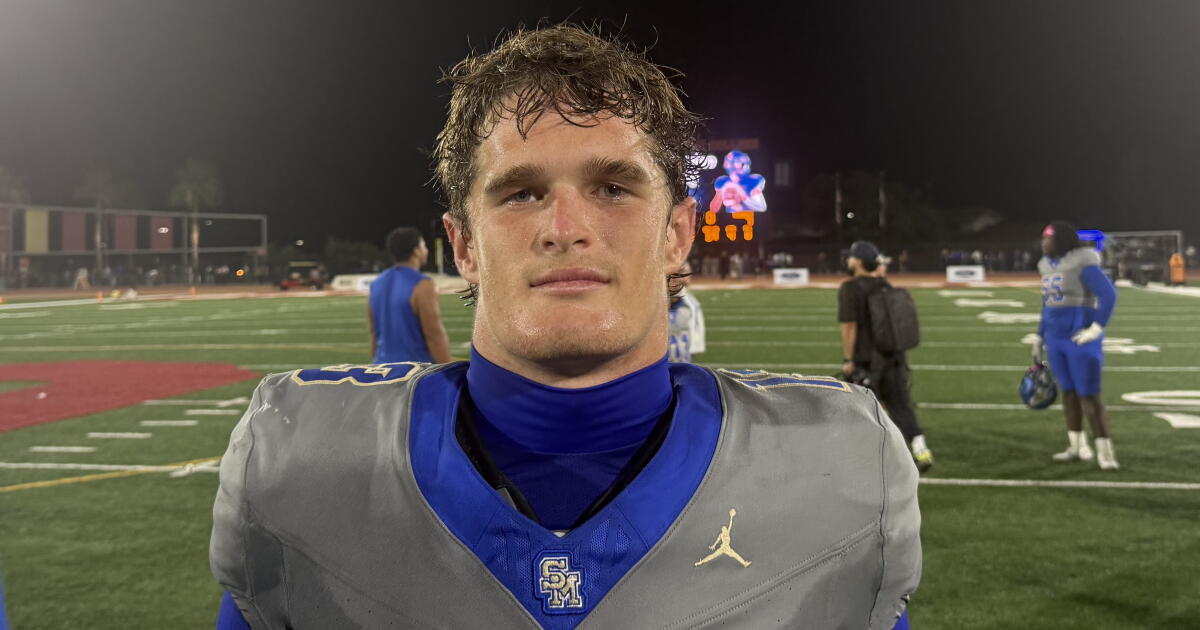
No, he was adamant that it is the special teams unit. Two plays from junior free safety Jake Martin proved his coach right.
Twice Mater Dei attempted a field goal and twice the kick was missed. Martin juked out blockers late in the first half to deflect the first attempt, keeping the score at 7-7. Then, he helped preserve a seven-point lead in the fourth quarter as his pressure on the outside forced a second miss.
“We’re unbreakable,” Martin said after the Eagles’ 14-7 win. “We’re trying to go back-to-back. This is the team that’s going to do it.”
The chances of a second straight CIF Open Division state championship look good so far. Winning the Trinity League opener at Saddleback College kept the Eagles undefeated at 6-0. Mater Dei dropped to 4-2.
Of course, the Eagles’ offense and defense made plenty of important plays.
The game was sealed with an interception from freshman safety Jayden Jack, as Mater Dei freshman quarterback Paytyn Guess heaved the ball to the end zone with the Monarchs out of timeouts and out of options. That, coupled with a big sack from sophomore defensive lineman Kingston Jimmerson, killed the momentum on the visitors’ final drive.
It wasn’t a bad night for the young quarterback, though, as Guess staked his claim to the starting role for the Monarchs.
Mater Dei rotated three quarterbacks in nonleague play, and coach Raul Lara kept his cards tight to his chest before the game. The starter was Guess, who took more than 90% of the snaps on a night when he finished 16 for 22 for 163 yards with one interception and no touchdowns.
“He’s dynamic, but the problem with him is that he’s a freshman who just came into the program and is getting his feet wet,” Lara said before kickoff.
The impressive Santa Margarita front exposed those growing pains. Guess held on to the ball too long and took too many hits.
His playmaking ability did give Mater Dei a chance until the final moments, as he scrambled around and found senior wide receiver Gavin Honore down the sideline. The inconsistency on offense, though, has been a source of frustration for Lara.
“It all comes down to execution. We have to execute,” he said. “When we have the opportunity to make a play, we need to make that play and take advantage of it.”
Mater Dei’s defensive line had a solid game, holding Santa Margarita star sophomore running back Adrian Petero to 41 yards on 11 carries, although he scored his team’s first touchdown.
It was Santa Margarita’s junior quarterback who had the decisive play as Palmer found junior wide receiver Grant Van Raaphorst in the back of the end zone for a six-yard touchdown in the third quarter.
Mater Dei sophomore running back Asir Nembhard had the only touchdown for his team, which gave the Monarchs their only lead of the night in the first quarter.
Before the game, Palmer said tat he tells his players to never take an opponent too lightly nor build it up too much. The former NFL quarterback played in a division with the prime Pittsburgh Steelers and Baltimore Ravens, so he knows a thing or two about a competitive schedule like the Trinity League offers.
“We’ve got a target on our back after last year, and we know that,” Palmer said. “We know that we are highlighted on other teams’ schedules.”
He also emphasized that his team could improve in every aspect of the game. That is certainly a scary prospect for foes facing the No. 1 team in the state.
I asked myself this question and then one second later I asked Google, because my phone was in my hand as it is 50% of the time, and 75% of the time when I’m not being social. I spend a lot of time alone, writing books that I hope will end up in libraries.
I knew there were many public libraries in L.A., and that walking to all of them would probably result in a trail that looked like a snarled nest. This turned out to be correct. The city of Los Angeles has 73 libraries. The county has 86. And Santa Monica has five.
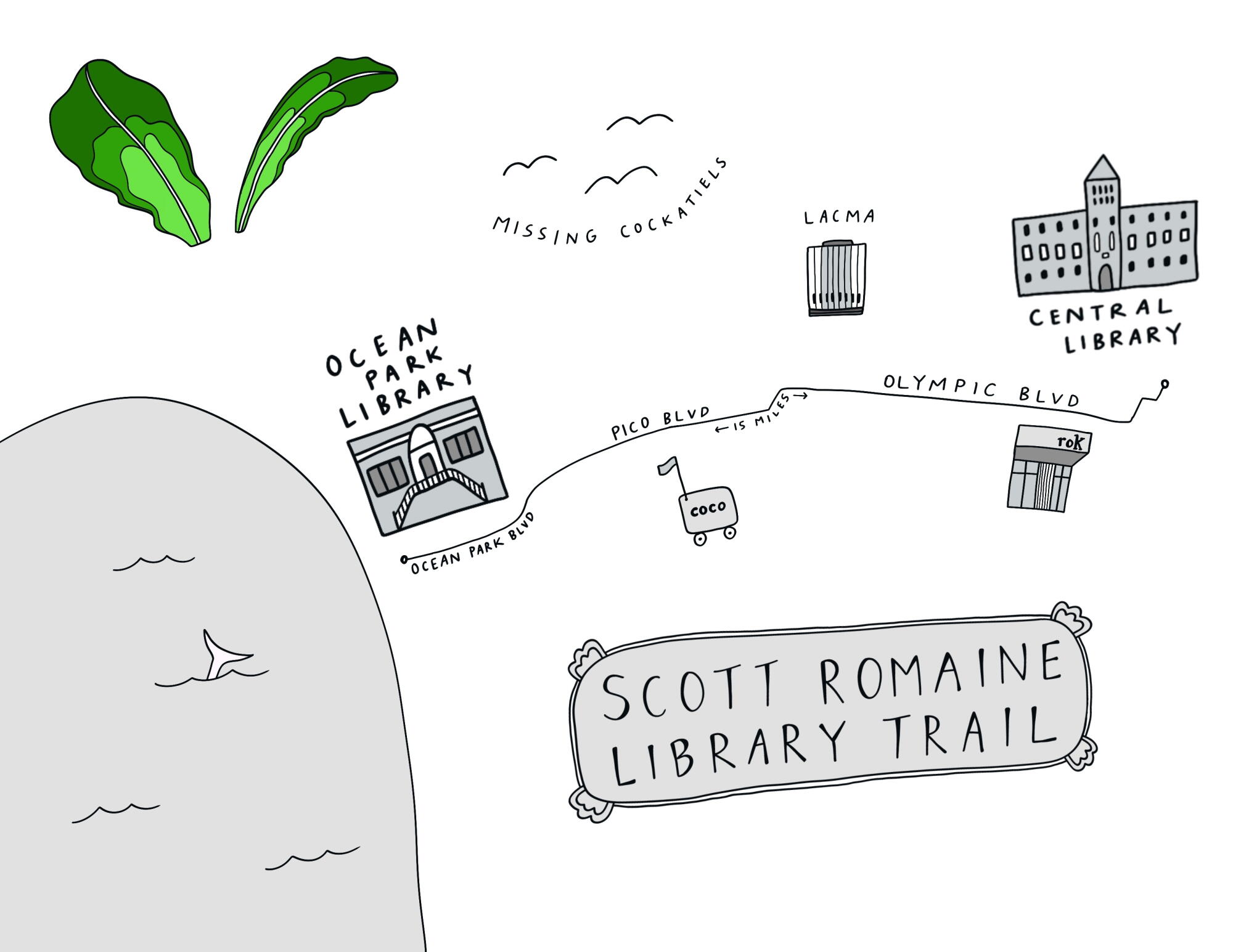
So, I decided to simplify. I would walk about 15 miles from the Central Library in downtown L.A. to the Ocean Park Library in Santa Monica, and, since every trail needs a name, I would call it … the phrase “booking it” arrived in my mind. I crossed that out, and then I crossed out some other bad options, and then I decided to let it go and name the trail after I was done, which is often what I do when writing a novel, because you don’t really know what a thing is until it exists. With books, and with trails, and with life, the only thing we can ever be sure of is that our plans will always turn out to be wrong.
An illustrated map of the 15-mile trek from the Central Library in downtown L.A. to Ocean Park Library in Santa Monica.
Case in point: The day before the trail, I planned to draw some lettuce on my sun hat with fabric pens. I envisioned that on one side, the lettuce would be beautiful and perfect, and on the other side, it would be goopy and rotting. What ended up happening was that I drew two lovely romaine leaves, and I liked them so much that I stopped there.
As I said, I spend a lot of time by myself, and I imagined that walking this trail would be a solitary adventure. I’m currently in the process of writing a new novel, and since walking is so conducive to writing, I thought the trail would give me a nice big swath of time to ponder the fictional world I’ve created.
I was told that a photographer named Scott Strazzante would meet me at the Central Library at 7 a.m. I assumed he’d take some shots and maybe walk with me for a little while, and then we’d part ways. What actually happened was that Scott stayed with me the entire time. This caused me to see the two romaine lettuce leaves on my hat as a foreshadowing. I was one leaf, and Scott was the other.
1
2
1. L.A. Central Library. 2.The Lodrick M. Cook Rotunda inside the library. (Scott Strazzante / For The Times)
But back to the Central Library. It’s a masterpiece. Maybe you already know that. In case you don’t, I recommend a visit. Scott and I ended up in the rotunda, surrounded by murals, and it felt like taking a quick trip to Italy. Although really, it was a trip through California’s history. That’s what the murals depict.
An important part of the library’s history is that people (or one person?) tried to burn it down. Twice. In 1986, there were two arson attacks, spaced a few months apart. Who would want to burn down a library? It’s still unclear, although the main suspect for the first attempt was an out-of-work actor named Harry Peak.
The route from the Central Library to the Ocean Park Library is so easy that you could do it without your phone. You walk down four blocks to Olympic Boulevard, then head west. At some point, switch over to Pico Boulevard and keep heading west. Eventually, you’ll veer off at Gateway Boulevard, which turns into Ocean Park Boulevard, and boom! You’re there!
If you do this trail, I suggest you bring sunscreen, a hat and an external battery to charge your phone. I would also bring water and snacks, although, of course, there are many places to get those things along the way.
As Scott and I walked down Olympic, I said hi to a few people we passed, and Scott did too. After one of these interactions, Scott said, “People must think we’re missionaries or something, saying hi like that.”
A woman holds a religious sign at Olympic Boulevard and Alvarado Street.
I didn’t respond. But as we kept walking, I wondered about the implication of Scott’s statement, which is that if you’re going to be nice to a stranger, then it must be because you want something from them.
Scott and I stopped for beverages at Rok Coffee & Tea at Olympic and Ardmore Avenue, which I highly recommend. They have a free photo booth! Without the booth! It’s a modern, open-air version. Scott and I took a selfie. The people behind the counter were exceptionally friendly. When we walked out, Scott made a comment about it. “They were so nice,” he said, kind of in awe.
The arc of this story, I would say, is that Scott’s heart melted more and more as we walked, and so did mine.
At the start of the trail, Scott kept stopping to take photos. Which, you know, was his job. But I was annoyed about it. I was thinking, Damn, I was planning to dream about my novel and maybe call my sister and now I have to wait for this dawdling photographer?
Internally, I had a quick chat with myself. I could either choose to be irritated, or I could choose to love Scott. By the time we took the selfie at Rok, I loved Scott. Then he told me about his life and I loved him more. Scott’s new to L.A. He moved down here from Marin County, but he’s originally from Chicago. He hates shopping. When I complimented his shirt ( which said “Lucky Brand” on it) he said, “I didn’t even see that.” I noticed he was especially interested in signs about lost animals, which I thought was sweet. “Somebody lost a cockatiel!” he said, jogging to catch up, because I hadn’t waited for him.
Scott ended up jogging a fair amount. “We’re making this light!” I shouted a few times, and he sprang into action. He was a good sport about it. Running uses different leg muscles than walking, he pointed out, and his walking muscles were tired.
1
2
3
1.A Chevrolet van parked on Sherbourne Drive.2.Writer Swan Huntley walks along Olympic Boulevard.3.A jogger passes Love Psychic on Olympic Boulevard and Citrus Avenue.(Scott Strazzante / For The Times)
In other moments, Scott took the lead. He wanted to cross the street to take a picture of the Koreatown sign, so we did that. He stopped to ask people if he could photograph them, which meant that we had more conversations with strangers than I would have had alone. Scott made my solo journey into a social one, and by the time we cut down to Pico, I couldn’t believe there had ever been a moment when I didn’t want this awesome man to walk with me.
Here’s another equation:
Being alone + reading news headlines = I think the world is bad.
When I’m by myself for too long, scrolling through articles about the worst things that have happened recently, I inevitably start to think that strangers suck and that kindness is an outlier. When Scott said that us chirpily saying hi to strangers must have made them think we were missionaries, I thought that was sad. As the day went on, I realized I spend more of my life than I want in that sad place.
Near the intersection of Pico and Robertson, Scott and I met a guy whose job it is to change out the batteries on Coco delivery bots. He told us that Cocos are not autonomous. They’re operated by people overseas, who might never come to Los Angeles. After our conversation with this guy, I said to Scott, “He was so nice!” Scott said, “I know!”
So, you can see how our hearts were totally melted. Strangers, as it turns out, often don’t suck.
By the time we got to the Ocean Park Library, my legs were noodles and Scott’s T-shirt was soaked in sweat. There were five people inside. One was on a computer, one was sitting at a table, one was napping in a small chair and two were in larger chairs, charging their phones, with a bunch of bags laid out by their feet.
Inside the community-centered Ocean Park Branch of Santa Monica Public Library.
Thomas Alexander, one of the librarians, told me that people come to the library for all sorts of reasons. Sometimes it’s for books. Sometimes it’s for events, like the zine workshop they put on recently in the basement, which was very well-attended. And sometimes it’s to charge a phone or use a computer or just be quiet for a little while.
I asked Thomas why he became a librarian. He said, “I like working with the community.”
On some other day, this statement might not have made that much of an impact on me. But on that day, it did. Scott and I had spent the last six hours communing with each other and with all the people we met along the trail. I thought about Harry, the out-of-work actor who had possibly lighted the Central Library on fire in 1986. I don’t know anything about him, but my guess is that he was someone who had forgotten that he was part of a community. I wish that Harry could have met Thomas, who has a calm, sincere demeanor and big, brown inviting eyes that seem to say, Hi, I just want to hang out.
Or I’m projecting. By the end of this walk, that’s what I was thinking. I’d gone from being a one-woman show to: Hi, I just want to hang out.
Swan Huntley arrives at Ocean Park Branch of Santa Monica Public Library.
So, my plans were wrong, as they always are, and I’m glad. The original goal of inventing (discovering?) the Scott Romaine Library Trail was to inspire you to care about books. I ended up inspiring myself to care about what libraries are actually about: community.