A disappearing California beach and the fight over driving on the sand
For Dylan Feierabend, there are few things more life-affirming than fishing for redtail surfperch and smelt at Centerville Beach in rural Humboldt County.
His favorite spot, where the Eel River meets the Pacific Ocean, is a few miles from the main road — too far to walk with fishing poles and an ice chest in tow. He instead gets there by driving a side-by-side, a small off-road vehicle, right onto the sand.
He might not be able to do so much longer.
If the California Coastal Commission has its way, vehicular access will soon be nixed at Centerville Beach County Park outside Ferndale — one of just a handful of beaches along the state’s 840-mile coastline where driving is allowed.
This month, the Coastal Commission approved a request from Humboldt County for a coastal development permit to rebuild a 0.17-mile segment of a storm-battered road adjacent to the fast-eroding beach — but only if the county stops people from driving on the sand.
Coastal Commission staff, in a 78-page report, said motorized vehicles threaten both sensitive vegetation and critical habitat for the federally threatened western snowy plover, a small, white-bellied shorebird.
“California’s dune habitats are particularly rare and important, so where driving could damage these sensitive areas, the Coastal Act requires that we protect them,” commission spokesman Joshua Smith said in a statement to The Times.
However, he said, the agency does not “have a one-size-fits-all policy on driving on the beach.”
But Humboldt County residents and officials decry the move as just the latest example of overregulation and government overreach in liberal California — and of the disconnect between its rural and urban places.
“What you see in Southern California isn’t what we see up here,” resident Joey Sancho told the Coastal Commission during its meeting in Eureka this month. “The beaches aren’t overly populated. They’re not being torn up by ATVs and so forth. But yet, [it’s] just one more thing just to take away from us up here in the North Coast.”

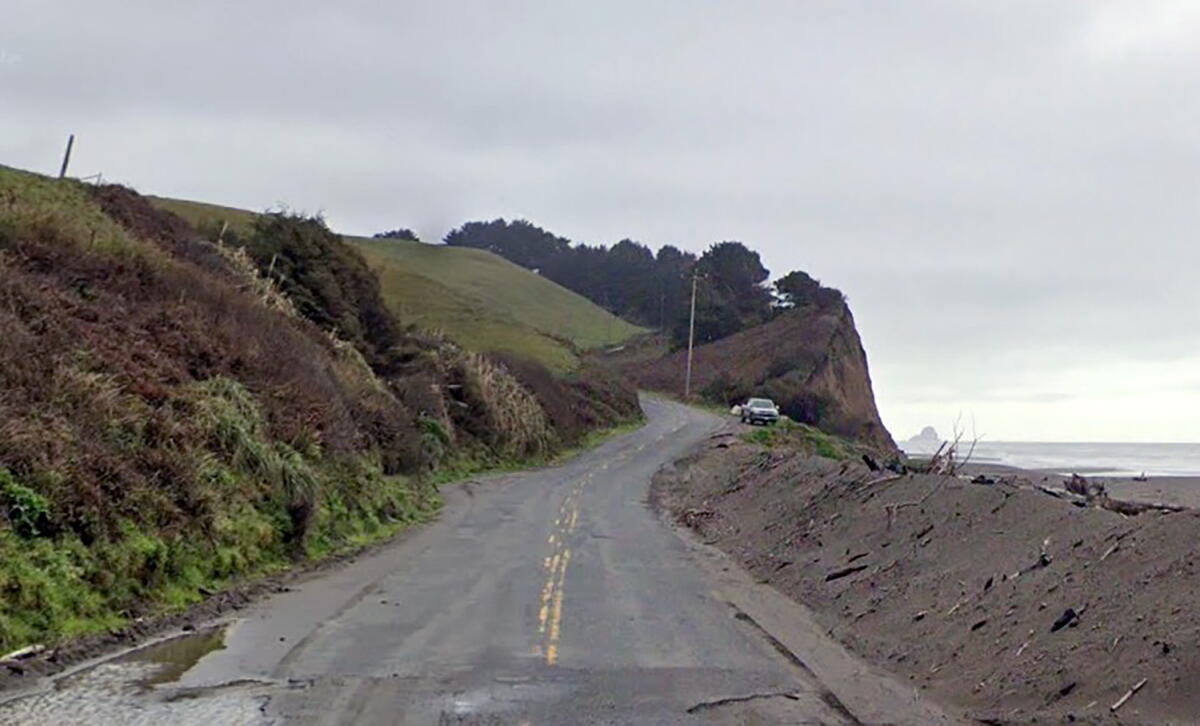
Humboldt County wants to make improvements to Centerville Road.
(Google street view)
Feierabend, a 36-year-old loan officer, told The Times: “It’s about slowly choking out the individuals that utilize the beach and gaining control under the ruse, or the guise, of conservation.”
The discord in Humboldt County comes as the Trump administration is taking aim at what it calls “environmental extremism” in California, with federal officials trying — largely over state objections — to open the treasured coastline to more offshore oil drilling, expanded rocket launches and floating nuclear reactors.
Amid this wider debate, beach driving has emerged as an unexpected flashpoint.
Last month, Republican gubernatorial candidate Steve Hilton called coastal commissioners “idiots” for their years-long effort to end off-road driving at Oceano Dunes State Vehicular Recreation Area, the only state park that allows recreational driving on the beach.

Cars, bikes and pedestrians share the sand at Oceano Dunes State Vehicular Recreation Area near Pismo Beach in February 2021.
(Myung J. Chun / Los Angeles Times)
Oceano Dunes, near Pismo Beach in San Luis Obispo County, temporarily closed to off-roaders this spring amid long-running legal battles between recreation advocates and environmentalists who say all-terrain vehicles are tearing through western snowy plover habitat and sending clouds of unhealthy dust into nearby neighborhoods.
“Surprise, the Coastal Commission are trying to shut it down because they’re joyless bureaucrats who don’t want anyone to have fun,” Hilton said in a social media video as he leaned on a bright yellow dune buggy on the sand. “And it’s not just about fun. This is a real economic engine for this community.”
If elected, he said, he would create a state “Office of Fun and Freedom.” Its first task? Protecting off-roading at Oceano Dunes.
The campaign for Xavier Becerra, the Democratic gubernatorial candidate, did not return requests for comment.
In Humboldt County, residents have stressed that rural Centerville Beach is nothing like Oceano Dunes, where thousands of pickup trucks, ATVs and dirt bikes may carve through the sand on a given day.
Centerville Beach’s nearest town, Ferndale, the childhood home of celebrity chef Guy Fieri, has a population of just 1,500. Residents say the beach typically sees a handful of four-wheelers and side-by-sides — with most heading out to fish, not joy-riding.
“Centerville is not a beach anyone can just drive on — you’ve got to know what you’re doing,” said Shawn Griggs, a painter who surfs there most mornings. “It’s a very volatile beach with coarse sand. It’s steep right off the shore; the sand bars are transient.”

A view of Centerville Beach, near where Humboldt County is looking to repair a stretch of Centerville Road.
(Beau Sanders / For The Times)
Griggs, 57, described himself as “an environmentalist at heart” who appreciates efforts to protect threatened species. But he doubts vehicles are doing much harm at Centerville.
“With the amount of sand that is pushed off that beach every year and moved around, it’s hard for me to imagine that beach would be a super stable beach for the snowy plover,” he said.
The Coastal Commission staff report says the area is “moderately suitable for plovers,” but that “heavy human use” has degraded the habitat.
In Humboldt County, driving is allowed on a handful of county-maintained beaches, as well as portions of the Samoa Dunes Recreation Area, which is managed by the federal Bureau of Land Management.
Feierabend, who grew up next to Centerville Beach, said vehicles are not destroying the beach — the ocean is.
“No one’s going too fast,” he told the Coastal Commission. “No one’s driving through dunes. In fact, there are no dunes.”
Centerville Beach, home to some of the state’s fastest-eroding cliffs, has been shrinking for decades. The rising and warming sea has accelerated that process in recent years, and powerful El Niño-charged storms this fall and winter could wreak further havoc on the coastline.
A beach parking lot that once accommodated up to 100 vehicles has already washed away. And Centerville Road — a narrow county thoroughfare that provides access to the beach, a few rural homes and the federally managed Lost Coast Headlands — is so regularly slammed by powerful storm waves that it is often covered with sand and made impassable.
The road is what initially brought Centerville Beach to the Coastal Commission’s attention.
The Humboldt County Department of Public Works applied for a required coastal development permit to repair a short stretch of storm-damaged roadway, a project for which it had already secured federal and state funding.
The county has proposed elevating the road 10 feet and adding a new parking area. It also is looking to build a revetment — a sloping layer of rocks on the sand meant to protect the road from waves, at least for a few decades.
Humboldt County initially pushed to move the roadway farther inland, but faced resistance from private landowners.
According to the Coastal Commission staff report, beach erosion puts Centerville Road at “severe risk of being destroyed” within the next five years.
Given the urgency of the needed repairs, the decision to tie the development permit to beach driving felt like “a backroom deal stuck into the project,” Humboldt County Planning Commissioner Iver Skavdal said at the Coastal Commission meeting.
The commission is “holding the project, the residents and the county hostage,” said Skavdal, noting that seven generations of his family had enjoyed the beach.
Though the commission approved the permit on the condition beach driving will be stopped, it added an amendment after locals pushed back — giving Humboldt County an opportunity to write a plan to allow restricted driving, provided it would not harm sensitive habitats. That plan would have to come back to the commission for approval.
The Humboldt County Board of Supervisors still must decide whether to accept the stipulations of the coastal development permit before any construction begins.
The potential loss of driving on Centerville Beach — a unique attraction in California’s sparsely populated, economically depressed northwest corner — struck a chord with residents, about two dozen of whom sat through several hours of a Coastal Commission meeting on a Wednesday morning to speak about it.
“Families here don’t have a lot to do,” Sue Long, former mayor of the nearby city of Fortuna, told the commission. “There’s not a lot of the kind of entertainment you guys have, with waterslides and Disneyland and all of those things. … We count on nature.”
Mike Astry, who runs a small off-road recovery business pulling out vehicles stuck in sand or mud throughout the region, told the commission most people towed off Centerville Beach are out-of-town tourists who traveled just to drive on the beach.
Stopping vehicular access is “a big deal to a lot of people,” Astry, 49, said in an interview. “People driving from out of town that want to come drive on that beach are not going to come to our town and spend money on hotels and food.”
Astry, who also is an automotive maintenance supervisor for Humboldt County, started the towing business with his souped-up Jeep during the COVID-19 pandemic, when people flocked to outdoor spaces during lockdowns. Now, he typically gets one or two calls a week.
At Centerville Beach, he said, “I’ve had some pretty gnarly tows,” including some “little old ladies who thought, ‘Oh, I thought my Prius could go here,’ and it can’t.”
A few years ago, he yanked a Tesla out of the ocean. Powerful waves ripped off its bumper. The driver was from the Bay Area.
“People are just sick of California, their mandates, and this is just one more thing to add to it,” he said of the coastal commission decision. “It’s just a power trip. We pay our frickin taxes.”
Jennifer Savage — California policy associate director for the Surfrider Foundation, a coastal protection nonprofit — was one of the few speakers at the Coastal Commission meeting who focused on a different aspect of the county’s Centerville Beach proposal: the rock revetment next to the old, crumbling road.
Revetments and sea walls, which generally are not allowed for developments built after the Coastal Act took effect in 1977, “make a beach erode significantly faster,” she told The Times.
Erosion has been a known problem for a long time, she said, and “the failure to prepare doesn’t justify sacrificing the public beach.”