sanchez

Sánchez sidesteps a Spain-U.S. dispute at NATO, brushing off reported Pentagon email

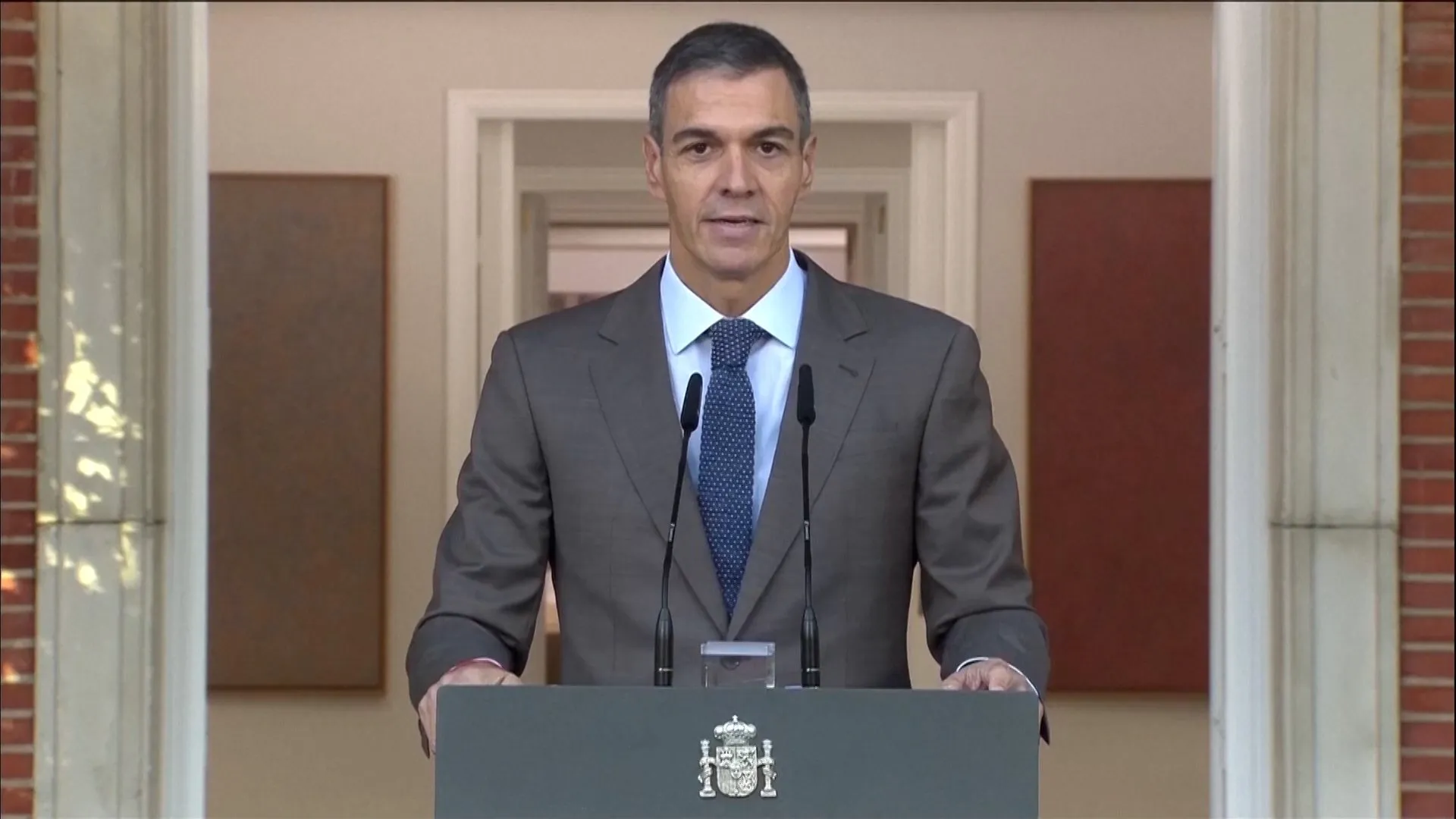
Spanish Prime Minister Pedro Sánchez on Friday refused to be drawn into a dispute with the United States over reports that the Pentagon is weighing whether to punish members of NATO that fail to support American operations in the Iran war.

Among those in the firing line is Spain, which has refused to allow U.S. forces involved in the war to use bases on its territory or airspace. Spain says that U.S.-Israeli actions in the Iran war contravenes international law.

France and the U.K. also refuse to give U.S. forces free rein to use their territory for the bombing campaign.

The Pentagon is reported to be mulling whether to suspend Spain from NATO, according to an unidentified U.S. official referring to a U.S. Defense Department email, and quoted by the Reuters news agency. The Associated Press hasn’t seen the email or had confirmation of its content. It has asked the Pentagon for comment, but received no immediate response.

“Well, we do not work with emails,” Sánchez told reporters at a European Union summit in Cyprus. “We work with official documents and positions taken, in this case, by the government of the United States.”

“The position of the government of Spain is clear: absolute collaboration with the allies, but always within the framework of international legality,” he said.

The Trump administration has routinely floated plans or ideas that are neither acted upon nor become policy.

The email also suggested reassessing U.S. support for the United Kingdom’s claim to the Falkland Islands, near Argentina, which are also known as Islas Malvinas.

Dave Pares, a spokesman for Prime Minister Keir Starmer, said the U.K. position on the islands is “longstanding and it’s unchanged: Sovereignty rests with the U.K., and the islanders’ right to self-determination is paramount.”

Pares noted “the Falkland Islands have previously voted overwhelmingly in favor of remaining a U.K. overseas territory.”

NATO staying out of the war

NATO operates by consensus, and all 32 member countries must agree for it to act.

The trans-Atlantic alliance’s founding treaty has no mechanism for suspending or ejecting any of the members, although nations may leave of their own accord one year after notifying the other allies. As an organization, NATO has no direct role in the Iran war except to defend its own territory.

Asked for comment, NATO headquarters said: “NATO’s Founding Treaty does not foresee any provision for suspension of NATO membership, or expulsion.”

President Trump has been angered by what he sees as the failure of some NATO members to back American actions in the Iran war and to help police the Strait of Hormuz, a major trade route. He has questioned the purpose of U.S. membership in the military organization.

EU foreign policy chief Kaja Kallas appeared perplexed by the U.S. criticism, given that the United Kingdom and France are leading an effort to help secure trade in the strait once the war is over.

“When we have had contacts with the American counterparts, then actually their asks for us have been exactly what we are able to offer after the cessation of hostilities,” she said. “Demining, escorting of ships, all of this that we have been discussing.”

But the United States has “long-standing arrangements and agreements with European allies on overflight, on basing” that should be respected, NATO Secretary-General Mark Rutte has said, in implicit criticism of some allies like Spain, but also France.

While Spain restricted U.S. military activity related to the Iran war, U.S. warplanes have flown over other NATO allies’ airspace and used U.S. bases in other NATO countries for war-related operations.

Trump has even threatened to cut trade with Spain over its refusal to allow the use of its bases and airspace. More broadly, Spain has also disappointed its allies by failing to commit to spend as much as they plan to do on defense.

Security without the U.S.

As the reality sinks in that the U.S. commitment to NATO and Europe’s security under Trump has waned, the EU leaders debated how best to use European laws to come to each other’s aid should one of them come under attack.

Cypriot President Nikos Christodoulides, whose country holds the bloc’s presidency until July, said that the leaders had tasked the European Commission to “prepare a blueprint on how we respond” should a member seek help under Article 42.7 of the EU treaties.

It’s only ever been used once, by France after the Paris terror attacks in 2015.

EU envoys and ministers are set next month to conduct “table-top exercises” to game out how the treaty article might be used, drawing on the bloc’s military capacities, but also other assets not available to NATO, like trade, border and visa policies.

Hadjicostis and Cook write for the Associated Press. Cook reported from Brussels. Jill Lawless in London contributed to this report.

Source link

Pedro Sanchez brushes off rumors Spain facing possible NATO suspension

April 24 (UPI) — Spanish Prime Minister Pedro Sanchez on Friday dismissed an alleged leak from the U.S. Department of Defense suggesting that Spain could face being suspended from NATO in retaliation for not supporting the United States in its war with Iran.

Arriving in Cyprus for a meeting of European Union leaders, Sanchez said he was not worried and that Spain was fully compliant with its treaty commitments to the collective defense pact.

“No worries. The Spanish government’s position is clear: absolute cooperation with our allies, but always within the framework of international law,” was his response to questions regarding a leaked Pentagon email setting out potential actions that could be taken against NATO allies who failed to adequately support the war or were otherwise seen as uncooperative.

However, Sanchez refused to be drawn directly on the alleged contents of the internal U.S. government communication leaked by a U.S. official to Reuters, which broke the story on Friday.

He said the Spanish government could talk about relevant official U.S. documents and policy positions but “does not comment on emails.”

An outspoken critic of the U.S. military offensive against Iran, Spain was highlighted as the prime candidate for being ejected from NATO, but the United Kingdom was also earmarked for retribution with a proposal pitching a rethink of Washington’s support for British sovereignty over the Falkland Islands.

In 1982, Britain fought and won a 74-day war with Argentina over the South Atlantic territory after its forces overran and seized islands.

President Donald Trump was incensed by Sanchez’s refusal to permit U.S. military aircraft to use U.S.-Spanish airbases or Spain’s airspace to launch strikes on Iran, culminating in him threatening to sever bilateral trade.

Britain initially denied permission for U.S. warplanes to use its airbases but relented two days or so after the start of the war on Feb. 28, allowing aircraft engaged in “defensive” missions to fly out of RAF bases in Britain and Diego Garcia in the Indian Ocean.

The Pentagon, which the Trump administration moved to rename to the Department of War, appeared to justify taking some type of punitive action.

Pentagon Press Secretary Kingsley Wilson said NATO allies “were not there for us” regardless of “everything” the United States had done for them.

“The War Department will ensure that the president has credible options to ensure that our allies are no longer a paper tiger and instead do their part. We have no further comment on any internal deliberations to that effect,” she added.

Calling NATO “a source of strength,” Italian Prime Minister Giorgia Meloni, who was also attending the EU summit, called for unity.

“We must work to strengthen Nato’s European pillar… which must clearly complement the American one,” she said.

Berlin dismissed the idea Spain’s position within NATO was under any threat.

“Spain is a member of NATO. And I see no reason why that should change,” a German government spokesman said at a regular news briefing on Friday.

The 1949 treaty under which NATO was formed by the United States, Britain, France, Canada, Italy, the Netherlands, Belgium, Portugal, Luxembourg, Denmark, Norway and Iceland as a response to the Cold War contains no process or means for the expulsion or suspension of a member country.

Former NATO spokesperson and senior fellow at the Royal United Services Institute, Oana Lungescu, also dismissed the idea Spain could be suspended.

“It’s hard to know how seriously we should take such emails beyond ideological trolling,” she said.

Secretary of Health and Human Services Robert F. Kennedy, Jr. speaks during a Senate Committee on Health, Education, Labor, and Pensions hearing on the Department of Health and Human Services proposed fiscal year budget for 2027 in the Dirksen Senate Office Building near the U.S. Capitol on Wednesday. Photo by Bonnie Cash/UPI | License Photo

Source link

A vaccine standoff and other key moments from RFK Jr.’s first congressional hearing in months

Health Secretary Robert F. Kennedy Jr. on Thursday faced federal lawmakers for the first time since September as he sought to defend a more than 12% proposed cut to his department’s budget and dodge arrows from angry Democrats along the way.

In his testimony before the House Ways and Means Committee, kicking off an expected sprint of seven budget hearings he’ll attend across congressional committees and subcommittees over the next week, Kennedy emphasized the administration’s work to reform dietary guidelines and crack down on waste, fraud and abuse.

Republicans on the committee praised Kennedy as a “breath of fresh air” and asked him to promote his department’s recent actions. Democrats, who have been furious over Kennedy’s sweeping overhaul of the U.S. Department of Health and Human Services, largely had a different agenda.

They needled Kennedy on what they viewed as the Trump administration’s hypocrisy on fraud, demanded to know why he was cutting budgets for various programs and slammed his efforts to pull back vaccine recommendations and messaging, which they said have caused unnecessary deaths.

Kennedy fired back, often raising his voice as he accused the Democrats of misrepresenting his work and past statements.

Here are three standout moments from Thursday’s hearing:

A standoff over measles

One heated exchange early in the hearing came between Kennedy and Rep. Linda Sanchez. The California Democrat decried recent measles outbreaks across the U.S. and asked Kennedy to answer for the fact that under his leadership, the Centers for Disease Control and Prevention pulled back public health messaging supporting vaccination.

“As a mother, this horrifies me,” Sanchez said. “Did President Trump approve your decision to end CDC’s pro-vaccine public messaging campaign?”

Kennedy repeatedly refused to answer, saying first he wanted to respond to the “misstatements that you’ve made” and later praising the Trump administration’s record on preventing measles, although protections against the disease have eroded in some parts of the country as vaccination rates have dropped.

“That’s not answering my question,” Sanchez said as the two talked over each other.

But Sanchez also got Kennedy, a longtime anti-vaccine activist before he entered politics, to acknowledge that a 6-year-old who died of measles last year in West Texas could have potentially been saved with vaccination.

“Do you agree with the majority of doctors that the measles vaccine could have saved that child’s life in Texas?” she asked.

“It’s possible, certainly,” Kennedy said.

RFK Jr. denies talking about Black children being ‘re-parented’

A fight erupted between Kennedy and Rep. Terri Sewell, a Democrat from Alabama, when Kennedy vehemently denied making remarks he’d said in 2024.

The comments dated back to when Kennedy was a presidential candidate. On the “High Level Conversations” podcast last July, he said, “Psychiatric drugs — which every Black kid is now just standard put on Adderall, SSRIs, benzos, which are known to induce violence, and those kids are going to have a chance to go somewhere and get re-parented to live in a community where there’ll be no cellphones, no screens, you’ll actually have to talk to people.”

“Have you ever re-parented, or parented, I should say, a Black child?” Sewell asked, as her staff held up a poster featuring an abbreviated version of the quote.

“I don’t even know what that phrase means,” Kennedy said. “I’m not going to answer something I didn’t say.”

“You’re making stuff up,” he later claimed.

A recording of the podcast shows he made the comments during a conversation about free rehabilitation facilities he was proposing opening at the time in rural areas around the country.

Health and Human Services spokesperson Emily Hilliard said Kennedy before joining the administration was referring to spaces where young people facing alienation, mental health challenges and despair could get re-parented, which she said was a psychotherapy term for “developing the emotional regulation, discipline, boundaries, and self-worth that may not have been established in childhood.”

For Kennedy and his former party, civility is the exception

Kennedy spent most of his life as a Democrat, the scion of one of the nation’s most famous political families. Both Republicans and Democrats during the hearing began their remarks by expressing their admiration of Kennedy’s relatives, among them former President John F. Kennedy.

But again and again throughout Thursday’s hearing, the fraying of bonds between Kennedy and his former party was on full display as spiteful comments were passed back and forth.

The Health secretary grew defensive and visibly agitated. He repeatedly criticized Democratic lawmakers for not giving him a word in edgewise.

“They’ve all shut me up,” Kennedy said at one point. “They give a little speech that they can go and market, you know, for fundraising, and they don’t allow me to answer the question.”

On a few rare occasions, the exchanges were civil. One representative, Gwen Moore of Wisconsin, used humor to make that happen.

“I promise to give you easy, comfortable questions if you don’t yell at me and hurt my feelings,” she told Kennedy. He promised he wouldn’t.

Swenson writes for the Associated Press.

Source link