Japanese PM Sanae Takaichi moves to revise Japan security documents

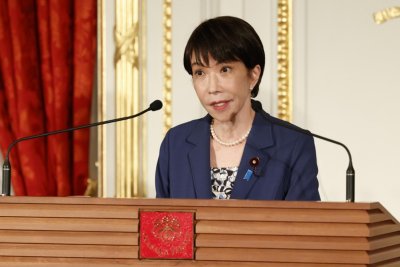
Japanese Prime Minister Sanae Takaichi speaks during a joint press conference with Philippine President Ferdinand Marcos Jr. (not pictured) at the Akasaka Palace state guest house in Tokyo, Japan, 28 May 2026. Photo by Rodrigo Reyes Marin / EPA
June 8 (Asia Today) — Japanese Prime Minister Sanae Takaichi’s government is moving forward with talks to revise Japan’s three core security documents, with defense spending, nuclear policy and artificial intelligence emerging as central issues.
The documents are Japan’s National Security Strategy, National Defense Strategy and Defense Buildup Program. They set the direction for diplomacy and defense policy for about the next decade, as well as defense spending and major equipment plans for five years.
Japan first adopted a National Security Strategy in 2013 under former Prime Minister Shinzo Abe. Former Prime Minister Fumio Kishida’s government revised all three documents in 2022.
Asahi Shimbun reported Monday that the Takaichi government’s review centers on eight issues: defense spending, Japan’s three non-nuclear principles, AI and drones, the defense industry, nuclear-powered submarines, ties with the United States, perceptions of China and economic security.
The largest issue is defense spending. The Kishida government’s 2022 documents called for raising defense-related spending to about 2% of gross domestic product by fiscal 2027. Takaichi’s government is seeking to reach that level in fiscal 2025 and then pursue another revision.
Asahi reported that the Trump administration has called on allies to raise defense spending to 3.5% of GDP, or 5% including related costs. If Japan applied the 3.5% target, annual defense spending could exceed 20 trillion yen, or about $125 billion.
Japan’s three non-nuclear principles are also under discussion. The principles commit Japan not to possess, produce or allow the introduction of nuclear weapons. The current National Security Strategy says Japan will maintain them.
Takaichi has questioned the realism of the principle barring the introduction of nuclear weapons, citing Japan’s reliance on U.S. nuclear deterrence. An Asahi poll conducted from March to April found that 75% of respondents supported maintaining the principles, compared with 21% who said they should be reviewed.
AI and drones are another major focus. Russia’s invasion of Ukraine and conflicts in the Middle East have raised the importance of low-cost drones, AI-based information processing, cyberattacks and cognitive warfare. Japan is considering expanding drone procurement, building domestic supply chains and using AI in defense.
The defense industry is also expected to be included in the review. Takaichi’s government views the sector as one of 17 priority areas in its growth strategy. Japan revised its defense equipment transfer guidelines in April, expanding the path for exports of weapons with lethal capabilities.
Government and ruling party officials are also discussing whether the state should own ammunition and other military supply plants while allowing private companies to operate them.
Whether Japan should introduce nuclear-powered submarines is another key question. China and Russia operate nuclear-powered submarines and North Korea is believed to be pursuing them. South Korea has also announced plans to deploy nuclear-powered submarines in the late 2030s.
Some Japanese officials and experts have argued for next-generation submarines that can remain submerged for long periods and travel long distances. Development costs, staffing and consistency with Japan’s Atomic Energy Basic Act remain challenges.
Relations with the United States and Japan’s view of China are also expected to shape the wording of the revised documents. The Trump administration is demanding greater defense burden-sharing from allies. If U.S. foreign policy priorities shift, Japan may need to adjust security plans that assume heavy reliance on Washington.
The 2022 documents described China as Japan’s “greatest strategic challenge.” Attention is now focused on how Japan will describe China after increased Chinese aircraft carrier operations, airspace incursions and concerns about a possible Taiwan contingency.
Economic security is expected to be treated as a separate pillar. Tensions in the Middle East, risks involving the Strait of Hormuz, dependence on energy and food imports and possible supply-chain disruptions are broadening Japan’s security debate. The Japanese government is emphasizing what it calls “collective autonomy” with allies and like-minded countries to maintain supply chains.
The Takaichi government is aiming to complete the revision by the end of the year. Asahi said the review could affect not only defense policy but also Japan’s national direction and public burden.
— Reported by Asia Today; translated by UPI
© Asia Today. Unauthorized reproduction or redistribution prohibited.
Original Korean report: https://www.asiatoday.co.kr/kn/view.php?key=20260608010002583