san diego padres

MLB approves sale of Padres to José E. Feliciano, Kwanza Jones

Major League Baseball’s team owners unanimously have approved the sale of the San Diego Padres to an investor group led by private equity billionaire José E. Feliciano and his wife and business partner, Kwanza Jones.

The league announced the approval Monday after a vote. Feliciano and Jones reached an agreement in May to buy the Padres from the family of late owner Peter Seidler at an MLB-record valuation of $3.9 billion. The deal is still contingent on the official closing of the transaction in the coming weeks.

“José and Kwanza understand the unique place the Padres hold in San Diego and the powerful bond between the club and its fans,” Commissioner Rob Manfred said in a statement. “We look forward to their leadership of the Padres and to working with them to build on the club’s strong foundation in a market that is so important to Major League Baseball.”

Seidler’s family announced its intention to explore a sale of the Padres last November, two years after his death. The 53-year-old Feliciano, a co-founder of Santa Monica-based private equity firm Clearlake Capital, emerged from the competition as the Seidler family’s top choice.

Padres Chief Executive Erik Greupner and general manager A.J. Preller will remain in charge of day-to-day operations, according to MLB’s announcement.

“We are a family first, and becoming owners of the San Diego Padres means joining an even larger one,” Jones and Feliciano said in a statement. “We are grateful to the Seidler family, and especially to Peter, for raising the expectations of what this franchise can achieve. … Our ambition is clear: to bring a World Series championship to San Diego and build an enduring organization capable of competing for championships year after year. We intend to be engaged owners, bringing our energy, experience and perspective while working alongside the talented team already in place and investing ambitiously and thoughtfully in the Padres’ future.

“We are all in and committed to winning.”

Peter Seidler assumed majority control of the Padres in 2020 after first joining their ownership group in 2012, but he became beloved in San Diego for his aggressive financial pursuit of winning and his eagerness to engage with the team’s fan base. He died at age 63 in November 2023.

The Padres dramatically increased their payroll under Seidler, allowing Preller to build the foundation for the current team, which has made four playoff appearances in the past six years and won at least 89 games in three of the last four seasons during the most successful stretch in franchise history. San Diego is currently in the playoff race again, winning 17 of its last 22 games entering Monday to surge into an NL wild-card position at 67-58.

“As far as the day-to-day operations, nothing changes for us,” Padres manager Craig Stammen said in New York before San Diego’s series opener against the Mets. “We’ve got to go out here and play the games, just like we have all season long. The ownership sale has kind of been something that’s been going on throughout the entire year. It doesn’t really affect the play on the field, but we’re excited to have José and Kwanza a part of the Padres and can’t wait to welcome them.”

The minority partners in the Padres’ new ownership group include Joey and Jesse Buss, two sons of former Lakers owner Jerry Buss. Coincidentally, the six Buss siblings decided earlier Monday to sell their remaining minority ownership stake in the Lakers to incoming majority owners Joshua Kushner and Bob Iger. Jeanie Buss is contesting the sale of the family’s shares.

When Feliciano and Jones reached their agreement to purchase the Padres earlier this year, they praised the team as “a unifying force in San Diego, rooted in community, connection and belonging.” They’ve since been spotted at Padres games in San Diego and in Mexico City.

“It’s good to see people that care working with us, you know?” Padres outfielder Jackson Merrill said. “I mean, the Seidlers cared a lot. It’ll be fun to see how these people take it, mold it into their own, you know? Trust in them, as they trust in us on the field. So, full confidence in them. Excited to meet them.”

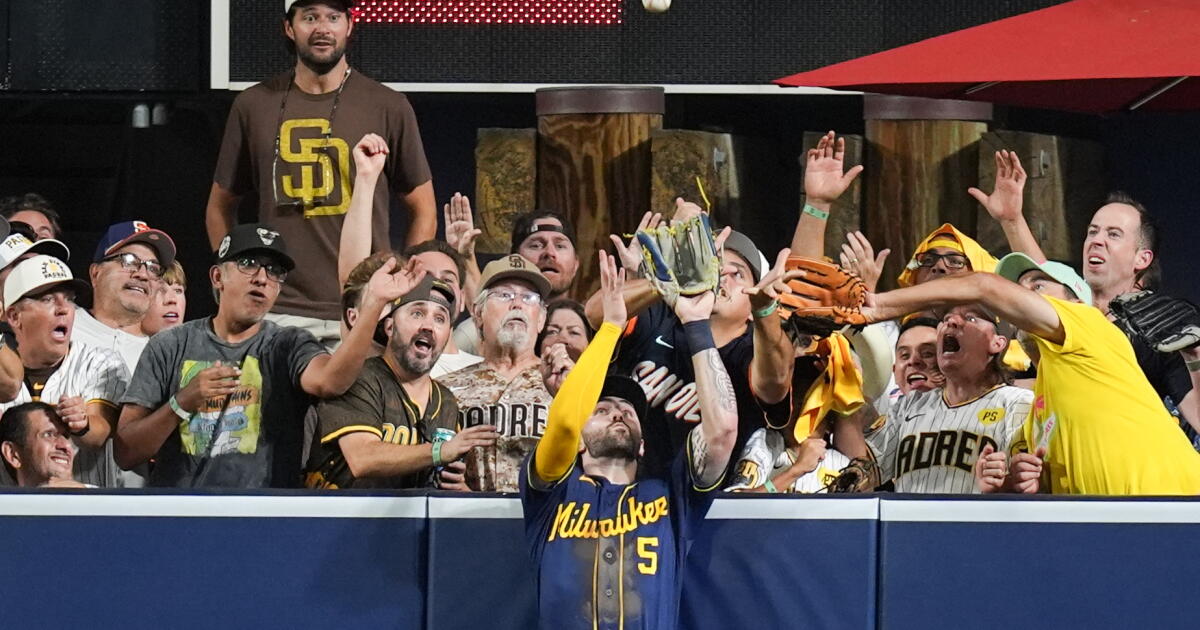
The Padres have never won a World Series, but they were a valuable commodity for potential owners as the only team in the four biggest North American sports leagues in a metropolitan area with roughly 3.3 million people. Downtown Petco Park has become one of the liveliest ballparks in the sport, and the Padres ranked second in the majors in attendance last season.

Feliciano, who was born in Puerto Rico, becomes the second Latino principal owner in baseball, along with the Angels’ Arte Moreno. Latino and Hispanic players comprise roughly 30% of major league rosters.

Feliciano and Jones will hold an introductory news conference at Petco Park on Aug. 24.

Beacham writes for the Associated Press.

Source link

Dodgers overcome Roki Sasaki’s poor performance to rout Padres

Roki Sasaki’s abysmal appearance faded away in the Dodgers’ 12-7 win over the San Diego Padres after Los Angeles rose from a catatonic first inning. The Dodgers roared back from a 6-0 deficit as Andy Pages skirted a tying double down the left-field line, and Mookie Betts and Max Muncy each drove in runs to give them the lead in a four-run fourth inning. All of which sent the sellout crowd into jubilant celebrations, some jumping, others breaking out World Cup chants.

“I don’t know,” manager Dave Roberts said of the team’s ability to turn the game around. “Thankfully, it played out the way I didn’t expect, or the way it started.”

By the time the game ended, Sasaki’s three-inning start seemed like a murky nightmare the Dodgers awoke from in a sweat. Except the Dodgers weren’t dreaming, and the team hadn’t done much to assuage the concerns with Sasaki.

The problem with Sasaki isn’t his stuff. On his best nights, when the velocity and command combine, Sasaki blows past batters with a triple-digit fastball and cutting off-speed pitches. The problem has been how to tick the radar without making the strike zone look like a Jackson Pollock painting — and recently, it has.

Sasaki’s June swoon, impervious to the calendar change, continued into Thursday’s series opener against the Padres, in which the right-hander gave up three home runs and seven hits before Roberts called it quits going into the fourth inning.

“They were on everything,” Roberts said. “You could see it.”

One possible concern? Tipping pitches. While Roberts and catcher Dalton Rushing said the team would need to do some more research into Sasaki’s start, both left the door open to this answer.

“That would be a big explanation as to how they felt like they were on every pitch,” Rushing said.

As San Diego chugged through its lineup, Sasaki struggled to keep up. With his first pitch, he gave up a double to Fernando Tatis Jr., who scored on Manny Machado’s home run that left center fielder Pages staring at the ball’s path as it plopped down on the other side of the blue outfield fence.

The inning was only a preview of the Padres’ power. Each of the nine San Diego batters got his chance against Sasaki in the second, and the team quickly dug the Dodgers into a six-run hole. He surrendered two home runs in the second inning. First, Jackson Merrill blasted a ball to left-center field, and, two outs later, Jake Cronenworth drove in two runs with a shot to right-center.

Sasaki said through interpreter Kensuke Okubo that he felt like he needed work on his command to improve, but he felt like his fastball was good.

Roki Sasaki has his head down after giving up a solo homer to Jackson Merrill in the second inning.

Roki Sasaki has his head down after giving up a solo homer to Jackson Merrill in the second inning.

(Gina Ferazzi / Los Angeles Times)

“I don’t think my stuff was bad today,” Sasaki said. “Overall, it wasn’t great but a lot of things evolved.”

Part of Sasaki’s issue lies with his approach. Roberts said he wants the second-year pitcher to be aggressive, to play the cat-and-mouse game required to beat batters in the box. But when given the opportunity, Sasaki has shrunken in recent outings, struggling with his command and his ability to pitch deep into games.

“We had a great May, so let’s just get back to competing and making pitches,” Roberts said.

When reliever Will Klein walked out to the mound in the fourth to the aggressive, rambunctious clamor of the Dropkick Murphys’ “I’m Shipping Up to Boston” and collected two scoreless, one-hit innings, the relief was immediate: The Dodgers took the lead.

The lineup already was revving, as Dalton Rushing homered in the second inning while Sasaki was still in the game, and both Kyle Tucker and Max Muncy drove in runs in the third, cutting the deficit to two. The Dodgers broke through against the Padres’ bullpen to score six runs in the fourth and fifth innings.

“The bullpen was fantastic tonight, and then the offense came up big,” Roberts said.

A late catch by Pages helped close out the game after he gloved a ball despite ramming into the padding of the center field wall. A combined effort by Paul Gervase and Tanner Scott shut down San Diego’s ninth-inning momentum after it pushed across a run.

“Turned back around, was able to find the ball and make a really good catch right there,” Tucker said. “That was a huge out.”

The Dodgers (57-31) beat their division rivals for the fifth time in seven games to open a 13-game lead over both San Diego and Arizona. The Padres, meanwhile, have given up 65 runs over the last six days, the most in such a span in franchise history.

But San Diego’s flaws don’t negate the Dodgers’ as they burned through six relievers in their win. So, while the Dodgers crawled out of the hole with a season-high 17 hits, the steep cost heightens the pressure on the rest of the rotation the rest of the series.

Source link