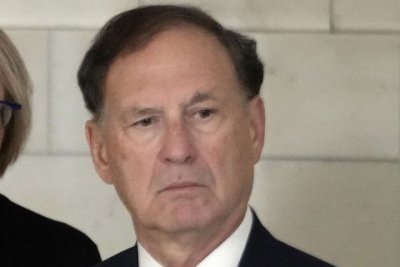
Samuel Alito

Justice Alito confirms he will return for another Supreme Court term

Aug. 7 (UPI) — Justice Samuel Alito said Friday in a rare interview that he is committed to returning for another term at the Supreme Court.

Speculation that Alito, 76, would retire swelled in June, after NPR mistakenly reported that he planned to step down at the end of this term.

On Friday, the justice put those rumors to bed.

“Obviously I’m here for another term,” Alito told The Wall Street Journal.

“It’s not pleasant, in the sense that it’s a reminder of mortality,” he said to the newspaper about questions related to his retirement.

“It’s like, what are those vultures doing up there?” the justice added. “They are flying around. But it goes with life tenure.”

Alito’s non-retirement was reported by NPR reporter Nina Totenberg, a veteran of Supreme Court coverage, on June 30.

NPR retracted the story later that same day.

Totenberg said she heard a retirement announcement while rushing out of the courtroom and mistakenly assumed it was Alito.

She called it “the worst professional mistake of my more than 50 years in journalism.”

Alito, a staunch conservative, was appointed by President George W. Bush and joined the court in 2006.
Source link

Supreme Court shoots down Hawaii’s private property gun restriction

June 25 (UPI) — The U.S. Supreme Court on Thursday struck down a Hawaiian law that required people to ask permission to carry a concealed firearm onto a private property.

The Court’s majority, in a 6-3 ruling, said that Hawaii cannot block a properly licensed person from carrying a concealed weapon on private properties that are open to the public.

Hawaii was one of five states that enacted similar laws after the Court in a 2018 ruling said that states could not limit gun licenses to “exceptional cases” because it violated the 2nd Amendment right to carry a firearm.

The law required people who wanted to carry their firearm in places such as gas stations, restaurants, grocery and other stores, dry cleaners and other properties that are “open to the public” to get permission to carry their gun.

“Under the new Hawaii law, no one carrying a firearm may enter without the property owner’s express authorization,” Justice Samuel Alito wrote in the majority opinion.

“The effect of this new rule is to impose severe restrictions on the daily activities of residents who have satisfied the State’s rigorous requirements for the issuance of a carry permit,” Alito wrote.

In a dissenting opinion, Justice Ketanji Brown Jackson disagreed with the majority that the Hawaii law is an “attempt to end-run our Second Amendment precedents,” suggesting instead that it applies the first principle of property law, the right to exclude.

In addition to noting that Hawaii has a long history of restrictive gun laws, Brown Jackson said it enacted the permission law in order to prevent confusion among property owners that federal law had affected traditional expectations in the state.

“The public might well have an implied license to enter private property open to the public, and such permission might generally include the ability to enter armed,” she wrote in the dissent.

“But,” she wrote, “any such license is not a matter of right — a license is a creature of state law and custom, and it can vary accordingly.”

Source link