L.A. voters will take up another sales tax hike. Will they do it for firefighters?
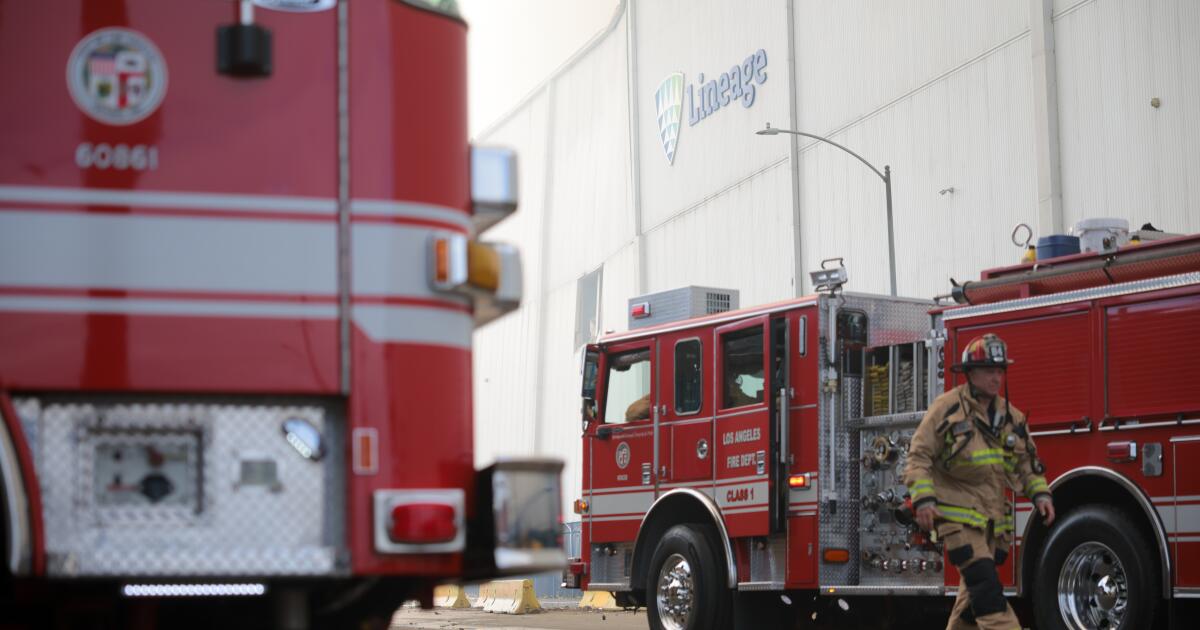
A new sales tax that would generate $345 million annually for the Los Angeles Fire Department will go before voters later this year, the City Council decided Tuesday, as a stubborn warehouse blaze burned for a seventh day on the city’s eastern edge.
The council voted 14-0 to put the half-cent sales tax hike on the Nov. 3 ballot, with supporters saying the additional funds would go toward more firefighters, new fire stations and new equipment, such as firetrucks and helicopters.
The vote came nearly 18 months after the outbreak of the Palisades fire, which destroyed thousands of homes in Pacific Palisades, Malibu and other coastal areas, leaving 12 people dead. But it more immediately coincided with the city’s fight to extinguish the blaze at the Boyle Heights cold storage facility, which has spread smoke across the region over the last week.
The campaign for the sales tax hike is being spearheaded by United Firefighters of Los Angeles City Local 112, the union that represents nearly 3,400 firefighters. Appearing before the council, union leaders pointed to the Boyle Heights fire as the latest sign that the city needs more money for emergency response.
“This is our plan to undo decades of under-investment in the department,” said Ryan Quigley, a 23-year firefighter/paramedic who also serves as the union’s secretary.
Mayor Karen Bass, through a spokesperson, said she is grateful to the union for bringing the tax proposal forward.
“[The mayor] has championed this measure from the very beginning,” the spokesperson, Paige Sterling, said in a statement.
The firefighters union began gathering signatures for the tax earlier this year, submitting them to the city clerk last month. Since then, backers have voiced confidence that it would pass, given the growing concern across the city about urban wildfires.
Still, the path to victory could be complicated by recent events.
Last month, Los Angeles County voters narrowly passed a different half-cent sales tax hike that’s expected to raise $1 billion annually to pay for healthcare. That measure, which received just above the 50% needed for passage, pushed the tax rate within the city of Los Angeles to 10.25 cents for every dollar of spending.
If voters approve the fire tax increase as well, the rate will jump to 10.75 cents per dollar.
The firefighters union also will be campaigning in a year when one of its recent leaders, Adam Walker, has been charged with one count each of grand theft and forgery. He has been accused of stealing more than $82,000 from a charity for injured firefighters to pay for his online gambling, his mortgage and other personal expenses.
Union President Doug Coates said Walker left his position two years ago. The union, he said, intends to make clear to voters that “the money is going to the right thing.”
So far, no one has emerged as an opponent of the tax increase. The Central City Assn., a downtown-based business group, is supporting the fire tax.
Susan Shelley, spokesperson for the Howard Jarvis Taxpayers Assn., said her organization has not taken a position on the proposal. Still, she argued that sales taxes in general are “extremely regressive,” hitting the hardest for Angelenos who can afford it the least.
“Our view is that the city budget should be prioritized to fund the fire department from the first dollar, not the last dollar,” Shelley said. “And that there shouldn’t be a need for a tax increase.”
The sales tax hike, if approved by voters, would represent the most significant public investment in the fire department since 2000, when voters passed a $532-million bond measure to pay for new facilities. Backers said the tax increase would help the department speed up emergency response times, while also building new fire stations and repairing existing ones.
The firefighters union began work on the tax proposal more than two years ago, before the inferno that erupted on Jan. 7, 2025, and carved a lethal path through Pacific Palisades and other communities. Still, the push for more funding gained greater attention in the wake of the fire.
While the flames were still raging, then-Fire Chief Kristin Crowley went on local and national television to accuse city leaders of failing to give her department the resources it needed. The media blitz shocked some at City Hall, who believed Crowley should have waited until the emergency was over before publicly assigning blame.
Crowley and the union said city leaders had forced the department to scale back its operations amid a budget crunch. Bass and the city’s policy analysts pointed out that fire department spending grew that year, largely because of pay increases given to firefighters.
Bass ultimately ousted Crowley, saying the chief failed to properly deploy firefighters amid warnings of dangerous Santa Ana winds. Crowley, who was demoted to another position, filed a lawsuit against the city, saying the mayor engaged in a retaliation campaign.
The fire that broke out last week at the Lineage Logistics cold storage facility has helped to rekindle calls for additional fire department funding.
Councilmember Eunisses Hernandez, whose Eastside district has been enveloped in smoke in recent days, told her colleagues Tuesday that climate change and corporate negligence are making such emergencies “more frequent and more severe.”
“Whether it’s the devastating fires that hit Altadena and the Palisades last year, or the Boyle Heights warehouse fire currently affecting air quality and public health across the whole city, every one of our districts is feeling the impacts,” she said, before voting to put the tax on the ballot.
Councilmember Traci Park, who represents the Palisades, said the fires in the Palisades and Boyle Heights have “exposed Los Angeles’ urgent need to modernize LAFD for the realities and demands of a modern century.”
Fire Chief Jaime Moore, in an interview Monday, said he asked Bass to declare a state of emergency last week so that his department could obtain additional resources to fight the Boyle Heights fire, including firefighters, firetrucks, drone pilots and hazardous materials teams.
“I had firefighters work Wednesday afternoon, Thursday, Friday, Saturday. I talked to my incident commander, and he goes, ‘Chief, these guys are getting their butts kicked.’ And that’s when I said, ‘I’m gonna reach out to the mayor, and I’m gonna see what I can do to get the state of emergency declared.’”
Supporters of the sales tax increase contend the department lacks the personnel to serve a city of nearly 4 million people. According to the union, L.A. has nearly 3,400 firefighters, roughly the same number as 50 years ago.
If voters pass the sales tax hike, the city would have the funds to bring the department up to 5,000 firefighters by 2050, union officials said.