sacramento

Backlash to Trump, RFK Jr. has scientists seeking office

As a California state lawmaker, Richard Pan authored some of the strongest vaccine laws in the country.

His reward — and part of the backlash, on top of death threats — was being physically assaulted outside the Capitol in Sacramento and spattered with blood thrown from the gallery.

Now, a few years removed from the state Senate and teaching health policy at UC Davis, Pan is running for Congress, in part to fight an old nemesis, the terminally misguided Robert F. Kennedy Jr., and to arrest the Trump administration’s sledgehammering of the nation’s public healthcare system.

“We need people in Congress who have the background, the training, the knowledge to basically hold this administration accountable,” Pan said last week on a baking 100-degree day in the Sacramento suburbs.

“I know what it’s like to be on the front lines,” said Pan, who spent a dozen years teaching and practicing pediatrics before being elected to the Assembly in 2010. “I’ve seen measles, right?”

In fact, his push to toughen vaccination requirements was spurred by a 2014-15 measles outbreak at Disneyland, which, at the time, was one of the largest and most significant epidemics to arise after the disease was supposedly eliminated from the U.S. in 2000.

Little did we know.

Every action has an equal and opposition reaction, a law of physics that’s equally applicable to the realm of politics.

Pan is part of a wave of doctors and scientists running for office this November — for school boards, city councils, state legislatures, the House and U.S. Senate — owing in good part to Kennedy’s quackery and the hollowing out of such vital health and research agencies as the Centers for Disease Control and Prevention, the Food and Drug Administration and the National Institutes of Health.

The political organization 3.14 Action — its name a decimal approximation of pi — has recruited and helped elect hundreds of candidates from STEM backgrounds (science, technology, engineering and mathematics) and endorsed more than 500 of those running this year, including Pan in his race in Sacramento and in neighboring Placer and Yolo counties.

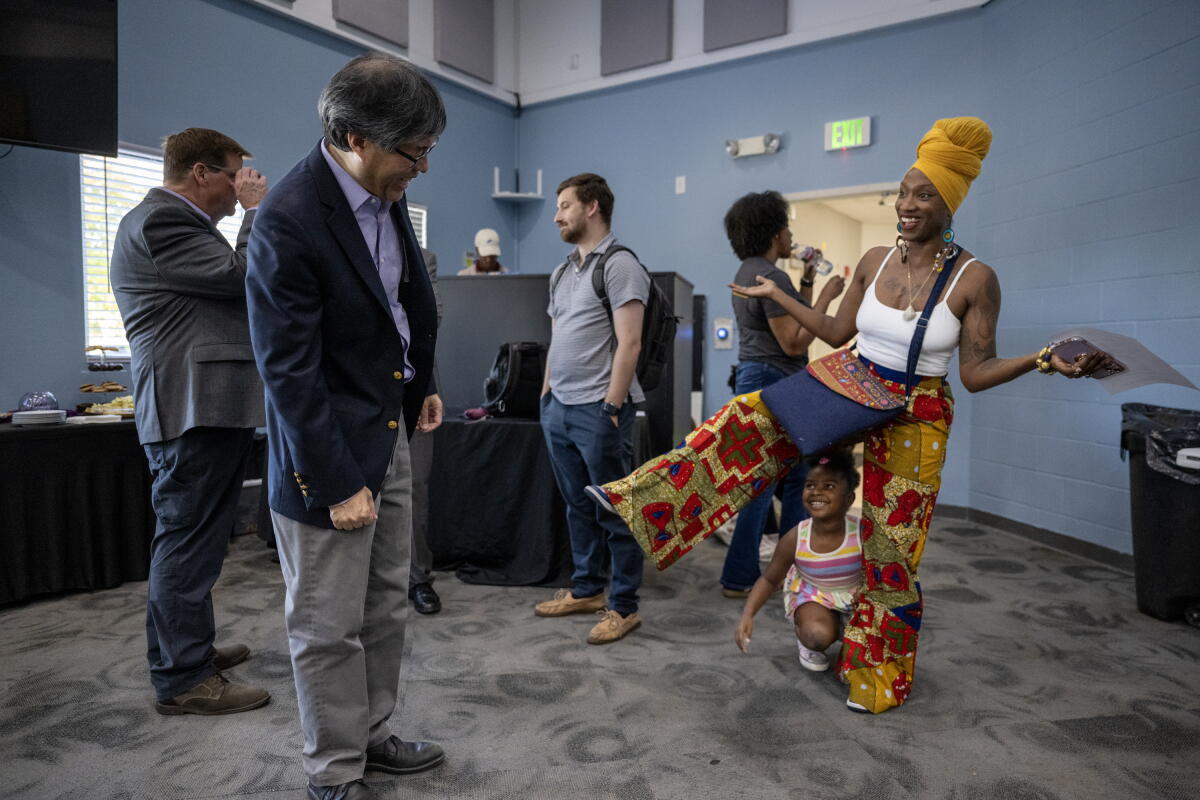
Dr. Richard Pan meets Dr. Teah Harris-Johnson and her daughter in Sacramento.

Dr. Richard Pan meets Dr. Teah Harris-Johnson and her daughter before participating in a roundtable discussion at Liberty Towers Church in Sacramento.

(Jose Luis Villegas / For The Times)

Shaughnessy Naughton, a chemist who worked on drug discovery and breast cancer research, founded 3.14 Action in 2016 after two unsuccessful tries for a congressional seat in the Philadelphia suburbs. When she started the organization, Naughton noted, there were more talk radio hosts on Capitol Hill than scientists and engineers. (Nearly two dozen doctors and nurses currently serve in Congress. More than 30 have run this election cycle.)

“There isn’t an issue that doesn’t benefit by having fact-based decision-makers, people that will go into office as problem-solvers,” Naughton said from Pennsylvania, which is in the throes of the nation’s worst measles outbreak in more than three decades. Health and Human Services Secretary Kennedy has downplayed the severity, even as the incidence of other vaccine-preventable diseases is rising.

“That’s essentially what scientists and physicians are,” Naughton said. “They are problem-solvers. and clearly our country is facing a lot of problems.”

Among those she cited was “the arsonist in charge of HHS.”

Pan has a history with Kennedy, who has long reigned as one of the country’s preeminent anti-vaxxers.

In 2015, he helped summon hundreds of demonstrators to Sacramento to protest Pan’s legislation tightening vaccination requirements. (Kennedy later apologized for using the word “holocaust” to condemn the proposed law, though he revisited the Nazi analogy during the COVID-19 pandemic.)

In 2019, Kennedy returned to Sacramento to oppose another bill Pan authored, this one tightening the rules for vaccination exemptions. Again, he was joined by an army of protesters. Tensions peaked when a demonstrator threw a cup of blood from the spectators’ gallery onto the Senate floor, halting business for several hours before the bill passed.

Roundtable discussion on Black Maternal Health.

Dr. Richard Pan sits between Illinois Rep. Lauren Underwood and Sean Frame, a candidate for state Senate, at the maternal health roundtable.

(Jose Luis Villegas / For The Times)

Pan’s opponent in November is Rep. Kevin Kiley, a conservative Republican running as an independent.

Seeking election in a Democratic-tilting district drawn under Proposition 50, the voter-passed gerrymander, Kiley has sought to distance himself from Trump and the MAGA movement, saying he would not caucus with GOP lawmakers if he returned to Washington.

Like his jury-rigged political persona, Kiley seems to want it both ways on vaccines.

Before going to Congress, while serving in the Assembly, Kiley voted against Pan’s legislation cracking down on fraudulent vaccine exemptions. He’s described vaccines as a vital public health tool, but condemned government mandates and suggested vaccination should be a matter of parental choice. He claims Pan has eroded public trust by politicizing the issue.

As for Kennedy, Kiley told the San Francisco Chronicle a lot of things “that I don’t agree with,” though he’s never called out the secretary for his cuckoo-land theories — vaccines cause autism, the fluoride in public water supplies is making Americans “stupider,” and many more — or denounced his destructive policies.

That passivity, Pan said, amounts to complicity.

“It’s not just simply a talking point,” Pan said of public health policy. “It’s reality and we need to have policy based on what’s really happening, not on some ideological conspiracy theory.”

Dr. Richard Pan participates in a discussion during a Black maternal health roundtable at Liberty Towers Church.

Dr. Richard Pan participates in a discussion during a Black maternal health roundtable last week at Liberty Towers Church in Sacramento.

(Jose Luis Villegas / For The Times)

Pan’s campaign is focused on more than vaccines and RFK Jr.

Like most Democrats, he’s made affordability a key part of his candidacy, citing higher gas and grocery prices and, inevitably, the rising cost of healthcare and the roughly $1-trillion cut from Medicaid under last year’s Big Sop To Billionaires Bill.

The super-wealthy got tax cuts, Pan told a silver-haired audience at a 55-and-older community in Roseville, while the bill will make healthcare less accessible for millions and undermine both Medicare and Social Security. Kiley supported the legislation, the centerpiece of Trump’s second term. As a doctor and state lawmaker, Pan said, he worked to expand healthcare and address the needs of his community.

“We don’t pass laws to make lives harder,” Pan said. “That’s what he’s done.”

Later, at a forum on Black maternal health, Pan said Trump’s attacks on diversity, equity and inclusion programs and the so-called war on woke ignores glaring disparities in the treatment of Black women versus other patients. “The data is there,” said Pan, speaking before a banner decorated with purple butterflies and the proclamation, “Black Mothers Matter.”

“The facts are there,” Pan went on. “It’s a very, very real problem and it needs to be addressed and it needs to be solved.”

He brought up, somewhat sheepishly, his campaign.

“That’s why I’m running,” Pan said, to “have another person in Congress … who’s going to tell the administration we are not going to bury DEI. We’re not going to bury disparities. These are real problems.”

As is the assault on science, the undermining of research and the promotion of nutty nostrums by those at the highest levels of the federal government.

Hopefully, the midterm election will begin the healing process.
Source link

Will California progressivism crush Newsom presidential hopes?

Gavin Newsom, the California governor who loves to heckle Donald Trump and talk about the “big swings” he’s taken at policy while in office, is now a lame duck.

Within a few short months, he will be termed out of office and return to being a regular citizen, if not an average one. Newsom’s presidential ambitions are stronger than ever, and there’s virtually no list of Democratic hopefuls that doesn’t include his name near the top.

But 2028 is a long way away, about a millennium in political time. Newsom has a tough road ahead to not just stay relevant, but also to forge a difficult path between keeping a national profile as a Trump-attacking defender of democracy and not getting pummeled (or worse, ignored) when he loses the safety and power of his elected office.

Our columnists Anita Chabria and Mark Z. Barabak take a look at what the next few months, and the next year, may have in store after the governor becomes simply Mr. Newsom.

Chabria: Newsom is making the most of his last leg in office. Recently, he went on an election jaunt through the South, visiting the Carolinas and Alabama to help campaign and raise money in those states.

It is not his first out-of-state trip to lend a hand in campaigns, but likely one of his last as governor. He wouldn’t be the first elected official to have a gap year (or years) before being elected to the Oval Office — Ronald Reagan had more than five years off between being governor of California and winning the presidency — but it’s definitely a disadvantage.

How much do you think being out of office hurts Newsom?

Barabak: Loyal readers of this column — thanks, we appreciate both of you! — know I’ve long looked askance at our gallivanting governor and his extracurricular, eyes-on-2028 activities. I understand that preening and politicking is way more fun and ego-enhancing than the minutiae of government in Sacramento. At the same time, I’m old-fashioned enough to think a person should do the job taxpayers are paying them to do.

But, as you note, that will be a moot point soon enough.

I’m not certain being out of office will be all that great a hindrance. In fact, I think it offers advantages, the main one being Newsom’s freedom to devote his full time and energies to running for president.

You mention Reagan; I don’t think it’s an accident he made two failed tries for the White House while serving in Sacramento. Pete Wilson also attempted the leap from the state Capitol to Washington, and failed badly.

It’s tough to do both.

As Dan Schnur, a former Wilson strategist, once put it, “There aren’t any direct flights from Sacramento to Manchester” — New Hampshire traditionally being home to the first primary — “and you can’t run the state from a cellphone at O’Hare” airport.

So I don’t think exiting office will necessarily hurt Newsom. But I’m highly dubious of his presidential prospects nonetheless. You?

Chabria: This is definitely a wide-open race, with, I suspect, contenders not yet on any lists. It’s way too early to know if Newsom will make it in the primary, but I do think he’s positioning himself in a way that differentiates him from some of the folks he may run against.

Socialism is the right’s boogeyman, framed as a peril to democracy full of death panels and welfare fraud. More than one presidential aspirant has shied away from the label for fear of supposedly losing middle-ground voters or being dragged through the “communist” muck that MAGA media such as Fox News love to sling.

In a recent PBS interview, though, Newsom didn’t disavow some democratic socialist ideas, such as Medicare for all, pointing out that California has long had a powerful progressive faction and many of the ideas considered radical for the right are run of the mill here — and potentially popular across the country.

Newsom seems to be embracing some of those lefty stances, especially ones about affordability and opportunity. While affordability is going to be everyone’s platform, pairing it with big-swing policy like universal health insurance might appeal to voters tired of words without action.

It’s a smart lane, embracing MAGA’s labels instead of defending against them, with policies even middle-ground voters might appreciate in these increasing desperate days when ground beef averages nearly $7 a pound and coffee costs more than booze.

Barabak: While I’m skeptical the words “socialism” and “communism” are the talisman that President Trump and other Republicans believe, warding off what could be a dreadful midterm election for the GOP, I still believe the connotation — wacky, lefty policies — has potency among a not-insignificant slice of the electorate.

November’s election is going to be a referendum on Trump, as Newsom himself frequently says. The fight for the Democratic nomination is a contest of a whole other order.

We agree that no fellow Democrat is going to cede the $7-a-pound affordability argument to Newsom. But to offer some differentiation, many will doubtless portray him as being a bit too out there, especially when they start making the electability argument.

And that’s not to mention what awaits him if Newsom were to emerge as the Democratic nominee. (Fun fact: In 1988, it was a Democratic primary opponent, Al Gore, who first criticized Michael Dukakis over Massachusetts’ prison-furlough program. Republicans then seized upon the issue and used it as a bludgeon, to Dukakis’ great detriment, in the fall campaign.)

In a way, it’s interesting we’re even having this discussion about whether Newsom is too far left. There are parts of his record — his chummy ties to Silicon Valley, his light regulatory stance toward data centers, his making nice with the likes of Charlie Kirk and Steve Bannon, that make some Democrats question whether he’s too far right.

Chabria: It’s true that Newsom is more centrist than progressive, and equally true that most of America misses that point.

I think there is a version of the next election, though, where the Democratic Party has its own Tea Party moment, when a populist faction wanting social change carries power.

Call it the anti-Trump swing, the search for a Democrat who seems authentic and pugilistic. Alexandria Ocasio-Cortez and Illinois Gov. JB Pritzker fit this mold.

Everything we know about elections and electability really is up for grabs in this new age of technology and billionaire influence, and the vein of frustration within the rank-and-file of the Democratic Party is only growing stronger because of it. If Republicans do lose out in the midterms — and I am not convinced they will — it changes the calculation on everything, including how far left the average independent voter may swing in the face of an economically crushing oligarchy.

But I would be remiss if I did not say this: Fears that Trump will interfere with the midterms or the next presidential election are justified. Even though things have calmed a bit — there is less talk of agents of some sort at polls — he is pursuing policies and pushing propaganda that could harm a fair election.

We need to safeguard elections, otherwise candidates don’t matter.

Barabak: We 100% agree on that. Candidates, and the campaigns they wage, matter only if elections are free and fairly conducted and all sides —looking at you, President Trump — acknowledge and abide by the outcome.

I wouldn’t, however, infer too much from the outcome in November. For many voters, it will be a chance to vent — about inflation, an unpopular war, Trump’s brazen money-grubbing, his blatant disinterest in the lives and livelihoods of struggling Americans and anything else that’s causing an irritating rash under their collars. That’s why it seems more likely than not Democrats will at least win control of the House.

But midterm results are notoriously unreliable barometers of the presidential election that follows. To give just a few examples, Republicans walloped Democrats in the 1994 and 2010 midterm elections and yet Presidents Bill Clinton and Barack Obama each won reelection just two years later. In 2022, Democrats fared surprisingly well in the midterm election, and in 2024, well … you know what happened.

Chabria: I don’t think America has a past political moment that can be compared to this one. By nearly every independent measure, the United States is closer to an autocracy than we’ve ever been. We’ve lost the respect and trust of our allies, and a political party that has the support of only about 30% of citizens is reshaping our social and civic life under white nationalist principles.

We are in a high-stakes moment, and the next election won’t be a decision between Democrats and Republicans, but between democracy and something else. The sad truth is that in 2024, more Americans did not vote at all than voted for Trump. About 64% of eligible voters cast a ballot, and Trump received only 49.8% of those votes.

The next Democratic nominee can come with whatever message they want, but if Democrats don’t vote, their candidates don’t win. So for Newsom, or whoever the nominee is, the first victory may be the nomination — but the real test will be turning out the vote.

Barabak: It’s a long way — about a millennium, as you said — from here to November 2028. I agree, though, on the importance of not sitting out this or any election, for that matter. I recollect a button I once saw in a shop on Elm Street, the main drag through, yes, downtown Manchester! It read: “Didn’t vote? Don’t bitch.”

That pretty well sums it up.

Source link