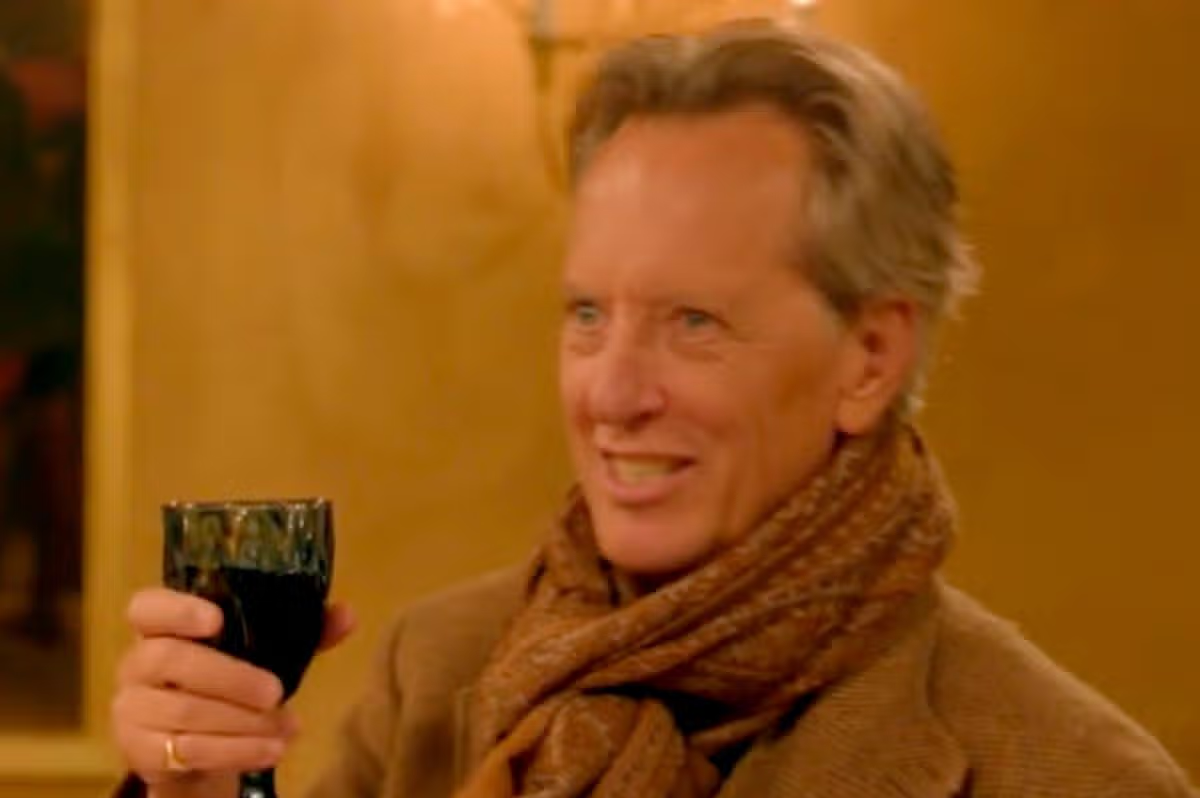
The opening episode ended with two players fighting for their lives but before that – what on earth was Richard E Grant thinking?

Richard is having a shocking time in The Celebrity Traitors
Richard E Grant’s outrageous act of self-sabotage on The Celebrity Traitors last night left producers and fellow players reeling.
Claudia Winkleman said she believed the huge gaffe, in which he openly revealed his role as a Traitor just minutes after she’d selected him, was not because he was nervous, but because he was giddy with excitement after achieving the role he’d always dreamed of.
Now viewers will have to wait until tomorrow’s episode to see if the actor can survive the first roundtable banishment – while also discovering whether it was comedian James Acaster or TV journalist Amol Rajan who met their grisly end in a coffin.
Claudia said that Richard, 69, was so desperate to be a Traitor, she had no choice but to tap him on the shoulder. “You just couldn’t not give it to him, because he wanted it so much,” she laughed at a screening last week. “I couldn’t believe he was literally in the castle. And yeah, he was giddy. The genius of the game is that everyone plays it completely differently, and he took that to the next level.
“I think it was excitement. I think he was genuinely so happy. He came into the church. He loved the game. He had to eat. He wanted to be a Traitor. He got picked for a Traitor. He just wanted to tell everyone.”
Producer Sarah Fay agreed: “Never in our wildest dreams did we think that we’d have a Traitor admit they were a Traitor five minutes on from the round table. We’ve never had anything like that happen before. I think it was just static delirium. I don’t know what he was thinking. I still can’t believe it now, but yeah, Richard E Grant, how iconic.” She confessed that the star’s astonishing faux pas had left her feeling conflicted in the moment: “It was a mixture of a little bit of sick coming up in my mouth and a punch at the same time.”
Ahead of being picked, Richard told Claudia: “If I was lucky enough to be a Traitor, that would be one of my dreams come true – it’s the only way to have some control. Friendships means diddly squit!” And he won over the audience by speaking about his late wife Joan Washington, who told him four days before she died, in 2021, that he was to find “a pocketful of happiness” each day. “I feel like I’ve got a wheelbarrowful, and then some,” he marvelled.
But it wasn’t long before he boldly told Joe Lycett that he was “a Traitor” – leaving the group stunned. Luckily for him, Jerry Hall – who claimed in the show that she’d make a good Faithful because her uncle was one of the Texas Rangers who’d caught Bonnie and Clyde – quickly dismissed his outburst. “Oh, that’s just Richard, he wanted to be a Traitor so bad,” she said. “I’ve known him for 30 years and he says and does eccentric things.”
Many of the group appeared to follow her lead, with actress Myha’la insisting he must have been joking because “he’s too smart for that”. But viewers saw Richard sigh on camera: “That might be the biggest mistake I have ever made in my life.”
Finding out her fellow Traitor was like “an unhinged uncle” left Love Island host Maya Jama, 32, realising they’d have to work hard to keep him in the game. Despite this, she wholeheartedly accepted the challenge of getting him off the hook. “Me and Richard are in it together,” she said in a solo chat. “It’s like heaving an unhinged uncle running wild in the castle – that is my partner in crime.”
Told they had to choose a new recruit to join them in the turret, the duo picked the pair who had expressed the loudest views about Richard being a Traitor – Amol, who called Richard the “lord of chaos” and James Acaster. Whoever joins the Traitors after pleading for their life and ending up in a coffin cliffhanger will now have to change their argument – or throw Richard under the bus. But what is certain is that either James, 41, or Amol, 43, will tonight follow in the footsteps of Paloma Faith by becoming the first celebrity to exit the series.
Sarah said the idea for this twist was sparked by the pop star’s swift death last year. “We thought wouldn’t it have been interesting if Paloma had had the chance to plead for her life?” she explained. “Going home first is a massive thing, but if you can slightly put the power back in their hands, how interesting would that be?”
The idea of having Claudia pop out of a coffin at the start came after the celebrities had to dig their own graves in last year’s opener. “We were racking our brains: how can we make this feel different” Sarah said. “We landed on starting in the church and ending in the church, bookmarking episode one. So opening with Claudia popping out of a coffin, and then our first murder being someone getting slammed into one.” Claudia’s own ideas, that she got into the suit of armour or emerged from the grandfather clock, were both dismissed.
Almost all of the 21 celebrities wanted to have the green cloak, with only a handful determined to be Faithful, including singer James Blunt, mathematician Hannah Fry and comedians Miranda Hart and James Acaster – who will have failed in that quest if he remains in the game.
Ross Kemp said in his entrance interview that he wanted to show people he had a good sense of humour – and he certainly provided plenty of laughs last night. But, sadly for him, the comedy he brought was mostly at his own expense after he went into a tailspin first during the mission, and then later over drinks in the castle.
The TV tough man had prepared so thoroughly by going through previous episodes that he interpreted any gesture towards him as an attempt to kill him in plain sight. First Bella Ramsay was under suspicion after placing the Captain’s hat on his head as an mark of respect because he’d excelled in the mission. Then it was Leigh-Anne Pinnock’s turn after she touched him in the bar because she felt chilly. “I’ve just had my arm rubbed – she rubbed me on the arm,” he spluttered to the group. Accusing her outright of murder, she could only insist: “Oh my gosh – calm down! Stop.”
Admitting he was caught in a spiral of doom, the 62-year-old sighed: “My guard is very much up. Anyone touching me, offering me a drink or talking to me in a slightly odd way – that could be me gone. I’m feeling pretty paranoid.” Uncloaked host Ed Gamble branded his reactions as “one of the funniest things I’ve ever seen”. He laughed: “He’s a big hard man running that mission and then immediately terrified of a member of Little Mix touching him on the arm.”
The Celebrity Traitors returns tomorrow on BBC1 at 8pm.