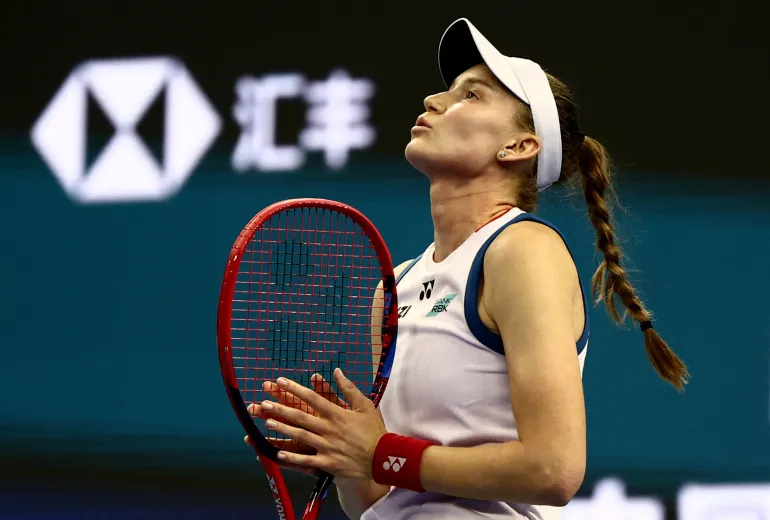
Sabalenka

Sabalenka ‘mentally off track’ as French Open exit made her want to ‘quit’ | Tennis News

After letting another big lead slip with an error-strewn performance at the French Open, top-ranked Aryna Sabalenka felt like getting as far away from the courts as possible.

“Just want to quit tennis right now,” Sabalenka said after wasting a lead of a set and two breaks in a 3-6, 7-5, 6-0 loss to Diana Shnaider in the quarterfinals on Wednesday.

Recommended Stories

list of 4 itemsend of list

“We’ll see in a few days. Hopefully, I’ll get back on track mentally.”

Sabalenka’s wait for a first French Open title continues despite the four-time major winner leading 4-1 in the second set and being two points from victory while serving for the match at 5-4.

What followed was a complete collapse as she lost 12 of the last 13 games against a player appearing in her first Grand Slam quarterfinal, looking increasingly frustrated and forlorn in the windy conditions.

Just like her loss to Coco Gauff in last year’s final, when she won the first set before becoming undone with a slew of unforced errors, this one will take some time to get over.

“You know those rooms where you just go in and you smash everything,” Sabalenka said. “Probably I will spend a whole day over there destroying stuff. Maybe it will help, maybe not.”

Shnaider next faces Maja Chwalinska, who extended her remarkable Roland Garros run by beating 22nd seed Anna Kalinskaya 7-6 (3), 6-3.

Sabalenka’s missed opportunities

The world number one stood still and screamed after losing a point to fall 0-30 down in the sixth game of the decider. Although she saved two match points at 0-40 down, she lost when she sent a shot into the net.

“I just think it’s [a] combination of everything,” Sabalenka lamented. “You overthink, then you make easy mistakes, then you miss opportunities.”

Her struggles were reminiscent of the match against Gauff, when she remonstrated loudly, shouting to herself and glaring at her team box.

“I just have to sit back and openly think about what’s going on in my head in those tough moments,” Sabalenka said, recalling that match. “Because I’m quite an experienced player. I have been through so many things, and I [have] overcome so many things.”

Sabalenka had already looked agitated when serving for the first set, but still looked in control as she served for the match in the second, holding a 30-15 lead.

“Of course I saw some moments of her frustration,” Shnaider said. “I know Aryna that she’s a very emotional person.”

Shnaider, who was already on her best run at a major, broke Sabalenka before taking complete control.

“Well, honestly, I am speechless. Super happy,” she said. “I feel like I was trying to focus point by point. Not thinking about the score. She is the world number one, so I [am] just trying to do my best. I just had to fight for every point.”

Sabalenka looked increasingly frustrated as the third set wore on, and when she missed a volley at the net in the fourth game of the decider, she crouched and rested her head on her racket.

Diana Shnaider shows appreciation to the fans after victory over Aryna Sabalenka
Diana Shnaider shows appreciation to the fans after victory at Roland Garros [Dan Istitene/Getty Images]

Another French Open upset

It was another big upset in a tournament, with defending champion Gauff (third round) and four-time winner Iga Swiatek (fourth round) already out.

Jannik Sinner, last year’s men’s singles runner-up, served for the match in a second-round defeat, and 24-time major winner Novak Djokovic wasted a two-set lead in a third-round loss.

That opened things up for lesser-known players. According to sports analytics company Opta, this year’s French Open is the first major tournament without a former men’s or women’s singles major champion in the semifinals since the 1977 French Open.

The unseeded Chwalinska came through three qualifying rounds to become only the second Polish woman to reach the semifinals at Roland Garros, along with Swiatek.

Chwalinska said British player Emma Raducanu’s run to the 2021 US Open title as an 18-year-old qualifier had inspired her.

“It was such an impressive run, you know,” Chwalinska recalled. “Also, she was so young.”

When Kalinskaya’s big forehand from the back of the court went out, the 24-year-old had her biggest win, having never been beyond the second round at any major before this tournament.

Chwalinska’s total prize money heading into Roland Garros was $864,030, and reaching the last four here earns her 750,000 euros (about $872,000).

The roof was open on Court Philippe-Chatrier, and there was a lot of wind.

“I don’t know why would they keep the roof open when it was crazy windy,” Sabalenka said. “It was very dirty tennis. I don’t know how people could actually just sit there and watch me play.”

Kalinskaya also struggled.

“I feel like I was fighting against the wind,” she said. “It was cold today, so the ball was going slower. I couldn’t use my speed, my power.”

Men’s singles exits

In the men’s quarterfinals, 10th-seeded Flavio Cobolli beat number four Felix Auger-Aliassime 4-6, 6-4, 6-4, 6-4 and will face fellow Italian Matteo Arnaldi for a spot in the final.

Arnaldi advanced when Matteo Berrettini, yet another Italian, retired due to a left hip injury, with Arnaldi leading 7-5, 5-2.

Berrettini had his hip treated during a medical timeout earlier in the second set.

The strong Italian showing comes despite top-ranked Sinner getting stunned in the second round.

Second-seeded Alexander Zverev and number 26 Jakub Mensik will meet in the other semifinal.

Source link

French Open 2026: Aryna Sabalenka sees another Grand Slam chance disappear after Diana Shnaider defeat in Paris

Clay is not Sabalenka’s strongest surface even though she has won three times in Madrid, where the high altitude makes the conditions similar to a hard court.

Nor did she have a good build-up to Roland Garros. Six match points were squandered in a quarter-final defeat by Hailey Baptiste in Madrid in April, before she let a set and a break lead slip against Romanian veteran Sorana Cirstea in Rome.

But, given her quality and pedigree compared to the other Paris quarter-finalists, it is hard not to think another golden opportunity has slipped through Sabalenka’s fingers.

Sabalenka’s four Grand Slam singles titles – two Australian Open and two US Open triumphs, all on hard courts – are more than most people can dream of.

But she has also lost four finals and six major semi-finals, despite a consistency on the biggest stages that is unrivalled among her peers.

Sabalenka has the proud record of not losing before the quarter-finals of a Grand Slam since the start of the 2023 season.

However, she has not always dealt well with the pressure of the latter stages – particularly during the period where she has clearly been the best player in the world.

Sabalenka was the heavy favourite to beat underdog Madison Keys in the 2024 Australian Open final, but came unstuck. Twelve months later, she reached another Melbourne final – and a flurry of mistakes saw her squander a break lead in the deciding set against Elena Rybakina.

At last year’s French Open Sabalenka played what she described as the “worst final” of her life, hitting 70 unforced errors in windy conditions as she lost from a set up.

Against Shnaider, Sabalenka looked in control at 6-3 4-1 up before losing 12 of the final 13 games.

“I just think that there is something in specific moments during the match [where] I lose control,” said Sabalenka, whose 57 unforced errors outweighed her 46 winners.

Source link

French Open 2026: Will Aryna Sabalenka and Naomi Osaka ‘open door’ for women’s night sessions?

Tournament director Amelie Mauresmo, herself a former women’s world number one, had regularly pointed to the possibility of short two-set matches as the reason for often overlooking the women.

“The match-ups are always interesting for both men and women, but there are multiple factors for us to make the choice,” Mauresmo said earlier on Monday.

“As you know, the potential length of the matches is something that we are also looking at.”

On picking Sabalenka against Osaka, she added: “It was obvious that it should be a night match tonight.”

There was a school of thought that Mauresmo might have looked elsewhere, though, had men’s world number one Jannik Sinner still been in the tournament.

Sinner would have been scheduled to play on the same day, but without him the men’s matches taking place on Monday lacked star power.

If Sabalenka against Osaka did not take place under the lights, then which women’s match would conceivably ever be picked?

With that came a sense of expectation.

If the match ended up being a dud, then it could have been used by critics as a stick to beat the women’s game with.

That, others argue, was a situation created by the French Open’s reluctance to showcase its female stars in the first place.

Was the burden which it placed on Sabalenka and Osaka to represent the women’s game fair?

“I don’t really care. There are so many different things to put pressure on myself – that was the last thing on my mind,” said Osaka.

“Shout out to the tournament for trusting us – I hope it was entertaining for people.”

Source link

French Open 2026 results: Aryna Sabalenka outserves Naomi Osaka to reach quarter-finals

When the two players met in Madrid in April, it was Osaka who won the opening set, and she started quickly once again, breaking Sabalenka in her opening service game.

However, it proved to be the only moment of uncertainty on serve for the top seed, who only conceded four points on her own delivery across the remainder of the first set and finished the match with 12 aces to Osaka’s two – and an 83% win rate behind her first serve.

Osaka, by contrast, invited pressure on herself, being taken to deuce after leading 40-15 in three first-set service games and landing just 53% of her first serves. Sabalenka routinely stepped inside the baseline to receive second serves and won 21 points from a possible 35.

Sabelenka’s canny shot selection also proved effective, winning 10 of her 11 points at the net and hitting five drop shots among her 39 winners as she avoided being drawn into endless baseline slog-fests.

She made the decisive break in the 11th game of the opening set before closing it out with a hold to love, and her relentless pressure told again in the second.

Osaka saved a break point in the fifth game but was broken to 15 in her next two service games, with Sabalenka converting match point with a trademark booming forehand.

Source link

French Open 2026 results: Aryna Sabalenka beats Jessica Bouzas Maneiro, Coco Gauff through

Coco Gauff overcame an “eventful” start to her French Open title defence – dealing with a “mini car accident” and a dress malfunction before securing a first-round win.

The American fourth seed opened her campaign with a routine 6-4 6-0 victory over compatriot Taylor Townsend.

But it was the drama off the court that left Gauff with the more memorable story.

“We got in a mini car accident on our way to the site today,” she told TNT Sports.

“There was this pole thing and it was supposed to go down and the police told him [the driver] to go and we ran into it.

“You felt an impact, I spilled my juice all over the car.”

Gauff said the car was “not driveable” afterwards and her team had to make alternative travel arrangements to get to the Roland Garros site.

The 22-year-old, who came from a set down to beat Aryna Sabalenka in last year’s final, said the accident – along with other incidents – felt like a “good omen”.

Gauff and Townsend were on Court Philippe Chatrier earlier than planned, with the men’s match before coming to an abrupt end when Alexandre Muller retired injured after 50 minutes against Stefanos Tsitsipas.

“The retirement happened and right before the match my dress got stuck so my physio was in the bathroom trying to help me take it off,” Gauff said.

“It was an eventful day, but whenever that happens it lets you not think about the match.”

Source link

Players v Grand Slams: Aryna Sabalenka says top players will boycott a major ‘at some point’ over prize money

Poland’s Swiatek said she would prefer continued discussions and negotiations with the majors instead of a boycott.

“I think the most important thing is to have proper communication and discussions with the governing bodies so we have some space to talk and maybe negotiate,” the Wimbledon champion said.

“Hopefully before Roland Garros there’s going to be opportunity to have these type of meetings and we’ll see how they go.

“But boycotting the tournament, it’s a bit extreme kind of situation.

“I guess we as players are here to play as individuals, and we’re competing against each other.

“So it’s really hard for me to say how it would work, if it’s even there on the picture. For now, I haven’t heard anything.”

But French Open champion Gauff thinks strike action would be a genuine possibility if the players come together as one.

“If we all collectively agree, then yes,” the American said.

“I wouldn’t want to be the only one, but we definitely can move more as a collective.

“From the things I’ve seen with other sports, usually to make massive progress and things like this, it takes a union. We have to become unionised in some way.”

World number two Elena Rybakina says she has not been involved in the campaign, but would go with the majority.

“If the majority say we are boycotting, then of course I’m up for it. It’s not an issue,” the Australian Open champion said.

World number five Jessica Pegula has been an articulate advocate of the players’ campaign, but virtually ruled out strike action during a BBC Sport interview in Indian Wells in March.

“We love playing the Slams – I don’t think anyone’s going to strike against the Slams,” the American said.

“I just think it’s us asking for what we think we deserve, but I do think that if the men and the women can come together – which we have on that front – and keep pushing, there’s nothing wrong with us just asking for what we think is right.”

Source link

Madrid Open: Aryna Sabalenka comes from a set down to beat Naomi Osaka

American Gauff, who has been unwell with a stomach virus, will drop from third to fourth when the updated world rankings are released, with Poland’s Iga Swiatek replacing her.

The reigning French Open champion was ruthless in the second set after losing the first and looked a safe bet to advance to the next round at the expense of Noskova, after breaking the 21-year-old for a second time in the third set.

But world number 13 Noskova produced an impressive comeback in front of the Spanish crowd as Gauff faltered and will face Ukrainian Marta Kostyuk in the quarter-finals on Wednesday.

Kostyuk, 23, won 6-2 6-3 against American Caty McNally to celebrate her ninth victory in a row and back-to-back Madrid quarter-finals.

“Sometimes I get lost on court, especially in the second [set], as it happened today,” said Noskova. “I had to find my rhythm all over again in the third [set].”

Meanwhile, Sabalenka will take on American Hailey Baptiste, who defeated Belinda Bencic 6-1 6-7 (14-16) 6-3 in her fourth-round match, on Tuesday.

She defeated Baptiste, 24, in the quarter-finals of the Miami Open on her way to winning the title last month.

Source link

Tennis duo Sabalenka and Alcaraz sweep top Laureus sports honours | Tennis News

Barcelona’s Yamal bags Young Sportsperson of the Year accolade a year after winning the Breakthrough award in 2025.

Tennis ruled the red carpet in Madrid as Aryna Sabalenka and Carlos Alcaraz were crowned Sportswoman and Sportsman of the Year at the Laureus Awards.

The pair were honoured on Monday after glittering 2025 campaigns that saw them finish atop the women’s and men’s tennis rankings, respectively.

Recommended Stories

list of 3 itemsend of list

Spaniard Alcaraz, 22, reclaimed the year-end world number one spot after capturing two Grand Slam titles at the French Open and US Open, underlining his supremacy across surfaces.

Belarusian Sabalenka, 27, meanwhile, stood alongside him in the winners’ circle in New York and also reached the final in Australia and France, capping a season of relentless consistency.

With her triumph, Sabalenka joins a roll call of Laureus Sportswoman of the Year recipients from her sport, including Serena Williams, Jennifer Capriati, Justine Henin and Naomi Osaka.

Barcelona and Spain athlete Lamine Yamal, 18, won the Young Sportsperson of the Year award. It is the second award for the young Barca forward after being voted Breakthrough Sportsperson of the Year in 2025, making him the youngest athlete to have won two Laureus awards.

German football great Toni Kroos won the world sporting inspiration award, and retired gymnast Nadia Comaneci got the lifetime achievement prize.

The world action sportsperson award went to American snowboarder Chloe Kim.

Brazilian Gabriel Araujo was the world sportsperson of the year with a disability.

In a first for the awards, the ceremony was hosted by two athletes – both former Laureus winners – Novak Djokovic and Eileen Gu. Last year’s top honours went to gymnast Simone Biles and pole-vaulter Mondo Duplantis.

Laureus World Sports Awards - Palacio de Cibeles, Madrid, Spain - April 20, 2026 China's Eileen Gu poses on the red carpet ahead of the awards ceremony REUTERS/Isabel Infantes
Eileen Gu cohosted the award show with Novak Djokovic[Isabel Infantes/Reuters]

McIlroy takes comeback prize

Elsewhere, Rory McIlroy claimed the World Comeback of the Year Award after ending an 11-year wait to complete the career Grand Slam with a playoff victory at the 2025 Masters, a title he defended in 2026.

Formula One’s Lando Norris was named World Breakthrough of the Year, while Paris St Germain took World Team of the Year after a trophy haul in 2025 that included the French league and Cup, plus their first Champions League crown.

The Laureus World Sports Awards nominees are selected by the global media, while the winners are determined by the 69 members of the Laureus World Sports Academy.

The awards have been presented annually since 2000.

Laureus winners 2026:

  • World Sportsman of the Year Award: Carlos Alcaraz
  • World Sportswoman of the Year Award: Aryna Sabalenka
  • World Team of the Year Award: Paris Saint-Germain
  • World Breakthrough of the Year Award: Lando Norris
  • World Comeback of the Year Award: Rory McIlroy
  • World Sportsperson of the Year with a Disability Award: Gabriel Araujo
  • World Action Sportsperson of the Year Award: Chloe Kim
  • World Young Sportsperson of the Year Award: Lamine Yamal
  • Laureus Sporting Inspiration Award: Toni Kroos
  • Lifetime Achievement Award: Nadia Comaneci
  • Laureus Sport for Good Award: Futbol Mas

Source link