Samsung targets higher Galaxy S26 sales with AI push

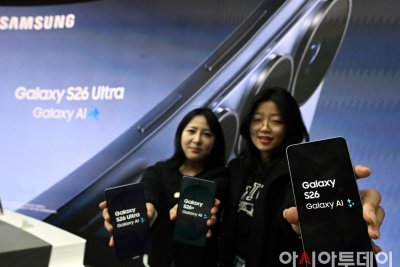
Staff members display Samsung’s Galaxy S26, S26 Plus and S26 Ultra smartphones at a KT retail store in Seoul on Wednesday. Photo by Asia Today
Feb. 26 (Asia Today) — Samsung Electronics President Roh Tae-moon said the company aims for the new Galaxy S26 to surpass its predecessor’s sales, highlighting upgraded artificial intelligence features despite higher retail prices.
Speaking Tuesday at a Galaxy Unpacked press briefing in San Francisco, Roh said the Galaxy S25 series exceeded the prior model’s sales, citing improved real-world user feedback over time.
Market researcher Counterpoint Research said Galaxy S25 sales from February through December rose 5% from the previous generation. Industry estimates place total sales in the high 30 million range.
Roh said the Galaxy S26 features more advanced “agentic AI” capabilities and strengthened practical tools such as Photo Assist. He added that tighter integration between software and hardware, including a privacy-focused display feature, has drawn positive responses from global partners.
Samsung has expanded its AI platform beyond Bixby and Google Gemini to include additional services, and introduced a new AI operating system developed in cooperation with Google to enable smoother AI-driven functions. Roh described the strategy as a “hybrid AI” approach allowing users to choose optimized AI tools for different tasks.
The company is also positioning AI as a differentiator across product tiers, from flagship to entry-level smartphones.
Samsung raised domestic launch prices for its latest Galaxy S series by as much as 300,000 won, about $225, after keeping prices unchanged for three years, citing rising component costs. Counterpoint has projected Samsung’s smartphone shipments could decline about 2% this year amid higher prices.
Roh acknowledged cost pressures but said Samsung’s long-established supply chain gives it flexibility. He said the company will pursue innovation that maintains performance even with fewer components, using AI to offset hardware constraints and limit the impact of cost increases.
“As AI evolves, the importance of devices will only grow,” Roh said, adding that smartphones remain the primary interface through which users generate data and interact with AI services.
— Reported by Asia Today; translated by UPI
© Asia Today. Unauthorized reproduction or redistribution prohibited.
Original Korean report: https://www.asiatoday.co.kr/kn/view.php?key=20260227010008181