TUI and easyJet, however, do allow the popular item to be brought onto flights
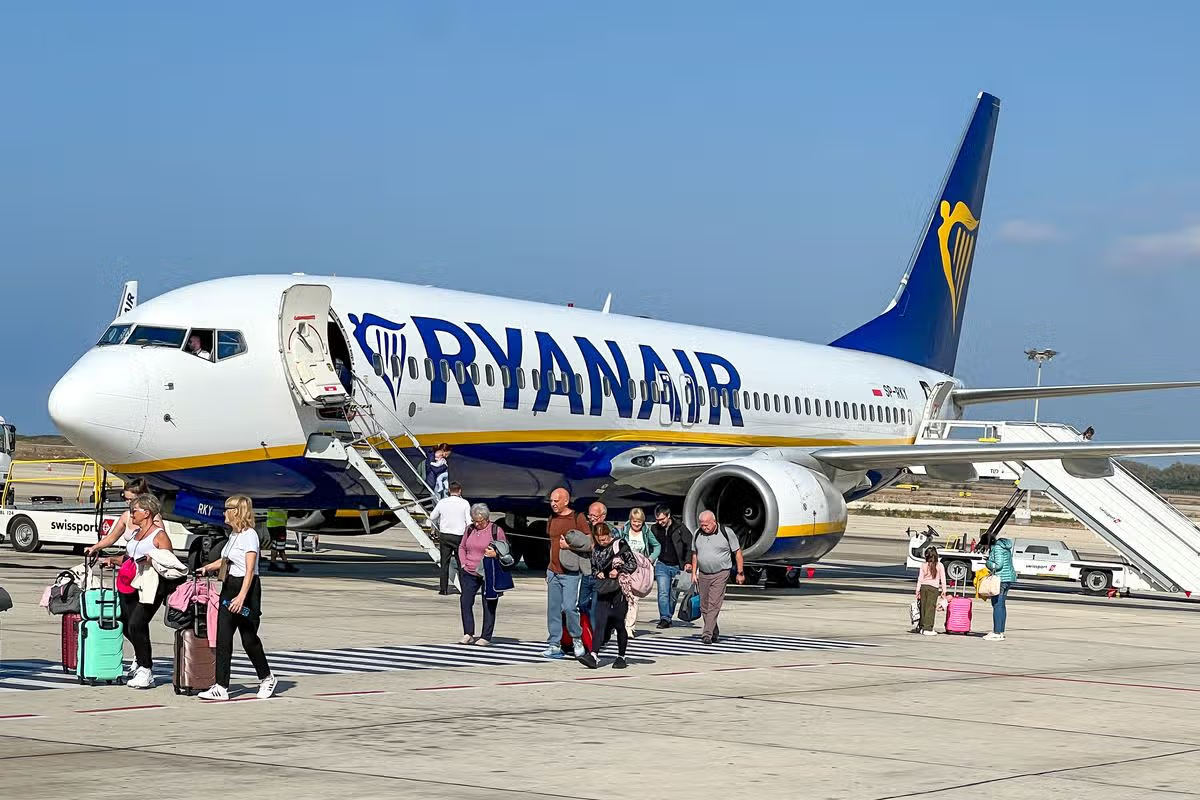
Jet2 and Ryanair have different rules(Image: GordZam via Getty Images)
Holidaymakers might be surprised to learn they’re banned from taking a commonplace item, which usually sets you back around £3, on board Ryanair or Jet2 planes. But the same item is perfectly acceptable on easyJet or TUI flights.
Different airlines have varying rules, and while many policies overlap between carriers, some specific rules can catch passengers off guard depending on which operator you’ve booked with. Travellers jetting off abroad frequently browse airport terminal shops and eateries, purchasing everything from duty-free products to snacks, drinks and more.
However, if you’re intending to splash out in the departure lounge, you ought to be aware that a specific purchase is not allowed on Ryanair or Jet2 services. Many passengers crave a caffeine hit while on the move, and airports typically offer numerous outlets selling coffee or other hot beverages, generally priced from approximately £3.
But you’ll have to drink your hot beverage before boarding Ryanair or Jet2 planes, as laid out in their respective regulations. Ryanair confirms it “cannot allow passengers to board the plane with hot drinks” due to safety reasons, while Jet2’s website explicitly states: “You may not bring hot food or hot drinks onboard the aircraft”.
If you’re jetting off with TUI or easyJet, though, you can take your terminal-bought coffee on board, as long as it’s got a secure lid on it. Meanwhile, post-Brexit regulations dictate that certain other items bought before departure aren’t allowed to accompany you into EU countries, and this applies no matter which carrier you’re flying with, reports the Liverpool Echo.
Whether you’ve picked them up at the airport or not, taking meat or dairy products into the EU – even if they’re part of a sandwich – is absolutely forbidden.
TUI, easyJet, Ryanair and Jet2 warning over common children’s toy that’s banned on flights – The Mirror
Need to know
Parents are being warned ahead of the February half-term holiday about a common children’s toy that is banned from all major airlines, including TUI, easyJet, Ryanair and Jet2
Parents are warned of a common kids’ toy that is banned in hand luggage(Image: Getty Images)
Warning for children’s toy banned on flights
All airlines have luggage restrictions that every passenger must abide by. This includes requirements for travelling with liquids, food and baby formula, and electronic devices
The luggage restrictions included banned items, including sharp and dangerous objects, as well as liquids over 100ml, although the liquid rule has changed at some UK airports
Many passengers are often aware of the common restrictions, but there are some that could come as a surprise, and might seem a little unusual
One of the items banned from all flights is toy guns and weapons, including replicas, which is often a common toy among kids, particularly after a trip to somewhere like Disneyland, where souvenirs are available to buy
Anyone boarding a flight with a toy gun or weapon is likely to have it confiscated, even if it belongs to a child and is just a toy
TUI outlines the restriction on “Toy guns, replicas, and imitation firearms that could be mistaken for real weapons”, under its dangerous and prohibited articles. They confirm they are not allowed to be carried through security or onto the plane
EasyJet states that “toy guns, replicas and imitation firearms capable of being mistaken for real weapons” are banned from hand luggage. However, toy guns can be carried in hold baggage
Ryanair affirms that “toy guns (including recreational guns such as paintball guns), replicas and imitation firearms capable of being mistaken for real weapons” are prohibited on board and in checked baggage
Jet2 states that firearms, including those that are toys, are “forbidden for carriage”
The ban applies to other major airlines, but it is best to check directly with the company for their restrictions and guidance on certain items before travelling
Do you have a travel story to share? Email webtravel@reachplc.com
In November 2025, Ryanair also made a major change to its ticketing system by discontinuing the use of physical tickets
Ryanair passengers should check in before heading to the airport (stock image)(Image: rparys via Getty Images)
It’s no secret that Ryanair is among the UK’s most popular airlines. Between 2024 and 2025, it celebrated reaching 200 million passengers, a first for any European airline in a one-year period.
Yet future passengers should know that a single oversight could incur a hefty charge. Dealing with this at the airport generally costs £55 in the UK, £30 (€30) for departures from Spain, and even £40 (€40) for departures from Austria. The fee is charged per passenger, per ‘sector’, which includes connections.
You may be surprised to learn that the mistake is simply forgetting or choosing not to check in with Ryanair before arriving at the airport. Customers are urged to check in for flights ahead of their journeys and use a Digital Boarding Pass (DBP).
Official online advice from Ryanair explains: “All Ryanair passengers will still receive email reminders to check-in online 48 and 24hrs predeparture. If any passenger arrives at airport but hasn’t checked in online (having ignored these reminders), they will still be required to pay the airport check-in fee.”
In November 2025, Ryanair made a major change to its ticketing system by discontinuing the use of physical tickets at most airports and instead operating as ‘100%’ DBPs. This scheme, originally planned for May 2025, aims to lower costs, save approximately 300 tonnes of paper annually, and enable travellers to receive direct flight updates.
To get one, travellers should check in online via the website or the Ryanair App, available on the Apple App Store and Google Play. After check-in, a DBP will automatically show up in the Ryanair App. This should be presented at airport security and the boarding gate before flights.
Overall, the budget airline insists that this method is ‘quicker, easier’ and results in ‘less stress’ compared to using paper tickets. Plus, travellers should still be able to board the flight even if their phones are lost or run out of battery.
This is primarily because personnel will have each traveller’s ‘sequence number’ at the departure gate. Ryanair boss Michael O’Leary explained on The Independent’s daily travel podcast last year: “The big concern that people have is: ‘What happens if I lose my battery or what if I lose my phone?’
“…If you lose your phone, no issue. As long as you’ve checked in before you got to the airport, we’ll reissue a paper boarding pass at the airport free of charge.”
Advice on Ryanair’s website mirrors this, adding: “If you have already checked in online and you lose your smartphone or tablet (or it dies), your details are already on our system and you will be assisted at the gate.”
Despite this, it’s important to note that Ryanair isn’t the only airline to issue check-in fees at airports. Wizz Air similarly charges between €40 and €50 for airport check-ins, which also apply per flight, per passenger.
Visit Ryanair.com or access the Ryanair app on your device.
Log in to your existing account or create a new one if needed.
Click on the ‘Check-in’ option.
Follow the on-screen instructions and enter the required details from your travel documents.
Once check-in is complete, either print out your boarding pass or save it to your mobile device for easy access.
Get all the hottest shopping deals, cash saving tips and money news straight to your phone by joining our new WhatsApp Community – The Money Saving Club. Just click this link to join https://crnch.it/eutplxS1
We also treat our community members to special offers, promotions, and adverts from us and our partners. If you don’t like our community, you can check out any time you like. If you’re curious, you can read our Privacy Notice here https://crnch.it/jeQqC872
Ryanair has branded the cheaper travel advice ‘fake news’
09:51, 06 Feb 2026Updated 10:01, 06 Feb 2026
Ryanair is not impressed(Image: GordZam via Getty Images)
Ryanair passengers are being encouraged to follow strategies to reduce their travel costs, though the airline has dismissed these suggestions as “fake news”. Consumer watchdog Which? claims its research indicates that travellers may be paying more than necessary.
According to Which?, families could potentially save upwards of £100 on their next Ryanair journey by simply disregarding the airline’s “recommended” fare option. When booking a summer getaway from London to Alicante for a family of four, Ryanair promoted its “Regular” fare as the “ideal” selection.
But opting for this would have cost £59 more than choosing the “Basic” fare and manually adding identical seats and baggage later during the booking process, Which? claims. The article goes on to say: “If our family decided that we could get by with four cabin bags instead of the eight included in Ryanair’s ‘Regular’ fare, then we could reduce the fare by £163 from Ryanair’s recommendation.”
It added: “The Regular fare comes with priority boarding, carry-on luggage and free standard seat selection included, but on around 30 checks over the past two years we’ve only once found it cheaper. We looked at 15 flights to a range of locations in February 2026 and only once was the Regular ticket cheaper, even if we wanted all those extras.”
Ryanair is not impressed. A spokesperson for the airline told Sky News: “This is more fake news from Which? Thankfully no one reads, or takes any notice of Which’s fake recycled news articles or your spurious ‘advice’, as our traffic growth from 200 million to 208 million passengers in 2025 proves.”
Spain is filled with beautiful destinations, but are often packed with tourists — but now Brits can fly to one Spanish city without fighting through the hustle and bustle
Rory Gannon Showbiz Journalist
02:00, 06 Feb 2026
Castellón de la Plana is an unspoilt gem that captures true Spanish life without too many tourists(Image: Getty Images/iStockphoto)
A breathtaking Spanish city could be yours to discover — for just the cost of a £13 flight.
Spain has a slew of destinations that are filled with amazing history, phenomenal beaches and great natural trails. However, this often comes at the cost of being inundated by tourists trying to capture their own private moment.
But now, a new destination has opened up for Brits to explore the glorious Spanish sun, without the need for wrangling through swathes of holidaymakers trying to take the perfect picture. The hidden gem also sits right on the Mediterranean coast, making it an unspoilt beauty, but still close to other holiday hotspots.
Castellón de la Plana is a small city sitting just inland of Spain’s Costa de Valencia. With a population of just over 174,000 people, the city is often dwarfed by its popular neighbours, including Benidorm, Valencia, and even Barcelona further along the coast.
However, the city is brimming with culture and history, being the fourth-largest city in the region. The town has been mentioned in history books as far back as 1233, when it was taken over by a Spanish king, and has since built up an impressive history, filled with castles and stunning panoramic views, all with 30 °C temperatures at the height of summer.
Being located close to the sea, the city boasts access to the stunning Islas Columbretes Natural Park, where tourists can take in the amazing natural landscapes. With huge sea stacks and rock formations coming out of the sea, the panoramic views are like no other in Spain itself.
Back on dry land, travellers looking to get stuck into the hustle and bustle of daily life can get lost strolling through the Mercado Central, filled with locals selling their best produce. Seafood is in plenty of supply, with customers often queuing around the markets to get fresh quality goods, including food and drinks.
But if the market chaos is too much, the city also boasts a number of quiet, peaceful plazas that show how locals live their lives. Places such as the Plaça Major offer spots for people-watching, whilst taking in the breathtaking architecture of the local cathedral and other prominent buildings.
Beaches are also dotted around the city, with the songs such as the Playa del Pinar and Playa El Gurugu being the perfect spots to catch the sunrise over the horizon of the Med.
Food and drink are also staples of the city’s thriving life, as there are a host of bars and restaurants offering traditional meals for a reasonable price. Modern history is also covered, with the Refugio Antiaereo air-raid shelter now serving as a museum, adding an extra quirk to the Spanish diamond.
British tourists are now able to catch a flight to Castellón de la Plana, after Ryanair officially connected London Stanstead Airport to Castellón Airport, based some 30 kilometres away from the city itself. The cost of the flights themselves are also incredibly cheap, with the cheapest one-way flight to the Spanish getaway coming in at £13 this month.
The airport can also serve as a great gateway to the rest of the Valencia region, with holiday hotspots such as Valencia City, Alicante, and Benidorm easily accessible. The price of flights also do not fluctuate that much, meaning a cheap flight to Spain is always guaranteed.
The European Parliament has voted to allow passengers to carry a small case alongside free underseat bags
easyJet, Ryanair and other airlines could be impacted(Image: Anna Barclay/Getty Images)
Travellers with Ryanair and easyJet may soon be allowed to bring two cabin bags on flights without facing additional charges. Currently, these carriers permit passengers on basic fares to take just one small personal item aboard, with any extra luggage coming at an additional fee.
Ryanair has been compelled to increase the size of personal bags it allows, following changes to EU regulations. Under the new rules, passengers flying with the budget airline will be able to carry hand luggage measuring up to 40 x 30 x 20cm, marking a 20 per cent increase from the previous 40 x 20 x 25 cm restrictions.
easyJet’s personal bag dimensions already complied with these requirements, but another EU rule modification could enable travellers to bring a cabin bag measuring up to 100cm, along with a personal bag, without extra costs. The European parliament voted last month to grant all passengers the right to carry a small case, in addition to the free underseat bags currently allowed.
Parliament wants passengers to have the right to bring onto the aircraft, at no extra cost, one personal item (such as a handbag, rucksack or laptop) and one small piece of hand luggage with maximum dimensions of 100 cm (combined length, width and height) and seven kilograms. The amendments, which require approval from the European Council before taking effect, would cover all travellers flying to or from an EU airport with an EU-based carrier, directly impacting the majority of short-haul journeys from the UK.
European Parliament members (MEPs) are also keen to guarantee that children under 12 are positioned next to an accompanying adult at no additional charge. At present, carriers have no legal obligation to place children beside their parents, although the Civil Aviation Authority (CAA) recommends they should do so.
The CAA explains: “Young children and infants who are accompanied by adults should ideally be seated in the same seat row as the adult. Where this is not possible, children should be separated by no more than one seat row from accompanying adults.
“This is because the speed of an emergency evacuation may be affected by adults trying to reach their children.”
Avoid paying a massive fee at the airport gates by checking your cabin bag size before you fly. With half term on the way, here’s the latest sizing regulations for some of the most popular airlines
Cabin baggage allowances can vary hugely by airline(Image: Getty Images/iStockphoto)
One thing that often catches passengers out when flying on budget airlines is cabin baggage allowances. On busy flights, it’s common to see the dreaded bag sizer coming out, and being over just a centimetre can mean you end up paying a massive fee to check your bag at the gate.
To make things even more confusing, cabin bag size allowances change all the time, so even if you’re a frequent flyer, you can get caught out. It’s always best to check the size of the cabin bag that’s included with your ticket just before you go, so you can avoid hassle at the gates.
It’s also much cheaper to pay for extra bags when you book your flight, not once you’re at the airport, so always make sure you’ve booked the amount you need in advance.
Ryanair is notorious for strictly enforcing cabin baggage sizes, and if you’re taking a bag on board, you should make sure you get the tape measure out and check the dimensions before you head to the airport.
However, there’s good news for Ryanair passengers: the free underseat bag included in its basic fare can now be slightly larger. Previously, this small bag had to fit in a sizer with the dimensions of 40 x 25 x 20 cm, but since summer 2025 it can now be up to 40 x 30 x 20 cm. These free bags need to fit under the seat in front of you, and usually people bring a handbag, laptop bag, or small rucksack.
Technically, there’s no weight limit on these small bags, as long as they fit under the seat, but passengers will need to be able to carry and handle them, and an excessively heavy bag could be noticed by flight attendants.
Passengers can also pay to bring a second cabin bag of up to 55 x 40 x 20cm onboard with them, and this bag has a weight limit of 10KG. Passengers will need to lift this bag into the overhead locker above them, so bear this in mind when packing. If you prefer to check a bag, you can add a 10KG, 20KG, or 23KG bag to the hold. Prices vary depending on route and availability.
EasyJet
Budget airline easyJet is also known for strictly monitoring bag sizes, and you’ll see lots of orange sizers around the airport so you can check whether your luggage will fit. However, it’s best to measure bags at home when they’re packed so you can adjust accordingly.
Everyone who flies with easyJet gets one small underseat cabin bag included in the price. This can be up to 45 x 36 x 20 cm in size, and easyJet states it can’t exceed 15KG in weight.
Customers also have the option to book a second cabin bag of 56 x 45 x 25 cm maximum, including handles and wheels. As a bonus, if you book a second bag, you get speedy boarding included. When booking your flight, you also have the option to pay for up to three checked bags of 15KG, 23KG, or a whopping 32KG. Some airports offer a twilight bag drop for passengers on early flights, meaning you can check your luggage the night before heading off and head straight for security in the morning.
Jet2
Whether you’ve booked a package holiday with Jet2, or just a flight, cabin baggage allowances are the same. You get a small bag of 40 x 30 x 20cm, which must fit under the seat, and the price also includes a 10KG piece of hand luggage of up to 56cm x 45cm x 25cm. Again, you must ensure measurements include handles, wheels, and other fixtures.
Package holidays include 22KG of checked baggage, but if you’ve only booked a flight, you can still add a checked bag for a fee. Passengers can buy up to three bags of 22KG in weight, perfect for those who don’t like to travel light.
Families travelling with young kids can also bring a collapsible pushchair, car seat, and/or travel cot free of charge.
British Airways
British Airways (BA)’s economy basic fare includes a handbag and a cabin bag. The former can be up to 40 x 30 x 15cm in size and needs to easily fit under the seat in front, while cabin bags can be up to 56 x 45 x 25cm in size. However, BA can only guarantee that the smaller item will be allowed on board. If there’s not enough space in the overhead locker, your cabin bag may need to go in the hold.
BA also offers a range of options for checked bags, depending on the flight route you take and which classes are available. Economy with checked bag includes a 23KG bag in the hold, and unlike most airlines, BA put a size restriction on these checked bags of 90 x 75 x 43cm. Those lucky enough to fly business or first class get much bigger allowances.
If you’ve booked a flight only on TUI Airways, you’ll get a piece of hand luggage of up to 10KG in weight for free, and this can measure up to 55 x 40 x 20 cm. You can also bring a small personal item like a handbag or laptop bag of up to 40 x 30 x 20cm that’s placed under the seat in front of you. TUI emphasises that passengers must be able to lift their hand luggage into overhead storage compartments themselves.
Customers can also add a checked bag when booking their flight, with prices depending on the route and availability. However, if you book a package holiday through TUI and are flying with its airline, then 20KG of checked luggage is included. Some holiday types, such as TUI BLUE or cruises, have a 25KG allowance, so it’s worth checking your booking confirmation before you go.
Have a story you want to share? Email us at webtravel@reachplc.com
A CANNY businesswoman faced with a nightmare train journey from London to Newcastle costing more than £100 flew instead for £30 cheaper — via Italy.
Victoria Williams, 42, had visited friends in the capital.
Sign up for the Travel newsletter
Thank you!
Victoria Williams flew from London to Newcastle via Milan as it was £30 cheaper than a train ticketCredit: NNP
But what should have been a three-hour rail trip home on Sunday was hit by engineering works.
The £110 trek from Kings Cross to Newcastle involved two changes, including a bus replacement, and would take five hours.
Victoria spotted a Ryanair flight from Stansted to Milan, and then Milan to Newcastle, for a total of just £74 — despite travelling 1,400 miles instead of 240.
She took off at 2pm and arrived at Milan Bergamo two-and-a-half hours later.
Amsterdam has long been the go-to destination for a final night of freedom, but research has shown that a new city has emerged as the top spot, while another destination is fast catching up
One surprising city has emerged as a growing hotspot for stag parties(Image: Getty Images/iStockphoto)
Amsterdam may have been dethroned as the king of stag do destinations. According to research analysing search trends, the number of people searching for information on stag dos in the Netherlands’ capital has plummeted by 77% since 2023.
Party organisers, Sofia Stag Do, put together a list of Europe’s top ten stag destinations based on the number of searches over the past two years. Its rankings saw Amsterdam plummet from being the top destination in 2023, to number six in 2026.
Unsurprisingly, Prague took the top spot. While interest was down slightly in this Eastern European city, its combination of lively nightlife, cheap pints, and a beautiful Old Town kept it at number one. However, at number two is a city that has seen a steady increase in interest, and may not be the first location that springs to mind when planning a stag party.
Riga in Latvia is becoming increasingly popular among stag parties, and there’s likely a combination of factors that have pushed it up the charts. Firstly, it is easy to get to from the UK. Flights take as little as two and a half hours, and Ryanair flies to Riga International Airport from East Midlands, Edinburgh, Leeds Bradford, London-Stansted, and Manchester, with fares from as little as £14.99 one way.
Riga’s compact size is also ideal for groups who want to enjoy a bar crawl or go for a night out without needing to get expensive taxis home. The liveliest nightlife can be found in Old Riga, an area full of historic buildings, town squares, and cobbled streets. You’ll find a huge number of bars tucked away, from stylish spots to fun themed places with drink deals.
Some spots to look out for include Secret Event, an underground bar set in a former monastery, and the Tiki Bar Riga, where you can enjoy colourful cocktails. If you’re doing fancy dress, head to Clayton McNamaras Drinking Emporium, a superhero-themed bar full of retro memorabilia that offers a range of shots named after comic characters.
Many bars open until the small hours, but for those who don’t want to head to bed just yet, weekends see a range of nightclubs opening their doors until dawn. Poseidon’s Club comes highly recommended for fans of EDM and stays open until 5am on Friday and Saturday nights. Teritorija has two rooms offering house and techno, while Bacio Riga offers a range of DJ sets and drink deals.
One thing potential stag parties always want to know is the cost of a pint. Riga can’t quite compare with the cheap beer prices of Prague, where you can often find pints for under £2. Pints generally cost £3-4 in the old town, but you can often find drink deals which bring down the prices.
Riga also tends to offer cheaper accommodation than Prague, and it’s walkable, so you may find that overall a stag do in Latvia could work out cheaper than going to Prague.
Have a story you want to share? Email us at webtravel@reachplc.com
Ryanair has told passengers to stop packing a popular toiletry in their hand luggage. If you make the mistake, it could cause a few problems at airport security
07:25, 03 Feb 2026Updated 07:25, 03 Feb 2026
Ryanair told passengers to stop packing the toiletry (stock image)(Image: Getty Images)
There’s nothing like jetting off to a hot location during the winter months, but you need to ensure you pack your belongings in the right cases. In fact, airline Ryanair has told passengers they need to avoid placing a popular toiletry in their hand luggage if they want to travel through airport security with ease.
It’s worth paying attention to as, if you fail to follow the expert advice, it could land you in a spot of bother. In fact, it was recently brought up on Reddit after a traveller was left a little confused about the rules as to what he could carry in his hand luggage.
On Reddit, a social media user posted: “I recently started using safety razors and I was wondering if I could carry mine with one blade inside or a packet of blades. I don’t have a checked bag, only the carry-on.
“Previously I was always able to bring disposable razors with the blades stored in the plastic compartment. In the General terms & Conditions, Ryanair says safety razors are allowed but, I asked the support and, even though he wasn’t anywhere specific to answer my query, he said that sharp objects are not allowed.
“So, if I bring the safety razor with me with a blade in it, the worst that can happen is they are just going to remove the razor and give me the head/handle (enclosure thing) back?”
The question got a lot of people talking, as one person replied: “Safety razor will be fine. Really comes more down to the airport you are going through, not the airline, and even then it also comes down to the individual person you deal with.”
Another added: “OP (original poster) is not asking about safety razors per se. He’s asking about the blades, which are definitely prohibited items. Someone intent on causing harm could quite easily unscrew the razor and use the blade or spare blades as weapons.”
A third also replied: “NO, you cannot. Razor blades, including straight razor blades and replacement blades, are prohibited items because they could be used as weapons.
“However, as you said, fixed cartridge razors (disposable razors) generally are allowed in carry-on luggage. Safety razors (with blades in a plastic head) also are usually permitted in carry-on luggage. But NOT the type where you can unscrew the head and extract the blade.”
If you usually carry razors with you when you travel, which a lot of people do, it turns out there are some rules you need to follow. All you need to know is detailed on the Ryanair website.
What does Ryanair say?
The website reads: “The following items must not be carried on board, but may be carried as part of your checked baggage. Objects with a sharp point or sharp edge capable of being used to cause serious injury, including razors and razor blades (except safety or disposable razors with enclosed blades and razor heads held in plastic compartments).”
It also detailed all the other items that are banned in carry-on luggage. While each airline may differ slightly when it comes to its regulations, generally there are some rules you should follow.
Even though all razors aren’t banned in carry-on luggage, certain types are prohibited. Some airlines allow disposable razors, cartridge razors and electric shavers/epilators to be carried in hand luggage.
However, traditional safety razors, straight razors and loose razor blades are usually not allowed in the cabin and must be packed in checked luggage. This is due to the fact that they are so sharp.
If deemed dangerous, security can confiscate them and the mistake could see you facing delays at the airport. In a nutshell, it’s a packing mistake that’s really not worth making.
Ryanair has told all passengers to stop putting a popular item in their hand luggage from January. It turns out, it should never be stored there and could cause problems at security
08:01, 27 Jan 2026Updated 08:01, 27 Jan 2026
Ryanair has told passengers to stop packing a certain item (stock image)(Image: Dmitri Zelenevski via Getty Images)
With the UK being so wet and dreary at this time of year, it’s no wonder people dream of escaping to other parts of the world, but there are some things you need to know if you’re preparing to hop on a plane. When it comes to packing, there are some important rules you need to follow to ensure your airport experience goes smoothly.
According to Ryanair, certain items should never be packed in your hand luggage, and one of them is super popular at this time of year. From January, you may want to think a little more about how you’re preparing to travel.
Previously, the topic came up on Reddit when a social media user asked: “Looking for a trekking pole to buy. Which kind of pole (collapsible/telescopic) would be better so that it could be brought as a carry-on bag on Ryanair/Iberia?”
It got a lot of people talking, and they were quick to point out an essential piece of information, and it’s worth noting if you’re planning on going skiing any time soon. One person replied: “I don’t think it really matters what airline you fly. You have to get past security with them, and they are usually not allowed.”
Another wrote: “You will always be taking a risk unless you put them in a checked bag.” A third also replied: “Trekking poles are not allowed in your carry-on. This rule is not always enforced, but that is the rule.
“One time I flew to a location with my poles in my carry-on, but they wouldn’t let me on the flight to come back with those same poles in my carry-on (same airline).”
However, according to Ryanair, this isn’t the only thing you need to be aware of. If you’re going skiing any time from January, you need to stop packing poles in your carry-on luggage too.
What does Ryanair say?
According to the airline, various items are prohibited in carry-on luggage, and all of these are detailed on the website. However, when it comes to poles, it offers specific advice.
It reads: “The following items must not be carried on board, but may be carried as part of your checked baggage. Objects with a sharp point or sharp edge capable of being used to cause serious injury.”
Ski poles and hiking poles feature in the list, so it’s important you don’t take them in your hand luggage. Generally, they need to be checked in, as they are deemed too sharp to carry through airport security.
Due to their length and sharp tips, they are considered potential weapons. While some travellers may find success with collapsible poles tucked away, security agents typically require them to be checked.
Though some airline guidelines may differ, the safest option is to put them in your checked luggage. This will help avoid any problems or delays at airport security.
If you opt to try and take them through, you risk having to surrender them at airport security. It’s a gamble that’s really not worth taking when you travel.
RYANAIR flights are about to get more expensive – after the airline reported a drop in profits.
The budget airline was fined £222million by Italian regulators for blocking travel agencies from accessing their flights.
Sign up for the Travel newsletter
Thank you!
Ryanair fares are set to go up this yearCredit: AFP
This has since resulted in a drop of profits, with pre-tax reports of £21.2million in the three months to December – a drop of 83 per cent in the previous year.
In response fares are likely to now go up by as much as nine per cent, more than their predicted seven per cent.
With the average fare costing around £50, this means it could go up to £54.50.
However, Ryanair has said they will be appealing the Italian case, and were “confident” it would be overturned.
The airline – known for its no frills, low-budget style – has cited higher taxes and airport fees as the reason behind some of its schedule and route changes
11:11, 26 Jan 2026Updated 11:12, 26 Jan 2026
Ryanair is making big changes to its European routes(Image: Mondadori Portfolio via Getty Images)
Ryanair is making some big changes to its European network of routes in 2026 by exiting some airports entirely – including closing all flights to the ‘Hawaii of Europe’.
The budget-friendly airline, established in 1985, is reportedly going to close bases at various airports and quietly axe some routes at others, meaning travellers might not know which destinations are no longer available until they try to book.
Its biggest withdrawals are happening in the Azores region of Portugal – known as the ‘Hawaii of Europe’ – and the Asturias region of Spain, where all flights are being stopped completely.
Do you have a travel story to share? Email webtravel@reachplc.com
The Azores closure is effective from 29 March 2026 and will affect approximately 400,000 passengers a year, leaving fewer non-stop options and creating higher average prices. The airline has cited higher airport fees and air traffic control (ATC) charges for the change.
Speaking about the removal of the Azores route, Jason McGuinness, Ryanair’s chief commercial officer, said: “We are disappointed that the French airport monopoly ANA continues to raise Portuguese airport fees to line its pockets at the expense of Portuguese tourism and jobs, particularly on the Portuguese islands. As a direct result of these rising costs, we have been left with no alternative other than to cancel all Azores flights from March 29, 2026, onwards and relocate this capacity to lower cost airports elsewhere in the extensive Ryanair Group network across Europe.”
In addition to the full removal of services in some places, Ryanair routes will also remain closed at Dortmund, Dresden and Leipzig/Halle airports in Germany and Maastricht Aachen in the Netherlands. The German market will see a reduction of almost 800,000 Ryanair seats – for the Winter 2025/2026 schedule. Other airports have already seen reductions including Hamburg, Berlin, Cologne, Memmingen and Frankfurt-Hahn. Ryanair has blamed air traffic control and security fees, as well as aviation taxes.
Such taxes are, partially, in place to account for the devastating climate impact of flying, which is much more polluting than travel via train.
Further changes in Ryanair services have been billed by the company as ‘capacity changes’ and have been confirmed by airport operators, regional governments and media instead of being announced by the airline itself.
These include a number of changes to various Spanish regions such as Vigo – where services with end at the start of 2026 – Santiago de Compostela – where Ryanair has closed its base ad sharply reduced its routes – Tenerife North – where services were halted in winter 25/26 and have yet to be reinstated – and Jerez and Valladolid – where operations ended in earlier cuts to Spanish regional routes that will continue into 2026.
France will also be affected, as Ryanair suspended all flights to Brive and Strasbourg in winter 25/26 and is expected to continue suspending them into 2026. A partial comeback is expected at Bergerac in summer 2026.
Even airports where Ryanair will remain will not be exempt from some route cuts. From Cork Airport in Ireland, Ryanair plans to end routes to Poznań, Gdańsk, and Rome in March 2026. In Belgium, the airline will cut around 20 routes and one million seats from Brussels and Charleroi in winter 26/27, but has warned that the reductions could start in April 2026 if higher taxes are brought in.
Passengers should also expect multiple route cuts across Bosnia, Serbia, and Croatia, which will affect airports including Banja Luka, Niš, Zadar, and Rijeka.
Ryanair claims it is not giving up on popular European destinations but is simply trying to find areas where government policy and airport charges are compatible with its low-cost model.
Passenges may not be too badly impacted by the route cuts. Rival airlines such as Vueling, Binter, Iberia and Wizz Air have all stepped into the gaps left by Ryanair.