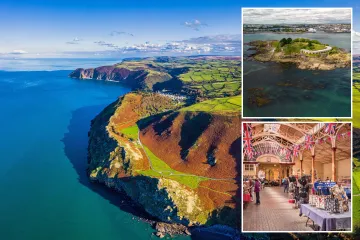
Looking for the perfect cosy UK countryside getaway this winter? This charming Cotswolds hotel ticks all the boxes, we discovered
11:25, 22 Nov 2025Updated 11:26, 22 Nov 2025
We found the perfect cosy Cotswolds getaway(Image: Laura Mulley, Calcot & Spa)
Visit Calcot & Spa around this time of year and the first thing you’ll notice upon pulling up is the fragrant smell of log fires. Just outside the honey-coloured town of Tetbury – the Cotswolds’ second largest, and where you’ll find Highgrove House, the private home of King Charles and Queen Camilla – Calcot is the ultimate countryside retreat.
The main house was built in the 17th and 18th century, but records show that one barn dates back to 1311, with dwellings here even as far back as Roman times. Now it’s a luxury spa hotel filled with cosy corners and a keen focus on sustainability; they burn logs made from coffee grounds and old newspapers, a tree is planted every time towels are reused, and they’ve eliminated single-use plastics.
Rooms are comfy and spacious – the tray of complimentary drinks and snacks is a nice touch (including the butteriest homemade shortbread), and I had one of the best night’s sleep in ages in the giant squishy bed.
Dinner can be taken in the elegant Brasserie restaurant (be sure to save room for one of the delicious desserts) or in The Hive, a pub-like space serving more casual bites, and which is better for kids.
In fact, the whole hotel is incredibly family-friendly, while still being a relaxing retreat for those travelling without children (a tricky balance to get right). There are dedicated hours for families in the pool and at The Hive, baby monitors are available to hire, and kids get four hours of free childcare in the nanny-run Playbarn when staying between Sunday and Thursday.
The spa at Calcot
A huge barn-style building a few steps from the main building, Calcot Spa features a light and airy café, indoor pool for lengths, sauna, steam room and snooze-inducing relaxation rooms.
The highlight, however, is undoubtedly the outdoor hydropool by yet another aromatic log fire, which somehow never feels overcrowded. Try to pay it a visit at the end of the day (the spa’s open until 9pm), as it becomes even more magical in the dark.
Top treatment at Calcot & Spa
Six months pregnant at the time, I went for the spa’s New Life New Mum Massage, which started with a back massage lying on each side (I appreciated the long sausage-shaped pregnancy pillow to hug), before turning over onto my back to work on my feet, legs and arms. While the lower back needs to be treated gently when pregnant, I was thrilled to still feel the knots in my neck being expertly loosened. The combination of vanilla-y scent of macadamia nut oil and my therapist’s soothing voice had me nearly nodding off.
What else is there to do at Calcot & Spa?
Calcot is, quite rightly, very proud of its rewilding programme across its 220-acre grounds, which includes wildflower meadows, beehives and a herd of fluffy Belted Galloway cows to graze the fields. Explore it all on the 3km nature trail; comfy Le Chameau wellies are available to borrow by the back door if it’s muddy underfoot.
Weekly insights and analysis on the latest developments in military technology, strategy, and foreign policy.
The Yantar, a notorious Russian spy ship, directed lasers at the crews of U.K. Royal Air Force aircraft in waters off the north of Scotland, the British government said today. While the Yantar has been a worrying presence around critical undersea infrastructure for years now, this development represents a concerning new trend, and one that could be very hazardous.
Britain releases images of the Russian spy ship on the edge of UK waters that aimed lasers at RAF pilots
The alleged incident took place after a U.K. Royal Navy Type 23 frigate and Royal Air Force aircraft, including P-8A Poseidon MRA1 maritime patrol aircraft, were sent to monitor and track the vessel. Publicly available flight-tracking data suggests that Royal Air Force Typhoon fighters, supported by Voyager tankers, may also have been involved.
It’s not clear what kind of laser was used by the Yantar, but these encompass a wide range of systems, some of which can have significant power, at least enough to be a major concern. Depending on their output, lasers have the potential to temporarily obscure optics and the vision of personnel or cause permanent damage to both. More powerful laser weapons can burn holes in craft, damaging or destroying them, but are highly unlikely to have been installed on this vessel.
The Yantar transits through the English Channel during an earlier visit off the British coast in 2018. Crown Copyright
It is worth noting that the Chinese People’s Liberation Army Navy (PLAN) has regularly been accused of using shipborne lasers to harass military aircraft, as you can read about here.
As for the Yantar, this vessel has been active off the coast of the United Kingdom for the last few weeks, according to the U.K. defense secretary, John Healey, who disclosed details of its activities today.
“This is a vessel designed for gathering intelligence and mapping our undersea cables,” Healey said.
The Type 23 frigate HMS Somerset (foreground) tracks the movements of Russian spy ship Yantar earlier this year, in waters close to the United Kingdom. Crown Copyright
Referring to the laser incident, the defense secretary described the Russian ship’s action as “deeply dangerous,” noting that this is the second time this year that the Yantar has deployed to British waters.
Healey continued: “My message to Russia and to Putin is this: we see you, we know what you’re doing, and if the Yantar travels south this week, we are ready.”
The Yantar is part of the Russian Defense Ministry fleet, being operated by the Main Directorate of Deep-Sea Research, a secretive branch that works on behalf of the Russian Navy and other agencies. The ship is around 112 feet long and, among other duties, operates as a mothership for uncrewed underwater vessels (UUVs), which can be used to investigate the seabed and potentially undertake sabotage and other activities, including manipulating objects on the seafloor.
As we have discussed in the past, the Yantar is officially classified as a Project 22010 “oceanographic research vessel,” but its specialized equipment can reportedly tap or cut submarine cables and investigate and retrieve objects from depths of up to 18,000 feet. The vessel is also likely to be able to place devices on the seabed that could cut cables long after the ship has moved on.
Yantar, or “Amber” in Russian. Notice the huge doors that cover the UUVs and their elaborate crane system. Almaz Design Bureau
Russia has repeatedly claimed that the vessel is used for legitimate maritime “research” or “survey,” but it has an established pattern of operating around critical undersea infrastructure. In particular, it is assessed that the Yantar is used for surveilling the U.K.’s crucial network of undersea cables, around 60 of which branch out into the sea from the British Isles.
The U.K. Ministry of Defense has long considered the Yantar a spy ship and tracks it closely, leading to several run-ins with the vessel in the past.
In September, the U.K.’s National Security Strategy Committee stated that the government was being “too timid” in its approach to protecting British undersea cables, some of which also have a military role.
Meanwhile, another British government oversight body, the Defense Select Committee, recently concluded more broadly that the United Kingdom “must be willing to grasp the nettle and prioritize homeland defense and resilience.”
At the beginning of this year, the United Kingdom confirmed that one of its Royal Navy nuclear-powered submarines surfaced close to the Yantar, to make it clear it was being observed. The Yantar was sailing in British waters in November last year, when that incident occurred. Specifically, the Russian ship was said to be “detected loitering over U.K. critical undersea infrastructure.”
The November 2024 incident involving the Yantar, as detailed in the U.K.’s National Security Strategy Committee report from September of this year. U.K. Government
At one point, one of the Royal Navy’s Astute class attack submarines surfaced close to the Yantar “to make clear that we had been covertly monitoring its every move,” Healey said.
A Royal Navy Astute class nuclear-powered attack submarine. Crown Copyright
Tracking the Yantar is not necessarily a difficult job, since its position is typically broadcast at regular intervals using the automatic identification system (AIS), an automatic tracking system that uses transceivers on ships. This data is then also published by online ship tracking services. However, commercial tracking can be manipulated and spoofed, or it can just go dark, making the vessel harder to pinpoint.
At the same time, it should be noted that the vessel has been operating within the U.K.’s exclusive economic zone (EEZ) but in international waters, which is entirely legal.
Earlier this year, the Yantar was reported in the Mediterranean. On this occasion, it was assumed to be involved in searching and potentially salvaging the wreck of the Russian cargo vessel MV Ursa Major, which sank after an apparent explosion in its engine room in late December.
🚨📸 Overview in the 🌊Alboran Sea on 16 January: the 🇷🇺Russian research vessel Yantar with the 🇺🇸American DDGH Paul Ignatius, then the 🇺🇸Ignatius with the 🇪🇸Spanish PSO Tornado. With #NATO forces in the 🌊Mediterranean, the 🇷🇺Yantar passing Gibraltar illustrates that the… pic.twitter.com/h6fC64rKkB
Back in 2018, the U.K. Royal Navy also escorted the Yantarthrough the English Channel as it headed into the North Sea. At this time, it was carrying a Saab SeaEye Tiger deep-sea robot on its deck. Russia acquired this underwater drone after the Kursk submarine disaster. It can reach depths of 3,280 feet.
The Type 45 destroyer HMS Diamond (foreground) shadows the Russian spy ship as it passes through the English Channel in 2018. Crown Copyright
A year before that, the Yantar was involved in a high-profile operation in 2017 when it sailed off the coast of Syria to recover the wreckage of two fighter jets, a Su-33 and a MiG-29KR, that crashed into the Mediterranean Sea during operations from Russia’s aircraft carrier Admiral Kuznetsov.
While the reported use of a laser in a hostile capacity by the crew of the Yantar is a new development, its activity comes as NATO becomes increasingly concerned about apparent sabotage to undersea infrastructure carrying oil, gas, electricity, and the internet. More generally, the threat to undersea infrastructure, specifically data cables, is of growing concern internationally.
In the Baltic Sea alone, cables have been damaged on several occasions, with all of them carrying at least some of the hallmarks of sabotage. In the most notable event, on December 25 last year, an oil tanker dragging its anchor damaged a power cable running between Finland and Estonia.
The vessel responsible for that incident in the Baltic was the Russia-connected Eagle S. The oil tanker was reportedly found to be brimming with spy equipment after it was seized by authorities. Finnish authorities filed charges of aggravated sabotage and aggravated interference with telecommunications against members of its crew.
Incidents like this led to NATO launching Baltic Sentry, a mission intended to ensure the security of critical undersea infrastructure in the region. As you can read about here, the mission also involves crewed surface vessels, UUVs, and various aircraft.
Royal Netherlands Air Force (RNLAF) F-35As flying over the Dutch frigate HNLMS Tromp during the Baltic Sentry mission earlier this year. Dutch Ministry of Defense
The scale of the threat was apparent even before Russia’s full-scale invasion of Ukraine, after which tensions between the Kremlin and the West heightened significantly.
“We are now seeing Russian underwater activity in the vicinity of undersea cables that I don’t believe we have ever seen,” U.S. Navy Rear Adm. Andrew Lennon, then serving as NATO’s top submarine officer, told The Washington Post back in December 2017. “Russia is clearly taking an interest in NATO and NATO nations’ undersea infrastructure.”
As Russia ramps up its hybrid warfare activities, which you can read more about here, the potential risk to undersea infrastructure is put into a much sharper focus. In many cases, such activities are deniable.
While NATO has long been aware of how difficult it can be to defend this kind of infrastructure against hostile actors, the apparent use of lasers by part of Russia’s spy fleet is another serious cause for concern.
KATHERINE Jenkins and Jessie J led the glam and tonight’s glitzy Royal Variety Performance.
The classical singer looked typically stunning in a Union Jack dress with a floaty cape, while Jessie was demure in a chic black outfit.
Sign up for the Showbiz newsletter
Thank you!
Katherine Jenkins looked stunning at the Royal Variety Performance at the Royal Albert HallCredit: PAShe proudly wore a patriotic Union Jack dressCredit: PAJessie J looked effortlessly cool in her black outfitCredit: AlamyMcFly’s Tom Fletcher cut a dapper figureCredit: Getty
Blonde bombshell Katherine beamed on the red carpet, proudly showing off her patriotic frock inside the Royal Albert Hall.
Westlife‘s Kian Egan, Shane Filan and Nicky Byrne were dapper in black suits, while Tom Fletcher swapped his rock ‘n’ roll tour outfits for a smart suit.
Queen drummer Roger Taylor and his wife Sarina Potgieter put on a loved-up display on the carpet, while ska legends Madness, led by frontman Suggs, were in fine form.
The Prince and Princess of Wales made their much-anticipated arrivalCredit: PAWestlife’s Kian Egan, Shane Filan and Nicky Byrne were dressed to impressCredit: PAMichael Ball (L) and Matt Lucas (C) were all smiles on the red carpetCredit: GettyQueen drummer Roger Taylor and his wife Sarina Potgieter put on a cosy displayCredit: PAAdrian Stoica and his dog Hurricane, from America’s Got Talent, brought some sparkleCredit: PAMadness looked delighted to be on the billCredit: GettyHost Jason Manford looked raring to goCredit: PAStephen Fry was in attendance after taking part in Celebrity TraitorsCredit: Getty
WHILE the Cotswolds is one of the most beautiful places in the UK, that also comes with expensive trips and lots of crowds.
But there are some villages in the north of the county that are rising in popularity thanks to their charming chocolate-box look and celebrity visitors.
Sign up for the Travel newsletter
Thank you!
Villages in the north of Norfolk have been compared to the CotswoldsCredit: AlamyBlakeney village in particular has been said to be a seaside lookalikeCredit: Alamy
One coastal spot in particular that’s been dubbed an ‘alternative Cotswolds’ is Blakeney.
The village has pretty grey flint cottages that sit on the seafront and quaint colourful homes in the streets behind the quayside.
There are small bakeries, a delicatessen, little cafes, craft shops and like with the Cotswolds there are plenty of opportunities for pictures.
However Norfolk has its own powerhouse, specifically, the Royal Family.
For many years the Royal Family have been seen on Holkham Beach which is close to the family’s Sandringham estate.
Last spring, Prince William and Princess Kate paid a visit to the Bakers & Larners food hall in Holt – which is just 12 minutes away from Blakeney by car.
Most read in Best of British
The Cotswolds has award-winning hotels too like Lords of the Manor and The Slaughters Manor House. Well, Blakeney also has its own one.
Earlier this year, The Manor Coastal Hotel & Inn picked up a Travellers’ Choice Award on Tripadvisor for being one of the ‘Best of the Best Hotels’ in the country.
The Manor Coastal Hotel & Inn picked up a Traveller’s Choice Award earlier this yearCredit: Google mapsIn Blakeney are the classic flint covered buildings and colourful cottagesCredit: Alamy
It was also the only one in Norfolk to make the top 25 – on Tripadvisor it has a rating of 4.7 out of five and 466 reviews.
One visitor wrote: “This was our first time at the Manor and it certainly won’t be our last. We felt so relaxed staying at the Manor. We stayed in a garden room, perfect!”
Another simply wrote “truly coastal. A very relaxing stay.”
The luxury boutique hotel has relaxing bedrooms with calming coastal colours ranging from a Deluxe Suite to a Classic Single Room.
It also offers food from brunch and lunch to afternoon tea and cocktails – including a Blakeney Collins.
Another similarity between the two locations, while it won’t affect your holiday is the house prices.
The Cotswolds are known for having big price tags on properties – but north Norfolk isn’t too far behind with homes selling on average around £365,000 in the last year.
There is one glaringly obvious difference between the Cotswolds and Norfolk which is the location.
The Cotswolds is surrounded by rolling hills and countrysideYou don’t get countryside in Blakeney – but you might spot a seal pup on the beachCredit: Alamy
One is in the rolling countryside hills and the other is by the coast.
But one thing you’ll get in Blakeney, and not in the Cotswolds is the chance to do some seal spotting.
Blakeney Point is home to England‘s largest grey seal colony. If you want to see a sweet Grey Seal pup then you’re best chance is to visit between late October and mid-January.
For quiet havens that have less crowds than Sheringham and Cromer, visit Holme and the nearby Thornham Beach.
She added: “If you’re looking for a solid pub with great food where you can bring your pet along, theRose and Crownin Snettisham has a dog-friendly bar and restaurant, as well as a cosy, walledbeergarden.
“But perhaps my favourite corner of the coast is Old Hunstanton Beach Café.”
Sun Travel spoke to one local who said tourists should start visiting now to see what Bedfordshire has to offer – including pretty Cotswolds looking villages to it’s own “Little Italy”.
Lydia Pettethas lived in Bedford for almost all of her life, having a brief interlude inLondonandLeeds, but she promptly returned to her home county.
Bedfordshire is in the East of England, probably known mostly for the towns of Bedford, Luton, Dunstable, Leighton Buzzard – and the fact that it’s set to be the home of the UK’s first Universal.
There are a number of villages in Bedfordshire that have even been compared to the Cotswolds.
The Telegraph even said “Bedfordshire has a secret equivalent to the covetable villages of the Cotswolds” – so they’re worth a visit.
Lydia explained: “I am a North Bedfordshire girl at heart and we have plenty of beautiful villages from Harrold to, Carlton and Sharnbrook.”
Not only do they have the classic chocolate-box houses, but also great pubs too – Lydia suggested The Oakley Arms in Harrold.
Lydia added: “You can have a really nice weekend away at one of these villages – the Cotswolds has been a tourist spot forever, so the villages around here don’t have as much going on, but they all still have so much to offer.”
In peak summer it can be as much as £380 per night.
If you want to simply explore, then jump on a ferry and take a daytrip from Dubrovnik.
To get to Šipan, holidaymakers need to take the ferry from Dubrovnik.
There’s one ferry a day, and the trip takes around 45 minutes with a one-way ticket costing £3.63pp.
Most read in Beach holidays
Once you get to the island, you’ll find a mass of olive groves – as it holds a Guinness World Record for the highest density of olive trees per square meter.
This is also why it’s called ‘golden island’, thanks to its rich land which produces quality olive oil.
It is inhabited by around 480 residents who live between the two main villages, Šipanska Luka on the western side and Suđurađ on the southeastern tip.
You’ll also spot some ruins that used to be Roman villas and summer residences of Dubrovnik nobility.
Thanks to its proximity to the city, Šipan Island used to be the holiday spot for rich and noble Croatian families from Dubrovnik.
One of those is Vice Stjepović-Skočibuha in the village of Suđurađ, the most famous one among them.
Of the 13 Elaphiti Islands, only three are inhabited; Koločep, Lopud, and Šipan.
Koločep is the island nearest to Dubrovnik, and it has two villages, plenty of hiking trails, and the Modra šilja, known as The Blue Cave.
On Lopud, visitors will find the very pretty Šunj beach and a historic monastery.
The houses have terracotta rooftops and there are two hotels on the island tooCredit: Alamy
Much further up the coast, nearer to Zagreb, Krk is Croatia’s largest island, and unlike Šipan, it can be accessed via a bridge, so there’s no need to take the ferry.
As it’s one of the larger Croatian islands, which has a number of resorts, hotels, holiday homes and campsites.
There are over 68 towns and villages on the island, and a popular spot is Beach Kozica, also known as the silent beach, which has been described as “dream bay” by visitors thanks to its clear waters.
CHRISTMAS markets are magical places – but one spot feels like the ultimate fairytale with a castle and dancing elves.
Located in the Piemonte Region of Italy, Il Magico Paese di Natale in Asti-Govone, has been named the best fairytale Christmas market in Europe.
Sign up for the Travel newsletter
Thank you!
Il Magico Paese di Natale in Asti-Govone, has been named the best fairytale Christmas market in EuropeCredit: Alamy
Awarded by European Best Destinations, the market runs from November 15 to December 21 in the towns of Asti, Govone and San Damiano d’Asti.
The ranking was formed by asking 12,621 international travellers from 108 countries, with participants deciding on their top ‘fairytale Christmas’ spot from 103 markets across Europe.
Spread across the city of Asti and the towns of Govone and San Damiano d’Asti, Il Magico Paese di Natale – which translates to The Magical Christmas Village – features a number of different events and activities.
Asti
In Asti, the Piazza Alfieri is home to 130 wooden chalets selling crafts and food.