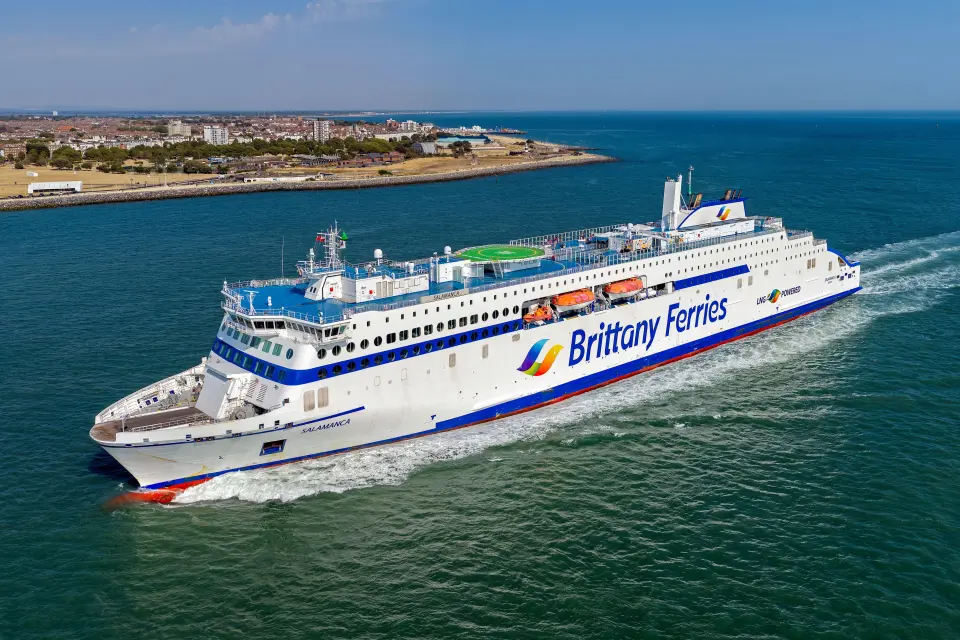
A VITAL ferry route to France is being axed three weeks earlier than planned after operating for over 40 years.
Customers have been told they will receive a full refund or alternative travel routes following the shock announcement.
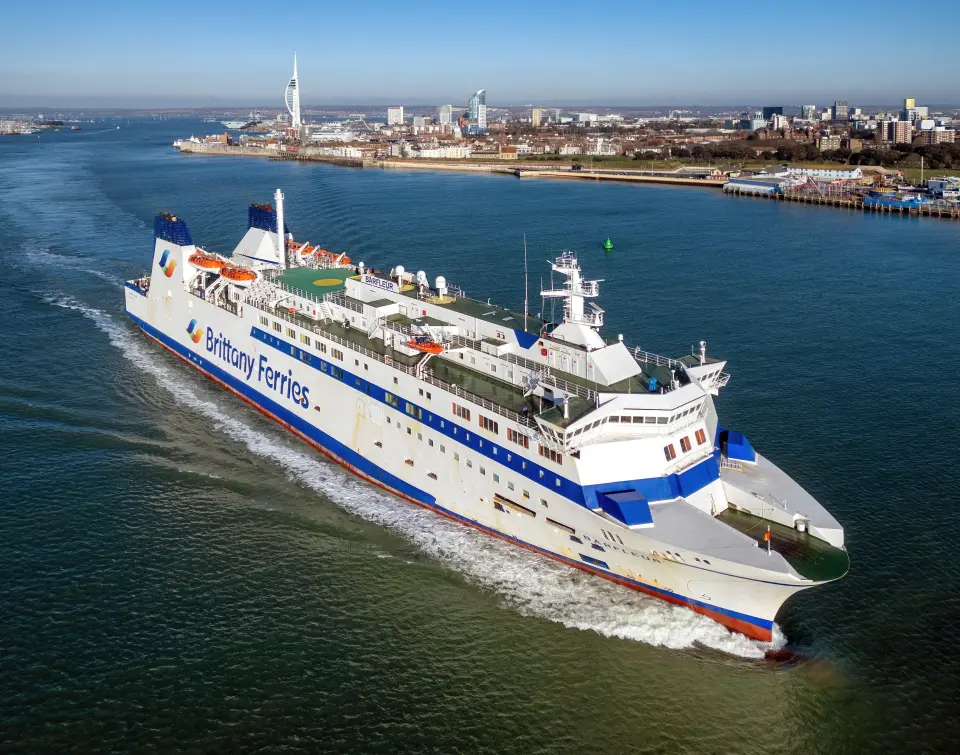
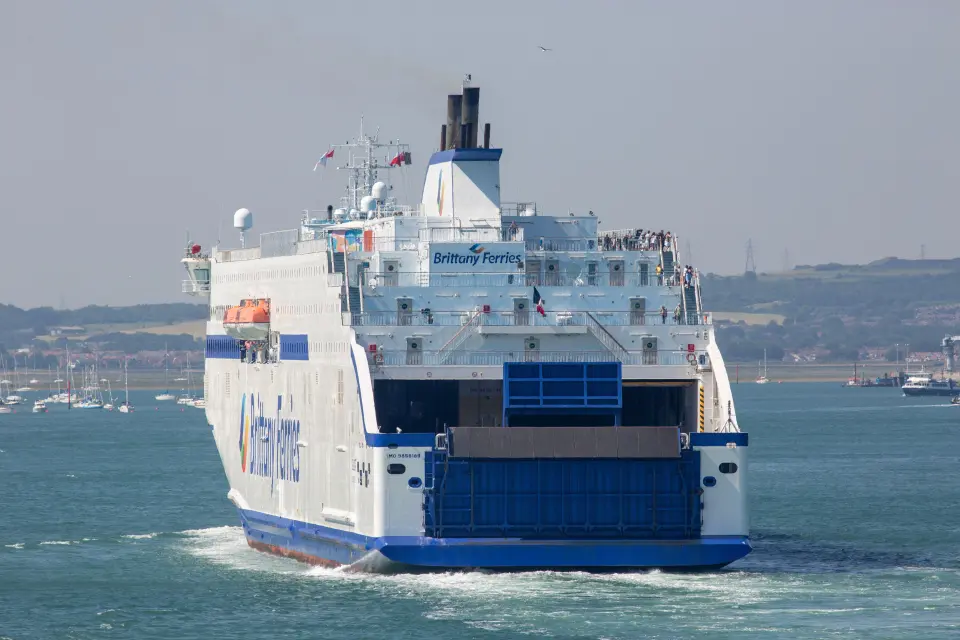
Brittany Ferries has axed its Poole-Cherbourg route three weeks earlier than plannedCredit: Alamy
Brittany Ferries has confirmed that the Poole to Cherbourg route will close three weeks earlier than planned.
The last crossing was originally set to take place at the end of the month.
Sign up for the Travel newsletter
Thank you!
All passengers who were set to be travelling in the latter half of the month will receive a full refund or be provided with alternative travel on Portsmouth routes.
The early axing of the Poole-to-Cherbourg route has occurred for two reasons.
Firstly, Brittany Ferries is selling the vessel which currently operates on the Rosslare/Cherbourg route – Cotentin.
To prepare, the vessel must be withdrawn from the service by mid-October.
Secondly, a back-up vessel, the Commodore Clipper, suffered gearbox failure earlier this month rendering the ferry out of action pending remedial work.
The gearbox issue forced the early closure of the Portsmouth-Le Havre route, but has now meant the company has needed to move Barfleur onto a new route and finish Poole-Cherbourg sailings earlier than planned.
Barfleur, the vessel which has served the crossing since 1992, is set to be moved to the Rosslare/Cherbourg route from October 12.
CEO of Brittany Ferries, Christophe Mathieu, said: “The reality is that, post-Brexit, Rosslare/Cherbourg has become a strategically significant route for Brittany Ferries, carrying nearly 25 percent of all freight traffic so we must prioritise.
“I know there will be disappointment with this operational change, and I apologise to all those travelling from Poole in the latter half of October.
“We shall of course refund tickets or provide alternative travel on routes out of Portsmouth.
“It has been a privilege to serve the Poole-Cherbourg route since 1986.”
The company revealed it would be shutting down the 40-year route owing to growing financial pressures, particularly affected by the pandemic, the EU’s Emissions Trading System and competition on the Eastern Channel.
The crossing closure is forecast to affect around 20 jobs and the decision forms part of a wider restructuring by Brittany Ferries.
Brittany Ferries has confirmed that passengers will still be able to head out to France from Poole, instead via the company’s seasonal service to St Malo.
Customers can also cross the Channel via routes from Portsmouth and Plymouth to Caen, Cherbourg, St Malo and Roscoff.
A new high-speed crossing between Poole, Guernsey and St Malo is set to be debuted in 2027.
The MS Barfleur first began her voyages between Dorset and France in 1992 and was the shortest journey over the Channel, taking just four hours and 15 minutes.
The crossing garnered a huge amount of success, leading to a £6million refurbishment of the ferry terminal in the 1990s.
The route has faced difficulties more recently, seeing a temporary closure in 2010 following a decrease in ticket sales – however it was reopened in 2013.
‘This carriage is due for modernisation. Don’t miss the opportunity to experience 90s Germany style,”reads the sign on the door to the dining carriage. The couple inside aren’t missing theirs: they’re taking endless selfies in the clinical pink-and-turquoise carriage that looks like a hospital canteen and smells like cinnamon buns and strong filter coffee.
I’m on Snälltåget’s iconic red-shelled train, on the Swedish rail company’s new route from Malmö to Oslo – a 6.5-hour journey along Sweden’s picturesque western corridor. Until now, the journey between the two cities involved long bus rides and fragmented train transfers. This direct line is easier and cheaper, with tickets starting at £11 each way. It’s already a hit, shuttling more than 25,000 passengers since launching this summer.
I was first seduced by Scandi rail travel a decade ago on a journey from Stockholm to Gothenburg, when I was berthed in a cosy dark-wood cabin and listened to a pianist play in a dining car. This time, starting in Malmö, I will take advantage of the new route to make a series of stops along the country’s western shore.
In my view Malmö, across the Øresund Bridge from Copenhagen, is too often overlooked in favour of Stockholm. The southern port city is less polished than the capital and grittier, but its residents seem more outgoing and curious. Within an hour of arriving, I’m invited to drinks by a group of local people – a level of openness I never experienced living in Stockholm. Almost half of the population is under 35, and 187 nationalities are represented, making it a hotbed of creativity. In the centre of town, the Form/Design Center occupies a former 16th-century grain store, now a meeting point and exhibition space for design, crafts and architecture enthusiasts. Then, there are Moderna Museet and Malmö Konsthall modern art galleries.
Points of View by Tony Cragg, a public artwork in Malmö. Photograph: Danita Delimont/Alamy
At Möllevången, or Möllan, a trendy neighbourhood popular with creatives, everybody looks as if they’re at art college, or have just returned from a weekend in Berlin. My friend Rob, who has lived in Malmö for nearly a decade, guides me through Folkets Park, the “people’s park”, pointing out his favourite pizza spot, Far i Hatten, which occupies cute wooden huts. We find a table at Ava nearby for a beer on a leafy square dotted with hip restaurants and organic wine bars – it feels like Malmö’s equivalent to London Fields in Hackney. Resisting the urge to continue our purposefully staid bar crawl, we down a nightcap at Bar Bobo and call it a night.
Snälltåget operates just one direct Oslo-bound train a day, at 6.38am from Malmö Central (plans are in the works to increase this next year), so it’s an early start at a station teeming with families and backpackers with rucksacks the size of fridge-freezers. We soon pass the romanesque towers of Lund Cathedral before chugging through pancake-flat yellowing agricultural fields, then skirt Apelviken bay – Varberg’s long, sandy horseshoe beach popular for kitesurfing and surfing.
Varberg is Sweden’s equivalent of a coastal British market town. It’s got bunting, cobbled streets, intimate cafes and a weekend market with vendors peddling fresh vegetables, fruit, marmalade, leather belts and socks. It’s also a spa town, which inspired my visit. I was intrigued by its pretty, Moorish-inspired Kallbadhuset (cold bath house), set on wooden piles above the Kattegat sea, where for about £8 visitors gain access to segregated men’s and women’s saunas, both with spellbinding sea views. A plunge in the brisk water after the sauna proves the perfect antidote to a 6am start after a bottle of red wine the night before. Floating on my back, I look up to see a group of Swedish veterans sitting on a wooden bench, baring all (it’s a nude bathhouse), the building’s mustard shades completing an almost Hockney-esque scene.
The Snälltåget. Photograph: Trygve Finkelsen/Alamy
According to a sign outside Skarpe Nord – a community-run women’s bathing spot nearby – people have been nude-bathing in Varberg for more than 100 years. Walking along the promenade by a cavernous passage of blasted rocks that resembles a secret pathway from Lord of the Rings, I pass a collection of other designated naked bathing spots. But with the grey weather showing no sign of clearing, my hotel’s spa proves more inviting.
In the bowels of Hotell Gästis hides a replica of Vladimir Lenin’s favourite bathhouse. The hotel’s owner, Lasse Diding, built the spa as a homage to his idol, inspired by a visit to the original bathhouse in St Petersburg in the 1980s. This slightly eerie space is clad in more than 75,000 cobalt tiles and decorated with candlelit busts of communist leaders.
Diding’s interest in the communist movement began during the Vietnam war and never left him. The eccentric entrepreneur is responsible for Varberg’s many visible politically left-leaning monuments – a giant Palestine flag, Hotell Havanna (an ode to revolutionary Cuba) and a statue of Danuta Danielsson, who became a symbol of solidarity after hitting a marching neo-Nazi with her handbag in Växjö in 1985.
The following morning, I hopon the fast train to Gothenburg, a 39-minute ride away. After checking in at the sophisticated, French boudoir-style Hotel Pigalle, just five minutes’ walk from Central station, I wander along Kungsgatan, the city’s modern shopping artery, towards Magasingatan. The area is packed with vintage shops (Ragtime, Pop and Humana) and craft stores such as Customwood, which makes bespoke wooden furniture to order.
I grab a fika(the Swedish tradition of taking a break to drink coffee and indulge in a sweet treat)at Da Matteo, a barn turned cafe spread across three floors. The Scandi-industrial interiors are straight out of a design magazine, as bespectacled folk work away on their laptops. Scents of bread and coffee drift from the in-house bakery and coffee roastery; my bullar (a classic cardamom bun) and a latte cost just under a tenner.
Wandering around Slottsskogen park later, I remember why I wanted to move to Gothenburg after a fleeting first visit all those years ago. Sweden’s second-largest city is compact and easy-going. It has a rough-around-the-edges feel like Malmö in places, with the liveability, nature and culture of Stockholm. At its heart is the pretty old town of Haga, which has narrow cobbled streets, inviting wafts of baked goods and the sound of creaky, wooden trams chugging by. And Slottsskogen is my favourite park in Europe. Roughly the size of Hyde Park, it’s home to deer, penguins and Gotland ponies, and exactly the kind of place you can spend long hours strolling without purpose.
The Gothenburg to Oslo leg of the journey is the cinematic climax. It starts with rolling green pastures, cows grazing on a riverbank and forests thick with towering conifers beneath a blue summer sky. Then nature really starts showing off: lakes widen, trees grow greener and granite canyons appear grander with every kilometre, drawing excited kids to press their noses against the windows.
Oslo from Vettakollen viewpoint. Photograph: Sean Harrison/Alamy
Keen to see it up close, after pulling into Oslo I dump my bags at Citybox, a minimalist hotel a few minutes’ walk from the station, and head north to Sognsvann. This lake and recreational area on the outskirts of the city is the starting point for a circular walk up to Vettakollen, a popular viewpoint. After an easy, 30-minute uphill hike, I reach a rocky mound skirted by pine trees, where families are picnicking. Oslo unfurls in the distance, the urban sprawl of metal and glass stretching to the fjord. For me, this is what makes Scandinavia special: the urban and the natural worlds seamlessly colliding.
The police prevented an early morning attempt by the Orange Order to make a controversial parade down a road which had previously been blocked by protesters.
A group of men tried to march from Drumcree Church down the mainly-nationalist Garvaghy Road in Portadown in the early hours of Monday but a line of police Land Rovers stood in the way.
They had been unable to make the permitted parade on Sunday morning because protesters had gathered on the Garvaghy Road. The stand-off continued throughout Sunday, with the Orangemen waiting at the church, around a mile from the road, for the go-ahead from police.
Sinn Féin First Minister Michelle O’Neill joined the protest, prompting Democratic Unionist Party leader Gavin Robinson to accuse her of acting unlawfully.
Northern Ireland Secretary Sir Chris Bryant called for “compromise”.
Breandán Mac Cionnaith, from the Garvaghy Road Residents Coalition, said he was meeting the secretary of state and chief constable on Monday, and that he would not prejudge those conversations.
Nigel Dawson, who is the Orange Order’s Portadown district master, told BBC News NI there was frustration.
He said they had a legal right to parade down the Garvaghy Road and the police should facilitate their route.
“We have been open and honest, and were seeking mediation to seek a resolution suitable to both sides that would bring this to a successful conclusion,” he added.
Democratic Unionist Party (DUP) MP Carla Lockhart, who came back to Drumcree in the early hours of Monday, said the Police Service of Northern Ireland’s chief constable needed “to take a grip of this very quickly or his position will become untenable”.
The Drumcree parade, which in the 1990s sparked some of the most serious disorder in Northern Ireland’s history, was due to go ahead for the first time in 30 years after a series of legal challenges.
Since 1998, the Orange Order had been banned from completing its Drumcree march – and until this year had been repeatedly refused permission to finish the route by the Parades Commission, which was set up to adjudicate disputes.
The Orange Order is a Protestant pro-British organisation, while the area where it wants to walk – specifically along the Garvaghy Road – is largely Catholic and predominantly inhabited by pro-Irish nationalists.
The scrapping of the ferry route was initially given the green light due to financial challenges, with September 28 outlined as its final sailing date.
Sign up for the Travel newsletter
Thank you!
However, the service has been forced to retire early, due to technical issues with the Brittany Ferries Commodore Clipper vessel.
In a statement, the company confirmed that the final voyages would not be made and apologised to passengers.
A Brittany Ferries spokesperson said: “We apologise to all affected customers, and are sorry that the route can’t complete its final sailings; we know many had hoped to be part of them.
“It has been a pleasure for all at Brittany Ferries to link Portsmouth and Le Havre since 2013.”
The statement continued: “The current economic context means the route is no longer viable and, sadly, we have had to make the difficult decision to close it.”
The cuts to various Brittany Ferries routes were announced back in June.
The business explained that it was having to “adapt” and “plan for a secure future” after facing a bill of €27 million in 2026.
This particular ferry route has been in operation, in either a passenger or freight capacity, for over 50 years.
The Poole to Cherbourg route is set to be replaced by a daily service from Portsmouth to Cherbourg, which will begin in November, as part of a “more efficient” schedule.
NEWBERRY SPRINGS, Calif. — Four decades ago, the cult hit “Bagdad Cafe” was filmed at a ramshackle diner in the Mojave Desert.
The tale of two women in the lonely landscape — a hardworking, rifle-wielding cafe owner and a stranded German tourist with a suitcase full of lederhosen — captivated viewers, particularly in Europe and Japan.
Busloads of international tourists rolled up to the actual Bagdad Cafe on a cracked, sunbaked stretch of Route 66.
Real-life proprietor Andrea Pruett, a sweet but steely Southerner who kept her own gun behind the counter, greeted them in French and German, then fed them buffalo burgers and omelets.
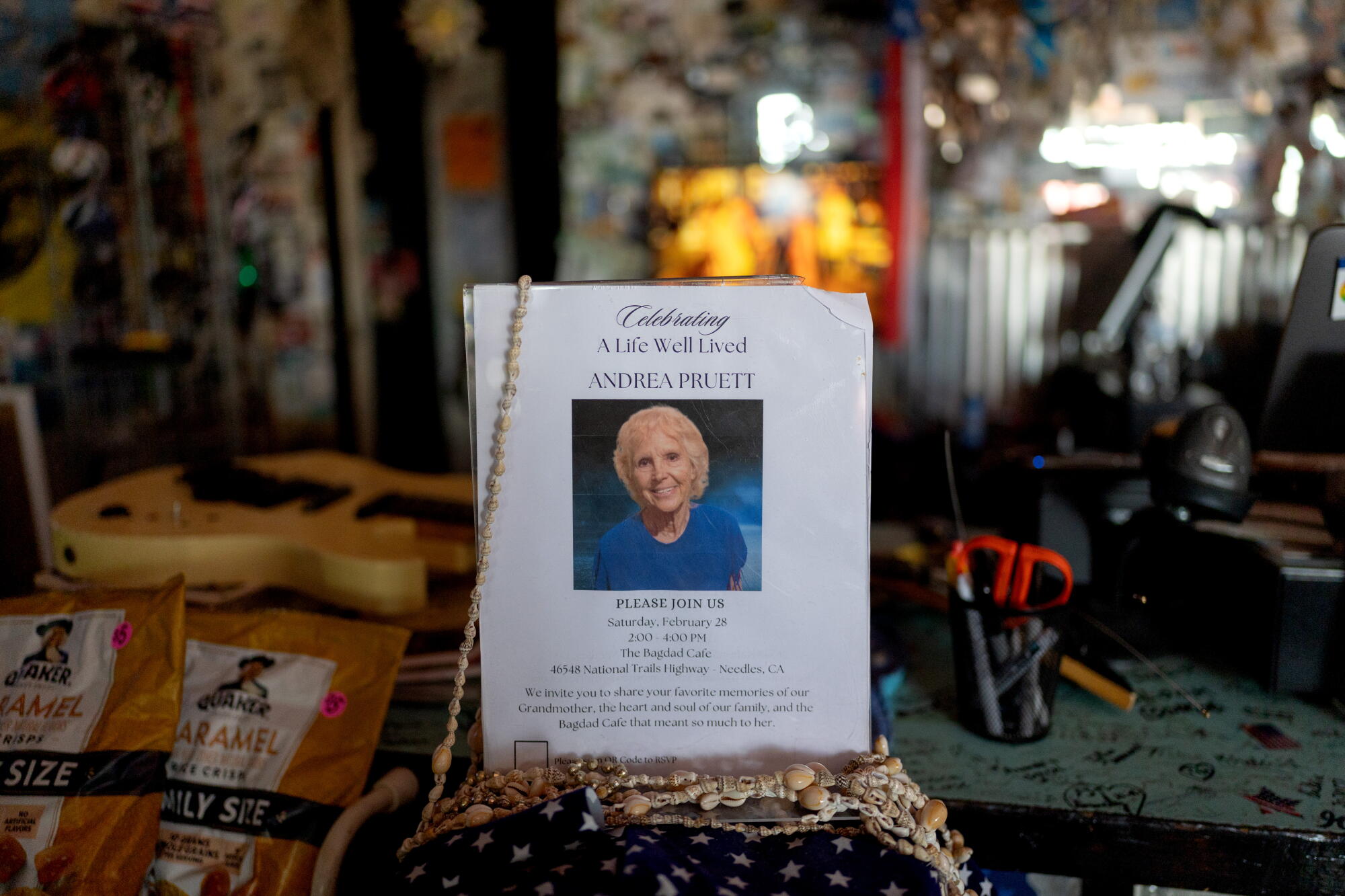
A memorial announcement for owner Andrea Pruett is seen at the Bagdad Cafe on Route 66 in the Mojave Desert.
As Pruett aged, her grip on reality loosened. But she refused to leave.
Now, the Bagdad Cafe is in limbo. Though T-shirts and tchotchkes are still for sale, the kitchen is closed. And Pruett’s family is figuring out what comes next.
Buses full of Europeans still come. So, too, do the roadtrippers celebrating Route 66, which turns 100 this year.
“We don’t get any locals, and we don’t cook any food right now,” said Mark Bradley, the cafe’s gruff but genial manager. “But we’re definitely on the map to see … it’s magic that takes place here.”
The cafe is a cacophony of color in an expanse of desert brown. Flags from all over — France, Brazil, Japan, New Zealand, Canada — hang from low ceilings. The walls are covered floor to ceiling by visitors’ passport photos and dollar bills with Sharpie signatures. “We’ve been here three times!” an Italian visitor raved in a guest book.
Pruett is still there, too. An urn holding her ashes sits by the front door.
A drone image shows the remote Bagdad Cafe on Route 66 in Newberry Springs.
In 1995, eight years after the movie’s European premiere, Pruett and her husband, Harold, stopped for burgers at what was then called the Sidewinder Cafe in Newberry Springs, 20 miles east of Barstow. They had just bought 640 acres for an ostrich ranch, which ultimately didn’t work out, though they kept some of the birds as pets.
The owner told them the A-frame, wood-shingled diner was for sale. “My husband looked at me and I said, ‘Don’t even think about it,’ ” Pruett told The Times in 2003.
But their son, actor Harold P. Pruett II — who was 26 and starring that year in a campy erotic horror flick called “Embrace of the Vampire” — declared the cafe “cool,” and that was that.
The Pruetts promptly rechristened it Bagdad Cafe, following German filmmaker Percy Adlon’s lead.
The exterior of the Bagdad Cafe.
Nearby Bagdad was a railroad town named in the 1880s by Southern Pacific Railroad officials after the Middle Eastern metropolis — without the H — because of the desert terrain.
Bagdad became a stop for steam-powered trains whose engines needed more water every eight miles or so in the desert climate, said Scott Piotrowski, past president of the California Historic Route 66 Assn.
The bustling little town was also a hub for gold, silver and copper mining camps.
Mining eventually faded, but cars on Route 66 overheated easily and often limped into town for water. A restaurant named, naturally, Bagdad Cafe, owned by a woman named Alice Lawrence, was the only place for miles with a dance floor and jukebox.
When Interstate 40 opened in 1972 about 10 miles north — taking most traffic and tourists away from Route 66 — it was the death knell for Bagdad, where all that remains today is a single scruffy cedar tree.
Thierry Farion, left, from France, and Aziz Khechine, right, from Tunisia, look at memorabilia inside the Bagdad Cafe.
At Pruett’s Bagdad Cafe, she embraced the movie. The two female characters, initially wary of each other, are both on a hiatus from their husbands, and the German tourist eventually draws big crowds by performing magic tricks.
“When people came in, it was like a director saying, ‘Action!’ ” said Pruett’s grandson, Greg Landers, 47, of Glassell Park. “She would just go right into welcoming people and telling them to sit down, answering their questions.”
A petite bottle-blonde who spoke with the laid-back drawl of her native Arkansas, Pruett showed off memorabilia signed by the “Bagdad Cafe” director. She got a yellow thermos like the one in the film, which, miraculously, never seems to run out of java, even when the coffee pot is busted.
A guest book displays messages at the Bagdad Cafe.
A desert road from Vegas to nowhere Some place better than where you’ve been A coffee machine that needs some fixing In a little café just around the bend
Pruett’s place drew desert eccentrics, including a gravelly-voiced man dubbed General Bob who sniped at customers who doubted his claims that he designed the Pentagon, built the Golden Gate Bridge, was a brain surgeon and was 109. (“Actually, he’s 83 years old, and if he wants to be older, I let him,” Pruett told NPR in 2003.)
Monaco’s Prince Albert II stopped in once. So did actress Renée Zellweger, who told Jay Leno on “The Tonight Show” that there was a “little old guy, he’s been sitting there for, I think, maybe 45 years on the same barstool. We had chicken fried steak together.”
When Huell Howser popped in unannounced for a 2001 episode of his California road trip show, General Bob, perched at the bar with a fedora atop his long silver hair, proclaimed he was 98 years old and “a real general, not a f—up.”
Marian Box, left, works the counter and talks to visitor Jaelene Kleckner.
For all the joy, desert life brought plenty of hardship.
One night in the 1990s, not long after Pruett bought the place, she was closing out the cash register when a man walked in, slammed a wooden 2-by-4 on the counter and ordered her to put all the money in a bag.
“She actually had a shotgun under the counter, and she pulled it out and said, ‘Stop,’ and cocked it,” said Landers, her grandson.
The man threw his hands up and said his family was in the car. They had been traveling and ran out of money. Pruett ushered them inside, fed them and sent them away with some cash — after making them wash their own dishes.
Pruett, who gave birth to Landers’ father, Corky, at 15, had a tough and impoverished youth. But she was “kind almost to a fault,” said Landers, a contractor who lived with her for a spell in his 20s and worked in the cafe. People who just about everyone else had given up on — she’d give them a place to stay and work to do.
In February 2002, the younger of Pruett’s two sons, Harold the actor, died of an accidental drug overdose. Her husband died two months later.
Pruett’s love for her customers kept her going, said Bradley, who has been around the cafe for 26 years as a frequent visitor and employee.
“She would have them crying as they left, but happy crying,” he said. “She could do that to people by giving them a hug and in just the few minutes that they were here. She had a magic to her.”
In 2016, Sarah Jane Woodall — a former nude model who posts popular desert travelogues on YouTube under the moniker Wonderhussy — stopped for breakfast and shot a video.
The cafe was quiet and grimy. She loved it.
“It was just, like, a lovable hot mess,” said Woodall, an Army kid who lived for a time in Germany, where people were obsessed with the movie.
The COVID-19 pandemic lockdowns devastated the Bagdad Cafe — and Pruett, who turned 80 in the summer of 2020.
The Europeans disappeared. Vandals busted the windows. Pruett let go of her waiters. Her kitchen closed and never reopened.
A sign for a former motel next to the Bagdad Cafe on Route 66 in Newberry Springs.
In 2021, her house burned down. She slept in the cafe, her thin frame curled up in a red vinyl booth.
That summer, Léa De Carmo, an aspiring actress, was driving back to Los Angeles from Las Vegas with a friend and, after a night of partying, craved a cup of coffee. They pulled into the Bagdad Cafe, where — as in the movie — the coffee pot was broken.
De Carmo, a native of Paris who had never seen the film, was stunned when she opened the door and “saw French flags and soccer team stuff everywhere.”
“It seems like all the French are led there for one reason or another,” said De Carmo, 29, who talked to Pruett that day for over two hours.
“She had essentially lost everything — her business, her house — but she just had this incredible energy and warmth and humor,” De Carmo said. “There was also this very deep loneliness.”
For the next four years, De Carmo drove from L.A. to Newberry Springs dozens of times, filming Pruett for a just-finished documentary called “The Keeper of Bagdad Cafe,” about her final years in the crumbling diner.
In the film, friends help Pruett move into an RV in the parking lot. As a woman gently washes her white hair with bottled water behind the cafe counter, Pruett says she can’t remember where she’s from.
“One thing she never forgot was the cafe,” De Carmo said. “She always knew where she was and that it was the place she wanted to be.”
Landers said his father, who died in 2022, asked her to move in with him in L.A., but she didn’t want to leave the Bagdad.
“It was just hard,” said Landers, who added that she might have fared better, physically, at least, in a dementia care facility. But she repeatedly said, “No, this is my place. This is where I want to be.”
Pruett’s friends in the desert stepped up. Bradley took care of her and the cafe, opening it each day for tourists to come in and take photos.
Woodall returned at the cafe’s request, filming the stained, decaying ceiling and the water-catching buckets and coffee pots on the floor. The YouTuber’s fans raised more than $25,000 — enough for a new roof.
In the video, Pruett stood by, smiling, quiet, a little confused.
For the next three years, she stayed at the Bagdad, even as her memory continued to fade. She died this January at 85.
On a Friday morning this summer, with the outside temperature already 115 degrees, Matt Parker stood behind the worn green Formica counter, setting a smart TV to the movie and preparing to make Nescafé instant coffee — a favorite of Europeans.
On a good day, they get three tour buses, he said.
Parker, 53, moved from L.A. County to Newberry Springs — where he used to camp with his dad and ride dirt bikes as a kid — a few years ago and fell in love with the cafe.
“You can’t recreate this,” he said. “We’re just caretakers of it. It’s a museum and church, in a sense, with all this stuff. Mrs. Pruett really focused on protecting it, protecting these people’s stuff — their mark.”
Andrea Pruett’s urn near the entrance of the Bagdad Cafe, which she ran for three decades.She died in January.
Landers said that, while the family figures out what to do with the cafe, he asked Bradley to keep it open like his grandma did.
Though her urn remains in the place she loved most, Landers hopes, someday, to bury her ashes in the Hollywood Forever Cemetery next to her youngest son.
Since her death, he can’t help but think of a scene from the movie. The German woman — forced to leave after her tourist visa expires — is gone and the bustling restaurant quiet again. A customer walks in and asks where the magic shows went.
A snoozing employee sits up and says: “The magic? It’s gone.”
In the end, the German returns to the Bagdad Cafe. And so do the crowds.
BRITISH Airways has confirmed one of its routes won’t start up again until next winter at the earliest, due to the Iran conflict.
It first suspended flights to the destination in February of this year.
British Airways won’t be restarting its route to a major city in the UAECredit: Getty Route to Abu Dhabi won’t start up again until at least next winterCredit: ac productions
British Airways has confirmed the suspension of its flights to Abu Dhabi won’t lift until winter 2027 at the earliest.
The airline cited the Middle East conflict and ‘airspace instability’ as the reason for its continued delay.
Sign up for the Travel newsletter
Thank you!
Talking to Simple Flying, a BA spokesperson said: “Due to the ongoing situation in the Middle East, we have made further changes to our flying schedule to provide greater clarity for our customers.
“We’re keeping the situation under constant review and are directly in touch with affected customers to offer them a range of options. (…) Our flights to Abu Dhabi are scheduled to resume in Winter 2027/2028.”
However, Simple Flying noted that Abu Dhabi appears to have been removed from BA’s long-haul plans for 2027 altogether.
Currently for those wanting to travel to Abu Dhabi with BA, they will have to book a flight from Heathrow to Doha, then switch to another airline like Qatar Airways to continue their journey.
The indirect route takes around 11 hours rather than seven.
But there are two routes back on the cards this year with British Airways – the first is to Dubai.
The airline will resume flights to Dubai from November 3.
These will initially operate once a day during the winter season before increasing two services each day during the summer season.
Flights to Amman will also restart on November 3 after being suspended in March.
However the airline will start flying to Dubai again from NovemberCredit: Alamy
Brittany Ferries will be axing a popular route linking the UK and France this autumnCredit: AlamyThe Poole to Cherbourg crossing has been operating for the past four decades, but rising financial pressures led to the closure of the routeCredit: Unknown
Brittany Ferries is set to permanently axe its Poole to Cherbourg crossing route at the beginning of November.
Passengers have been travelling between Dorset and France for over forty years, but now the popular journey will shut down.
Sign up for the Travel newsletter
Thank you!
The company cited growing financial pressures as the cause for the decision, including outstanding Covid-19 loan repayments, competition on the Eastern Channel and weaker demand for travel.
Rising costs of the European Union’s Emissions Trading System have further burdened the company’s remaining debt.
Around 20 jobs are expected to disappear as a result of the closure.
The decision comes as part of a wider restructuring by Brittany Ferries, with the firm taking a “pragmatic approach” to the economic challenges.
Steps also include the sale of the Cotentin, which sails between Cherbourg and Rosslare, alongside the closure of the Portsmouth to Le Havre route from October 2026.
A spokesperson for Brittany Ferries told The Sun: “This wasn’t a decision we took lightly, and we know it will be disappointing news for our customers in Poole and the surrounding area.
“We’ve worked hard over many years to keep this route running, but a long-term decline in passenger and freight numbers, compounded by rising costs and red tape, including Brexit-related border processes, EU environmental taxes, and unfavourable exchange rates, has made the route commercially unsustainable.
“We’re not withdrawing from Poole. Customers will still be able to travel to France with us via a seasonal service from Poole to St Malo, as well as our conventional routes from Portsmouth and Plymouth to Caen, Cherbourg, St Malo and Roscoff, including a new daily Portsmouth–Cherbourg service.”
A high-speed crossing between Poole, Guernsey and St Malo is also set to be debuted in 2027.
The crossing was first introduced in 1985, with the iconic MS Barfleur starting her voyages between Dorset and France in 1992.
It takes just four hours and 15 minutes – the shortest journey over the Channel – and garnered a huge amount of success, leading to a £6million overhaul of the ferry terminal in the 1990s.
The route has faced a number of challenges in recent years, temporarily shutting down in 2010 owing to a decrease in ticket sales – however it was reopened in 2013.
The Barfleur will soon undertake its final journey, but all may not be lost quite yet for the route.
Captain Brian Murphy, chief executive of Poole Harbour Commissioners told the Bournemouth Echo that Brittany Ferries’ departure could pave the way for another operator to take over the route.
I wasn’t exactly in “Sunday best”, but I had made some effort. Well, I’d changed my underwear for the first time in a couple of days and given myself a baby-wipe bath. Still, as we filed into the chapel at Alkavare, I felt more a member of an expedition than a congregation. We sat on the low wooden benches, waterproof jackets rustling and leather walking boots stamping on the flagstone floor to keep warm. Fortunately, the priest, Mogens Amstrup Jacobsen, appeared to be a “man of the Gore-Tex”, as well as a man of the cloth, as he unzipped his own black rain jacket to reveal his dog collar. As the service began, the Arctic wind whipped through cracks in the dry stone walls, insulated only with reindeer hair, and candles flickered in their brass sconces.
I had hiked to Alkavare following the Präststigen, or “Priests’ trail”, a 37-mile (60km) route from Kvikkjokk that could stake a claim as Europe’s wildest pilgrimage route, and certainly one of its most beautiful. The Präststigen follows the path that priests would once have taken to the chapel, built in 1788, to perform a service each summer, and today, on the last weekend in July, intrepid hikers and perseverant pilgrims can attend that same service.
Alkavare sits on the western border of Sweden’s Sarek national park, home to many of the country’s highest mountains and steepest valleys, yet with no campsites or tourist huts and only scant sections of the more famous Kungsleden trail. There are no other marked paths and to hike here means wild camping, a heavy backpack and a sense of adventure. It was described by famed Swedish diplomat Dag Hammarskjöld in 1926 as vår sista stora vildmark – “our last great wilderness”.
Wild camping en route. Photograph: Arctic Sweden
“I hate it when people use the term ‘wilderness’,” Christian Heimrot from Laponia Adventures, a local guiding operator, told me, as I joined him on the research exhibition for a new Präststigen group trip launching next year. “This is a living landscape, people have lived, worked and shaped this land for thousands of years.” Indeed, Sarek national park, (as part of the wider Laponia region), was recognised as a Unsesco World Heritage Site in 1996 for both its cultural and natural value.
The Sami, Europe’s last Indigenous population, have braided themselves into these landscapes as tightly and beautifully as the thread of pewter in their traditionalhandicrafts. The Sami word for the Laponia area is Sápmi, the same word they use to refer to themselves, highlighting the indelible link between people and their environment. Sarek sits on the Sami’s traditional reindeer herding grounds. While they might now use motorcycles and snowmobiles to follow and herd the reindeer, their knowledge of and kinship with this landscape remains undimmed.
So, not wilderness, then, but certainly wild. To even reach the start of the Präststigen, I had crossed the Arctic Circle on the road north from Luleå, met with Christian at his warehouse in Jokkmokk (home to the famous Sami winter markets each February) to load up our rucksacks for the six-night trip, and journeyed an hour farther west to the town of Kvikkjokk. From there the trailhead was a short boat ride across Sakkat lake.
The first section of the trail climbed steeply, switchbacks tightly coiled in birch woodland; wild blueberries and cloudberries littered the path. Eventually we left the woodland and reached the ridge for our first proper view of Sarek. Away to the north was the cloud-covered summit of Bårddetjåhkkå, where in 1911 Swedish geologist Axel Hamberg built an observatory to conduct meteorological and glacial studies.
The trail involves walking through icy rivers, as there are no bridges. Photograph: Arctic Sweden
We slept soundly, as we eased into the rhythms of wild camping – water collected from a gin-clear lake, a hearty supper of reindeer stew, and an eye mask to keep out the midnight sun. The next day we hiked deeper into Sarek via the Vállevágge, the skies the blue of the Swedish flag, the silence only disrupted by the occasional breath of wind.
We were following the guidebook Priest’s Path by Hans Fowelin (currently only published in Swedish), and while there was no marked trail, Fowelin had plotted a path of cairns we were supposedly to follow. While some were solidly built square towers, most were little more than one rock propped up against another, mere whispers of waymarkers in a landscape of scree and moraine.
Alongside the familiar buttercups and heather there were bright blue blossoms of mountain gentian, red ptarmigan berries and otherworldly looking wild angelica, a source of vitamin C for the Sami. Sarek was visited by botanist Carl Linnaeus during his epic expedition through northern Sweden in 1732, and the first part of the Priest’s trail is sometimes referred to as Linnaeus’s trail.
On our fourth day of hiking Alkavare chapel appeared on a bluff above the glacial blue waters of Alggajavvrelake, surrounded by high peaks and valleys. It was utterly beautiful. I had a grin on my wind-burnt face for most of the day, one that even wading across rivers (a common feature of hiking in Sarek), shin-high in glacial meltwater, failed to dim.
After rowing across the Miellätno river, using one of the rowing boats left on each bank by the park rangers, we climbed up to the chapel late on Saturday evening where Jacobsen greeted us with a beaming smile.
Priest Mogens Amstrup Jacobsen was flown in by helicopter to lead the service.
Over tea, he told us he had been dropped off by helicopter at Alkavare with his family on Friday morning and this was his first time leading the service here. Others in the diocese no longer volunteered. “It is physical, hard work and the days are long,” he said, before heading off to re-tar the chapel’s roof and fix one of the rowing boats that had come loose and floated away down the river – returned, later, swinging beneath a helicopter.
Sunday mass began promptly at 11am the following morning for our small band of pilgrims (we numbered 11 in total, including the priest). The altar had a simple wooden cross and cloths on loan from the church in Jokkmokk. They were in the poster paint palate of traditional Sami clothing and a reminder that it was for the Sami that the chapel had been originally built – not an act of benevolence, but as part of the forced Christianisation and eradication of their shamanistic beliefs in the 18th century.
Alkavare chapel. Photograph: Habip Kocak
After the service we sat outside for coffee and pastries, before beginning our hike home. Christian was keen that we hiked via Sweden’s point of inaccessibility or otillgänglighetspunkten, just over the border from Sarek in the Padjelanta national park. This is the country’s point furthest from any road or town, about 31 miles (50km) in fact, and is often cited as western Europe’s remotest too. Marked with no cairn or monument, just a circle of quartz stones and a trio of reindeer antlers, it felt no more or less remote than most of the previous week’s hiking. And I was struck that what made Sarek and the Präststigen special wasn’t just the scenery, as beautiful as it was, it was the people – the Sami, Hamberg and Linneaus, and the motley congregation we’d briefly joined, and it was a route firmly deserving of more visitors. “I told you,” Christian said, grinning, “It isn’t a wilderness.”
The trip was provided byLaponia Adventures, which will lead a guided, small-group trip along the Priest’s Path to Alkavare in July 2027, and offers equipment rental and advice for independent hikers. For more information on Sarek national park and northern Sweden, visit arcticsweden.com