Ross Newhan, The Times’ Hall of Fame baseball writer, dies at 89
The suggestion caught Ross Newhan off guard.
The Angels had just reached the promised land, after more than four decades of wandering through baseball’s wilderness. Who better than Newhan, who had been there since Day 1, to write a first-person account of that long and winding road to their first World Series?
Newhan was reluctant. That would make the story about himself, which he despised. The editors prevailed, and within the story he delivered a sentence that struck deep within the heart of every loyal and long-suffering Angels fan.
“I can’t help but feel a sweep of emotions seep through the cynicism and dispassion that is the byproduct of being present for all or part of every Angel season,” he wrote on Oct. 14, 2002.
To this day, the Angels have one guy in the Hall of Fame: Vladimir Guerrero. The Times has two: Jim Murray, the Pulitzer Prize-winning sports columnist, and Newhan.
If Vin Scully provided the voice for the first half-century of Major League Baseball in Southern California, Newhan provided the words.
Newhan died on Sunday, at 89, after what his wife Connie called a “cardiac event.” His reporting — first at the Long Beach Independent Press-Telegram, then over 37 years at The Times — distinguished The Times as a national source for baseball coverage.

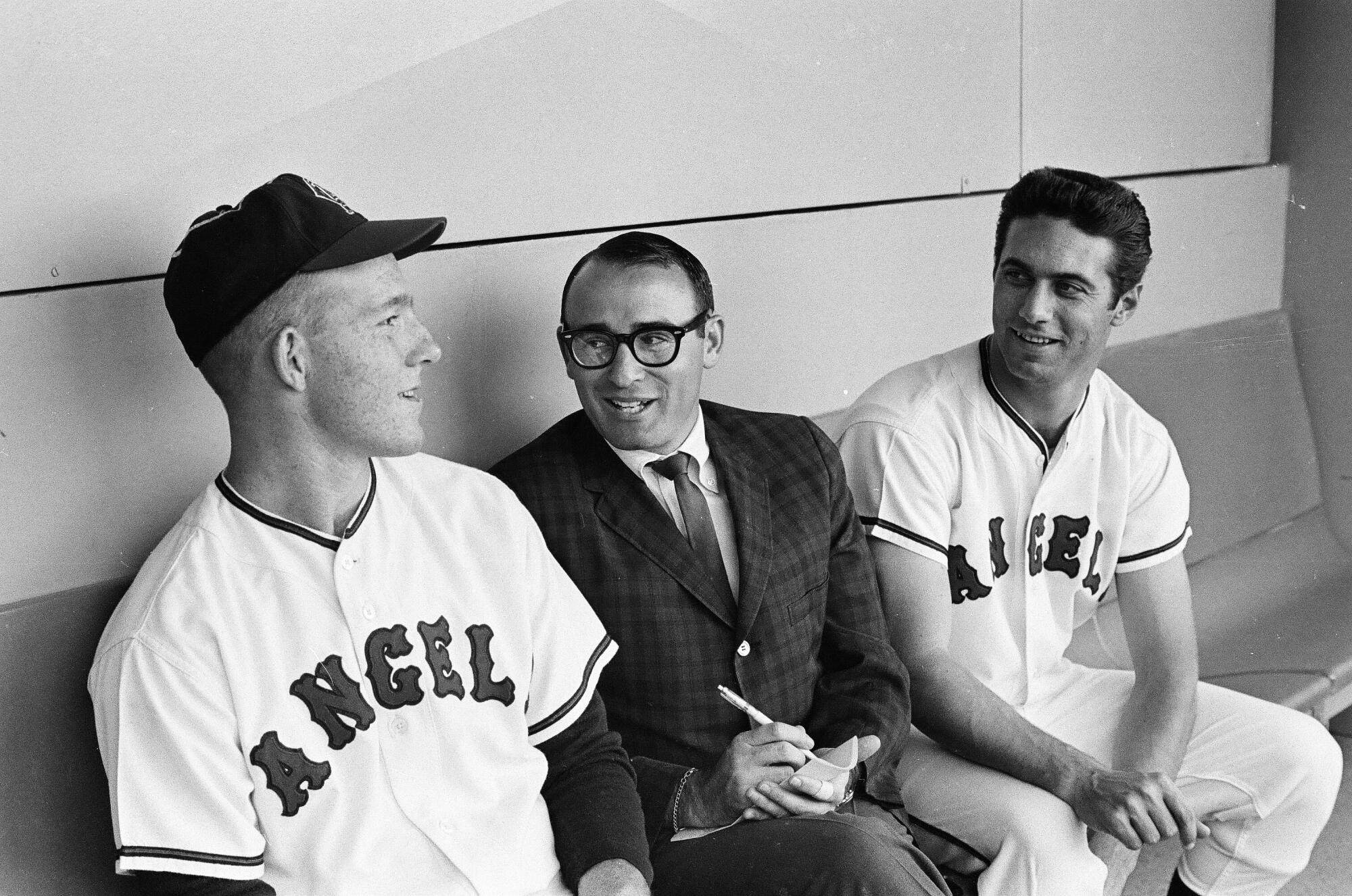
Ross Newhan, center, interviews Jim McGlothlin, left, and Jim Fregosi of the California Angels during the 1969 season.
(The Sporting News via Getty Images)
He was so renowned within baseball that the Dodgers, MLB, and the players’ union posted condolences.
Bud Selig, the former commissioner and occasional antagonist in Newhan’s columns, told The Times: “I mourn the passing of Ross Newhan. He was an excellent sportswriter, and I always had a great amount of respect for him personally and for his work.”
In his Hall of Fame acceptance speech, he reserved a special mention for a teacher at Wilson High in Long Beach, the one that envisioned a writer blossoming within a student dozing in class.
“If a high school journalism instructor named John Gartner hadn’t hollered my name and pounded my desk one day, I might still be sitting there asleep,” Newhan said, “with no real clue what I wanted to do in my life.”

Ross Newhan, receives the J.G. Taylor Spink Award from Jane Forbes Clark, chairman of the National Baseball Hall of Fame, in Cooperstown, N.Y., on Aug. 5, 2001.
(Associated Press)
In the 1990s, as a young reporter at the Riverside Press-Enterprise, I was among a small group of writers talking with Tony Gwynn, the San Diego Padres’ Hall of Famer. Newhan was there too, and as the group dispersed, he told me: “You ask good questions.”
Talk about inspiration: It was as if Clayton Kershaw had seen a kid throw a curveball and said, “Not bad.”
Behind a gruff and occasionally intense exterior, Newhan had a heart of gold. Mike DiGiovanna, the longtime Times baseball writer, called Newhan “a security blanket” for colleagues needing a fact check, a phone number or an introduction to someone famous.
“He was a giant without the giant ego,” DiGiovanna said.
Newhan trained former Times colleague Jason Reid on how to cover baseball. Reid affectionately called him “Boss Ross.” The two were such relentless reporters that, amid the wild initial days of the McCourt family ownership of the Dodgers, Reid got co-owner Jamie McCourt so frazzled that she actually said this: “This is bad because you guys remember everything and you write everything down.”
Newhan and Reid had reported on concerns with the McCourt financing before the ownership deal closed, and six years before Frank McCourt’s divorce attorney admitted in court that McCourt had put “not a penny” of his own money into the deal. That did not make Newhan and McCourt the best of friends, but neither did it make them bitter enemies.
“He seemed to take a sort of pride in being the guardian of Los Angeles baseball, for lack of a better term,” said Hall of Fame president Josh Rawitch, then the Dodgers’ publicist. “He had an ability to garner respect from people even when he was writing something you weren’t happy about.”
Said Mike Scioscia, on whom Newhan reported as a Dodgers player and Angels manager: “Ross was a true gentleman and had a real matter-of-fact way of asking questions that put you at ease.”

Ross Newhan shares a happy moment with his great granddaughter, Bailey, earlier this year.
(Courtesy of the Newhan family)
There was nothing flashy about Newhan, not in his writing, certainly not in the way he conducted himself. He let his work and its credibility speak for itself.
Newhan is survived by his wife, Connie; his son, David, and daughter-in-law, Karen; his daughter, Sara, and son-in-law, Mike; five grandchildren and one great-grandchild.
The story about David is the one most often recalled Monday, because it really was a story about his father.
David, the kid that tagged along with Newhan when the Angels held spring training in Palm Springs, developed into a major leaguer. He had joked with reporters that he hadn’t been sure if rumors of his call-up were true because “as everyone knows, you can’t believe what’s in the paper.”
In 2004, as Newhan and I covered a game at Dodger Stadium, David appeared as a pinch-hitter for the Baltimore Orioles against the Colorado Rockies, in his first major league at-bat in three years. Newhan was glued to his laptop, where these words suddenly appeared: “In play, run(s).”
Waiting, waiting, waiting … and then I heard one of the loudest screams I have ever heard. Rawitch heard it too. Everyone in the press box heard it.
“Home run.”
The scream was out of character for a professional writer, entirely in character for a proud father. He aced both, and we’ll miss him.