How Rómulo Betancourt Allied with the US Without Surrendering Sovereignty
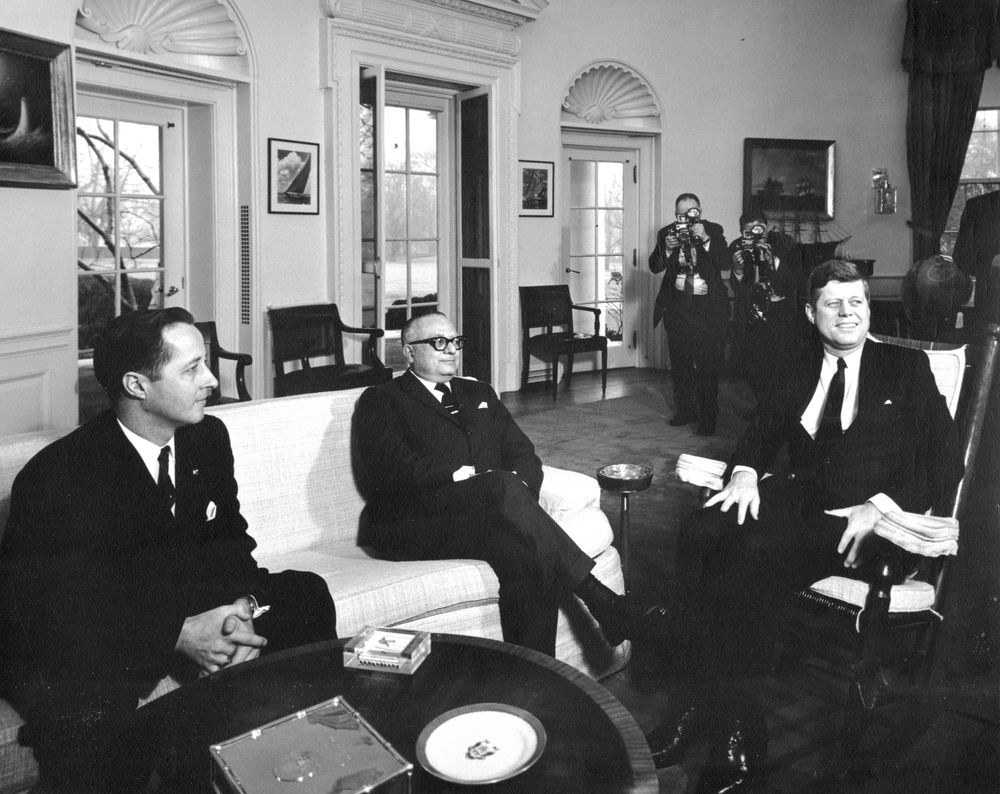
John F. Kennedy receives Betancourt in the Oval Office on February 19, 1963. White House photograph by Abbie Rowe, JFK Presidential Library and Museum.
In 1898, the United States entered Cuba promising to liberate a nation; the subsequent occupation and the Platt Amendment ultimately granted it the right to intervene in the country’s affairs. A century before chavismo, Juan Vicente Gómez found a different formula: domestic order, foreign capital, and oil, all while leaving the citizenry out of the equation. Rafael Osío Cabrices and Marcus Golding have revisited both precedents to reflect on the Venezuela that would emerge after January 3. These two mirrors are uncomfortable, yet they are not the only ones; a third exists—also born of the relationship between Venezuela and the US—though it is based on a different idea of how to build stability.
During the 1950s, Venezuelan social democrat leader Rómulo Betancourt wrote from exile to convince Washington that its policy toward Latin America was based on a flawed premise. While military dictatorships might declare themselves anti-communist and guarantee a certain level of stability, repression, inequality, and a lack of civic participation paved the way for the very radicalization the US wished to contain. A democracy capable of enacting social reforms could serve as a more reliable ally.
This wasn’t Betancourt’s idea alone. Within the US government, there were already officials who viewed reformist forces as a more effective bulwark against communism. Betancourt’s own contribution lay elsewhere: articulating this argument from within Latin America and attempting to prove its validity while in power. Research by Steven Schwartzberg shows that this approach had begun even before the long exile triggered by the 1948 coup.
Upon returning to Venezuela after January 23, 1958, Betancourt did not ask the White House to build Venezuelan democracy. The major political parties agreed on rules for coexistence and the country held elections, which he won. His government undertook agrarian, educational, and social reforms starting in 1959, all while facing military conspiracies, guerrilla violence, and hostility from neighboring dictatorships. There were abuses, restrictions on civil liberties, and incomplete results. It was not a conflict-free democracy, but a democracy struggling to survive.
Both voting and finding a way out of the economic crisis remain priorities that oil alone cannot resolve.
That experience bolstered Betancourt’s argument before Washington. A State Department report from the time described Venezuela as a hemispheric leader in promoting social reform and economic development within a constitutional framework. This foreign alliance rested on a domestic political foundation: it did not rely solely on oil or on a shared stance against a common enemy.
The Cuban Revolution had made this discussion more urgent since January 1959. Upon arriving at the White House in 1961, John F. Kennedy understood that anti-communism alone was insufficient, and he found an exceptional partner in Betancourt. The Alliance for Progress sought to link development, social reform, and representative democracy. When Kennedy visited Venezuela in December 1961, the two governments issued a joint declaration framing economic cooperation within the context of “the effective practice of representative democracy.” Democracy was not a destination to be reached only when conditions became more favorable. It was an integral part of the journey itself.
1961 versus 2026
We can’t idealize that era. The Alliance for Progress yielded uneven results, and the US continued to tolerate dictatorships when it served its interests. Years later, Betancourt would welcome Jimmy Carter’s emphasis on human rights—as Guillermo Ramos Flamerich notes—precisely because such a stance had never been a constant in US foreign policy, which has historically oscillated between democratic values and the immediate benefits of partnering with governments capable of maintaining order.
That tension has returned. Democratization expert Thomas Carothers argues that the Trump administration has departed from five decades of bipartisan US commitment to promoting democracy, adopting policies that favor autocratic regimes instead. Other intellectual figures such as Ricardo Hausmann and Paul Krugman have also questioned the direction of the process: Hausmann warned that if Trump does not facilitate the transition, Venezuelans will have to oppose his strategy; Krugman criticized the agreement with former members of the Maduro government while the democratic opposition is sidelined.
For her part, María Corina Machado continues to regard Trump as a “key ally” but calls for a democratic transition. Nor does Venezuelan society appear willing to trade its vote for a promise of stability: an in-person poll cited by the Financial Times found greater optimism following Maduro’s removal on January 3, but also revealed that the majority wanted free elections in 2026. After the electoral fraud of July 28, 2024, both voting and finding a way out of the economic crisis remain priorities that oil alone cannot resolve.
On July 24, 2026, Donald Trump stated in the Oval Office that Venezuela was “not yet” ready to hold elections. He praised the “fantastic work” of Delcy Rodríguez and linked his assessment of her to the volume of oil the country is shipping—according to the Republican president—to the US. On September 2, he reiterated that Venezuelans were not ready, while Rodríguez avoided setting an election date during a press conference focused on oil deals.
The solution, however, does not lie in waiting for Trump to become Kennedy. Betancourt did not simply wait for a sympathetic US president, either.
The difference compared to 1961 lies in more than just words. Kennedy and Betancourt framed their cooperation within a shared democratic commitment. Current rhetoric allows oil interests to advance in the present while democracy waits for an undated future. This does not mean Washington has permanently abandoned the idea of Venezuelan elections, but it does reveal its priorities: barrels can be counted, legitimacy can be deferred.
This exemplifies what I termed “asymmetric reconstruction” in a previous article for CEBRI: the recovery of certain economic and geopolitical capabilities, while institutions, rights, and public wellbeing progress at a different pace. Here, the warnings of Osío Cabrices and Golding converge. An intervention can displace the actors who fought for democracy; an opening of the oil sector can coexist with opaque deals, unelected authorities, and power structures that have learned to survive by switching partners.
The solution, however, does not lie in waiting for Trump to become Kennedy. Betancourt did not simply wait for a sympathetic US president, either. He organized a political party, built consensus within Venezuela, formulated a vision for the country, and then sought to alter Washington’s calculations. He understood that while a nation like ours cannot dictate the priorities of a major power, it can present itself to that power as a political actor rather than merely as available territory.
The United States’ best ally will not be the most obedient Venezuela.
Venezuela can once again become a solid ally of the United States. To achieve this, it requires competitive elections with a set date; institutions capable of protecting rights, providing services, and managing resources; and an economy that transforms investment into a better life for its citizens. Oil-driven growth can help. It is no substitute for any of that.
It also requires a mature international relationship. Cooperating with the United States should not mean ceding to Washington the decision of who governs Venezuela or when its citizens are ready to vote. Sovereignty does not consist of isolating oneself from the world. It consists of participating in it without losing one’s identity.
History offers three possibilities: the tutelage experienced by Cuba starting in 1898, the order-without-citizenship of the Gómez era, and the democratic alliance Betancourt sought to build with Kennedy. None can be replicated exactly as they were at the time. Yet, we can still decide which model we wish to emulate.
The United States’ best ally will not be the most obedient Venezuela. It will be the Venezuela that regains legitimacy in the eyes of Venezuelans themselves.