Rogers

Key takeaways from US Senate debate in Michigan between El-Sayed, Rogers | US Midterm Elections 2026 News

The leading candidates in Michigan’s heated Senate race have faced off in their first televised debate, with less than a month remaining before the United States midterm elections.

Thursday’s hour-long debate was a microcosm of how tense the toss-up race has become.

Recommended Stories

list of 3 itemsend of list

Democratic nominee Abdul El-Sayed, formerly the health director for Wayne County, repeatedly sought to paint his Republican adversary Mike Rogers as a yacht-owning millionaire out of touch with ordinary voters.

For his part, Rogers, a former member of the US House of Representatives, lobbed accusations at El-Sayed that he was soft on “terrorism” and had foreign sympathies.

The Michigan-born El-Sayed has repeatedly faced Islamophobic attacks while on the campaign trail, with Republican President Donald Trump labelling him an “extremist, terrorist sympathizer” whose history “goes back to the days of the Jihad”. If elected, El-Sayed would be the first Muslim member of the US Senate.

The two candidates spent much of their hour onstage together speaking over one another, as they exchanged pointed barbs.

“He can’t condemn a terrorist act that happened on our soil in the state of Michigan. He can’t bring himself to condemn –,” Rogers began, referencing a March attack on a synagogue.

“I did condemn it,” El-Sayed said, jumping in. “No, you did not,” Rogers replied, with El-Sayed quickly responding, “You make stuff up. You make stuff up.”

The Senate race in Michigan is considered key to the battle for control of the US Senate. Democrats are seeking to flip both chambers of Congress, but shifting control of the Senate will be a tougher prospect, given that only a third of its 100 seats are on the November 3 ballot.

Host Rick Albin at times struggled to keep the debate on track, as tensions rose.

“We’ve got dozens of questions we want to get to. You can’t litigate all of these with 14 different rebuttals, so please work with me,” Albin told the two candidates at one point.

Here are the key takeaways from the evening’s debate.

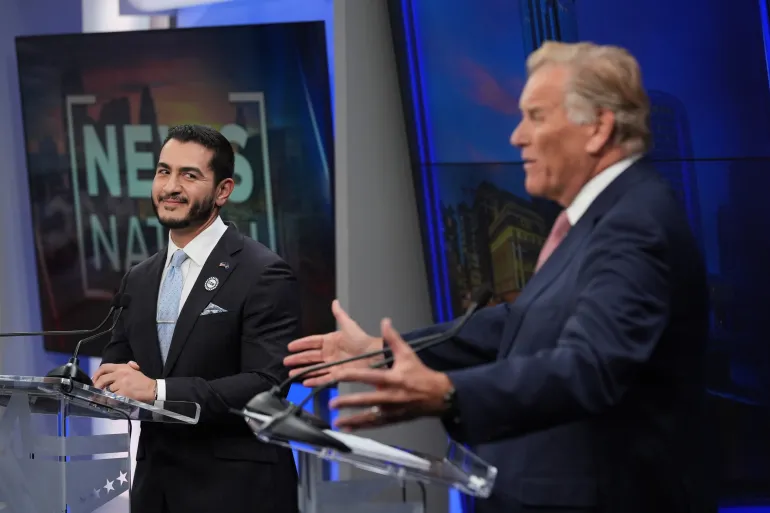
Republican nominee for U.S. Senate Mike Rogers, right, speaks during a televised debate with Democratic nominee for U.S. Senate Abdul El-Sayed, at WOOD-TV, on Thursday, Oct. 8, 2026, in Grand Rapids, Mich. (AP Photo/Paul Sancya, Pool)
Republican nominee Mike Rogers, right, speaks during a televised debate with Democratic nominee Abdul El-Sayed [Paul Sancya/Pool via AP Photo]

Rogers insinuates El-Sayed family ties to ‘terrorism watch list’

The ferocity of the debate was underscored by the high volume of ad hominem attacks the candidates deployed against each other.

But Rogers repeatedly pushed a series of attacks that seemed to centre on El-Sayed’s identity as a Muslim.

In response to a question about healthcare, Rogers said that El-Sayed has “taken money from individuals on his campaign who openly support Hamas, Hezbollah, al-Qaeda”.

Later, when asked about his position on surveillance by Flock cameras, Rogers argued that such technology has helped catch people suspected of terrorism. He then implied that El-Sayed’s concerns about the cameras were suggestive.

“Why would that bother you?” Rogers asked El-Sayed. “Well, if you have somebody in your family that might be on the terrorism watch list …”

El-Sayed interjected, seeming to dare Rogers to continue his thought.

“Are you going to go ahead and say that I’m a – go ahead and say it,” El-Sayed said. “You’ve been tiptoeing about it the whole time. Just say it. Just say it. Go ahead and say it.”

Muslim and Arab candidates in the US have frequently been subjected to Islamophobic attacks on the campaign trail, accusing them of support for “terrorism” and Islamic fundamentalism.

Republican nominee for U.S. Senate Mike Rogers, talks during a televised debate with Democratic nominee for U.S. Senate Abdul El-Sayed, at WOOD-TV, on Thursday, Oct. 8, 2026, in Grand Rapids, Mich. (AP Photo/Paul Sancya, Pool)
Republican Mike Rogers insinuated El-Sayed may have family on the ‘terrorism watch list’ [Paul Sancya/Pool via AP Photo]

Both sides agree on ending the Iran war

There were issues, however, on which both candidates found a measure of common ground.

Both Rogers and El-Sayed agreed the US-Israeli war against Iran should end, but they had opposite views on Washington’s relationship with Israel and its role in the conflict.

High gasoline prices and inflation, El-Sayed said, were directly caused by the Iran war, and he blamed the Trump administration for Iran’s decision to shut down the Strait of Hormuz, a critical trade route.

“This is what happens when you start wars you never should be fighting,” El-Sayed said. “We literally taught the Iranian regime that they have a choke on the Strait of Hormuz, and now we’re living in that reality.”

Rogers agreed that “we need [the war] to come to an end”, but he also justified the conflict, saying that Iran’s uranium enrichment programme had been “set back twenty years”, echoing a frequent White House talking point.

The Trump administration has argued that the war was necessary to prevent Iran from creating a nuclear weapon, a goal Tehran has long denied.

Rogers’s position led El-Sayed to accuse him of “cheerleading” for the war and the Trump administration.

Democratic nominee for U.S. Senate Abdul El-Sayed, talks during a televised debate with Republican nominee for U.S. Senate Mike Rogers at WOOD-TV, on Thursday, Oct. 8, 2026, in Grand Rapids, Mich. (AP Photo/Paul Sancya, Pool)
Democratic nominee Abdul El-Sayed pushed for an end to unconditional support for Israel [Paul Sancya/Pool via AP Photo]

Rogers backs continued Israel aid, El-Sayed calls for end

As part of the debate about US foreign policy, the candidates were also pressed on their positions about the US alliance with Israel.

The country is considered the largest overall recipient of US aid since World War II. From the start of Israel’s genocidal war on Gaza in October 2023 through September 2025, experts estimate that Israel received nearly $21.7bn in military aid.

El-Sayed has openly called for ending aid to Israel, and he has repeatedly denounced the conflict in Gaza as a genocide, in line with evaluations from United Nations experts and human rights watchdogs.

During the debate, he indicated he preferred US taxpayer dollars to be spent on domestic concerns like education and healthcare, rather than Israeli aid.

“He wants unconditional support for a foreign government,” El-Sayed said of Rogers. “I want unconditional support for kids in our schools, unconditional support for our healthcare, childcare.”

He also blamed Israel for the US military action in Iran. “I don’t want to be pushed into war by Israel, and I don’t want to be in war with Iran,” El-Sayed said.

Rogers, meanwhile, has joined most of his fellow Republicans in continuing to support aid for Israel. He argued that the country had “the right to defend itself in a very difficult neighbourhood”.

“Is there anything Israel could do that would lose your support?” the debate host asked.

“Listen, if they’re talking about using nuclear weapons, they would definitely lose my support,” Rogers replied.

Democratic nominee for U.S. Senate Abdul El-Sayed, right, greets Republican nominee for U.S. Senate Mike Rogers prior to a televised debate at WOOD-TV, on Thursday, Oct. 8, 2026, in Grand Rapids, Mich. (AP Photo/Paul Sancya, Pool)
Abdul El-Sayed, right, and Mike Rogers shake hands prior to their debate [Paul Sancya/Pool via AP Photo]

Rogers calls immigration crackdown ‘not appropriate’

Another hot-button issue during the debate was Trump’s crackdown on immigration.

The Republican leader has pledged to carry out the largest mass deportation effort in US history, and his campaign has spurred human rights concerns.

When asked how they would approach the crackdown, both Rogers and El-Sayed agreed on tempering the militarised nature of the campaign.

In several cities, including Minneapolis, Minnesota, immigration authorities have been accused of racial profiling and using excessive force against immigrants and protesters, as well as violating their rights to due process.

Multiple fatal shootings have occurred during immigration enforcement operations, including the deaths of Renee Good and Alex Pretti in January.

Rogers indicated he would not have supported such confrontational operations, but he repeated a Trump claim that the raids were taking dangerous criminals off the streets.

“I think the public efforts in Minnesota were probably not appropriate,” Rogers said. “You always want to go in quiet, get the bad guy, get out of the neighbourhood for less problems. So that, to me, was something that they could have done differently.”

He later claimed that, under Trump, the country had seen “the largest decrease in murders ever recorded”.

El-Sayed, meanwhile, has previously voiced support for abolishing Immigration and Customs Enforcement (ICE), a key agency in Trump’s deportation campaign. He defended that stance on the debate stage.

“ICE right now is not about immigration enforcement. ICE is about terrorising our streets,” he said.

Republican US Senate candidate Mike Rogers looks on while speaking to the press in the spin room after taking part in a debate with Democratic rival candidate Abdul El-Sayed in Grand Rapids, Michigan, US, October 8, 2026. REUTERS/Jim Vondruska
Mike Rogers speaks to reporters in the spin room after the debate on October 8, 2026 [Jim Vondruska/Reuters]

Candidates debate Canada trade war and tariffs

Donald Trump’s trade war with Canada, felt acutely in neighbouring Michigan, was another key topic of conversation.

El-Sayed depicted Rogers as an uncritical backer of Trump and his tariffs and tied him to past free trade deals such as the North American Free Trade Agreement (NAFTA), which paved the way for companies to shift manufacturing facilities out of the US – though Rogers did not enter Congress until 2001, eight years after NAFTA passed.

“You did that, man. That was your policy. NAFTA, that was your policy,” said El-Sayed.

Rogers sought to distance himself from the current trade war but expressed support for a deal with Canada that would loosen some of Ottawa’s tariffs on US goods.

“I would like to see the deal made,” said Rogers, adding that high Canadian tariffs for US goods “should be eliminated”.

Both candidates tried to strike a balance between criticism of the economic fallout of the trade war and qualifying their support for more selective tariffs, favoured by some industries and labour unions as a means of protecting domestic jobs.
Source link

Abdul El-Sayed says Kamala Harris’ visit for his Michigan U.S. Senate race is about Democratic unity

Jacqueline Ganun and Bill BarrowAssociated Press/Report for America 

Michigan U.S. Senate nominee Abdul El-Sayed said Tuesday that he wants Kamala Harris’ midterm campaign stop in Detroit to unify Democrats in the key swing state where their party’s factions were on full display in a hotly contested primary earlier this year — and in Harris’ 2024 presidential defeat.

“We’re building an electoral coalition here,” El-Sayed said, speaking about the economy hours ahead of a planned appearance with the former vice president.

An unapologetic progressive, El-Sayed downplayed his differences with Harris over the Biden administration’s support for U.S. military aid to Israel. El-Sayed has called Israel’s military actions in Gaza a genocide against Palestinians. Israel rejects that position, but it aligns El-Sayed with many voters in Michigan’s large Arab American community and with progressives who withheld their votes from Harris in 2024, when the state tipped narrowly to Republican Donald Trump.

That election “ended where it did because we could not find the places of agreement to be able to bring people together or move in the direction that we need to move,” El-Sayed said, emphasizing that he and Harris both want to help voters who are struggling economically.

Harris, the first Black vice president, remains popular among Black voters who anchor the Democratic base in Detroit and who leaned in favor of El-Sayed’s primary opponent, Rep. Haley Stevens, in the August primary. El-Sayed said Harris, who will attend a roundtable on Black maternal health with him and separately join an event hosted by the Detroit chapter of the NAACP, is a critical advocate in helping him close ranks as he tries to defeat Republican Mike Rogers.

“Her presence here speaking to communities that were really empowered by her voice throughout her political career, I think will help us to continue to bring our coalition together,” El-Sayed said.

El-Sayed vs. Rogers is a critical contest for Senate control

The Democrat’s matchup against Rogers, a former congressman, will help determine control of the Senate for the final two years of Trump’s presidency. If Democrats hold the seat, which was opened by Sen. Gary Peters’ announced retirement, they’d still need to win at least four more currently held by Republicans to flip the chamber. A Rogers victory would narrow Democrats’ path to a majority.

Rogers’ campaign framed Harris’ visit as a sign of weakness for both Democrats.

“Abdul is so desperate that he’s parachuting Kamala Harris into Michigan to save his flailing campaign,” said Alyssa Brouillet, Rogers’ spokesperson.

Rogers has been campaigning in Detroit, a predominantly Black city where his campaign is optimistic he can pick up support from voters hesitant to support El-Sayed.

Black voters could prove especially critical as El-Sayed also faces pressure among white Jewish voters who typically back Democrats.

“Jews in Michigan are currently scared” by their Senate options, said Barry Goodman, a Democratic National Committee member and major Michigan fundraiser in the party. Goodman backed Stevens in the primary.

The race is also seen as another referendum on progressives’ viability in battleground races. El-Sayed is running to the left of the Democratic Party establishment, including advocating for universal healthcare.

Goodman described himself and many other Jewish Democrats as “holding our noses and voting for Abdul” because they “believe in the Democratic ticket and they believe that one man can help win the Senate but can’t destroy the Senate.” Other moderates, Goodman said, are still deciding whether to back Rogers or sit out the Senate race.

El-Sayed has attempted to soften his approach on Israel and Gaza. He has apologized for some past controversial comments and said he is committed to Jewish safety.

Michigan will also be a key state for the 2028 Democratic presidential primary

For Harris, the trip comes as questions swirl about her intentions to run for president again. Under the Democratic National Committee’s recently revised nominating calendar, Michigan now will hold the fifth presidential preference primary in 2028.

It’s unclear whether Harris will use the trip to restate or recalibrate her past statements on Israel. But campaigning with El-Sayed is notable, nonetheless, given her past tensions with Democrats’ left flank.

“She probably figures she won’t lose her establishment folks, so maybe she makes gains to her left,” Goodman said.

Harris has said she’s in no rush to announce whether she will run in 2028. But ahead of Election Day this November, she also has campaign stops planned in Nevada and Georgia, two other important states on the political map.

Ganun and Barrow write for the Associated Press. Barrow reported from Atlanta.

Source link

Can Democrats flip the Senate? Here’s the latest in key races

As Republicans contend with President Trump’s deep unpopularity, Democrats are attempting to seize the opening to take the U.S. Senate in the Nov. 3 midterm elections. Polls have shown Trump with an approval rating consistently below 40%, with no end in sight to the Iran war and voters expressing deep economic anxiety.

Republicans currently hold a 53-47 edge in the Senate, and 35 seats are on the November ballot.

Months of polling indicate that eight Senate seats — six of which are currently held by Republicans — are now up for grabs. Democrats will need to win at least four of them, while holding on to two contested seats currently held by their party, in order to flip the chamber.

Five key races are unexpectedly close, with some polls giving Democrats a better edge than expected, but the outcomes are still in doubt, as swaths of voters remain undecided. The Cook Political Report, a leading forecaster, rates each one a toss-up. Here’s how they are shaping up:

Michigan: El-Sayed vs. Rogers

In perhaps the highest-profile contest, former public health official Abdul El-Sayed is facing Republican Mike Rogers for the seat being vacated by retiring Democratic Sen. Gary Peters.

El-Sayed, aligned with the party’s progressive wing, narrowly defeated moderate Rep. Haley Stevens in a heated Democratic primary. He is looking to rally her supporters as well as disaffected Republican voters.

Rogers is courting independents and a cohort of Jewish Democrats who view El-Sayed’s desire to reduce funding to Israel’s military as a dangerous proposition.

According to a CNN/SSRS poll of likely voters released Sept. 9, El-Sayed led Rogers 47% to 44%, a result within the margin of error. Notably, 26% of respondents said they could still be persuaded to vote for either candidate, leaving the race wide open.

The barbs in this race have become deeply personal, with anti-Muslim rhetoric taking center stage.

In a series of ads and artificial-intelligence-generated images, Republican groups — including the National Republican Senatorial Committee and Front Line Action — have cast El-Sayed as a supporter of terrorism. During speeches and interviews, members of the Trump administration, including the president, have repeatedly referred to the candidate by his full name, Abdulrahman Mohamad El-Sayed.

Rogers has continually drawn attention to a campaign event hosted by El-Sayed that included Hasan Piker — a Los Angeles-based online political commentator who recently drew widespread attention for a 2019 comment that “America deserved 9/11” while discussing blowback against U.S. foreign policy in the Middle East.

El-Sayed has railed against Rogers for refusing to debate and for his endorsement by Trump.

This week, El-Sayed stood alone on the Fox 2 Detroit debate stage after Rogers declined an invitation, dubbing his opponent “Mike Dodgers” on several occasions.

Rogers later accused the moderator of bias toward the Democratic candidate. The candidates have agreed to debate on Oct. 8 and 21.

Texas: Talarico vs. Paxton

State Rep. James Talarico is seeking to become the first Texas Democrat elected to the Senate since 1993.

His Republican opponent, state Atty. Gen. Ken Paxton, received Trump’s endorsement and defeated four-term incumbent Sen. John Cornyn in the primary.

While gaining a seat in Texas has long been a far-off dream for Democrats, Paxton’s controversies have dogged him during the race. A Mason-Dixon Research poll showed the Democrat leading Paxton 46 to 43, in a state that Trump won by nearly 14 points in 2024. Other polls, including one from Insider Advantage, had the margin at a single point.

Paxton is seen as a prominent fixture in the MAGA movement, using his position as attorney general to contest Obama-era clean energy and healthcare acts and launching lawsuits against the Biden administration for its immigration policy.

Talarico has made Paxton’s association with the president a key piece of his campaign, slamming Paxton as “the most corrupt politician in Texas” and spotlighting his impeachment by the Texas House of Representatives in 2023 over allegations of bribery, breach of public trust and misuse of his office to aid a donor. (Paxton survived the impeachment vote and denied wrongdoing.)

Several attack ads on Talarico, launched by Republican political action committees, have focused on his past support for transgender youth and accused him of exaggerating his faith to garner the Christian vote.

Maine: Jackson vs. Collins

Six-term incumbent Republican Sen. Susan Collins is hoping to retain her seat as Democratic challenger Troy Jackson attempts to replicate the grassroots success of former nominee Graham Platner’s campaign.

Jackson, a former state lawmaker, was chosen by Maine Democratic Party delegates to run in place of Platner, who dropped out in July after sexual misconduct allegations against him. A former lumberjack, Jackson shares Platner’s working-class background and is running on Medicare for All and increased taxes for billionaires.

Collins has repeatedly demonstrated her staying power and won reelection in 2020 even as the state went blue in the presidential race. Her willingness to stand up to Trump could become a deciding factor this time around; Collins is working to highlight her votes to block Trump’s $1.8-billion Department of Justice anti-weaponization fund and against the Iran war.

She has mostly stuck to promoting her decades-long record on the campaign trail, which has recently focused on increased healthcare access for seniors, workforce development and Social Security benefit increases.

She has faced criticism from Jackson and others over her vote to confirm Supreme Court Justice Brett M. Kavanaugh, who faced sexual assault allegations, which he denied, and later voted to strike down Roe vs. Wade, which had granted a constitutional right to choose an abortion.

Jackson has had difficulty generating the same enthusiasm among voters as his predecessor, Platner, who consistently held town halls across the state and had a viral social media presence. Over Labor Day weekend, Jackson hosted at least a dozen events up and down Maine to make his first public introductions to voters deep into the cycle.

A recent poll from YouGov shows Jackson narrowly leading the incumbent, 46% to 44%, with a crucial 9% undecided.

Alaska: Peltola vs. Sullivan

Former Democratic Rep. Mary Peltola and incumbent Republican Sen. Dan Sullivan are leading a field of candidates — including another Dan Sullivan — ahead of a ranked-choice general vote.

Alaska hasn’t elected a Democratic senator since 1995, giving Peltola an uphill battle in a state that Trump won by 13 percentage points in 2024.

A late July poll by Change Research showed Peltola in the lead by six percentage points. A more recent poll from Alaska Survey Research had the race within 1 point in favor of Peltola.

Much of the media attention surrounding this race, however, has focused on the third-place candidate, who only received 2.5% of the primary vote — and also happens to be named Dan Sullivan.

Dan J. Sullivan, a retired teacher who made the top four in ranked-choice voting, has been accused by Republicans of being a Democratic plant that could potentially confuse voters. Sullivan has denied these accusations and the Alaska Supreme Court decided to keep him on the ballot.

If none of the candidates receive over 50% of first-place ranked-choice votes — which is likely in this race — the last-place candidate will be eliminated, with their vote distributed to their next choice until one candidate receives a majority of the total.

Iowa: Turek vs. Hinson

In a race that has seen the candidates trade political jabs in separate speeches on the same state fairgrounds, Republican Rep. Ashley Hinson and Democratic state Rep. Josh Turek are nearly neck and neck.

According to a Suffolk University poll, Hinson is leading Turek 45% to 40%, in a state where Trump won by 13 points in 2024. A poll conducted by YouGov, however, has Turek in front by a single point.

GOP incumbent Sen. Joni Ernst elected not to run this year, leaving the seat open for a potential flip.

Turek, a two-time Paralympics gold medalist, has attacked Hinson for past campaign ads in which she said: “I don’t trade stocks, and no one else in Congress should either.” Tucker pointed to the fact that Hinson purchased and sold stocks in Amazon, Tesla and insurance firms after she was elected, according to financial disclosure forms.

In return, Hinson criticized Turek for missing over half of his state Legislature floor votes, and labeled him an “anti-ag” activist.

Source link

Chelsea 6-3 Leeds: Xabi Alonso ‘takes responsibility’ as Palmer, Rogers and Welbeck rescue Blues in cup

For the Premier League’s biggest clubs, this competition is usually an opportunity to blood youngsters and give fringe players valuable minutes.

However, only 35-year-old Danny Welbeck, who scored twice, emerged from the starters with a compelling case for more regular involvement.

Even Valentin Barco, despite scoring Chelsea‘s fifth goal, was partly at fault for Leeds‘ second and was among several players who repeatedly surrendered possession during a difficult first half.

Young attackers Estevao Willian and Jamie Gittens suffered the disappointment of being substituted at half-time, while £40m signing Geovany Quenda, who joined from Sporting, did not add to his solitary substitute appearance for the club as he watched from the bench.

Midfielder Reggie Watson, making his debut at the age of 16, was also withdrawn at the break after being booked.

Alonso later said he would not take a “cynical” view as some on the outside might about the difference in level between his proven stars and Chelsea‘s back-up options.

He added: “I know that probably I have to take the right decisions for them to show their best level, so it’s something that I will analyse and learn from today.”

Nevertheless, reaching the fourth round is important for Chelsea.

It is not only about preserving their hopes of silverware in a season without European football, but Chelsea are also a club that need as many competitive fixtures as possible.

They have a 27-man squad, supported by a strong academy pipeline, and these matches are vital for keeping a large group of players engaged throughout the campaign.

There is an irony, then, that Palmer, Rogers and Chelsea‘s other established stars may have secured future opportunities for the very fringe players whose performances had put the club’s EFL Cup campaign at risk.

Source link