May 2 (UPI) — The Pentagon announced Friday that the United States would draw down 5,000 troops from Germany, and Germany responded Saturday that the move was anticipated.
The decision came after Chancellor Friederick Merz made comments criticizing the war with Iran, saying the United States has been “humiliated” by the war.
“The Secretary of War has ordered the withdrawal of approximately 5,000 troops from Germany,” Pentagon spokesperson Sean Parnell said in a statement. “This decision follows a thorough review of the Department’s force posture in Europe and is in recognition of theater requirements and conditions on the ground. We expect the withdrawal to be completed over the next six to 12 months.”
President Donald Trump lashed out at Germany on Truth Social Thursday after Merz made the comments.
“The Chancellor of Germany should spend more time on ending the war with Russia/Ukraine (Where he has been totally ineffective!), and fixing his broken Country, especially Immigration and Energy, and less time on interfering with those that are getting rid of the Iran Nuclear threat, thereby making the World, including Germany, a safer place!” the president said.
At a visit to a school in Germany on Monday, Merz said U.S. officials had entered a war without a clear strategy, saying the “whole affair is ill-considered to say the least.”
“The Iranians are obviously very skilled at negotiating, or rather, very skillful at not negotiating, letting the Americans travel to Islamabad and then leave again without any result,” CNN reported Merz said. “An entire nation is being humiliated by the Iranian leadership, especially by these so-called Revolutionary Guards. And so I hope that this ends as quickly as possible.”
On Tuesday, Trump said that Merz “doesn’t know what he’s talking about.”
In response to the announcement of the drawdown, German Defense Minister Boris Pistorius downplayed the news and called it “foreseeable.”
He said it illustrated the need for Germany to take more responsibility for its own security and said the country is “on the right track.”
As of December 2025, there were 36,436 active-duty U.S. military personnel permanently stationed in Germany, according to the U.S. Defense Manpower Data Center.
After the removal of 5,000 troops, Germany will still host more than 30,000 U.S. personnel.
Trump also threatened to remove troops in 2020 when Angela Merkel was the chancellor.
On Friday, Trump told reporters in the White House that Italy had “not been of any help to us,” and accused Spain of being “absolutely horrible.” He said he may remove troops from those countries, too. Italy and Spain have denied any U.S. military planes that are used in the war against Iran from using their bases.
Germany has allowed limited use of its military infrastructure, though it hasn’t allowed its use as staging grounds for strikes.
Merz has said Germany will help if the war moves to a post-war stage, such as a stabilization mission, CNN reported. Berlin recently announced it was sending a naval minesweeper to the Strait of Hormuz once a lasting cease-fire deal is in place.
Lawmakers of both parties have opposed the decision to remove personnel from Europe.
Sen. Roger Wicker, R-Miss., and Rep. Mike D. Rogers, R-Ala., chairs of the Senate and House Armed Services committees, issued a joint statement Saturday against the decision and telling the Department of Defense to work with the oversight committees. They said they were “very concerned” about the move.
“Rather than withdrawing forces from the continent altogether, it is in America’s interest to maintain a strong deterrent in Europe by moving these 5,000 U.S. forces to the east,” the statement said. “Allies there have made substantial investments to host U.S. troops, reducing costs for the U.S. taxpayer while strengthening NATO’s front line to help deter a far more costly conflict from ever beginning.
“Any significant change to the U.S. force posture in Europe warrants a deliberate review process and close coordination with Congress and our allies. We expect the Department to engage with its oversight committees in the days and weeks ahead on this decision.”
House Armed Services Committee member Rep. Adam Smith, D-Wash., said that pulling the troops isn’t “grounded in any coherent U.S. national security policy, strategy, or even analysis.”
“It is counter to what is needed and will embolden Russia,” Smith said in a statement Friday. “It doesn’t matter that our presence in Germany is essential to our national security. … It doesn’t matter that withdrawing a brigade combat team from Europe runs counter to the intent of the law that Congress passed overwhelmingly last year. All that matters are the hurt feelings of a president who is seeking political vengeance.”
Sen. Jack Reed, D-Rhode Island, the ranking Democrat on the Senate Armed Services Committee, asked Trump to reverse the decision.
“Weakening our military footprint in Europe at a time when Russian forces continue to mercilessly attack Ukraine and harass our NATO allies is a priceless gift to [Russian President] Vladimir Putin and suggests American commitments to our allies are dependent on the president’s mood,” Reed said in a statement Friday.
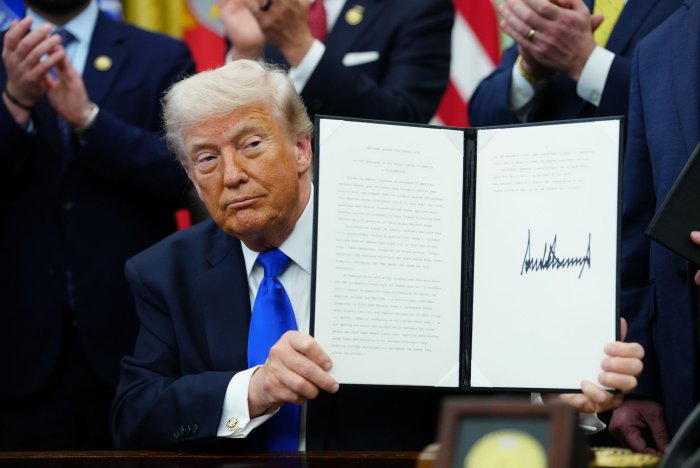
President Donald Trump signs a series of executive orders in the Oval Office of the White House on Thursday. Trump signed an order to expand workers’ access to retirement accounts. Trump also
signed legislation ending a 75-day partial shutdown of the Department of Homeland Security after the House voted in favor of funding. Photo by Aaron Schwartz/UPI |
License Photo