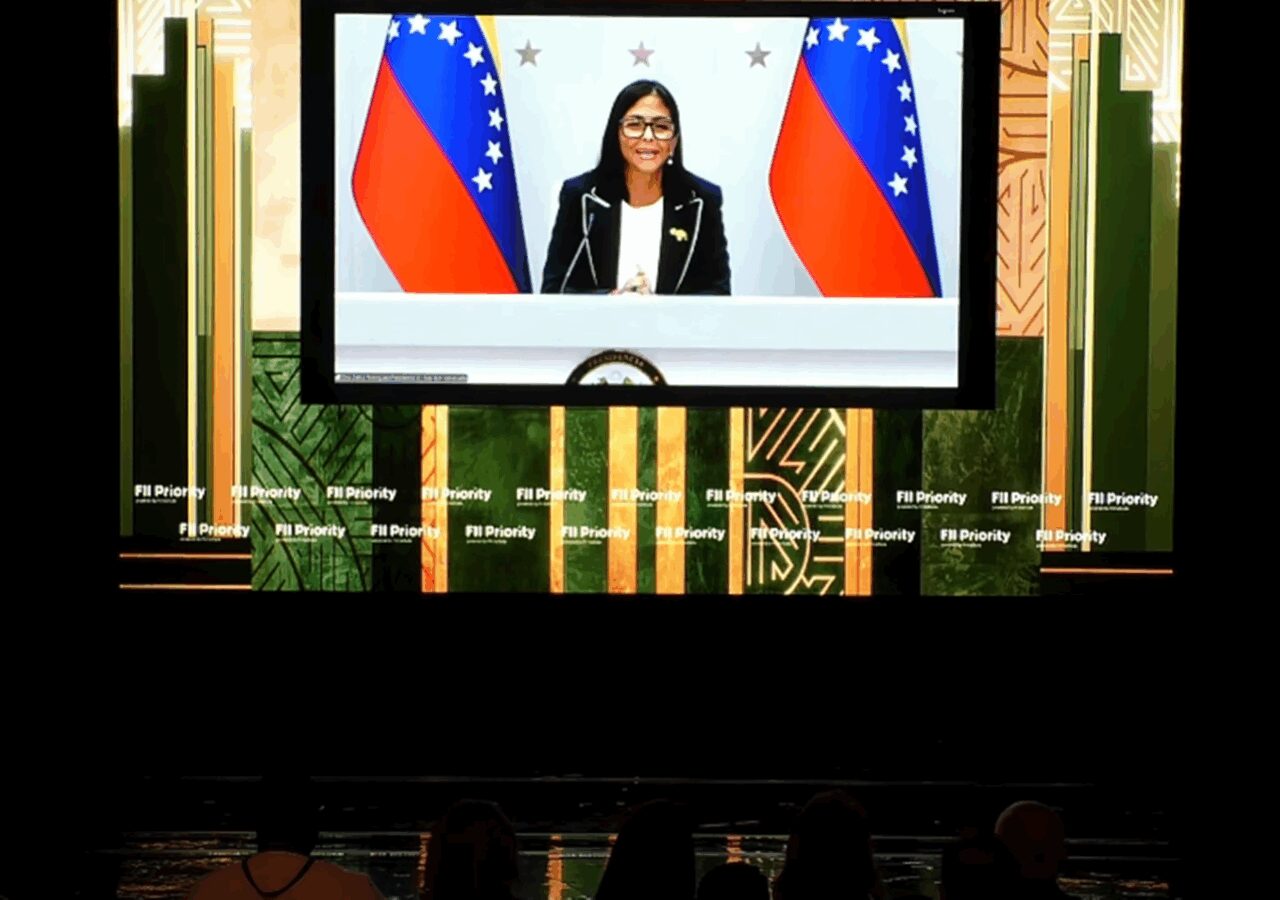
Rodríguez connected remotely to the FII Priority conference. (Archive)
Caracas, March 25, 2026 (venezuelanalysis.com) – Venezuelan Acting President Delcy Rodríguez has reiterated calls for foreign investment in the Caribbean nation.
Addressing the FII PRIORITY Miami Summit, Rodríguez showcased Venezuela’s economic growth and lauded the investment opportunities in the country’s vast oil, natural gas, gold, and other mineral resources. The Venezuelan leader highlighted the recent pro-business overhaul of the country’s Hydrocarbon Law and other upcoming reforms as key in generating “flexibility,” “guarantees,” and “security” for investors.
“The new Hydrocarbon Law creates important mechanisms for private sector control over production and commercialization,” Rodríguez said in her video message from Caracas. “It also creates flexible fiscal arrangements and establishes alternative conflict-resolution processes such as international arbitration.”
The acting president added that 64 percent of the price of a barrel is up for “negotiations with investors” in terms of reduced royalties and taxes, as well as dividends.
Approved in late January by the Venezuelan National Assembly, the new Hydrocarbon Law allows the executive to reduce taxes and royalties at its discretion. The reform also grants expanded control to private corporations, curtailing the state’s sovereignty over the industry established under Hugo Chávez under the 2001 Hydrocarbon Law and subsequent reforms.
In her remarks, Rodríguez urged “de-ideologization,” vowing, “regardless of different [political] views, a favorable climate can be created so that investors have the mechanisms so that their investments foster returns.” She added that she has met with representatives from 120 multinational corporations since January.
“Our reforms are a call for investors to participate,” Rodríguez stated. She went on to press for greater Latin American economic integration and for an end to unilateral sanctions against Venezuela, though she refrained from mentioning the US by name.
The Future Investment Initiative (FII) Institute is a non-profit run by Saudi Arabia’s Public Investment Fund and holds regular conferences bringing together business executives, analysts, and political leaders.
Rodríguez’s participation in the Saudi initiative came amid unprecedented energy market volatility as a result of the US and Israeli war against Iran. In spite of strong Venezuelan ties with Iran over the past 25 years, the Rodríguez administration has not taken a firm stance on the conflict, having published and later withdrawn a controversial statement. Caracas expressed solidarity with Qatar and the UAE after Iran retaliated against US military assets in the region.
The Venezuelan leader’s Wednesday message to investors in Miami followed a meeting with business executives at Miraflores Presidential Palace on Tuesday. The companies represented were not disclosed, though Houston-based oil giant Exxon Mobil has confirmed it has a team in Caracas “looking to assess the state of the resource that’s there.”
Rodríguez delivered a similar pitch hailing Venezuela’s natural resource potential and the prospects for foreign conglomerates opened by ongoing reforms. She appealed for the full lifting of sanctions, arguing that US Treasury licenses hurt investor confidence.
Since January, the Trump administration has issued a number of sanctions waivers allowing Western entities to engage with the Venezuelan energy and mining sectors. The licenses block transactions with companies from China, Cuba, Iran, North Korea, and Russia.
Additionally, the Treasury exemptions mandate that all royalty, tax, and dividend payments destined for Venezuelan state entities be deposited in US-run accounts. Washington currently controls Venezuelan oil proceeds, having returned a reported US $500 million, out of an initial $2 billion agreement, to Caracas.
On Tuesday, Rodríguez likewise announced the imminent departure of a Venezuelan diplomatic mission to Washington. Félix Plasencia, slated to become the country’s ambassador to the US, will lead the delegation.
“Our delegation will manage this new stage of diplomatic relations and dialogue between our two countries,” she affirmed.
Caracas and Washington fast-tracked a diplomatic rapprochement in the wake of the January 3 US attacks against Venezuela and kidnapping of President Nicolás Maduro and First Lady Cilia Flores. The two governments reestablished diplomatic relations in early March after a seven-year hiatus. The Trump administration went on to recognize Rodríguez as Venezuela’s “sole leader” days later.
Rodríguez, who had served as vice president since 2018, assumed the presidency in an acting capacity on January 5 with the endorsement of the Venezuelan National Assembly and Supreme Court, which declared Maduro’s absence as temporary.
Maduro and Flores pleaded not guilty to charges including drug trafficking conspiracy and will have a court hearing on Thursday. US officials have not presented evidence to sustain reiterated “narcoterrorism” accusations against Venezuelan leaders, while data from specialized agencies has found Venezuela to play a marginal role in global narcotics trafficking.
MIAMI — Secretary of State Marco Rubio testified in court that he had no knowledge that former Florida congressman David Rivera was lobbying on behalf of Venezuela’s government — as prosecutors later alleged — when he met with his longtime friend to discuss U.S. policy toward the South American country several times at the start of the first Trump administration.
“I would’ve been shocked” had I known, Rubio said in almost three hours of testimony Tuesday at Rivera’s federal trial in Miami.
Rivera and an associate were charged in 2022 with money laundering and failing to register as a foreign agent after being awarded a $50-million lobbying contract by Nicolás Maduro’s government.
Prosecutors allege that the goal of the lobbying effort was to persuade the White House to normalize relations with Venezuela, while Rivera’s attorneys argue that the three-month contract, which ended before Rivera met with Rubio, was focused exclusively on luring Exxon Mobil back to Venezuela — commercial work that is generally exempt from the Foreign Agents Registration Act.
As part of his work, Rivera and his co-defendant are accused of trying to arrange meetings for then-Foreign Minister Delcy Rodríguez — now Venezuela’s acting president — in Dallas, New York, Washington and Caracas, Venezuela, with White House officials, members of Congress and the chief executive of Exxon.
Rubio testifies, an unusual move
In sometimes deeply personal testimony Tuesday, Rubio discussed at length friendships that date back to the start of his political career as an aide to Bob Dole’s 1996 presidential campaign and a West Miami council member.
Testifying in a packed courtroom with heightened security, Rubio said he and Rivera became “very close” when they overlapped as members of the Florida Legislature. The two Cuban American Republicans co-owned a house in Tallahassee, celebrated family events together and ardently opposed Venezuela’s socialist government when both went to Washington at the same time — Rubio elected to the Senate, Rivera to the House.
So when Rivera texted Rubio in July 2017 that he needed to see him urgently to discuss Venezuela, they agreed to meet the next day, a Sunday, at a friend’s home in Washington where the then-senator was staying with his family, Rubio said.
At the meeting, Rivera informed Rubio that he was working with Raul Gorrín, a media magnate in Venezuela, on what he described as a plan for Maduro to step aside.
“I was skeptical,” said Rubio, adding that the Maduro government was full of “double dealers” constantly pitching unrealistic plans to unseat Maduro. “But if there was a 1% chance it was real, and I had a role to play alerting the White House, I was open to doing that.”
Rubio said he had no knowledge Rivera was himself working for Maduro, as prosecutors would later allege. Rubio said he doubted Gorrín would betray Maduro even when the former congressman opened his laptop and showed millions of dollars in a Chase bank account that he was told were payments from the businessman to Venezuela’s opposition.
“It was an impressive amount,” Rubio said. “He didn’t tell me whose account it was. He said it was to support the opposition.”
Two days later, borrowing talking points provided by Rivera, Rubio wrote and delivered a speech on the Senate floor signaling the U.S. would not retaliate against Venezuelan insiders who worked to push Maduro from power.
“He provided me with insight into some of the key phrases that regime insiders would’ve wanted to hear to know this was serious,” Rubio testified. “No vengeance, no retribution.”
Rubio also spoke to Trump, alerting the president in his first term that there may be something “brewing” with Venezuela.
‘A total waste of my time’
But the peacemaking effort collapsed almost immediately. At a second meeting at a Washington hotel, Gorrín failed to produce a promised letter from Maduro to Trump that he wanted Rubio to hand-deliver to the president.
“It was a total waste of my time,” Rubio testified.
Shortly afterward, Trump imposed heavy sanctions on Maduro and members of his inner circle for their decision to go forward with what Rubio called a “fake election” to empower a constituent assembly that undercut the opposition-controlled legislature.
By that time, the senator hewed closely to the Trump administration’s hard line. He taped a rare 10-minute address to the Venezuelan people in July 2017, a day after the divisive election, that was broadcast exclusively on Gorrín’s Globovision network.
“For Nicolás Maduro, who I am sure is watching, the current path you are on will not end well for you,” Rubio said in the televised address.
On the stand, Rubio said that had he known Rivera was working with Gorrín on behalf of Maduro, he never would have agreed to deliver the address on the network.
But Rivera said Rubio’s testimony backed his defense that as a lifelong opponent of communism he never worked to strengthen Maduro’s grip on power.
“Marco Rubio made it abundantly clear today that everything we worked on together in 2017 was meant to remove Maduro from power in Venezuela,” he said in a statement.
Throughout his testimony Rubio, a lawyer, spoke calmly and in command of granular details of U.S. policy toward Venezuela over the past decade, even as he struggled to recall the specifics of his text exchanges with Rivera on Venezuela matters.
His testimony was highly unusual. Not since Labor Secretary Raymond Donovan testified at a Mafia trial in 1983 has a sitting member of the president’s Cabinet taken the stand in a criminal trial.
As if to underscore the uniqueness of his appearance in federal court, Rivera’s attorney, Ed Shohat, asked Rubio to sign a copy of his 2012 autobiography, “An American Son,” at the conclusion of his testimony.
Rivera and his co-defendant, political consultant Esther Nuhfer, are among a small number of friends and family Rubio thanks in the acknowledgment section of his memoir.
The Venezuelan acting president called for a rational use of electricity in the coming weeks. (EFE)
Mérida, March 23, 2026 (venezuelanalysis.com) – The Venezuelan government announced a 45-day electricity saving plan as extreme temperatures and regional outages impact Venezuela’s power grid.
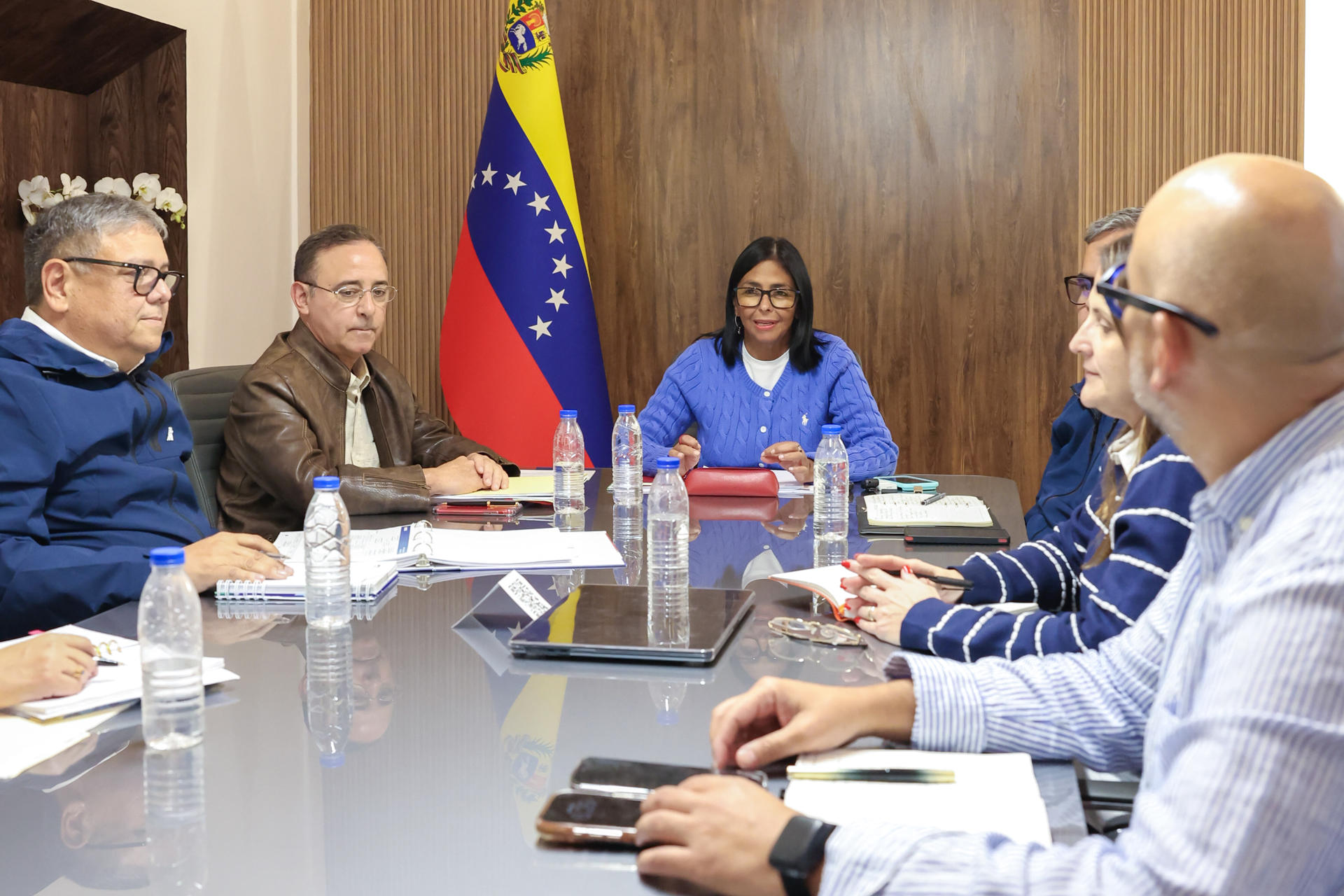
The announcement, made by Acting President Delcy Rodríguez on Saturday, comes on the heels of recurring blackouts, particularly in western states.
“We are entering a period where solar radiation will impact our territory directly, intensifying heat and drought across the country,” Rodríguez stated during a televised cabinet meeting with officials responsible for the electricity and infrastructure portfolios.
She explained that the “perpendicular passage” of solar rays would significantly increase energy demand for cooling. Alongside drought forecasts, officials expect a greater strain on Venezuela’s electricity generation and transmission infrastructure.
As part of the contingency plan, the Ministry of Electric Energy is set to publish a protocol urging reduced air-conditioning use other rationing measures. In addition, the government has authorized the deployment of thermal drones to monitor high-temperature areas and prevent forest fires from compromising transmission lines.
In March 2025, the Nicolás Maduro administration implemented a similar electricity-savings plan and was compelled to reduce public sector work hours to half a day to ease demand. While the 2025 measures were temporary, the recurrence of shortages underscores the systemic vulnerabilities of the electric grid.
Last Friday, residents in Zulia, Táchira, Mérida, and Trujillo experienced widespread power outages lasting several hours. Local media outlets in the Andean region reported that some sectors are facing daily rationing of up to four hours. Nationwide electricity fluctuations were likewise registered on Monday, with parts of Caracas suffering temporary outages.
The origins of Venezuela’s electrical instability extend over a decade, culminating in the 2019 widespread nationwide blackouts that authorities blamed on “cyber-sabotage.” The alleged attacks compounded infrastructure hard-hit by years of economic sanctions, as well as underinvestment, inadequate maintenance, and the departure of skilled personnel.
Venezuela’s electric grid remains heavily dependent on the Simón Bolívar Hydroelectric Plant, also known as the Guri Dam, in southeastern Bolívar state, which provides approximately 80 percent of the nation’s power.
However, the transmission lines stretching from the southeast to the western border are often unable to handle the load, with thermoelectric plants in the region unable to cover the additional demand. Current estimates indicate that while Venezuela has an installed generation capacity of approximately 34 gigawatts (GW), only around 12 to 14 GW are currently operational.
Sanctions and push for private investment
In her Saturday address, Rodríguez reiterated the damage caused by US-led unilateral coercive measures and called for their removal. The Venezuelan acting president argued that sanctions hampered the state’s capacity to procure essential technology and components from international suppliers.
“The blockade has impeded the full recovery of this essential service,” Rodríguez said. “Though we have recovered capacity through our own efforts, sanctions limit our response to a demand that grows alongside the economy.”
The Venezuelan government has also announced plans to scale back state control over the electricity sector in order to attract private investment. Earlier this month, authorities unveiled a “pilot plan” to promote foreign investment into the electric grid, following similar blueprints from the oil industry.
Under the proposed framework, the government aims to update the Organic Law of the Electricity System (LOSSE) to allow private companies to assume control of generation and distribution through joint ventures.
According to the Venezuelan Chamber of Construction (CVC), a preliminary investment of US $1.29 billion could lead to the reincorporation of over 6,300 MW to the grid in two phases. The CVC is specifically promoting a project with the Latin America Development Bank to stabilize 2,000 MW in the central industrial region.
The new electricity management model would allow private actors to take control of specific “industrial nodes,” ensuring a reliable supply for manufacturing while retaining a portion of the proceeds to cover maintenance costs.
However, the immediate focus for the Venezuelan executive remains on electricity rationing. Rodríguez concluded her address by calling for “national consciousness,” urging the public to see energy saving not just as a government mandate, but as a collective necessity to navigate the coming weeks of extreme heat and drought.
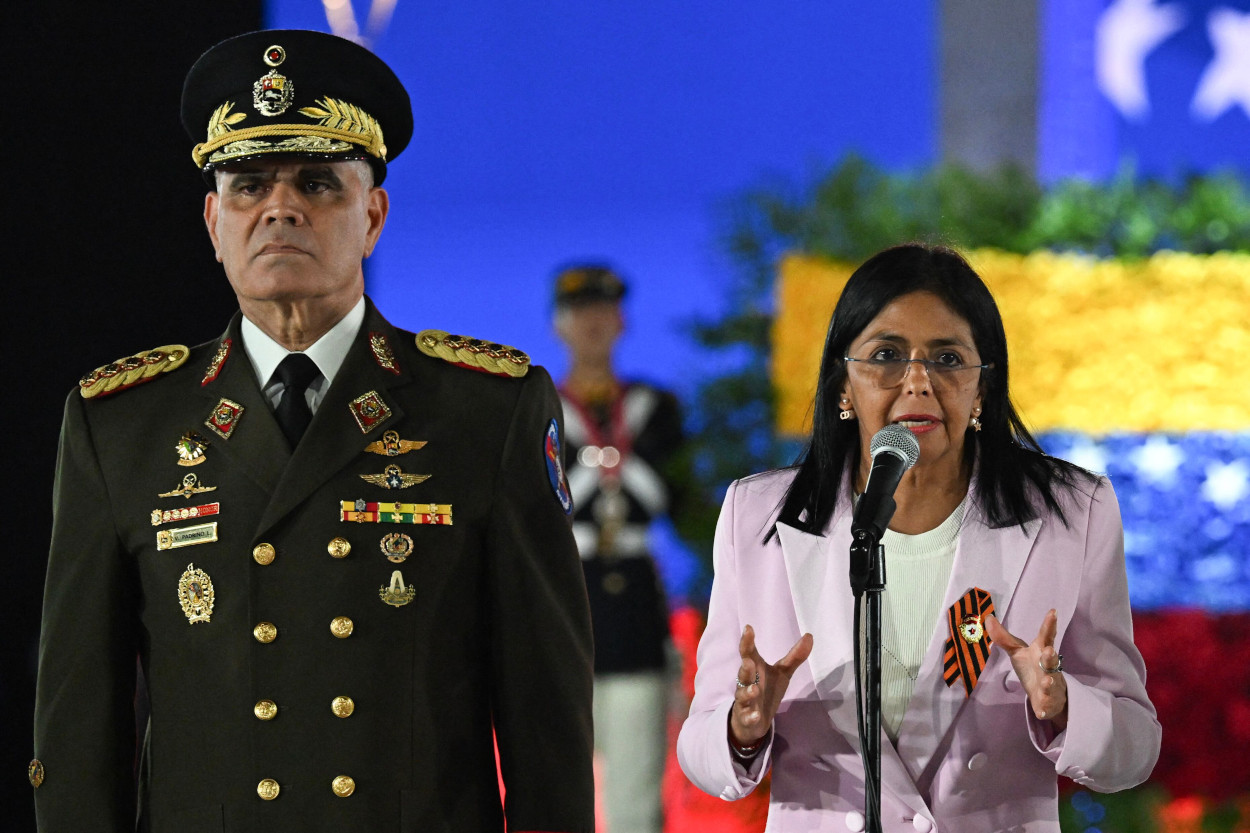
Acting President Delcy Rodríguez (right) thanked Padrino López (left) for his service as defense minister. (AFP)
Caracas, March 19, 2026 (venezuelanalysis.com) – Venezuelan Acting President Delcy Rodríguez tapped Gustavo González López as the country’s new defense minister on Wednesday, replacing Vladimir Padrino López after more than a decade in the post.
“We thank General Vladimir Padrino López for his loyalty and for having been the first soldier in the defense of our country for so many years,” Rodríguez wrote on social media. In response, Padrino thanked the acting president and stated that “serving the Homeland” had been his “highest honor.”
Padrino had served as defense minister since October 2014. The four-star general staved off a number of US-backed coup attempts, including the May 2020 “Operation Gideon” failed mercenary invasion.
In 2025, the Biden administration announced a $15 million bounty for information leading to Padrino’s capture as part of a “narcoterrorism” indictment against several Venezuelan leaders, including President Nicolás Maduro. However, US officials have not presented evidence tying Venezuelan high-ranking officials to narcotics activities.
Padrino’s removal follows the January 3 US military strikes against Venezuela that saw special forces kidnap Maduro and First Lady Cilia Flores. Despite months of defense exercises in the face of escalating US threats, Venezuelan forces, particularly air defenses, were quickly neutralized by US bombing and electromagnetic warfare on January 3.
The Venezuelan armed forces have yet to offer a complete account of the operation, including a definitive list of casualties that are said to surpass 100. Padrino condemned the US attacks and pointed to Washington’s military superiority, arguing that it would have been “suicidal” for Venezuelan air force jets to take off and engage with the enemy.
The 60-year-old Gustavo González López previously held posts as interior minister and director of intelligence services and has been under US sanctions since 2015. A career military officer, he briefly studied at the School of the Americas in the early 1990s.
Following the January 3 attacks, González was chosen by Rodríguez to lead the presidential guard. He was pictured alongside the acting president during a visit to Caracas from CIA Director John Ratcliffe on January 16. General Henry Navas will replace González as Commander of the Presidential Guard of Honor.
Rodríguez announced several other cabinet changes on Wednesday. She had previously replaced the industry, oil, tourism, healthcare, communications, and eco-socialism ministers as well.
Jorge Márquez and Rolando Alcalá will take over the housing and electricity portfolios, respectively. Furthermore, Supreme Court magistrate Carlos Alexis Castillo will serve as labor minister amid rising demands for minimum wage increases and labor rights, replacing veteran official Eduardo Piñate.
Former Caracas mayor Jacqueline Faría was likewise appointed as the new transport minister, replacing Aníbal Coronado after two months in the post. Faría’s appointment followed a public transportation strike in Caracas as private bus operators push to increase single-ride fares to 120 bolívars, roughly US $0.25 at the present exchange rate.
Wednesday’s cabinet changes also included Raúl Cazal becoming culture minister, replacing Ernesto Villegas, who had held the post since 2017. Villegas is one of the candidates shortlisted by the Venezuelan National Assembly for the vacant ombudsman post.
Finally, Rodríguez picked academic Ana María Sanjuan as minister of higher education, replacing Ricardo Sánchez. A trained psychologist and professor at the Central University of Venezuela (UCV), Sanjuan had participated in political dialogue initiatives as a representative of moderate opposition sectors.
For years, the legal fight over Venezuelan assets abroad turned on one basic question: who does a foreign government recognize as the person entitled to act for Venezuela? In the United States, that question once pointed toward the opposition-led structure tied to the 2015 National Assembly and, before that, Juan Guaidó. After Guaidó fell, Dinorah Figuera became the head of what remains of that 2015 Assembly, the Comisión Delegada. Through that entity, the opposition continued trying to preserve control over foreign assets such as Citgo and funds held abroad.
Reuters reported in 2023 that the new opposition leadership under Figuera moved to oversee foreign assets, including Citgo and gold held at the Bank of England. During the Biden administration, the State Department likewise said in January 2023 that it would continue to recognize the democratically elected 2015 National Assembly as the last remaining democratic institution in Venezuela.
That is no longer the key US posture. In March 2026, the US government formally told a federal court in New York that the United States is recognizing Delcy Rodríguez as the “sole Head of State, able to take action on behalf of Venezuela.” The filing relied on the State Department’s March 5 statement normalizing relations with Venezuela under Delcy Rodríguez and on President Trump’s public remark that the United States had “formally recognized” the Venezuelan government. That is the legal pivot. Once Washington says who it recognizes as Venezuela’s head of state, US courts and agencies do not get to run their own foreign policy.
This is why the debate about Delcy’s legitimacy under Venezuelan domestic law, while politically important, is not the decisive question in New York, Delaware, Texas, or Washington. The majority of Venezuelan lawyers believe that Delcy Rodríguez is illegitimate. I am not arguing otherwise. However, under US constitutional law, recognition of a foreign sovereign belongs exclusively to the President of the United States.
The recognition question has shifted sharply in Delcy’s favor, even if some operational steps are still controlled by licenses, sanctions, and pending litigation.
In the case Zivotofsky v. Kerry, decided in 2015, the US Supreme Court said exactly that: the President has the exclusive power to grant formal recognition, and the nation must speak with “one voice” on that subject. Older US Supreme Court cases say the same thing in slightly different words. The practical result is simple: if the President recognizes one person as the one entitled to act for a foreign state, US courts (federal and state courts) generally follow that determination.
So, does that mean Delcy now controls Citgo? As a matter of US recognition law, the answer is yes, in the sense that authority now runs through the person Washington recognizes, not through whichever Venezuelan faction lawyers or commentators prefer. But there is one important practical wrinkle: Reuters reported that Delcy’s team still needs US Treasury clearance to take over Citgo’s US subsidiaries, and Citgo also remains entangled in ongoing court proceedings. In other words, the recognition question has shifted sharply in Delcy’s favor, even if some operational steps are still controlled by licenses, sanctions machinery, and pending litigation.
England works in much the same way. In the Bank of England gold litigation, the Supreme Court of the United Kingdom held that recognition of foreign heads of state is a matter for the executive, not the courts. The Court called this the “one voice principle”: English courts must accept the executive’s recognition position as conclusive. That is why the courts treated Juan Guaidó as the recognized head of state when the UK government recognized him. The logic is straightforward. English judges do not decide who truly won the constitutional struggle in Caracas. They follow the position taken by His Majesty’s Government.
If London does the same, the same logic will likely carry over to Venezuelan assets in England, including the gold dispute.
That is also why there is no serious legal basis for pretending that personal politics can change the answer. A lawyer may dislike Delcy Rodríguez. Another may dislike Dinorah Figuera. Someone else may prefer Edmundo González. None of that changes the recognition rule. On this issue, legal analysis is supposed to be colder than politics. If Washington recognizes Delcy, US institutions will generally treat Delcy as the person entitled to act for Venezuela. If London does the same, the same logic will likely carry over to Venezuelan assets in England, including the gold dispute. The law here is not about who we admire or dislike. It is about who the executive power of the US recognizes. Nothing else.
One last point matters. I have not found any official UK statement, as of now, publicly recognizing Delcy Rodríguez in the same clear way the United States has. A January 2026 statement by the UK Foreign Secretary referred to her as “acting President” and urged democratic steps, but it did not announce the kind of formal recognition statement the UK issued for Guaidó in 2019.
So the US conclusion is already here. The English conclusion depends on whether London takes that additional recognition step.
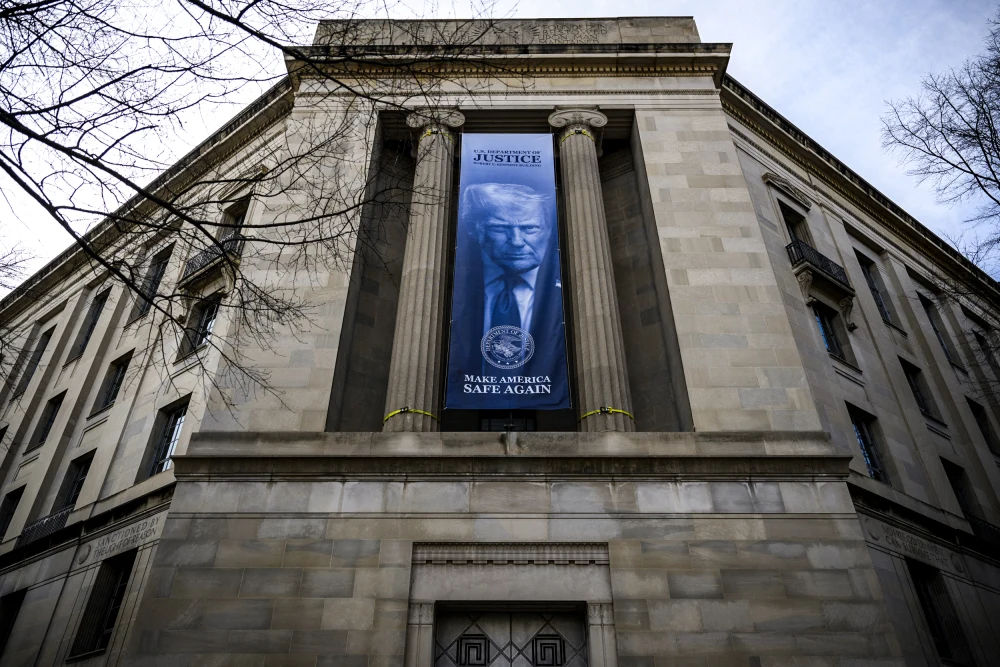
The US Justice Department reiterated its non-recognition of Maduro since 2019 ahead of a March 26 hearing. (AFP)
Caracas, March 13, 2026 (venezuelanalysis.com) – Venezuelan Acting President Delcy Rodríguez welcomed on Wednesday the formal recognition granted by the United States government to her administration as the South American country’s “sole” and legitimate authority.
Rodríguez argued that Washington’s decision goes beyond any individual figure or government.
“It is not recognition of a person or a government; it is recognition of a country so that it is able to recover its life,” she said during a televised broadcast, referring to the impact of wide-reaching US unilateral coercive measures imposed since 2015.
The Venezuelan leader affirmed that the diplomatic move could help advance “national unity” and contribute to the “normalization” of the country’s political, economic, and social life. “What matters to me is that this can bring a process of reordering and normalization,” she added.
The recognition was communicated by Manhattan US Attorney Jay Clayton in a “statement of interest” addressed to federal Judge Sarah Netburn. Clayton is likewise heading the prosecution in the US Justice Department’s case against Venezuelan President Nicolás Maduro.
Maduro was kidnapped by US special forces alongside First Lady Cilia Flores on January 3 during a military operation. The pair has pleaded not guilty to charges including drug trafficking conspiracy and will face a hearing on March 26. US officials have not provided evidence tying Venezuelan high-ranking officials to narcotics activities, while specialized reports have consistently found Venezuela to play a marginal role in global drug trafficking.
Clayton’s missive referenced a letter from State Department official Michael Kozak which identified Rodríguez as Venezuela’s “sole Head of State.” Kozak’s letter expressed the Trump administration’s argument that the recognition will help advance US interests in the Caribbean nation.
Trump publicly acknowledged Washington’s recognition of the Venezuelan government for the first time during the Shield of the Americas Summit on March 7. The White House argued that its stance would contribute to Venezuelan stability and economic recovery, as well as create the conditions for “a peaceful transition toward a democratically elected government.”
Caracas and Washington reestablished diplomatic ties on March 5 and have taken steps to reopen their respective embassies and consulates. The Maduro government severed ties with the first Trump administration in 2019 when the latter recognized then–National Assembly president Juan Guaidó as Venezuela’s “interim president.”
Kozak reiterated in his letter that since January 23, 2019, the US has not recognized Maduro as Venezuela’s head of state and that this position had not changed.
“Maduro is an accused narco-terrorist awaiting trial in a US federal court for his crimes,” the document read. The Venezuelan president’s defense team is expected to argue that Maduro should be entitled to immunity from prosecution as a sitting head of state.
Washington’s formal recognition of the acting government in Caracas could also have implications for Venezuelan assets abroad. Since 2019, several bank accounts and US-based Venezuelan refiner CITGO have been frozen or under the control of the US-backed opposition.
The White House’s move will also pave the way for renegotiations surrounding Venezuela’s sizable sovereign debt, with creditors eager for a potential windfall after buying defaulted bonds at very depressed prices.
While Clayton’s address identified Rodríguez as the only person “able to take action on behalf of Venezuela,” US authorities have not clarified whether the Venezuelan government will retake control of its US-based assets.
In addition, the Justice Department attorney declined to take a position regarding “which counsel is authorized to represent certain Venezuelan state-owned entities.” On Thursday, Judge Netburn requested further clarification from the administration regarding the representation of Venezuelan interests before US courts before March 26.
In her Wednesday address, Rodríguez went on to acknowledge “daily exchanges” with US counterparts and expressed “gratefulness” for the reestablishment of trade relations. The acting president stated that Venezuela has imported medical equipment and medicines from US companies in recent weeks.
Since early 2026, the Trump administration taken direct control of revenues generated by Venezuelan oil exports, depositing funds into accounts held by the US Treasury. Around a quarter of an initial US $2 billion crude sale agreement has reportedly been returned to Caracas.
Recently issued US licenses allowing transactions in the Venezuelan oil and mining sectors likewise mandate that proceeds be deposited in Treasury-run accounts.
US officials have claimed that Venezuelan authorities need to submit a “budget request” to access the country’s funds and will only be allowed to import goods and services from US manufacturers.
Edited and with additional reporting by Ricardo Vaz in Caracas.
Good morning, and welcome to L.A. on the Record — our City Hall newsletter. It’s David Zahniser, with an assist from Howard Blume and Noah Goldberg, giving you the latest on city and county government.
She’s blunt. She’s combative. She doesn’t go along to get along.
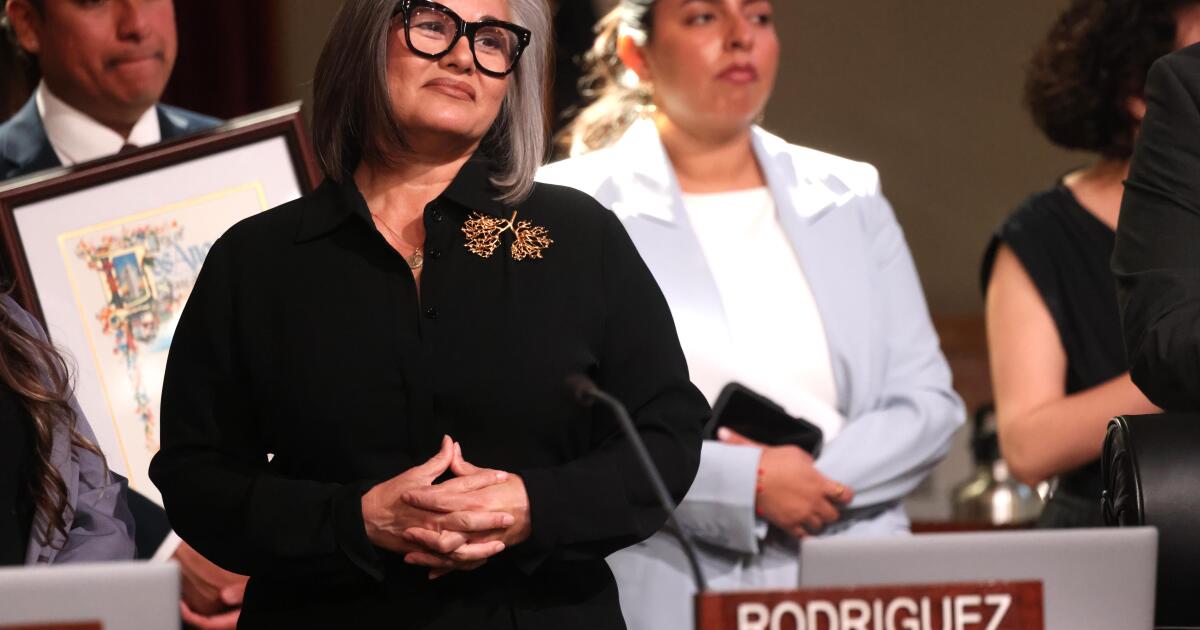
And now, Los Angeles City Councilmember Monica Rodriguez is almost certainly getting four more years in office.
On Wednesday, with the deadline past, no one filed a petition to challenge Rodriguez in the June 2 primary election. That makes her the only official at City Hall to be in that coveted position this year.
One caveat: Someone could still run as a write-in, waging a long-shot campaign. But realistically, Rodriguez has a free ride to continue representing her northeast San Fernando Valley district.
Rodriguez, who lives in Mission Hills, said she had been prepping for “another fight,” raising money and giving endorsement interviews. Now, she’s started talking about what her third and final term could look like.
“Giddyup. Everyone better buckle up,” she said, cackling.
You’re reading the L.A. on the Record newsletter
For an elected official, nothing can bolster one’s confidence like a reelection victory or two. Newly elected council members tend to keep a low profile their first few years. The longer they stay, the more outspoken they become.
Rodriguez, on the other hand, has been willing to speak her mind for quite some time.
She’s been a longstanding critic of Mayor Karen Bass’ Inside Safe program, which moves homeless people indoors. She has pushed, without success, for the city to yank its money from the embattled Los Angeles Homeless Services Authority, or LAHSA. Last fall, she told a mayoral aide that Bass’ team “botched” the Palisades fire recovery in the first few months.
Rodriguez frequently expresses her views in vivid terms, and in ways that can annoy her colleagues.
Last year, she warned a proposal to hike the minimum wage for hotel and airport workers to $30 per hour would trigger job losses, leaving the city with “the best paid unemployed workforce in America.”
She denounced the city’s plan to upgrade the Convention Center, saying the council was continuing to “fund failure.” She regularly drops the phrase “merry go round from hell” — shorthand for her struggle to get her colleagues to pull out of LAHSA, the city-county homeless agency that’s been the subject of blistering audits.
With the election approaching, the zingers have only gotten zingier.
Six weeks ago, City Councilmember Nithya Raman launched a last-minute bid to rewrite Measure ULA, the city’s tax on high-end property sales, saying it had chilled development of much-needed apartments. Raman wanted her proposal to go on the June ballot but failed to garner support from her colleagues, who said it hadn’t been vetted.
Rodriguez, in a screed delivered on the council floor, compared Raman to “the arsonist that comes showing up as a firefighter.”
That was a not-so-veiled reference to the fact that Raman promoted Measure ULA in 2022 — and downplayed concerns that it would affect housing production.
“Ms. Raman, you supported and endorsed the false notion to voters that [Measure ULA] was going to be the panacea — without study, without any of the verified proof,” she said. “We knew that these were the implications.”
Raman, in a statement on Friday, said she endorsed Measure ULA after reading through research suggesting that the tax, which generates money for housing programs, would not affect housing production. Newer analysis, she said, found that the measure “indeed resulted in less investment in multi-family housing.”
“That is a huge concern to me and should be to everyone in L.A., a City that is still very much facing a housing shortage,” said Raman, who is now running for mayor. “I am willing to take some heat to get the best outcomes for the City and to secure support for these crucial revenues.”
Stuart Waldman, president of the Valley Industry and Commerce Assn., a San Fernando Valley-based business group, said he appreciates Rodriguez’s direct approach, even when he disagrees with her.
“A lot of councilmembers, if they don’t agree with you, they won’t even meet with you,” he said. “There are council members who say they’ll listen and take [an issue] under advisement, even though they’ve made up their mind. They just don’t want to tell someone to their face that they disagree.”
Rodriguez’s approach doesn’t always reap political dividends.
Last year, Council President Marqueece Harris-Dawson removed her from a number of high-profile committees, including those that oversee homeless programs, public safety and the city budget.
Despite her warnings, the council hiked the minimum wage for tourism workers and approved the $2.6-billion Convention Center project. She championed the creation of a new youth development department, only for it to wind up on the chopping block in last year’s budget.
Rodriguez, 52, grew up in Arleta, the daughter of a U.S. Marine veteran who served in Vietnam while holding a green card, and later became one of the city’s earliest Latino firefighters in the wake of a federal consent decree on hiring. She graduated from San Fernando High School in 1992, one year after Assemblymember Luz Rivas and two years after U.S. Sen. Alex Padilla.
She worked for former Mayor Richard Riordan and former Councilmember Mike Hernandez and later ran unsuccessfully against former Councilmember Richard Alarcon. She joined the Board of Public Works in 2013, running for council a second time four years later.
With a third term looming, Rodriguez wants to take a program she launched in her district — moving homeless people out of RVs and into housing — and take it citywide. She’s excited about expanding a program for fixing sidewalks that also teaches job skills to young people.
Rodriguez acknowledged that her stances, and her remarks, can rub people the wrong way, noting that it’s “more comfortable to walk in a group than to walk alone.” Nevertheless, she doesn’t intend to change her approach.
“I know what I’m here to do, and I’m just going to continue,” she said.
State of play
— SCRAMBLE FOR SIGNATURES: The deadline for candidates for city office to turn in petitions arrived on Wednesday, and the signatures are still being counted. By Friday, 12 mayoral candidates had qualified to run against Bass, including Raman, reality television star Spencer Pratt and tech entrepreneur Adam Miller. The City Clerk’s office is still reviewing the petitions of several other mayoral hopefuls, all of them political unknowns.
— ANOTHER FREE RIDE: L.A. Unified School board member Kelly Gonez is also running unopposed in the June 2 election. On Wednesday, her one potential opponent, JP Perron, announced he was dropping out. Like Rodriguez, Gonez represents part of the San Fernando Valley.
— A HELPING HAND: For a hot minute, things were touch and go for Sylvia Robledo, a former council aide looking to unseat Councilmember Eunisses Hernandez. After filing her petitions, Robledo learned Tuesday that she was short 14 voter signatures. Raul Claros, one of her rivals in the race, stepped in to help close the gap, gathering some signatures himself. “People want options,” he said later on Instagram. “People want anybody but Eunisses Hernandez.”
Two of Robledo’s other opponents — entrepreneur Nelson Grande and nonprofit executive Maria Lou Calanche — added their own names to her petition. On Wednesday, she qualified for the ballot.
“We may have a different vision or path, but we all want new leadership,” Robledo said.
— JANISSE JETS OFF: The top executive at the Department of Water and Power, Janisse Quiñones, announced this week that she has taken a job as CEO of a privately owned electrical company in her native Puerto Rico. Quiñones, who was hired at $750,000 a year, faced criticism over the DWP’s decision to drain a reservoir shortly before the Palisades fire broke out. Her first day in the new job is March 30.
— TRUMP ON LINE 1: Bass spoke on the phone this week with President Trump to request FEMA reimbursements for the Palisades fire, KNX News reported. Bass told the station that the president was “very receptive.”
“I was reluctant to call because there are a few other things going on, like what’s happening overseas, and I didn’t think, given all that was happening internationally, that he would actually return my call,” she told the station.
— OVERDUE BILLS: The county Board of Supervisors voted this week to fund a financial review of the Los Angeles Homeless Services Authority, after finding that the agency owes tens of millions of dollars to nonprofits that oversee interim housing for the region’s homeless population. Supervisor Lindsey Horvath said her phone was “ringing off the hook” from groups needing to get paid by LAHSA.
— TIT FOR TAT: Meanwhile, the long-running feud between Bass and Horvath continued to boil over, with the two taking digs at each other over the future of the region’s homeless programs. Bass, in a statement, said pulling out of LAHSA too quickly would bring “unintended consequences” and leave “more Angelenos to die on our streets.”
“When the County created their new Department of Homeless Services and Housing, they also created a $300 million gap, which they had to close by prioritizing bureaucracy rather than services,” Bass said.
Horvath shot back, saying she is already conferring with council members on a strategy to have the city pay the county to provide homeless services.
“I’m ready to work with the City Council and show the Mayor what locking arms actually looks like,” she said, swiping one of Bass’ signature phrases.
— PALISADES BOWL IN PERIL: The owners of a mobile home park destroyed last year in the Palisades fire are marketing the site as a potential “mixed use” project — housing plus commercial space, which would result in permanent displacement of residents. City Councilmember Traci Park said any developer looking to take the sellers up on their offer should “pound sand.”
“What we are interested in doing is restoring this property as a mobile home park for the people who were there and remain displaced,” she said.
— PURSUING POT PROCEEDS: L.A. cannabis companies owe the city more than $400 million in business taxes, late fees and interest. Hoping to recoup $30 million of that total, the council voted this week to set up an amnesty program for those pot businesses that still owe money and haven’t already shuttered.
— JAIL DEATHS: Ten people have died in L.A. County jails so far this year, putting the county on track for another record-setting year of in-custody deaths. Now, county supervisors want the Sheriff’s Department to reverse that trend by beefing up safety checks, more closely monitoring cameras and increasing access to the overdose reversal drug Naloxone.
— FOR FLOCK’S SAKE: The Police Commission wants to know how data captured by the controversial license plate reader Flock Safety are being stored and shared. Commissioner Jeff Skobinasked for the information following reports that federal agencies had repeatedly accessed Flock’s surveillance data as part of Trump’s ongoing immigration crackdown.
QUICK HITS
Where is Inside Safe? The mayor’s signature program to fight homelessness went to a stretch of Laurel Canyon Boulevard in North Hollywood, underneath the 170 Freeway. About three dozen people went inside, according to Bass’ team.
On the docket next week: The council’s Planning and Land Use Management Committee meets Tuesday to take up a proposal to hike the penalties for putting up illegal billboards and other unpermitted signs.
Stay in touch
That’s it for this week! Send your questions, comments and gossip to LAontheRecord@latimes.com. Did a friend forward you this email? Sign up here to get it in your inbox every Saturday morning.
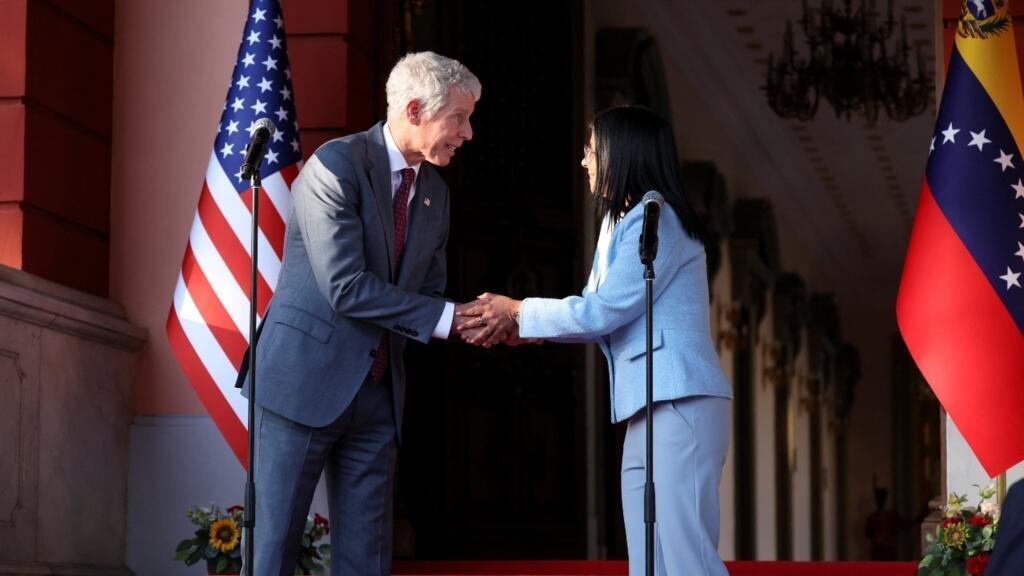
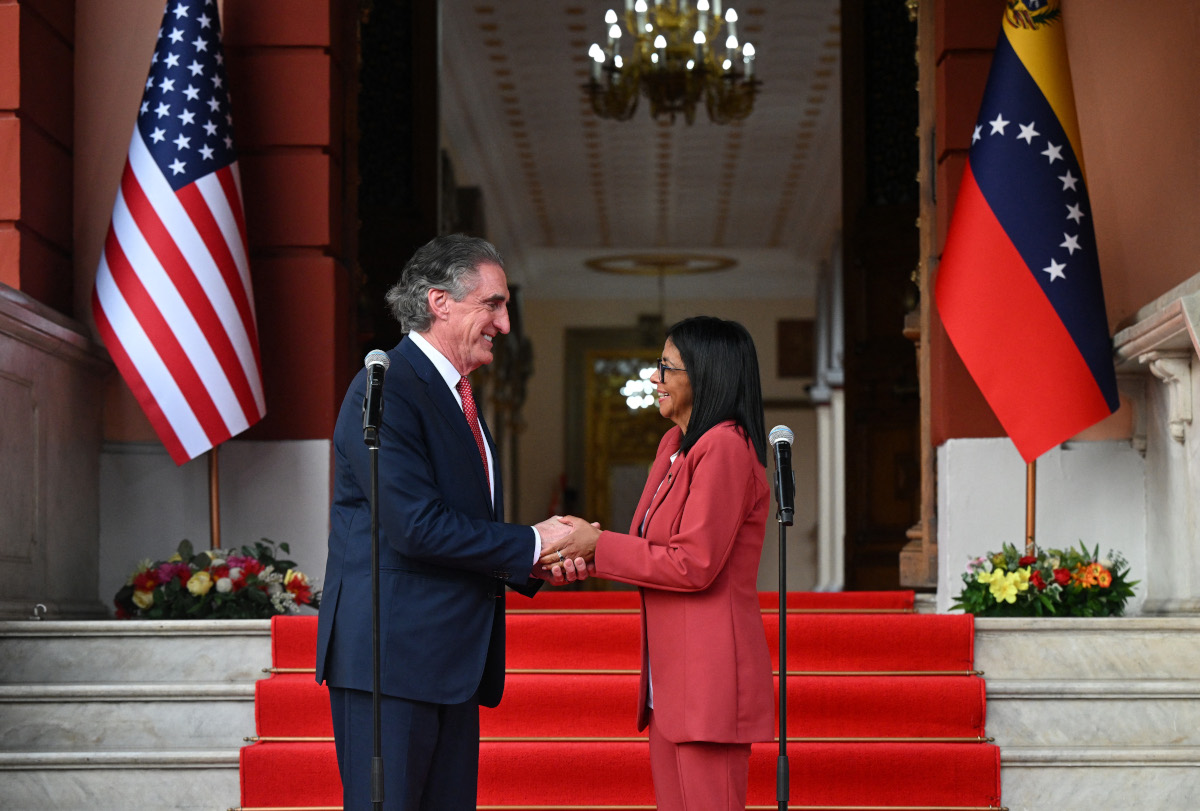
Rodríguez and Burgum gave a joint press conference in Miraflores Palace. (AFP)
Caracas, March 5, 2026 (venezuelanalysis.com) – Venezuelan Acting President Delcy Rodríguez met Wednesday with US Interior Secretary Doug Burgum at the Miraflores Presidential Palace in Caracas to discuss a bilateral agenda focused on energy and mining.
Senior officials from both countries also attended a closed-door meeting, including US Chargé d’Affaires Laura Dogu and Venezuelan Interior Minister Diosdado Cabello. Rodríguez and Burgum later gave a joint press conference.
“We welcomed Burgum to address important aspects related to metallic, non-metallic, strategic and non-strategic minerals,” the acting president told reporters. “We want the Venezuelan people to see the advantage of having good relations with the world and with the United States.”
Rodríguez said that her economic team will soon present a proposal to the National Assembly to “expand” Venezuela’s Mining Law, urging lawmakers to reform it “swiftly” in order to showcase “investment and development opportunities in the mining sector” to both domestic and international business groups.
Venezuela’s current mining legislation was approved in 1999. Rodríguez noted that the government intends to replicate the “win-win formula” of the recent hydrocarbon reform approved on January 29, which introduced wide-reaching benefits for foreign capital in the oil sector.
Under the overhauled legislation, private operators get expanded control over operations, with limited parliamentary oversight and a reduced tax burden.
Rodríguez also thanked US President Donald Trump for a social media post praising the Venezuelan acting president for “doing a great job.” The Venezuelan leader highlighted the US government’s “kind disposition” to work on a “mutually beneficial” cooperation agenda.
For his part, Burgum said that Venezuela is “an extraordinarily rich nation” in oil, gas, and critical minerals, adding that the opportunities for collaboration between the two countries “have no limits.” He serves as chair of the US National Energy Dominance Council as well.
According to the senior White House official, who holds the natural resources portfolio, the potential cooperation could deliver something “truly remarkable” for both the Venezuelan and American people. Burgum’s delegation included representatives from over 20 US and Canadian mining companies, some of them with a past presence in Venezuela.
“These companies are ready to begin,” he said. “I know that [Acting President] Rodríguez, like President Trump, wants to cut bureaucratic red tape so this capital investment can start flowing.”
Among the companies represented in the visit were US firms Peabody Energy—the world’s largest private coal company—Hartree Partners, Orion CMC, Paulson & Co., and Caterpillar Inc., along with Canada’s Lundin Mining Corp and Singapore-based commodities trader Trafigura.
Canadian miner Gold Reserve also announced plans to return to the Caribbean nation and disclosed a 30-day US Treasury license to negotiate with Caracas.
According to Axios, US officials additionally negotiated a multimillion-dollar agreement with Venezuela’s state mining company Minerven to sell up to one metric ton of gold to the US market, currently valued at roughly $165 million.
The deal would require Minerven to supply between 650 and 1,000 kilograms of doré gold bars—a crude alloy of gold and silver with 50 to 90 percent purity—to Trafigura, which would transport the metal to US refineries. The transaction details were not disclosed, including whether Trafigura will deposit payment in US-run accounts in an arrangement similar to the one the Trump administration has imposed for Venezuelan oil exports.
Burgum is the fourth senior US official to visit Venezuela since the January 3 US military strikes and kidnapping of President Nicolás Maduro and his wife, National Assembly deputy Cilia Flores.
Earlier visits included US Southern Command chief Francis Donovan, CIA Director John Ratcliffe, and US Energy Secretary Chris Wright.
Venezuela possesses vast unexplored and proven mineral reserves, including significant gold, iron, bauxite, diamonds, nickel, and copper deposits. Coltan reserves have likewise been touted in recent years.
According to the International Center for Productive Investment (CIIP)—an agency attached to the Venezuelan vice presidency—the country holds the eighth-largest iron reserves in the world, estimated at 14.7 billion metric tons, as well as more than 321 million tons of bauxite, the raw material used to produce aluminum.
Regarding gold, the CIIP estimates that Venezuela may hold between 2,200 and 8,000 metric tons, which would place the country among the largest gold reserves globally.
Analysts have also highlighted the possibility of finding rare earth deposits in the South American country. The 17 elements have diverse applications in cutting-edge technology and advanced weapons systems. Washington is currently highly dependent on rare earth imports from China.
As a child in Newark, N.J., Narciso Rodriguez was often transported back to Cuba by the stories from his family and their friends. He walked the halls of El Encanto, a Havana department store and fashion mecca on the island — one that drew in celebrity clientele and featured haute-couture designs and fragrances from the far-flung fashion capitals of Paris and Milan.
“I don’t know that they could have afforded any of those things when they were in Cuba,” he tells De Los. “But they certainly filled my imagination with beautiful stories and laid the foundation for my work.”
It was the women in his life — the “amazing, powerful, loud, colorful dynamos,” as he describes them — who inspired him to pursue a career in fashion.
“Their stories, their lives, their power, their curves, it all influenced me,” he says. “They’re the reason I wanted to create things.”
Over the last three decades, the renowned designer has earned a reputation for sleek, flattering lines and effortless shapes, most famously seen on the career-launching dress he designed for his friend Carolyn Bessette-Kennedy to wear on her wedding day. The bias-cut silk slip has remained a source of inspiration for generations of brides since, and has been making waves again thanks to the FX series “Love Story: John F. Kennedy Jr. and Carolyn Bessette.”
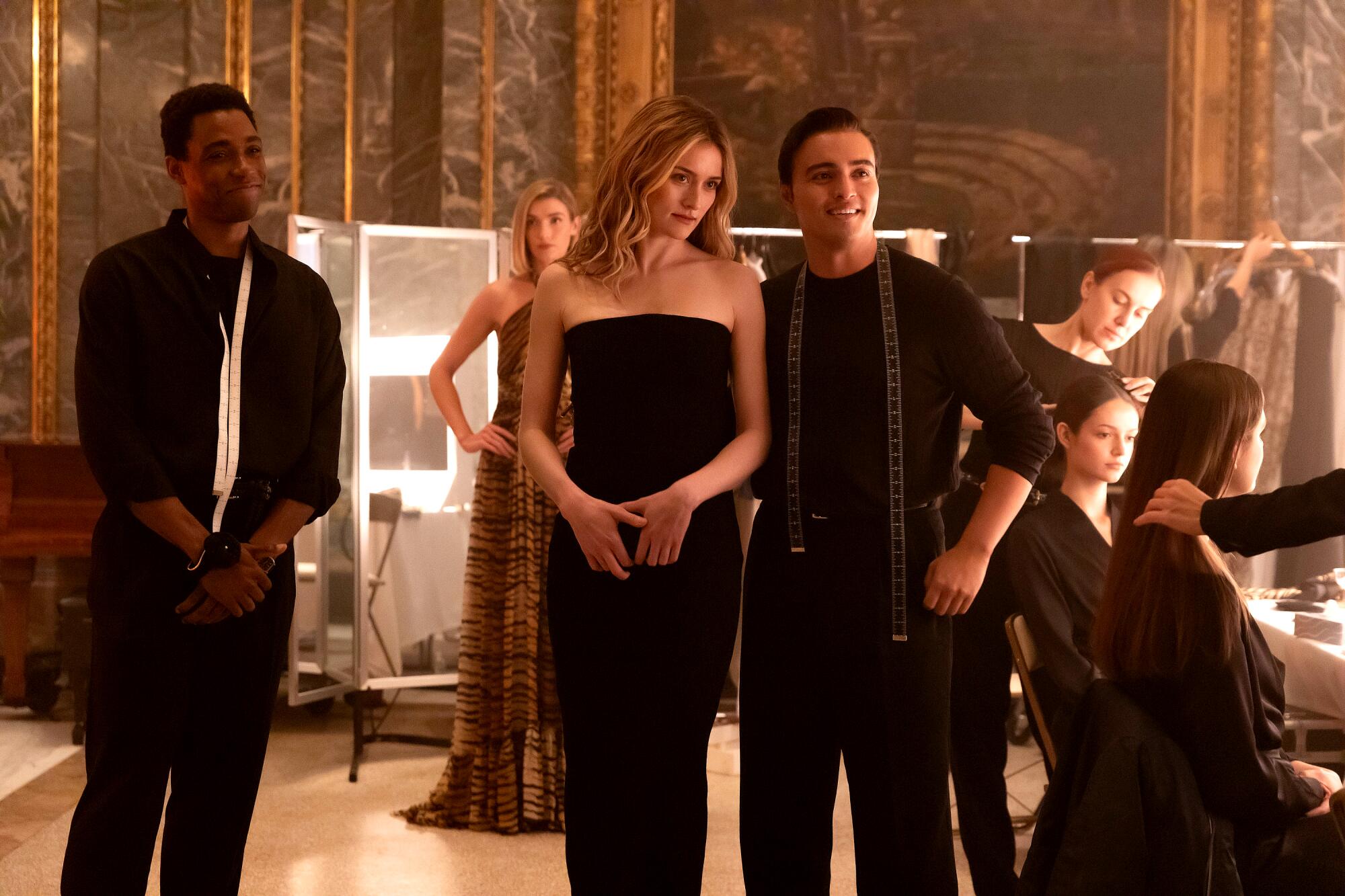
Omari K. Chancellor as Gordon Henderson, from left, Sarah Pidgeon as Carolyn Bessette, Tonatiuh as Narciso Rodriguez in FX’s “Love Story: John F. Kennedy Jr. & Carolyn Bessette”
(Eric Liebowitz / FX)
“Love Story” will follow the couple’s wedding in the latest episode, out March 5. (Rodriguez is portrayed by Tonatiuh on the show.)
After designing Bessette-Kennedy’s dress, Rodriguez launched his own label and a fragrance line, and has continued to create designs that are woven into the fabric of American history — Michelle Obama wore his dress on election night in 2008.
De Los spoke with Rodriguez about his career, upbringing and memories of designing Bessette-Kennedy’s dress.
You’ve spoken about how inspired you were by the women in your life growing up. Are there any “fashion icons” from your family or neighborhood that you could point to from your childhood?
You know, I’m so lucky because I was raised in a very Cuban household in a very culturally rich community in Newark. I mean, it was Italian, Spanish, Cuban, Puerto Rican, Black. It was everything. But I always think back to when I was very, very young, there was a kind of matriarch here in the neighborhood. Her name was Concha and she was kind of this lightning rod. My dad’s sister was married to her son, so when my parents came to the U.S., she gave them a place to stay. She would teach all of the young women how to cook and gave everyone a place to stay until they got on their feet. She was larger than life, she was like “Auntie Mame.” She had these great ‘60s beehive wigs in amazing wig boxes, she made these beautiful Chanel suits for herself, and had all these gold bangles, great lipstick and stilettos. When she came into the room, she just radiated power, joy and style. I always think of her as being my first signpost on the road.
They were all beautiful, you know? My aunts and my mom were the most beautiful, glamorous women. None of them were wearing designer clothes, but they took great pride and great care in how they looked, and that really made an impression on me.
How did that impression translate into a concrete passion? How did you go about actually pursuing a career in fashion?
I loved architecture. I loved building things, so I was always drawing, sketching and sculpting. Then I would see my mom take a piece of fabric and the way she could take something flat and shapeless and turn it into a garment was fascinating. By the time I was 13, I was doing fashion illustration, and I got a job in a tailor shop. Later, I enrolled myself in Saturday courses at Parsons [School of Design], and I kind of had to hide it from my parents at first. I felt like I couldn’t be a fashion designer, you know, because of the whole “macho” idea, but I just kept going. I was lucky that I was someone who always knew what they wanted to do, and that Parsons recognized I had talent for it at a young age.
I was exposed to really great people there, too. Donna Karan was a critic, Calvin Klein was a critic, Oscar de la Renta too. I got to do projects with all of them, and then I was hired after school by Donna Karan while she was still at Anne Klein. It was an amazing experience, and then I got poached by Calvin Klein, which was a very different experience.
How so?
It was incredible, but just very different. Whereas Anne Klein was this melting pot of creativity, Calvin was much more image-driven and precision-driven. He brought in great talents to collaborate with, so on any given day, you’d be working with the most amazing photographers, stylists and art directors. It was a really great finishing school as a young person.
You arrived at Calvin Klein during a period of reinvention for the brand. This was in the era of Kate Moss, and the famous “Marky Mark” print ads. We see a version of it in “Love Story,” but what was it like to actually be there?
When I got there, I think around 1989, it hadn’t really started to change yet. And I thought, “Wow, I made a really big mistake. This is not my aesthetic, not my thing.” But it changed very quickly, and it was very exciting. [Calvin] worked very hard. He was very focused, and he appreciated that I could keep up. Like everybody, there was a rough initiation period, but afterward, he gave me the opportunity to work on some tailored pieces that sold really well at retail, so I was rewarded with more opportunities.
But it was the ‘90s, and it was New York, and it was brilliant. It felt like the whole city was reinventing itself, and Calvin was a leader in that. All the best photographers, the most brilliant artists were there. Jacky Marshall, Zack Carr, Carolyn — the talent was endless. I was really fortunate to experience it and build friendships that were lifelong.
I’m curious if you remember your first impressions of Carolyn. How did you two connect?
We were quite friendly immediately, and then we became the best of friends. We lived in the same building, so the rest was history. You know, she’s an incredible person, and she had great style. She was bigger than life.
Carolyn has been regarded as a fashion icon, and especially now, everyone is trying to re–create her look. There was something more subtle and interesting going on than just “minimalist” fashion, so how would you describe what made her style so special?
Carolyn was so authentic in so many ways, and I think that she was very pragmatic about her choices. She had a great eye. She knew what worked for her, and she knew how to present herself. She never wanted to be uncomfortable. She was very connected to herself. I think so many people have this relationship to fashion and what they think they should look like based on the ideas they see in a magazine or being sold to you by the industry, and Carolyn never fell into that trap.
I have this conversation often with young designers, with people, with journalists. Today, everything that we see is inauthentic. Celebrities are paid to wear designer clothes. They’re styled by a stylist, and nothing is innate. That is the opposite of Carolyn. She was 100% real.
Narciso Rodriguez in 1997.
(Paolo Roversi)
We have to talk about her wedding dress. If you’re a bride, it’s impossible to look for inspiration without coming across her dress. What was it like to have a friend ask you to create something for such a special, important moment?
You know, until my children were born, Carolyn was the love of my life. We were very close, and she asked me, as you said, to make the dress that she would marry the love of her life in. It was very personal for me. It wasn’t a press event, it was a conversation between two people who were very close. I knew what looked good on her, she knew what looked good on her. I knew that she would never want to be bogged down with trains and lace. It wouldn’t be her.
What was the actual design process like?
It was an effortless collaboration. She came to fittings in Paris, we pulled the neckline down a bit lower, and the dress was born. I added the gloves, the veil and the shoe. It was just magical, and exactly the way it should be. It really made her the focus. You know, she was the one who pointed that out to me about my work. She always said, “You create a frame for a woman’s beauty and personality to shine through.” I’ve always thought that was a really beautiful thing that she gave me, because it’s true. I never want my work to be what you see first. I think the success of that dress is that you see her and her happiness and the purity of it all.
Everything about the wedding, including the dress, had to be kept a secret. Was it a challenge to make sure that no one knew what you were working on?
I was working in Paris, and I got approval from the owner of [Cerruti]. He was discreet about it. I worked with one pattern maker. I had a fit model who was lovely. Nobody knew who it was for. They always asked. But because I was working in Paris, they didn’t really connect me to her. I was also quite cautious when the dress was in work, I remember I had become quite friendly with Azzedine Alaïa. I asked, “Can I take this dress over to you and have you check it out to see what I’m doing?” I went over and he looked at the prototype, and said, “Why don’t you move this seam over the bum by a centimeter. I think it’ll be more flattering.” And I did, because he was the master, and he tortured me to know who it was for, but I never told him. Later, when it was all over the press, he would call and pretend he was a fancy lady looking for a wedding dress for her daughter. [Laughs] He tricked me a few times into believing some of his gags, but he was an amazing person.
It was just a magical time in all of our lives. And then I flew to America with the dress and went to the wedding, and it was that simple. You know, I’ve heard all these amazing stories about how the dress didn’t fit, and I had to sew her into it, and that she was hours late because of it, and none of this is true. But I love that people have made up all these stories.
Maybe the dress on her seems so effortless that people want to invent a way to complicate it.
[Laughs] I really have heard so many crazy stories, but when you look at the pictures, it certainly doesn’t look like it didn’t fit. That’s for sure.
As you mentioned, the dress was all over the press later. How did that moment impact your career?
Well, I went from Paris to my best friend’s wedding, and then I flew home to New York to do a pit stop at my apartment. When I arrived, there was a huge crowd outside the building with news trucks. I kind of walked through the crowd and into the building, and I said to the doorman, “What’s all that about?” And he looked at me, and he said, “They’re here to see you.”
Oh, wow.
It was a very big, kind of scary, unexpected change in my life. I remember going up to my apartment and trying to navigate that when Anna Wintour’s office called and said, “Anna would like for you to come to the Princess [Diana] benefit in Washington.” And I said I couldn’t go, I needed to be back in Paris, I didn’t even have a white shirt. And they said, “It’s Princess Di and Anna Wintour. You’re going. We’ll send you a shirt.” So I went, and I met Princess Diana, and it was really strange to be at such a big event and have so many eyes on me, because I didn’t expect that, and everyone was curious. I remember they were shady journalists trying to sit next to me and get information about where [John and Carolyn] went on their honeymoon. Life changed dramatically, but it brought great attention to the work that I was doing in Paris, and I was able to then go off and start my own business and do my own thing.
I’m sure you had an understanding through Carolyn about what it felt like to be hounded or followed by photographers and press, but did that firsthand experience in New York give you another layer of understanding for what she was going through?
It’s so funny because society today will do anything for that. But it was a very different time, and she was a very private person. I was a very private person. It’s very invasive, and I was kind of stuck in the middle, because while I needed to promote my work and my shows, and sort of be in the press, it wasn’t something that I was very comfortable with. I mean, I love doing the work more than I like the things attached to it. It can be debilitating, and it was difficult for me, but I adjusted, because I could hide behind my work, but as a private citizen, it was more difficult for her.
Narciso Rodriguez.
(Sølve Sundsbø)
You’ve been a part of fashion history on numerous occasions. Michelle Obama frequently wore your designs, but most famously, on election night in 2008, and then during her final appearance as first lady. How does it feel to have been a part of those moments?
It’s hard to put into words. You know, you spend so much time in it, and you have these amazing moments, like designing a dress that became legendary for brides, or getting to dress the first lady, and it wasn’t until COVID that I took a step back. I think about my mother and father coming here to give their son a chance to live out his dreams. And to have been able to sit with my friends on election night and watch her appear in my dress on such a historic moment — the first African American elected president of the United States — words fail. [Michelle Obama] is such an incredible human being who I admire so much, and to have been a part of that night, I feel so lucky.
I don’t talk about my work with my children, but the other day, when they were on the bus headed to school, they told one of their friends, “My dad went to the Obama White House.” They were proud of me. My parents’ dreams came true, and now I get to share that with my children. It’s very special.
It’s really powerful to hear you frame it that way — that these moments mean so much because of your experience being the child of immigrants. How does it feel to be in the midst of a revival right now?
It makes me want to create more. It means a lot to me that people remember these pieces, and that they’re still part of the conversation. But it also means a really great deal to me because I think it’s an important story to tell today. I think it’s important that young people hear that this kind of thing can happen to the children of immigrants, especially as I’m watching all of the horrible things happening to immigrants now.
I could never do what my parents did. When I think about it now, my parents were so much more successful than I could ever be, because they left behind their home for a cold climate, in a place where they couldn’t speak the language, and they really struggled for a long time before I was born. And now, the idea that we’re trying to take that opportunity away from people? It just blows my mind.
My parents faced so many hardships, their life wasn’t easy, but I can’t imagine if they had been put through what immigrants are put through today. I am the “American Dream,” right? I got the chance I got to do the work that I love and succeed because of them. I want that for everyone. I want that to be the world we live in.