
Global equities mixed amid rising yields and oil prices
Global equities mixed amid rising yields and oil prices
Source link
Global equities mixed amid rising yields and oil prices
Source link
Gold hits seven-week low; silver follows suit and records a nearly 5 percent loss.

Published On 28 Sep 202628 Sep 2026
Gold prices are falling as concerns of rising fuel prices stoke inflation worries on the back of the war between the United States and Iran.
Spot gold prices fell by 3.3 percent to reach a more than seven-week low at $4,146.51 per ounce on Monday.
list of 4 itemsend of list
Rising oil prices, a higher US dollar and Treasury yields stoked inflation concerns, creating further headwinds for the metal.
This is the lowest level for gold values since August 5. US gold futures also fell by 3.3 percent to $4,178.40.
Although gold is traditionally considered an inflation hedge, higher interest rates dent its appeal as investors prefer yield-bearing assets.
“There might be no notable direct impact on regular people due to that. However, investors who had turned to gold will see a hit, especially under the current high inflation rates,” Sherif Othman, CEO of the Maryland-based Poise Investment Advisors, told Al Jazeera.
“Gold does not yield interest, so when Treasury yields go up, investors turn away from gold, impacting its value”, he added.
The Fed lifted benchmark rates by a quarter percentage point earlier this month and flagged that at least one more hike is likely in the coming months.
The US dollar was steady near a two-month high, and oil prices spiked about 3 percent as US President Donald Trump rejected an Iranian offer to resolve the conflict and reopen the Strait of Hormuz.
Such factors triggered several policymakers to warn that inflation risks remain elevated and that interest rates may need to rise, with Cleveland Fed President Beth Hammack among the latest officials to reiterate that view.
Higher Treasury yields and the US dollar are “creating a perfect storm to push the metals prices sharply lower,” according to Jim Wyckoff, a market analyst at American Gold Exchange.
Spot silver also fell by 4.7 percent to $61.27 per ounce, platinum declined 2.9 percent to $1,726.30 and palladium lost 4.4 percent to $1,211.45.
Asian markets decline amid rising oil prices, Middle East tensions, and US futures decline
Source link
Marvin Reid can’t say how many pedestrians he’s seen get hit while trying to brave the North Hollywood intersection of Magnolia Boulevard and Tujunga Avenue. He gave up keeping count long ago.
One afternoon last spring, he watched a man get run over while walking toward a 7-Eleven on the corner. Fortunately, the man popped to his feet “like nothing ever happened” and hustled into the store, Reid said. A week or two prior, he said, an out-of-control motorist nearly plowed into the statue of Amelia Earhart that sits next to a library bearing the famous aviator’s name.
“This is really a bad spot,” said Reid, who has helped run a Jamaican food pop-up at the busy street corner for the past five years. “It doesn’t matter if it’s an old lady crossing the street with a walker.”
The number of Angelenos who die in traffic crashes now regularly outpaces those killed by homicide. From 2016 to 2023, the annual traffic death toll rose nearly 29% overall, and pedestrian deaths jumped roughly 54%. Fatal crashes fell slightly last year, but deaths still exceeded 300 in each of the last three years.
The city is rolling out 125 speed cameras in school zones, known street-racing corridors and places where speeding has contributed to a high rate of collisions — including Reid’s intersection.
But for him, the cameras aren’t a replacement for police traffic enforcement, which he said seems virtually nonexistent.
Even though LAPD squad cars are posted up outside the library “everyday,” he says, they rarely do anything about the drivers who come careening off the exit ramps from the nearby 170 Freeway.
Similar complaints are being echoed around the city. Historically, Los Angeles — like other places across the U.S. — has relied on police stops to produce road safety. But in recent years, public pressure has compelled city leaders to think more critically about whether enforcement can continue without the historical harms that has come along with it.
LAPD data show the department is far less proactive than it used to be.

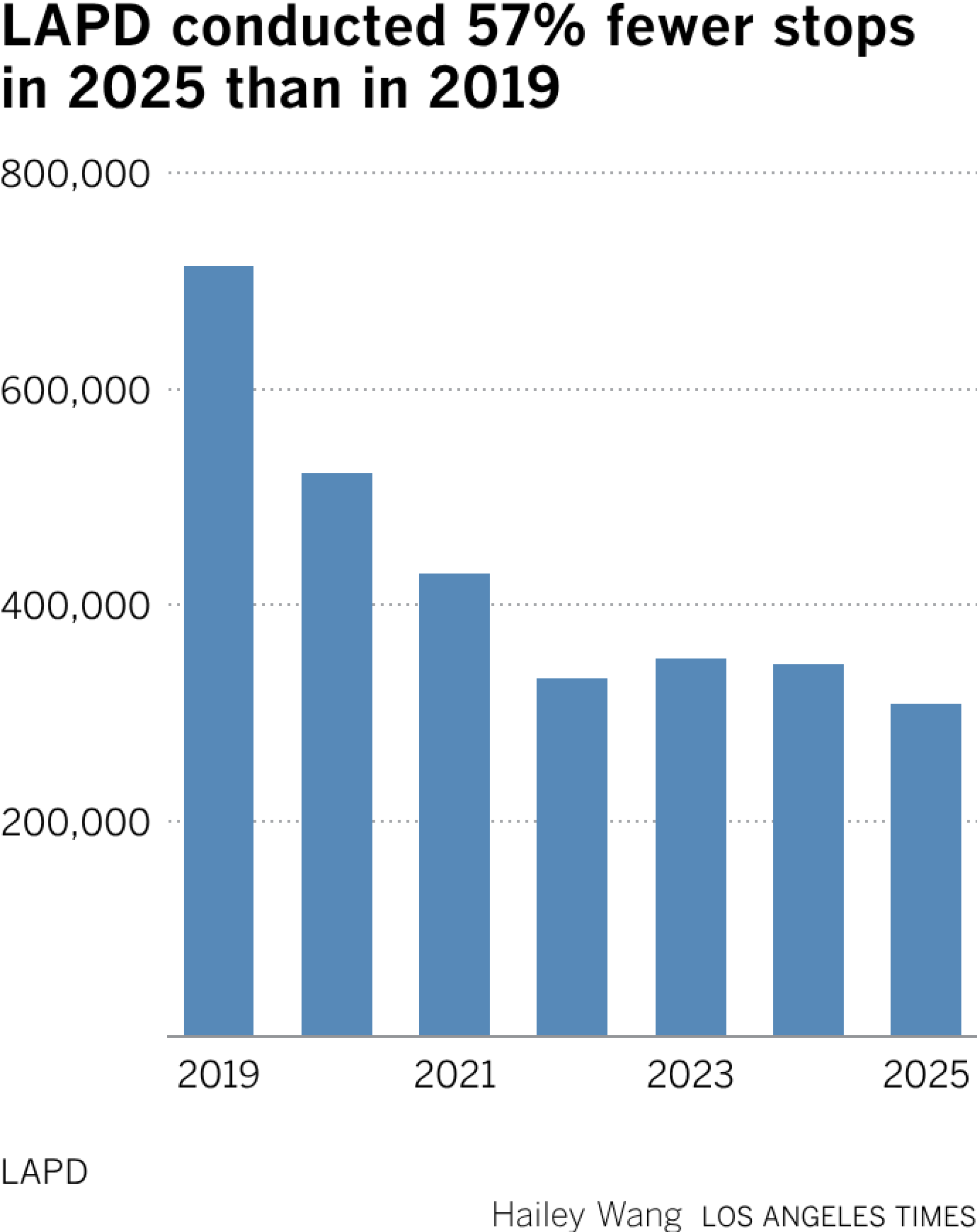
In 2019, LAPD officers made about 713,000 stops across the city; by 2025, that number had decreased to roughly 308,000 — a roughly 57% decline. A Times analysis of police stop data found that the drop-off was especially pronounced in the Central, West Valley, 77th Street and Southeast police divisions.
In some ways, the decline in stops is unsurprising. Other large U.S. cities have seen similar changes in enforcement strategies by police since the pandemic. As the department continues to shrink, LAPD commanders say they have fewer resources to devote to traffic duty. Officials have been under pressure to curb the use of so-called “pretext stops,” in which officers use a minor violation — a broken turn signal, say, or a cracked windshield — as justification to stop someone in order to investigate whether a more serious crime has occurred.
LAPD
Hailey Wang LOS ANGELES TIMES
Reform activists and some city leaders argue the stops are fishing expeditions that lead to police abuses — while failing to deliver safer streets.
The practice of pulling over random vehicles, often based on little more than a hunch, has been a cornerstone of the city’s crime-fighting strategy for decades. The tactic is especially prevalent among the department’s elite Metropolitan Division and anti-gang units, several of which have come under investigation in recent years for failing to document the stops and improper searches.
Since 2019, when a Times investigation found significant racial disparities in LAPD crime suppression tactics, officials have slowed — but never abandoned — the practice of flooding neighborhoods with tactical officers to pull people over and search their vehicles.
Four years later, stops for minor violations began dropping again after LAPD overhauled its policies to limit the circumstances under which officers can make pretext stops, joining law enforcement agencies in cities like Philadelphia, Seattle and Berkeley, Calif.
Yet a report published last year found that officers are still disproportionately targeting Black and Latino drivers.
LAPD Chief Jim McDonnell and other department leaders have fought against more restrictions, arguing they risk losing an essential weapon against serious crime.
But in May, the Los Angeles City Council passed a measure urging the Police Commission, the LAPD’s policy-making body, to further limit arbitrary pull-overs for non-moving traffic violations.
Commission officials said they would wait for the results of a pair of audits by the inspector general’s office before making any further policy changes. The first report suggested that problems with the department’s gang officers were far more widespread than the department has publicly let on.
While LAPD officials had acknowledged issues in a handful of police divisions, the latest audit found that gang units citywide routinely flouted the department’s rules on pretext stops, including by often failing to obtain proper consent to search the vehicles they stopped. The inspector general’s office also found that gang officers didn’t always turn on their body-worn or dashboard cameras as required during these encounters and at times failed to properly log who they were stopping — resulting in an undercount of “both the number of detentions and the enforcement actions taken,” the report said.
The review, based on a sample of 300 stops as well as interviews with current and former gang officers, also highlighted ongoing confusion about what the department expects its officers to do when pulling someone over.
The findings of the second report — which reviewed pretext stops by officers from other units in January — are expected to be presented at an upcoming commission meeting.
The Los Angeles Police Protective League, the union for rank-and-file officers, and other proponents of pretext stops argue that elected leaders don’t grasp the consequences of doing away with the tactic, which the U.S. Supreme Court has deemed lawful.
Reform advocates have fought to deploy unarmed civilians instead of LAPD officers for traffic enforcement — as the city has already started doing for certain mental health-related calls — but the union has warned that the work is too dangerous. A state bill that would have allowed trained civilian workers to make traffic stops failed to make it through the state assembly.
With the death toll from speeding on the rise, more enforcement is needed, not less, department leaders say. The city, they argue, can’t afford to wait on alternative programs that require study, money and public buy-in that could take years.
Amid the debate over how to proceed, LAPD enforcement hasn’t vanished completely.
Even though the department no longer dispatches officers to the scenes of minor accidents, LAPD statistics show that enforcement the department’s 308-member traffic bureau has gone up. As of July, the number of traffic tickets issued had climbed 44% from the same time last year — increasing to more than 14,600 from around 10,100. Citations for impaired driving have also risen, and the department continues to crack down on street takeovers.
Still, progress toward new, non-police approaches to traffic enforcement has been frustratingly slow in Los Angeles, advocates say.
Advocates have pointed to mounting research in other cities that showed road improvements along high-injury street corridors were more effective than police at changing driver behaviors, ultimately reducing the number of traffic-related deaths and serious injuries more than the threat of being ticketed.
Supporters of so-called “self-enforcing” roads say narrowing lanes can lead to a considerable decline in crashes as drivers reduce their speed and move more cautiously than when the road is less wide. Such changes also reclaim space for protected bike lanes, public transit lines, or safer walkways — after long prioritizing convenience for cars, advocates say.
Car accidents are dangerous for everyone involved, but they have become even more hazardous for pedestrians and cyclists.
Experts cite speeding and cellphone distractions as two of the biggest problems.
Another factor is the proliferation of larger vehicles — a phenomenon known as “autobesity” — which have bigger blind spots and more likely to seriously injure a pedestrian or bicyclist.
Andres Ramirez, executive director for the transportation advocacy nonprofit People for Mobility Justice, said he’s cautiously optimism that the mayor’s promise of a “No Car” 2028 Olympic Games will help fast-track some of the most pressing road safety projects.
“The streets needs to be a lot safer for pedestrians, for bicyclists, different modes,” Ramirez said. “The most obvious way is ensuring that infrastructure projects are prioritized in communities that have long been ignored.”
EDINBURG, Texas — Quinten Martinez, pumping gas under a hot south Texas sun, remembers a time when fueling up didn’t require difficult decisions.
“Is it going to be groceries this week?” said the 28-year-old Amazon delivery driver as he watched the numbers tick higher. “Is it gonna be getting gas in our tank to go to work?”
He shook his head when asked about President Trump’s assertion last week that higher gas prices are a small price to pay for the war with Iran.
“I don’t feel like it’s a good trade-off,” Martinez said. “I don’t feel like this is good for anyone.”
Voters across the country, and across the political spectrum, tend to agree.
Interviews with voters in several states, along with a fresh round of national polling, reveal an overwhelming sense of frustration that skyrocketing gas prices — a direct result of Trump’s war — are creating serious and sustained financial hardships for America’s working class.
The acute concerns are adding to a bad political environment that may be worsening for Trump and his Republican Party as early voting gets underway in the November midterm elections.
Historically, the party holding the White House has suffered major losses in midterms. About seven weeks before election day, Republican candidates at all levels are struggling with the additional burden of Trump’s weak approval ratings, an unpopular war and an affordability crisis that Trump and his congressional allies had promised to fix.
But when Trump campaigned in North Carolina on Wednesday, he played down the effect of surging gas prices.
“You have a little higher. It’s a very inexpensive price to pay for what we’ve done,” Trump said of the war, which he describes as necessary to prevent Iran from obtaining a nuclear weapon. “Remember that. It’s a little more. Frankly, even if it was a lot more.”
Despite what Trump says, there are few things that may matter more this election year than the price of a gallon of gasoline, according to political operatives in both parties.
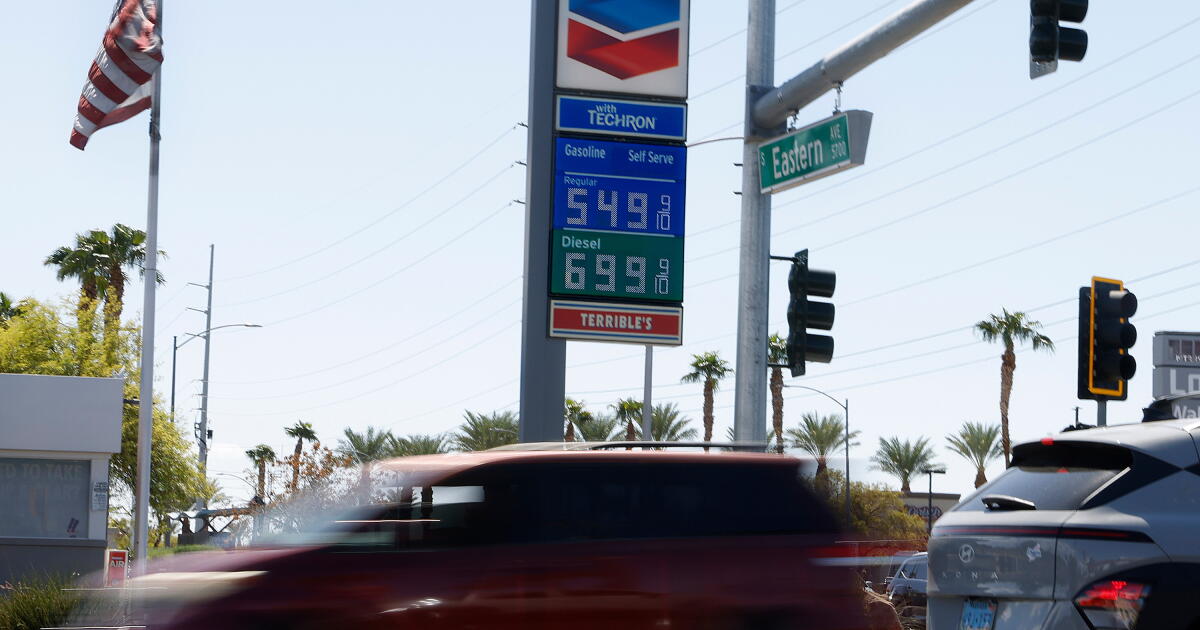
Gas prices are moving sharply in the wrong direction at a time of year when drivers typically get some relief. The national average for a gallon of gas reached $4.48 on Friday, according to the American Automobile Assn., up roughly 17 cents over the last week, 40 cents in a month and $1.27 from a year ago.
“Gas prices matter because they’re one of the few economic indicators voters experience and see in real time,” said veteran Republican strategist Chris Wilson. “The price is literally staring them in the face several times a week. So I wouldn’t minimize the frustration we’re seeing, particularly among working- and middle-class voters.”
Interviews with voters last week found bipartisan frustration and disappointment.
Democrats and unaffiliated voters were especially motivated to punish Republicans at the ballot box for their economic hardship, while some of Trump’s working-class supporters pledged to support Republicans this fall, even if they weren’t happy with the president’s leadership on the economy.
Dan Lloyd, who voted for Trump, lamented the president’s leadership as the 63-year-old carpenter paid $4.39 a gallon to fill up his pickup truck in Mesa, Ariz.
“He hurt himself stepping into this,” Lloyd said of Trump. “Where’s all this oil from Venezuela? I thought we were flush with gas and everything, but no. The American people eat it every time, whether it’s interest rates, food, gasoline.”
Still, he expects to vote Republican in the midterms.
“I think the Democratic Party has lost its way,” Lloyd said. “I just feel like the whole system’s on the verge of collapse.”
In sweltering Edinburg, Texas, 52-year-old Kristin Jimenez shrugged off the rising price of gas after filling up her Mercedes.
“We’ve paid the same price under Republican presidents, we’ve paid this price under Democrat presidents,” said Jimenez, a mother who runs a small business. She plans to vote for a Republican because they’re the “lesser of two evils.”
She said gas prices aren’t part of her calculation.
“We don’t mind paying $8 for a cup of coffee at Starbucks, but we have a problem paying four bucks at the pump?” she said. “Make it make sense.”
More than 1,500 miles to the north in central Michigan, 35-year-old Garth Johnson is trying to make ends meet running a deep-cleaning business with several gas-powered vehicles and one machine fueled by diesel, which was $6.79 a gallon as he filled up his SUV.
Johnson voted for Trump, but doesn’t know what he’s going to do in November. He said he doesn’t feel qualified to second-guess the president’s evaluation of the war, but he’s feeling financial pressure in his own life.
“I like a lot of the things he’s done,” Johnson said, but added, “I’m a little guy and I’ve got to live my life.”
Midterm voting was already underway Friday in Virginia, where Alan Johnson said Trump seems to have “no empathy” for Americans who are struggling financially.
“With the gas prices being what they are and continuing to grow, we’ve got to do something. Hopefully the Democrats can get into office and turn the ship around,” said the 60-year-old engineer, who cast ballots in the morning for Democrats for the U.S. Senate and House.
In Raleigh, N.C., teacher Brittney Bivins sees surging gas prices as evidence that Trump and his Republican Party aren’t dealing with the issues that matter most to people like her.
“He really doesn’t care about everyday people,” the 45-year-old said. “He can afford the gas, but most of us can’t. So it feels like he’s not even connected to his own people.”
Bivins, who described herself as an independent, said she’s eager to support Democrats this fall — especially the party’s emerging democratic socialist wing.
At a gas station in Lansing, Mich., Rina Risper spent $50 on eight gallons of premium gas.
“When I rolled up I was in shock, actually, and said, well, maybe I should drink water instead of having that $4.99 bottle of whatever it was I was gonna get,” Risper said. She thinks Trump’s tariffs will make affordability even worse.
“We’re not in Miami. We’re in Lansing, Michigan,” she said. “It’s really going to impact our people.”
Nationwide, more than three times as many voters say they are falling behind financially as getting ahead, according to a Fox News survey released Wednesday. By a 15-point margin, Democrats are considered the party that would better handle inflation and prices at a time when the cost of living and the economy are voters’ top concerns.
The Fox poll found that 61% of voters say gas prices are a major problem for their household, compared with 48% two years ago, while 52% say the same for healthcare costs, compared with 44% in 2024. Majorities also view housing costs and grocery prices as major problems, although neither has increased.
Overall, nearly two-thirds of voters (63%) say the administration has made the economy worse, compared with 52% in September 2025, including one-quarter of Republicans. Only 46% of Republicans say the administration has improved the economy, while about one-quarter don’t see an impact.
Back in rural south Texas, an area where Trump’s GOP made gains in recent elections, Martinez, the Amazon delivery driver, could not contain his frustration.
Trump “likes to tout that we are the best economy in the world,” said Martinez, but in rural towns, “you don’t see any of the winning, you don’t see any of the ups that he’s talking about.”
“You just see struggles for day-to-day life,” he said.
Peoples, Bedayn and Cooper write for the Associated Press. Peoples reported from New York and Cooper from Mesa. AP writers Allen G. Breed in Raleigh, Jacqueline GaNun in Lansing, Sarah Rankin in Richmond and Nicholas Riccardi in Mason, Mich., contributed to this report.