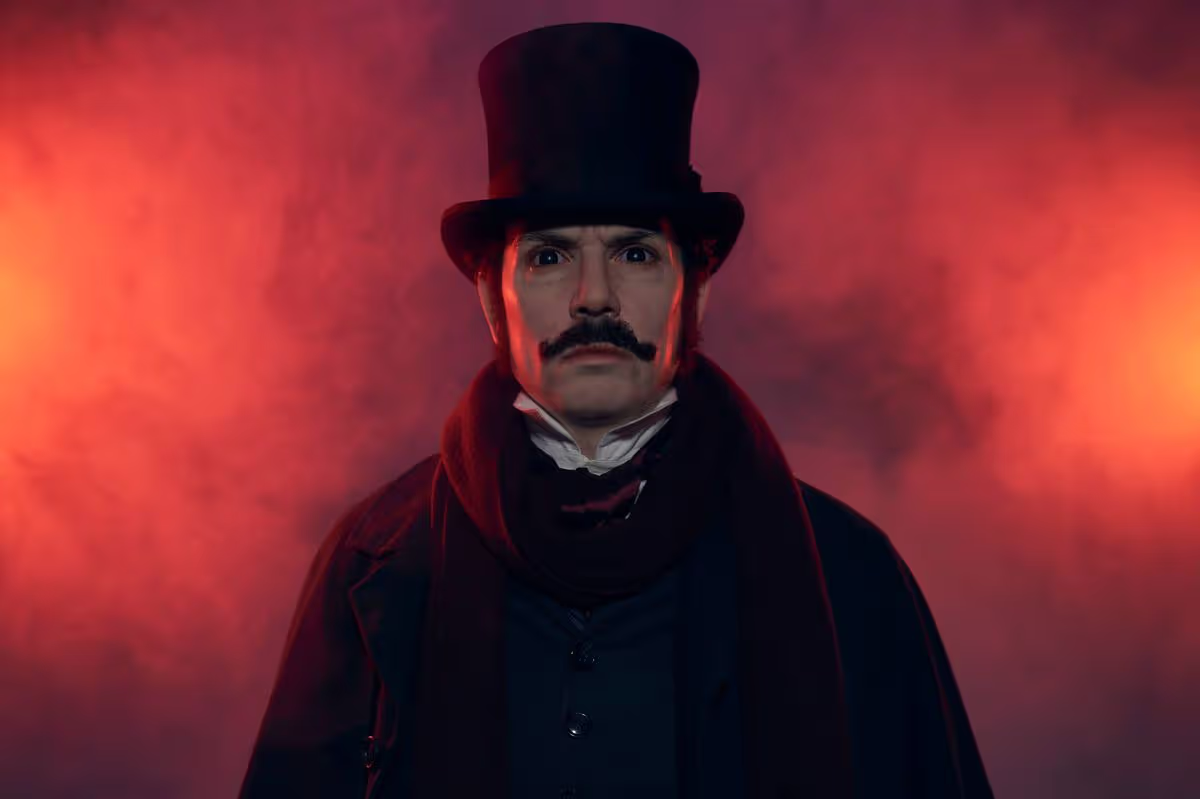
It’s one of the most famous cold cases in British history but could the killer have finally been uncovered

Jack the Ripper’s identity has never been known(Image: Getty images)
It’s the most famous cold case in the world more than 100 years after the serial killer Jack the Ripper caused terror in the streets of East London.
Carrying out his heinous crimes over the space of just four months, the brutal murderer, who targeted sex workers and killed them in a truly horrifying way.
Not content with merely slitting their throats, the cold blooded murderer horrifying mutilated them, removing several organs in his twisted killing spree.
Operating in and around Whitechapel between August and November 1888 – one of the poorest London areas where crime, depravation and starvation were common and law enforcement often turned a blind eye, the killings came to an abrupt end with the death of Mary Jane Kelly.
The case continues to fascinate and with that in mind – as someone who has lived in the east end of London for the past decade – I decided to learn more about this most infamous of killers.
One rainy Saturday I joined the Empire Tours Jack the Ripper tour, which takes in the sites of the killings and examines the fascinating, and often tragic, stories these streets still have to tell.
Led by our expert tour guide, Rebecca, we started off at the site of the first murder, Mary Ann Nichols, who was discovered in the early hours of the morning with her throat slit so badly she was basically decapitated, and some of her sex organs removed. She was found by a butcher on his way to the nearby Spitalfields Market to begin his working day – and he was promptly arrested.
Starring at what is now a fairly modern street, the benefit of looking at this on a tour immediately becomes apparent. Not only are parts of the pub where Mary Ann was last seen still there (but if you blinked, you’d miss them) the tragic story of her life were painted in all its haunting glory.
Divorced and forced into sex work to survive, Mary Ann was one of the many people living in Whitechapel forced to call a doss house home. With no street lights and pitch black alleyways where violent crimes were often committed, it’s easy to see how a killing could take place – although not one as violent and surgically skilled as hers.
As we made our way to the site of the second killing – Annie Chapman – the guide painted a vivid picture of how the streets will have looked and the conditions people were forced to live in. Found in very similar circumstances to Mary Ann, Annie was another sex worker forced into a life on the streets and was brutally killed on September 8, 1888.
Elizabeth Stride and Catherine Eddowes were Jack the Ripper’s next two victims, both killed on September 30, 1888. Elizabeth wasn’t mutilated in the same way as the other four victims are is a theory the killer was interrupted and forced to flee the scene.
His thirst for a brutal murder unquenched, he passed just into the neighbouring city of London to kill Catherine. Horrifyingly, a witnesses claimed to have seen the victim entering Mitre Square with a man in the hours leading up to her death. Again, she had had her throat slit all the way round and several of her organs removed.
Jack the Ripper’s third and final victim was Mary Jane Kelly and it was his most sick and brutal killing yet. Her horribly mutilated and disembowelled body was found in the single room she rented in Whitechapel on November 9, 1888.
Her faced had been “hacked beyond recognition” and her throat “severed down to her spine”. Her abdomen had almost completely been emptied of its organs with her uterus, kidneys and one breast placed beneath her head. Mary Jane’s heart was missing from the crime scene.
At the time, many theories were published by the press – including the ritualistic nature of the killings as several of the victims had had their intestines placed on their left shoulder. The surgical expertise of whoever had carried out the murders was also apparent, showing they were unlikely to have been carried out in a rage or crime of passion. Each of the murders was also efficiently done, with one taking just 15 minutes, including removing organs.
However, despite no one charged for the murders, the police at the time closed the investigation just one week after Mary Jane’s death. Officers had even been sent two letters, both with different handwriting, claiming to be from the killer himself. One signed it, Jack the Ripper, and so the legend was born.
Now, more than 100 years later, one suspect has been named as the possible killer – Mary Jane’s former boyfriend, Joseph Barnett. He was said to be deeply in love with her and was desperate for her to leave her life as a sex worker behind.
There is a theory that he began his killing spree in the hope it would terrify her away from her work, however Mary Jane was not to be deterred and eventually the couple split up in October 1888.
If this theory is to be believed, Barnett tried to win Mary Jane back but was unsuccessful until finally, he accepted they would never be together and in a rage turned up at the single room she called home. This becomes all the more compelling because she was the only victim killed indoors and Barnett would have had a key.
Several eye witness accounts of those who saw the women before they were killed described a man who could have been Barnett, and he also lived in the heart of Whitechapel. He also worked as a fish monger and so would have had some skill with a knife, which he could have used to carry out the surgical dismemberment of his victims.
This theory is explored in the book, Jack the Ripper: The Simple Truth by Bruce Paley.
However, you’ll have to head on one of Empire Tours Jack the Ripper tours to find out.
Empire Tours also offers a Buckingham Palace and Changing of the Guard experience, a Churchill’s War Rooms and World War Two tour, and a London’s gangster history tour.