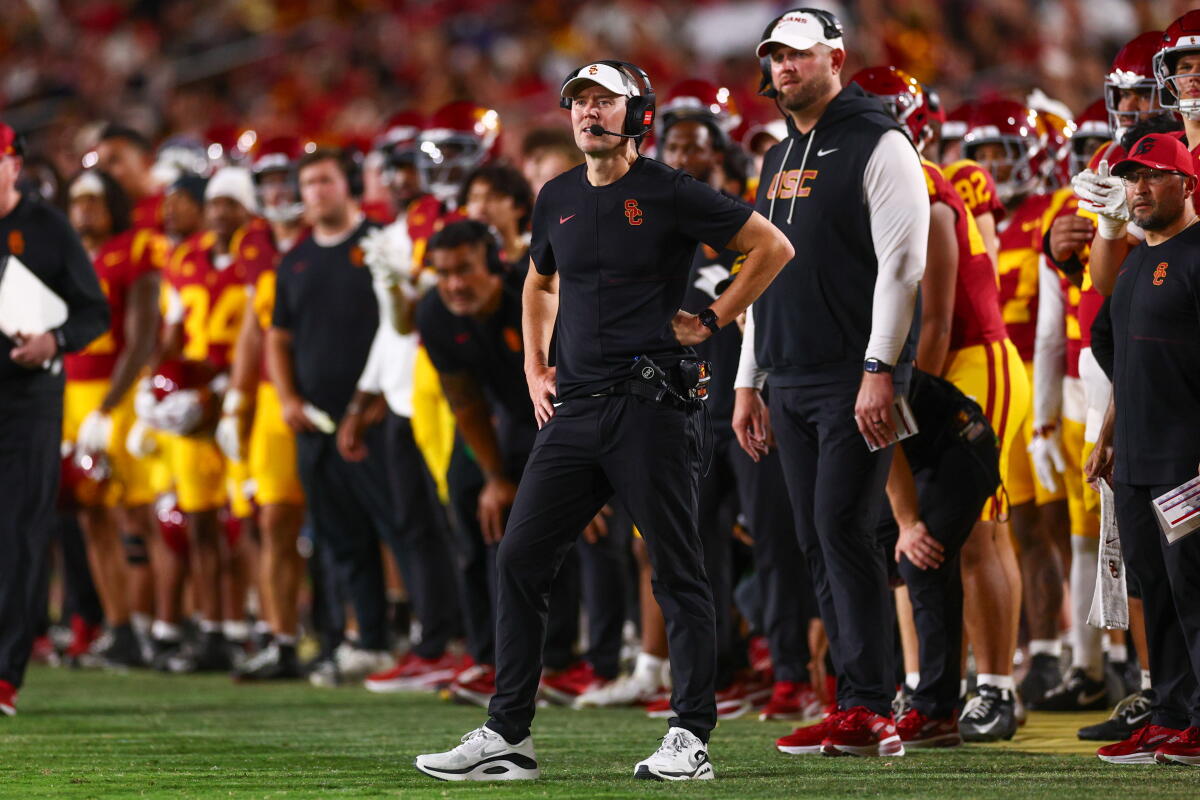
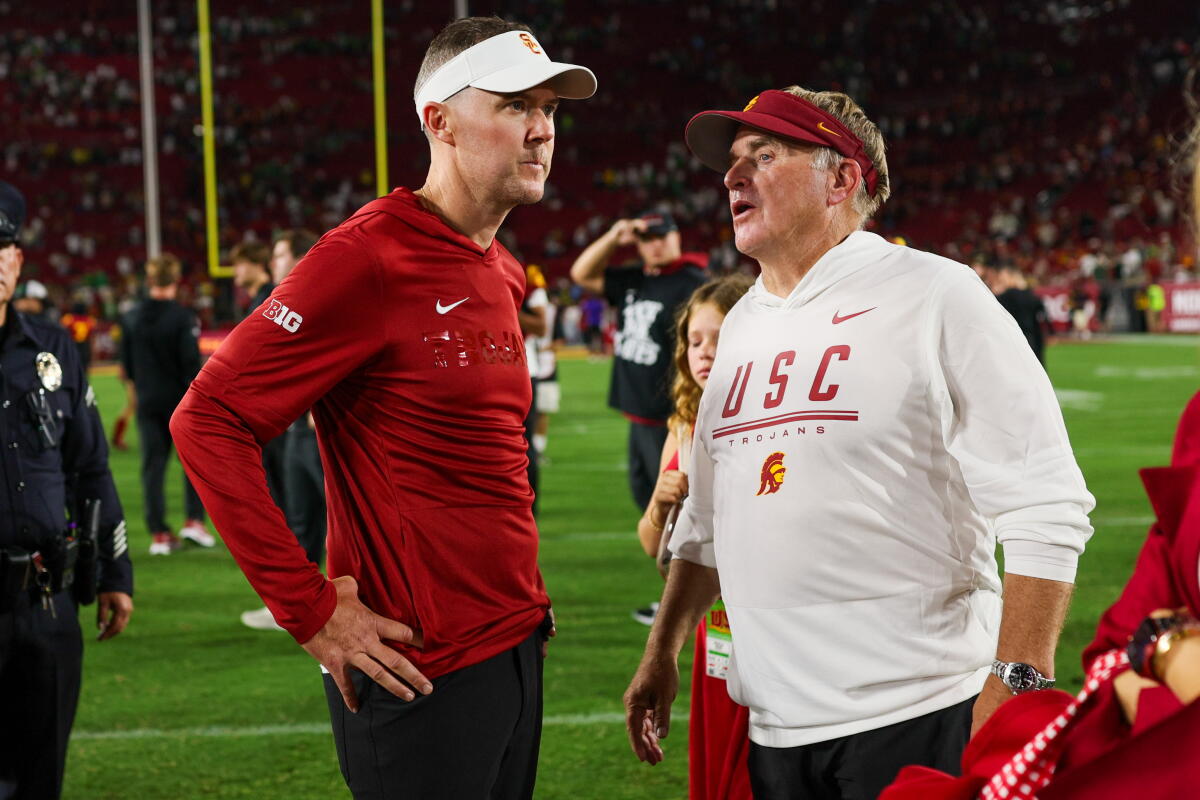
As questions swirl this week about his future at USC and his potential fit elsewhere, Lincoln Riley didn’t mince words about where he wants to be coaching when asked Tuesday.
“I love it here,” the fifth-year coach said.
“Listen if I didn’t want to be at this place, I wouldn’t have come here in the first place. If I didn’t want to be at this place, I’ve had plenty of opportunities to leave. This is where I want to be. This is the right place for me. I’m the right person to be here. And that’s as honest and transparent as I can be with you guys.”
Whether Riley will actually have a say in that decision remains to be seen. After falling 24-7 to Wisconsin in one of the worst defeats of Riley’s tenure on Saturday, USC can’t afford another loss this season if it hopes to make the College Football Playoff for the first time.
Lincoln Riley says he’s “the right person to be [at USC].”
“Listen, if I didn’t want to be at this place, I wouldn’t have come here in the first place. If I didn’t want to be at this place, I’ve had plenty of opportunities to leave.
That was the bar all parties at USC appeared to agree on ahead of Riley’s fifth season with the program. The coach himself said in August that expectations should be “through the roof.”
“We do expect to make the playoff,” USC athletic director Jennifer Cohen said in May. “We do expect to have a championship run. We do expect to be competing for championships every single year. I think that’s what’s awesome about USC, is that that’s what we all expect of it.”
That looks unlikely now, with three of USC’s final four games coming against top-10 teams, beginning with No. 2 Ohio State on Saturday. It has led to speculation that USC is bound for a breakup with its football coach.
But when asked about Cohen on Tuesday, Riley heaped praise on the athletic director. He said they had “an incredible working relationship.”
“She’s a tremendous AD,” Riley said. “Even though she’s not the AD I came here with, and I’m not the head coach she hired, [we have a] fantastic relationship. She’s been a huge part of the progress that we’ve made and has been incredibly supportive.”
It’s unclear how long Riley will hold on to that support if USC’s season starts to slip away. A person familiar with discussions around the coach’s future told The Times after USC’s loss to Oregon that “all options are on the table” with Riley. The trajectory of the Trojans’ season has turned downward since.
That’s led to further speculation that Riley and USC could potentially agree to a mutual parting of ways after this season. And that Riley could land at a program like Baylor, which just fired its coach.
Riley still has six years remaining on his contract at USC, according to a person familiar with the deal, due to an automatic one-year extension he accrued after the Trojans earned a New Year’s Six bowl bid in 2022. Buying Riley out of his deal would mean forking over upwards of $70 million, plus more for his assistants.
If Riley were to find another landing spot, though, it would allow the Trojans to offset the otherwise astronomical cost of his departure.
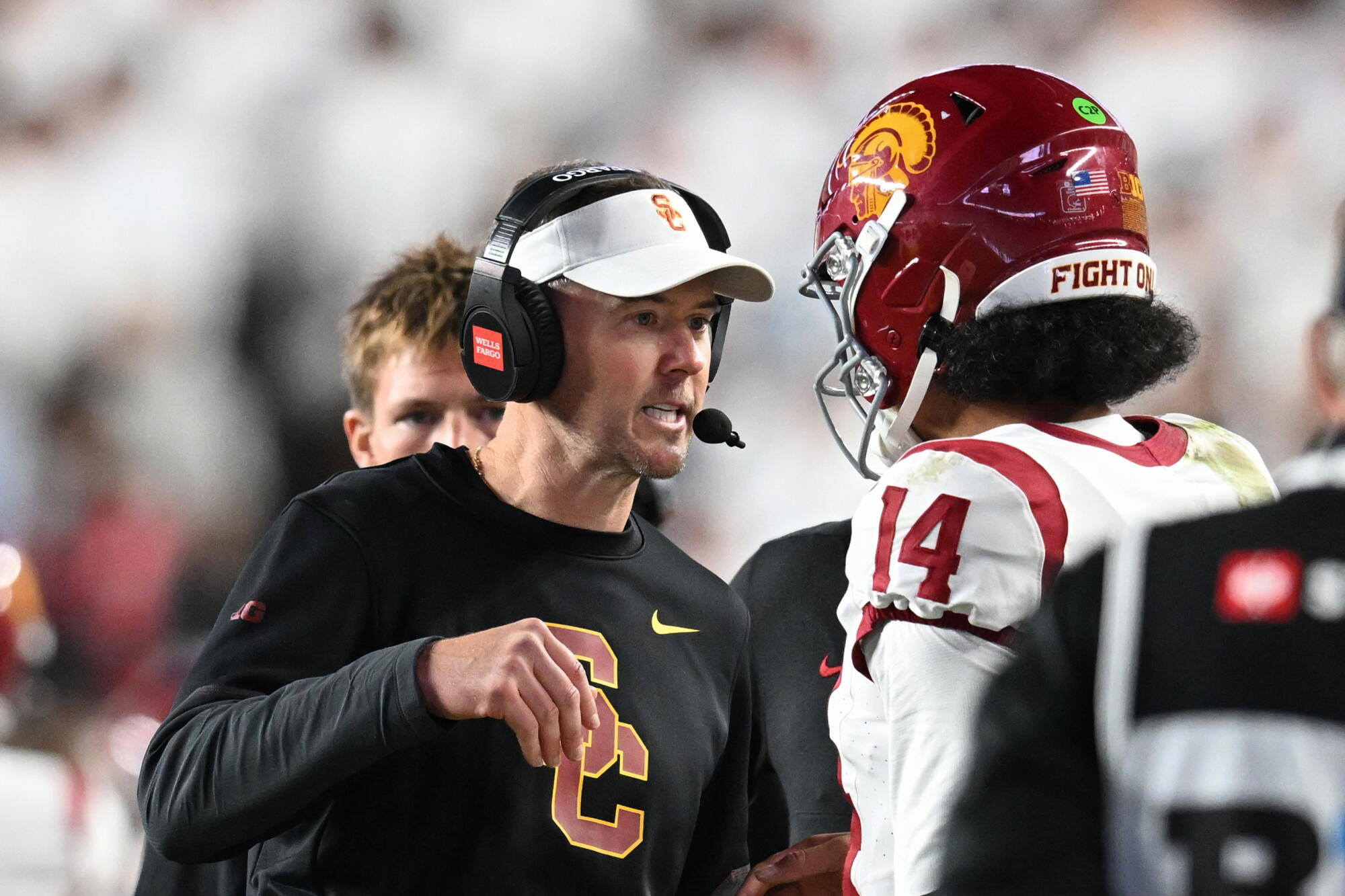
USC coach Lincoln Riley talks with quarterback Jayden Maiava during the team’s win at Penn Sate on Oct. 10.
(Barry Reeger / Associated Press)
Riley said Tuesday that was nowhere near his mind.
“Like I told you guys a lot of times, there’s not a lot of people in college football history that gave up what I gave up to come here,” Riley said. “I came here because this is where I want to be. I came here because I believe in this place. And none of that has changed whatsoever.”
The question is whether USC still believes in Riley.
Inside the locker room, at least, there seems to be no doubt whether Riley should be USC’s coach.
“I know he’s the right guy,” said left tackle Elijah Paige. “I believe there’s not a better leader in the country.”
“He’s the greatest coach I’ve been around,” added freshman wideout Trent Mosley. “We’re all right there with him.”
It was a potential nightmare scenario. Starting left tackle, Elijah Paige, had been scratched in pregame warm-ups at Penn State. And in his place stepped a true freshman in his first start at USC, forced to find his way in a White Out, surrounded by a hostile crowd of 114,000 strong.
But when Vlad Dyakonov learned he was stepping in, a couple of hours ahead of kickoff, his coaches were surprised by how little it seemed to faze him.
“Some of us [coaches] were like, ‘Does he realize what he’s getting himself into?’” coach Lincoln Riley said, with a grin. “He didn’t flinch, man.”
You could say the same, generally, about USC’s entire front through the first half of this season. After years of shallow depth, unfortunate injuries, and transfer misfires at the position, USC’s offensive line has been the stabilizing force propelling its high-powered attack to a 6-1 record.
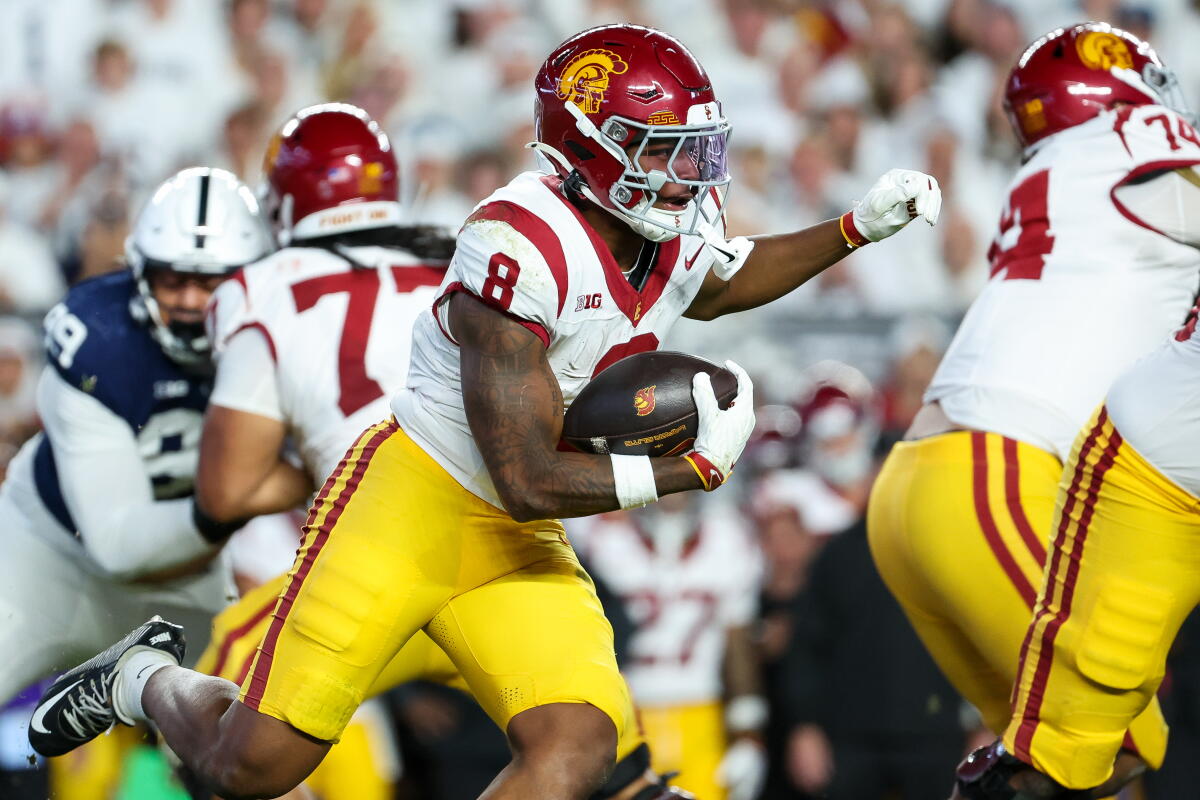
USC running back King Miller carries the ball as the offensive line blocks during a win at Penn State on Oct. 10.
(Isaiah Vazquez / Getty Images)
That’s a testament primarily to offensive line coach Zach Hanson, who, in his fifth season, has now fully rebuilt the room in his image.
“He’s a very steady guy,” Riley said of Hanson. “He’s not a guy who fluctuates a lot day to day, so our players kind of feed off of that. There’s a steadiness to our group.”
USC is also entering the brutal back half of its schedule with that group as healthy as it has been all season. As the Trojans take to the road Saturday looking to build momentum off the big win over Penn State and subsequent bye week, they’ll have all five starters available along the offensive line against Wisconsin. Paige is set to return, as is left guard Hayden Treter, who missed the last two games.
It comes at an ideal time, considering the pass rusher they’ll have to contend with Saturday. The Badgers have just eight sacks as a defense this season, but boast one of the best pass rushers in the Big Ten, senior Sebastian Cheeks. Cheeks leads the conference with 28 quarterback pressures.
Few teams, though, have been better than USC through seven games at protecting the quarterback. The Trojans’ starting offensive line has only given up one more combined pressure (29) than Cheeks has accumulated himself this season, while only allowing seven sacks in seven games.
“We’re a unit,” center Tobias Raymond said. “So everyone is feeding off each other.”
USC offensive lineman Elijah Paige blocks during a game against Oregon at the Coliseum on Sept. 26.
(Ben Liebenberg / Getty Images)
With Cheeks and a handful of other fearsome pass rushers approaching on USC’s upcoming Big Ten slate, right tackle Justin Tauanuu said the Trojans used the bye week to get back to the basics up front.
“Going against great players like that, you have to go back to fundamentals,” Tauanuu said. “Fundamentals will triumph over everything else.”
USC hasn’t looked like a line in need of much instruction this season. Jayden Maiava has faced pressure on just over 20% over his dropbacks, which ranks 10th among all quarterbacks nationally. It’s also a considerably lower rate of pressure than any USC quarterback has faced in recent years. The previous low, under Riley, was 30.5% with Miller Moss at quarterback in 2024.
Part of that success is Maiava’s penchant for getting rid of the ball quickly. But his protection has certainly been a critical aspect of his success this season. Because when pressure has managed to reach him, the USC senior has been much less effective as a passer. According to Pro Football Focus, Maiava has a completion rate of just 39% under pressure versus 79% when he has a clean pocket.
Blitzes also haven’t bothered USC’s passing attack much, either. Another product of the line’s impressive performance to date. Maiava has essentially had the same amount of time to throw when blitzed (2.7 seconds) versus when not blitzed (2.78 seconds).
Creating room in the run game has been a different story. USC has been considerably less effective on the ground this season than in recent years — a fact that Riley said was front of mind during the bye. The Trojans rank ninth in the Big Ten in rush yards per attempt (4.33) and 10th in rush plays of 20-plus yards (5).
“We definitely can run the ball better,” Riley said. “We’re gonna need to run the ball better. Good is not good enough for us.”
As a whole, though, it’s hard to imagine USC being in a better place up front this season. Especially considering where the position stood at the start of Riley’s tenure. The coach tried, at first, to build the room through the transfer portal and saw mixed results. After that, injuries ravaged an otherwise thin room.
But now the depth Hanson has built over the past few years is paying off. USC has already weathered injuries, including a season-ending injury to last year’s starting center, Kilian O’Connor. Meanwhile, several highly touted linemen are still currently buried on the depth chart, among them five-star freshman Keenyi Pepe, whose progression Riley said has been impressive.
“If you just kind of look at the makeup of it, we don’t have transfers,” Riley said. “We have a lot of guys who were kind of homegrown in this program. We have a good healthy young group. Zach has obviously had a big role in putting that whole group together.”
Asked what the return of star freshman wide receiver Trent Mosley brought to the USC offense, Trojans quarterback Jayden Maiava kept his answer simple.
“Score touchdowns,” Maiava said with a smile after practice Tuesday.
In a massive 31-23 road win over Penn State on Saturday, Mosley did just that and more, catching nine passes for 111 yards, including a 19-yard touchdown catch to end USC’s first drive and give his team an early lead.
Mosley was a game-time decision Saturday after he missed the Trojans’ last three games with an injury, including USC’s crushing loss to Oregon in late September.
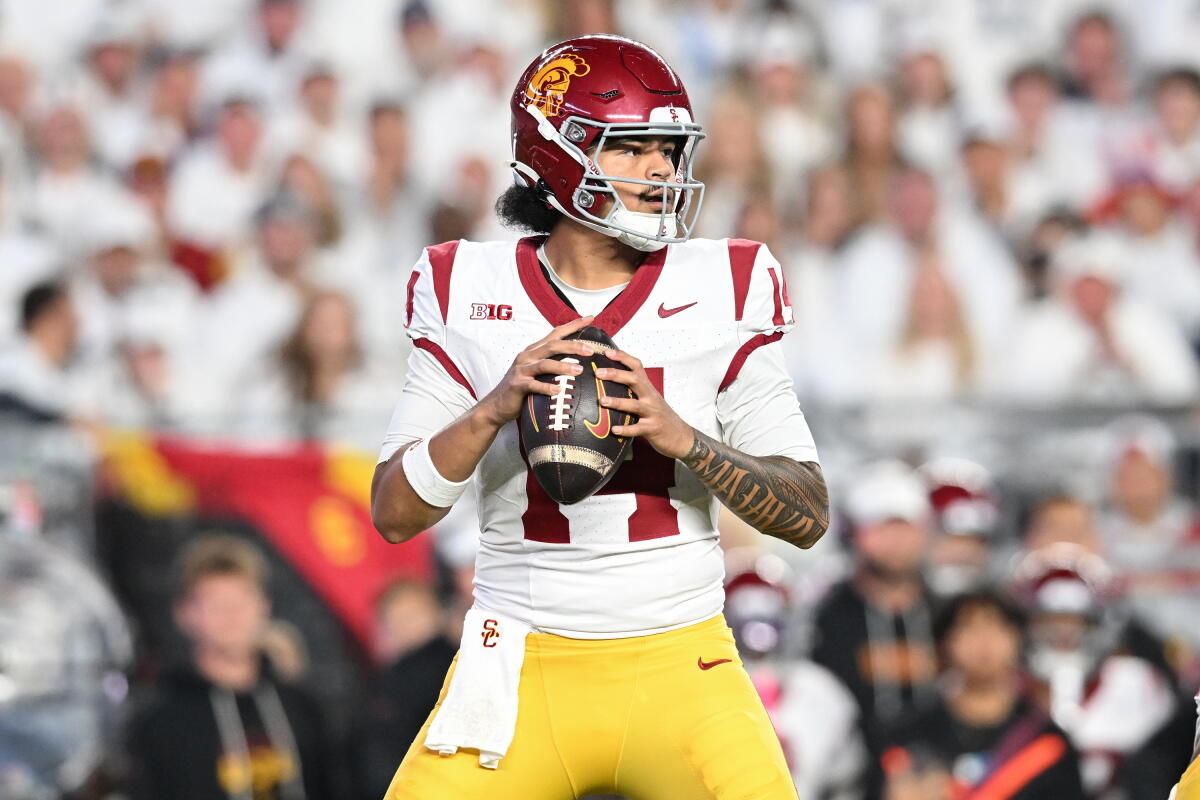
USC quarterback Jayden Maiava looks to throw a pass during a win over Penn State Saturday in State College, Penn.
(Barry Reeger / Associated Press)
For his performance against Penn State, Mosley earned Big Ten Freshman of the Week honors, becoming the fourth Trojan to win the award this season. It was far from his first strong performance for USC.
Mosley caught 13 passes for four touchdown and 255 yards in his first three college games and returned a punt for a touchdown. The only game Mosley has played for USC during which he didn’t earn at least 100 receiving was the Trojans’ win over Louisiana, during which he was injured.
“I’m just trying to do my part,” Mosley said Tuesday.
The freshman, who came to USC in the spring out of Santa Margarita High, rejoined the Trojans ahead of the Penn State game while the team faced a variety of injuries to other key players on both sides of the ball. Fellow freshman standout tight end Mark Bowman and left tackle Elijah Paige were among the Trojans to miss Saturday’s game with injuries, while defensive tackle Jide Abasiri was significantly limited.
“He’s one of our best players,” Trojans coach Lincoln Riley said of Mosley. “Getting him back has added a huge boost for us. He’s a tremendous playmaker. He’s tough to tackle after the catch. We trust him a lot.”
Now, the Trojans are in a bye week before they play at Wisconsin on Oct. 24. During the bye, the first of two for USC this season, Riley said he hopes to see his team get healthier.
Riley did not address the status of any individual players Tuesday besides saying that Bowman is “getting better,” Riley said he would not rule anyone out for the Wisconsin game. USC’s next Big Ten availability report will be released on Oct. 21.
“I’m hopeful, going into Wisconsin, that just from a whole we’ll be as healthy as we’ve been the whole year,” Riley said. “We haven’t been able to see this team quite at full strength yet from a health perspective. So, I’m kind of excited and interested to see what that would look like.”
Vlad Dyakonov bolsters Trojans
With various starters injured, younger players have filled the gaps for the Trojans.
On Saturday, freshman Vlad Dyakonov took center stage filling in for the injured Paige.
Riley on Tuesday praised Dyakonov’s performance and said the lineman didn’t know he was going to start his first college game until pregame warmups. Paige was moved to a game-time decision on USC’s final availability report two hours before the Penn State game after being listed as available the entire week beforehand.
“There’s some young people across the country that if you told them that and they were in that position in that atmosphere and environment, [they] … would be a little wide-eyed,” Riley said of Dyakonov’s debut in front of more than 114,000 fans during Penn State’s annual White Out Game. “Vlad wasn’t. Vlad was like jacked. He was ready to go.”
USC’s King Miller carries the ball during a win over Penn State Saturday in in State College, Penn.
(Isaiah Vazquez / Getty Images)
In an appearance on Trojans Live on Monday, Riley recalled Dyakonov boldly calling out 6-foot-5, 295-pound star defensive tackle Jahkeem Stewart in a one-on-one drill during practice and holding his own.
“I think we all knew, look, he’s not going to play perfect, but I think we all knew like he’s going to go compete his you-know-what off,” Riley said Tuesday. “Nobody doubted that because that’s what he does every day. He’s built a lot of trust in here.”
Maiava echoed Riley’s sentiment when asked about Dyakonov, praising his ability to fill in for Paige on short notice.
“What an unbelievable player,” Maiava said. “He never flinched when he went out there, and we didn’t either.”
Though Dyakonov has become known for his intensity, Trojans running back King Miller, who rushed for 102 yards and a touchdown on 19 carries Saturday behind an offensive line that included Dyakonov, said he also has a sense of humor. Asked what Dyakonov was like off the field, Miller’s first description was “hilarious.”
“It’s great to have a guy like him in this room,” Miller said.
Times of Troy writer Ryan Kartje is out sick this week, but we didn’t want USC fans to miss extended coverage of the Trojans’ win at Penn State. Times sports editor Iliana Limón Romero is filling until Kartje returns.
USC coach Lincoln Riley lingered at Beaver Stadium on Saturday night, soaking up a hard-fought moment of vindication.
Riley celebrated out-coaching Penn State’s Matt Campbell like he won a national championship, offered gleeful remarks to NBC and reporters at his postgame news conference and shook the hands of USC fans who ventured to Happy Valley to catch the Trojans’ first road win over Penn State.
“It’s one of my favorite wins as a head coach no question, for so many reasons,” Riley said after the Trojans’ 31-23 victory. “Obviously phenomenal atmosphere, as good as it gets there in college football, so give credit to Penn State, their fans, but really proud of our team, man.”
Fight on! Are you a true Trojans fan?
Get our Times of Troy newsletter for USC insights, news and much more — exclusive to L.A. Times subscribers. Free Members receive a partial preview of each edition.
By continuing, you agree to our Terms of Service, which include arbitration and a class action waiver. You agree that we and our third-party vendors may collect and use your information, including through cookies, pixels and similar technologies, for the purposes set forth in our Privacy Policy such as personalizing your experience and ads.
And even Riley’s harshest critics had trouble arguing this wasn’t a meaningful win. A serious test his team passed. The kind of beast Riley and the Trojans have struggled to slay.
Yes, the Nittany Lions now sit 3-3 overall and 0-3 in Big Ten play, but White Out games are their super power. When an announced crowd of 114,419 fans commits to wearing white and roaring in unison, it’s hard for any visiting team to pull off a victory. USC had never won in State College, Pa., and Riley noted seemingly no one outside of his team believed the streak would end Saturday.
How did USC do it?
The Trojans figured out how to overachieve in every area that was considered a weakness entering the matchup.
Maiava lights up Nittany Lions
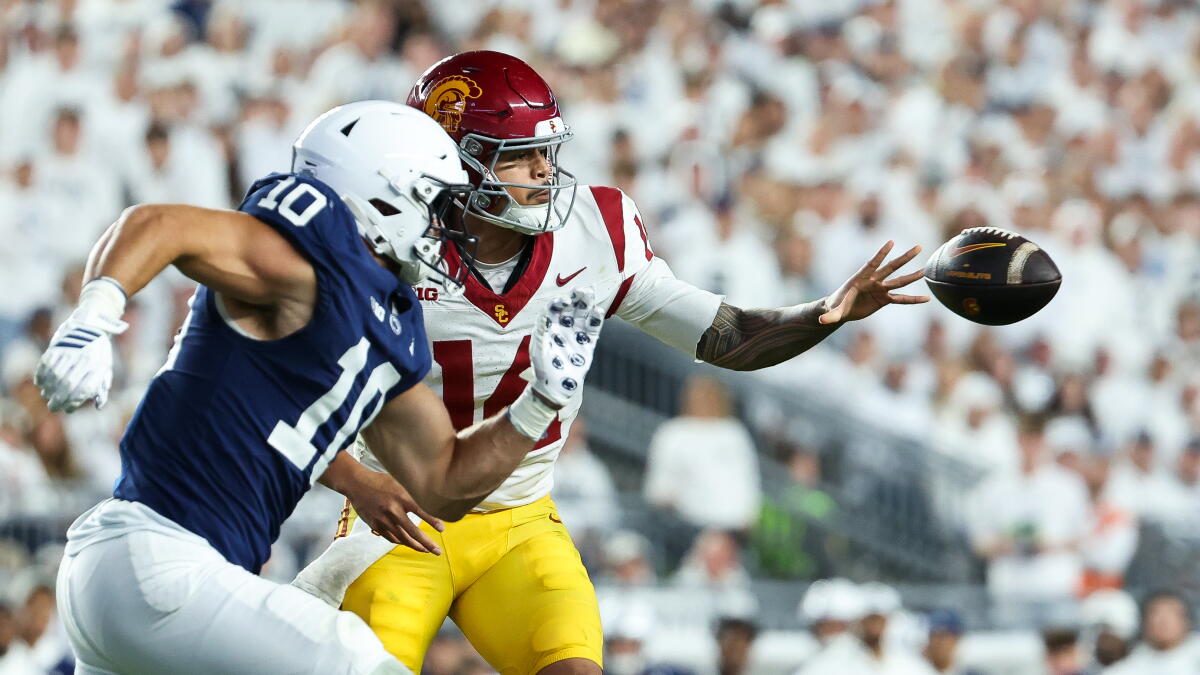
USC quarterback Jayden Maiava delivers an option pitch under pressure from Penn State’s Caleb Bacon on a play that scored a touchdown Saturday at Beaver Stadium.
With big-play threats Mosley and Tanook Hines on the field, Maiava looked like an elite Big Ten quarterback dealing the ball in locations only his two ace receivers could catch.
Maiava completed 21 of 33 passes for 301 yards, three touchdowns and no turnovers.
Mosley had nine catches for 111 yards and one touchdown. Hines had four catches for 82 yards and another score. The passing attack opened up enough space for King Miller to earn 102 yards and a touchdown in 19 carries.
Of course fans have come to expect big highlight plays from a Riley offense, but Maiava was unquestionably tentative the past few weeks and the offense wasn’t clicking. It hit top gear at Penn State.
USC’s Christian Pierce punches the ball out of the hands of Penn State’s Brett Eskildsen, forcing a fumble in the fourth quarter at Beaver Stadium on Saturday.
(Isaiah Vazquez / Getty Images)
While Riley has caught considerable heat this season, the USC defense directed by Gary Patterson wasn’t far behind.
The Trojans have shown marked improvement with Patterson shifting from the sideline to the press box the last two games.
Patterson had always worked from the sideline, but he also was always surrounded by staff members who knew his system well. Riley said the goal of the move was to speed up communication.
Desman Stephens II returned from his one-game suspension and led USC in tackles with nine. Luke Wafle and Kennedy Urlacher earned sacks. Jahkeem Stewart played after being listed as a game-time decision on the injury report and recorded a quarterback hurry.
Jontez Williams, Prophet Brown and Elijah Newby were credited with breaking up one pass apiece.
Riley can deliver in crunch time
USc coach Lincoln Riley talks with quarterback Jayden Maiava during the Trojans’ win over Penn State Saturday at Beaver Stadium.
And he was well aware few expected USC to win at Penn State, with betting odds favoring a rebuilding Nittany Lions squad by 1 1/2 points.
Riley’s clock management and use of timeouts, along with his play-calling, unquestionably got the best of Penn State’s Campbell and helped seal the USC win.
Opening the second half with an onside kick set the tone that everything was on the table for USC.
When Riley kept his offense on the field on fourth and four at the USC 13 late in the fourth quarter. Campbell said he called timeout with 4:15 remaining to be sure he put his team position to go get the ball.
Riley was delighted Campbell burned his final timeout and sent on his punt team.
After his defense forced a turnover, Riley’s offense burned time off the clock and lined up for fourth down when Penn State jumped offside.
For once, the Trojans didn’t flinch when it mattered most. USC finished with three penalties for a loss of 25 yards, a remarkable improvement for a team that has racked up a lot of ill-timed penalties during Riley’s tenure.
USC was awarded the first down and took a knee to run out the clock on a victory.
USC’s Kameryn Crawford and Luke Wafle celebrate with fans after their win over Penn State Saturday at Beaver Stadium.
(Barry Reeger / Associated Press)
The Trojans celebrated in the rain before starting a bye week.
“I was not surprised at all that we played well,” Riley said. “I felt like we really had one of the best weeks of prep that we’ve had since I’ve been here. I thought team had a great mindset coming in.
”… I’ve only been a head coach at two schools. They’ve both been blue bloods. … Blue bloods are unbelievable. The advantages far, far outweigh the disadvantages, but the disadvantages at blue bloods are the outside noise is always going to be way over the top, no matter what’s happening. And your ability to deal with that as a coach and then your team is critical if you want to have success in these jobs.
“And I thought our team blocked out everything. Our team knows how good of a team we have in that locker room and didn’t flinch.”
House of Troy ‘Chapter 4: Higher Power’ episode drops this week
Lane Kiffin was stunned when he was fired on the tarmac at Los Angeles International Airport at about 3 a.m. on Sept. 29, 2013.
He called his wife, who was equally surprised by the abrupt end to his tenure leading the Trojans.
“And I remember saying, I do not want to wake up tomorrow,” Kiffin recounts in the latest episode. “My life’s over.”
Kiffin helps provide an inside look back at the highs and lows of his USC era during Episode 4 of “House of Troy” available Tuesday morning at latimes.com/sports and everywhere you get your podcasts.
Olympic sports spotlight
The USC women’s volleyball team has been through some big changes, with coach Brad Keller missing matches Oct. 2 and Oct 4 because of an illness. USC announced on Oct. 5 Keller is taking personal leave and assistant Megan Moenoa is the Trojans’ interim head coach.
The Trojans (8-8, 2-4 Big Ten) earned a 26-24, 25-19, 25-22 road win over No. 15 Indiana (10-5, 3-3) in Bloomington on Sunday. It was Moenoa’s first win since stepping in for Keller.
Sophomore Abigail Mullen led USC with 11 kills, four blocks and nine digs. Freshman Milly McGee earned 31 assists, six digs and one kill.
Polling the people
Please note the following poll included voting before USC’s win over Penn State. The results do help illustrate the stress level Riley faced entering the game.
We asked “Will Lincoln Riley be USC’s coach in 2027?”
That concludes today’s newsletter. If you have any feedback, ideas for improvement or things you’d like to see, email Ryan at ryan.kartje@latimes.com, and follow me on X at @Ryan_Kartje. To get this newsletter in your inbox, click here.
USC quarterback Jayden Maiava has been playing above-average football, but the signal-caller’s deep throws have not been as sharp lately and he has shied away from some contact after taking a big hit to his shoulder during a 39-0 shutout of Fresno State on Sept. 4.
When asked about his quarterback on Tuesday, Trojans coach Lincoln Riley quickly replied that Maiava is not injured.
“Jayden has been pretty healthy,” Riley said. “They’ve kept him upright all season long.”
Maiava has adapted to shifting receiving options, calling it a learning experience as he connects with new pass catchers. USC freshman Trent Mosley was an early breakout star, but Maiava has had to look to others with Mosley out the past two games because of injury.
“I’ve been trusting myself, trusting the plan and trusting those guys on the perimeter,” Maiava said
He credits co-offensive coordinator Dennis Simmons for having his receivers ready whenever their names are called.
“It’s the next-man up mentality and we are all going to do the same thing,“ Maiava said.
A key building block
USC coach Lincoln Riley watches from the sideline during the fourth quarter of a win over Washington at the Coliseum on Oct. 3.
(Ronaldo Bolaños / Los Angeles Times)
As USC chases the program’s first win over Penn State in Happy Valley, Riley said he expects the Trojans to draw on the resilience they showed against Washington.
He called the rally for a victory over the Huskies a potential turning point for a program that can’t afford another loss if it hopes to reach the College Football Playoff for the first time during Riley’s tenure.
“It wouldn’t shock me if six to eight weeks down the road you’re going to look back at us and see that’s the game that was critical in the season,” Riley said of the Washington win. “Those are important. It helps develop the personality of your team. Most importantly, the biggest thing it shows is the brotherhood within our locker room right now.”
Supporting the defense
USC cornerbacks Chasen Johnson and Prophet Brown break up a pass intended for Washington receiver Dezmen Roebuck in the end zone to secure the Trojans’ win at the Coliseum on Oct. 3.
“[Patterson] is one of the best coaches of our generation. One of the best defensive minds in college football history,” Riley said, backing up his coordinator when asked about his progress.
Riley, however, did not defend poor tackling on Washington’s final touchdown drive that put the Trojans on the brink of a loss.
When asked whether the mistakes were addressed with the players, Riley responded, “Oh yeah. … It was a bad play. Not near our standard.”
He later added, “I bet we don’t see it again.”
While the Huskies’ scoring drive exposed some problems, the defense held its ground late in the fourth quarter to seal the win.
Stephens served a one-game suspension for a late hit to the head on Oregon quarterback Dante Moore and his behavior celebrating as Moore was being treated by medical staff before leaving the Coliseum in an ambulance.
USC released an apology from Stephens a day after the game. Riley was asked Tuesday whether Stephens would get his starting job back after Robinson’s strong play. While he didn’t specifically address the starting role, Riley did suggest Robinson earned more snaps.
“It was an opportunity for some other guys to step up and they did. … When you see guys that are there for that opportunity and rise to the occasion, it’s going to create more opportunities for some of those guys, there’s no question about it,” he said. “But Des is a good player and an important part of this football team. We view this a lot like just we’re coming back off any normal football game, like nothing else happened. … I think what we learned this week is we have a handful of guys who can go out there and play really, really well. … We look at it as a positive.”
When Lincoln Riley hired Gary Patterson to be his third defensive coordinator in five seasons, the USC head coach naturally pointed to Patterson’s impressive track record.
His reputation, after all, was as one of the great defensive minds in the modern history of college football, a coach who, at Texas Christian, knew how to get more out of lesser talent. It stood to reason that he could do the same at USC, where they’d just signed the nation’s No. 1 recruiting class. And through the spring and summer, that appeared to be the case, as coaches and players alike raved about their new coordinator, who earlier this year was enshrined in the College Football Hall of Fame.
But as the Trojans approach the midway point of an increasingly tense campaign, Patterson and his defense have fallen drastically short of those expectations.
As USC welcomes Washington to the Coliseum with its season on the brink, its defense is currently allowing more than 6.14 yards per play, good for 115th nationally. The secondary, which has struggled with consistent miscommunication, is allowing 8.4 yards per pass play — more than either of former coordinator Alex Grinch’s defenses allowed at USC. And big plays are becoming a big problem. Only three defenses the country have allowed more explosive plays of 20-plus yards than USC (23), which is also in line with Grinch’s defenses.
USC coach Lincoln Riley and defensive coordinator Gary Patterson talk after a loss to Oregon at the Coliseum on Saturday.
(Ronaldo Bolanos/Los Angeles Times)
And all this despite the fact four of the Trojans’ first five games were against opponents who were expected to struggle against USC’s far superior talent.
Patterson has yet to answer questions about those early results. That’s because unlike Riley’s first two defensive coordinators at USC, who spoke at least weekly, Patterson has not spoken to reporters since the preseason.
Without any explanation from him for USC’s early issues, the numbers don’t exactly paint a promising portrait of Patterson’s season. But while Riley acknowledged that the defense has “had some breakdowns at all levels” and must “play tighter in all areas,” the coach insisted Thursday that the Trojans were close to reaching their potential on defense, again reassuring that there was “a lot of good on tape” on that side of the ball.
“We don’t necessarily need any level of the defense to make this massive jump,” Riley said. “We just need each level to play a little bit better and each level to play a little bit better together.”
Outside of USC’s Week 1 shutout of Fresno State, though, the Trojans haven’t looked particularly good at any level of the defense. The pass rush has been lacking, with only three sacks across USC’s four other games. And on the back end, the Trojans continue to be caught flat-footed, with defensive backs out of position.
One former USC defensive back, Max Williams, posited on social media that the Trojans’ secondary appeared to be getting the defensive calls too close to the snap of the ball. In another social media breakdown by a former Trojan player, former quarterback Max Browne suggested that USC’s defensive backs were often out of position before the play began, putting them behind.
Those problems have seemingly been exacerbated the past two weeks in Big Ten play, as Rutgers and Oregon combined to pile up 964 yards on USC’s defense. And the Ducks did it with a backup quarterback at the helm in Dylan Raiola, who converted all seven of his third- and fourth-down pass attempts.
Patterson’s defense will have another tough test this week in Washington quarterback Demond Williams Jr., who’s just as much a threat with his legs as his arm. The Trojans already had trouble with a dual-threat quarterback earlier this season, allowing Louisiana’s Lunch Winfield to rush for 94 yards during a Week 2 Trojans win.
Any further struggles from here for USC’s defense could spiral in a hurry. The Trojans travel to Penn State next weekend and still have No. 5 Indiana and No. 6 Ohio State on the schedule. They’ll have to win two of those three, plus all their other games, if they still hope to contend for the College Football Playoff.
Those hopes hinge largely on Patterson, who Riley bet before the season would finally bring him salvation on the defensive end.
Riley still has faith that bet will pay off. Mostly because “there’s very few that have been through as much as he has.”
“Trust me, nobody takes it more personal than him or takes more responsibility than he does,” Riley said of Patterson. “He’s done this for a long time. He’s done it at a high level. And there’s nobody, you know, more committed to getting it fixed.”
After 72 particularly miserable hours for his football program, Lincoln Riley took his place behind a lectern Tuesday and tried to assure that things at USC weren’t as bad as they looked.
“There’s a lot of things to be proud of in this football program right now,” Riley assured. “Those that really look into it and look at what’s happening here will see that and understand that. There’s people on the outside that just don’t.”
But the optics at USC, since Saturday’s 41-27 home loss to Oregon, certainly couldn’t have been much worse for Riley. Because it wasn’t just that his Trojans lost a critical game to a bitter rival, one framed for weeks — months, even — as a must-win. Or that in its wake, Ducks coach Dan Lanning had savaged him or his program multiple times.
It was what happened in the midst of that loss, as well as the reactions after, that only made matters much worse for USC.
The days since have prompted questions across the country about Riley’s future at USC, where he’s midway through his fifth season as coach. One person familiar with the situation but not authorized to speak publicly on the matter told The Times that “all options are on the table” with Riley after the loss and the events of last weekend.
The chain of regrettable decisions began the moment Trojan linebacker Desman Stephens lowered his shoulder into the helmet of sliding Oregon quarterback Dante Moore in the second quarter Saturday evening. Moore’s head slammed hard into the ground, and he laid motionless for several minutes surrounded by medical personnel, until he was lifted onto a backboard and loaded into an ambulance that had driven onto the field.
The whole unsettling scene was made far worse by Stephens’ reaction in the immediate aftermath of the hit. After jawing with Oregon players, the junior linebacker was seen taunting the Oregon sideline and celebrating on his way back to USC’s side of the field. He continued high-fiving teammates while the Ducks surrounded their quarterback, who was diagnosed with a concussion but no other serious injuries.
The next morning, both Stephens and his coach said in a statement that his actions were “unacceptable,” “inexcusable” and “completely inappropriate.” But after the game, Riley first said he didn’t see Stephens celebrate the hit. And when Riley was asked why Stephens was allowed to stay on the sideline for the second half, the coach responded, incredulously, “‘cause he’s on our football team.” He wished Moore well, but said nothing further about Stephens or his vicious hit.
“It’s an easy answer,” said Petros Papadakis, a local radio host and former USC captain. “I understand you can’t have eyes everywhere as a head coach. But even if you didn’t see it, by the end of the game you know most of college football has turned against you in the last hour.
“The story didn’t go away because Lincoln didn’t get in front of it.”
It was clear that night, among USC’s leadership, that the immediate response wasn’t adequate enough. So the next morning, athletic director Jen Cohen met with Riley to discuss a suspension for Stephens. They settled on one game.
On Tuesday, Riley took a different tone. He said he was “disappointed with how [Stephens] handled it” and that he “needs to have more awareness.”
Riley also asked for understanding from those who have been critical of Stephens, whom he described as “a young person who made a mistake.”
“Consider if that was your son,” he said, “how would you want it handled?”
But three days later, the college football world was still litigating Stephens’ hit. The story was still alive, in part, due to a short documentary from the game, published by Oregon on Tuesday morning. In it was a clip that would unexpectedly make things even worse at USC.
The clip is of USC’s radio booth, where Pete Arbogast has been the Trojans’ play-by-play guy for the past quarter century. From his perch in the Coliseum press box, Arbogast is painting the scene of the play when Moore was injured. Except, in this case, listeners heard a different account of his slide and Stephens’ hit than what happened on the field.
“He did not try to slide feet first!” Arbogast said in the moment.
Arbogast went on to say that Moore “ducked into that hit. I did not see him put his feet out first. I saw him dive forward.”
When confronted with the replay moments later, Arbogast stood by what he said, claiming that Moore’s slide was “more of a knee-first slide.” Even Arbogast’s radio partner — former Trojan defensive tackle Shaun Cody — raised his eyebrows at the suggestion.
Both Arbogast and the university declined to comment on the situation when reached by The Times.
Papadakis, who previously worked on the broadcast with Arbogast, called it “a bad look,” but explained that Arbogast was “usually defending USC or trying to spin something positive.”
That job was left to Riley and his players on Tuesday. Though, some were more convincing than others.
“This is a time of adversity, the best time to come together as one,” left tackle Elijah Paige said.
“Times like these you tend to see teams fall apart,” quarterback Jayden Maiava added, “but this team is such a tight team and we’re all bought into each other.”
Riley, meanwhile, pointed for the second day in a row to a stretch early in Saturday’s fourth quarter against Oregon, when the Coliseum had reached a fevered pitch and momentum seemed to be swinging in the Trojans’ favor.
Except, it never did. USC allowed two fourth-quarter touchdowns after that. Riley still tried to find the silver lining.
“We didn’t get run out of the stadium,” Riley said. “There’s a lot of good on that tape. You don’t have a chance to win a game like that if you don’t do some things pretty well.”