In 100th lawsuit against Trump, California challenges ICE courthouse arrests
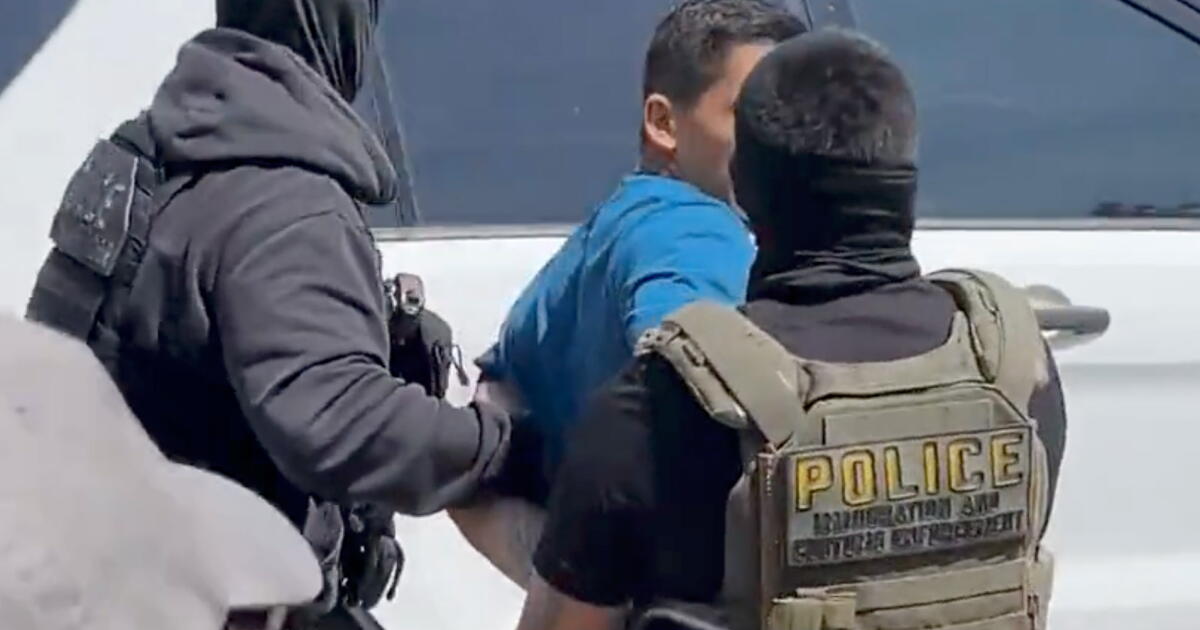
California sued the Trump administration for the 100th time in under two years Thursday, challenging the practice of U.S. Immigration and Customs Enforcement agents arresting people for civil immigration violations at or near state courthouses.
California Atty. Gen. Rob Bonta said such arrests have long been barred because they are unconstitutional and deeply disruptive to the rule of law and the rights of victims, witnesses, defendants and other parties to court proceedings.
“We’ve seen serious criminal charges dropped and entire cases jeopardized because victims and witnesses are too scared to come to the courthouse to testify,” Bonta said. “Our justice system cannot function this way.”
Bonta said his office having to take the Trump administration to court 100 times in less than two years, often alongside other Democrat-led states, was a “sobering milestone” and a reflection not of political interference on California’s part — as the president and his supporters have cast it — but of Trump’s nearly unbridled lawlessness.
“It’s very troubling when the most powerful person on the planet and the president of our country is the one trampling over the Constitution, breaking the law so blatantly and brazenly, so consistently, so frequently,” Bonta said.
Independent legal experts said several factors have driven the wave of lawsuits.
Presidents of both parties have increasingly flexed their executive power, and state attorneys general have increasingly sued in response. During Trump’s first term in office, California — under the leadership of then-attorney general and current gubernatorial candidate Xavier Becerra — sued the Trump administration more than 120 times over four years. Texas Atty. Gen. Ken Paxton — now a Republican candidate for Senate — sued the Biden administration just over 100 times in four years.
Trump in this term quickly began implementing an array of policies leftover from his first term or outlined in the Project 2025 policy blueprint, many of which Bonta and other Democratic attorneys general were prepared to sue over, experts said.
Trump was also able to appoint a host of loyalists with the help of the Republican-controlled Congress, who helped advance policies that less loyal agency heads would have balked at, and which were sure to draw additional legal challenges, experts said.
Daniel Farber, a professor at UC Berkeley Law School and author of “Contested Ground: How to Understand the Limits on Presidential Power,” said California’s raft of lawsuits is a result of the current Trump administration “doing more aggressive things right off the starting block” — but also repeatedly targeting California specifically.
The White House did not immediately respond to a request for comment Thursday. However, it has consistently derided Bonta’s litigation against the administration as baseless and misguided.
When Bonta claimed in August that his lawsuits had saved California more than $200 billion, namely by reversing Trump cuts to federal funding meant for the state, White House spokesperson Abigail Jackson said Bonta should stop “filing frivolous lawsuits” and “focus on addressing problems in his own state.”
ICE, which also did not immediately respond to a request for comment, has defended its arrests near courthouses as a “common sense” approach to apprehending offenders at times and locations where authorities know they will be.
The 100th case
Bonta’s lawsuit argues that such arrests are arbitrary and capricious given the chilling effect they have on justice in the state. They violate the Immigration and Nationality Act as intended by Congress, and interfere with California’s rights under the 10th Amendment to execute its “core sovereign judicial and police functions,” Bonta’s office said.
His arguments echo those made by other state officials in the past. During Trump’s first term, for example, then-California Supreme Court Chief Justice Tani G. Cantil-Sakauye called the arrests “disruptive, shortsighted, and counterproductive.”
Arrests at or near courthouses began to rise again after Trump took office in January 2025. An ICE memo, issued in May 2025, said agents could conduct “civil immigration enforcement actions in or near courthouses when they have credible information that leads them to believe the targeted alien(s) is or will be present at a specific location.”
Incidents quickly began cropping up. In June 2025, ICE agents arrested two women outside a Los Angeles courthouse after a hearing in a local criminal case. The same unfolded across the state.
Alejandro Barraza, a criminal defense and immigration attorney, said he has witnessed the impact firsthand.
In October 2025, a client was arrested driving home from a hearing at the Riverside Hall of Justice. In December, another client was arrested leaving the Rancho Cucamonga courthouse. And a third client chose to plead guilty in his criminal case rather than go to jury trial, despite Barraza’s advice that the case was worth fighting, for fear of being arrested by ICE.
“The victims are losing. Our clients are losing their rights to due process. Everyone is losing,” Barraza said.
In June, U.S. District Judge P. Casey Pitts in San Francisco struck down ICE’s expanded courthouse arrest policies nationwide. Although the lawsuit focused on immigration courthouses, the ruling also covered state criminal courthouses, restoring earlier restrictions that barred civil immigration arrests in or near courthouses except in limited circumstances. The Trump administration is appealing the ruling.
Since then, California court officials have tracked arrests by federal agents and reported them to the Judicial Council of California. Thirty people were taken into custody in June, 29 in July, 19 in August and 14 in September.
State legislators have tried to push back. Last month, Gov. Gavin Newsom signed a law strengthening California’s protections against civil arrests for people traveling to, attending or leaving courthouses for lawful purposes. The measure extends those protections to public ways within 1,000 feet of court facilities, while preserving an exception for arrests made under a valid judicial warrant.
Bonta said his lawsuit is necessary despite the new California law, in part because the Trump administration thinks that “no state law applies to them,” and courts have in some cases agreed — including the U.S. 9th Circuit Court of Appeals, which this week blocked a state law that would have required federal immigration agents to display identification while working in the state.
The wider legal battle
Bonta’s office has had substantial success in halting some of the Trump administration’s biggest policy moves — including its plans to end birthright citizenship for the U.S.-born children of immigrants, its worldwide tariffs, its deployment of National Guard troops in Los Angeles and other U.S. cities, and its withholding of billions of dollars in federal funding allocated to the state by Congress.
Michael McConnell, director of the Constitutional Law Center at Stanford Law School, said many of California’s lawsuits have been “legally meritorious,” as there is a “whole lot of legal error” coming out of the Trump administration — with a “lot of the overreach” having been “facilitated by the lack of internal checks” from loyal Trump agency heads.
However, he also said that as a California taxpayer, he doesn’t “appreciate having government using my tax dollars for what essentially are in many cases ideological lawsuits, even if meritorious,” because private litigants can and often do bring lawsuits of their own. He said he felt the same way about many of the lawsuits brought against the Biden administration by Republican states.
Bonta said he is proud of his team for challenging the Trump administration every time they believed it had broken the law and harmed California, despite Trump’s intentional effort to make that difficult.
“It was a shock and awe. It was flood the zone. It was trying to overwhelm with speed and volume, and we kept pace every time,” he said.
What happens next, he said, will depend on Trump. If he keeps breaking the law in ways that hurt the state or its residents, he’ll keep getting sued by California.