Iran’s leaders rail against US, ‘sedition’ in 1979 revolution celebrations | Protests News
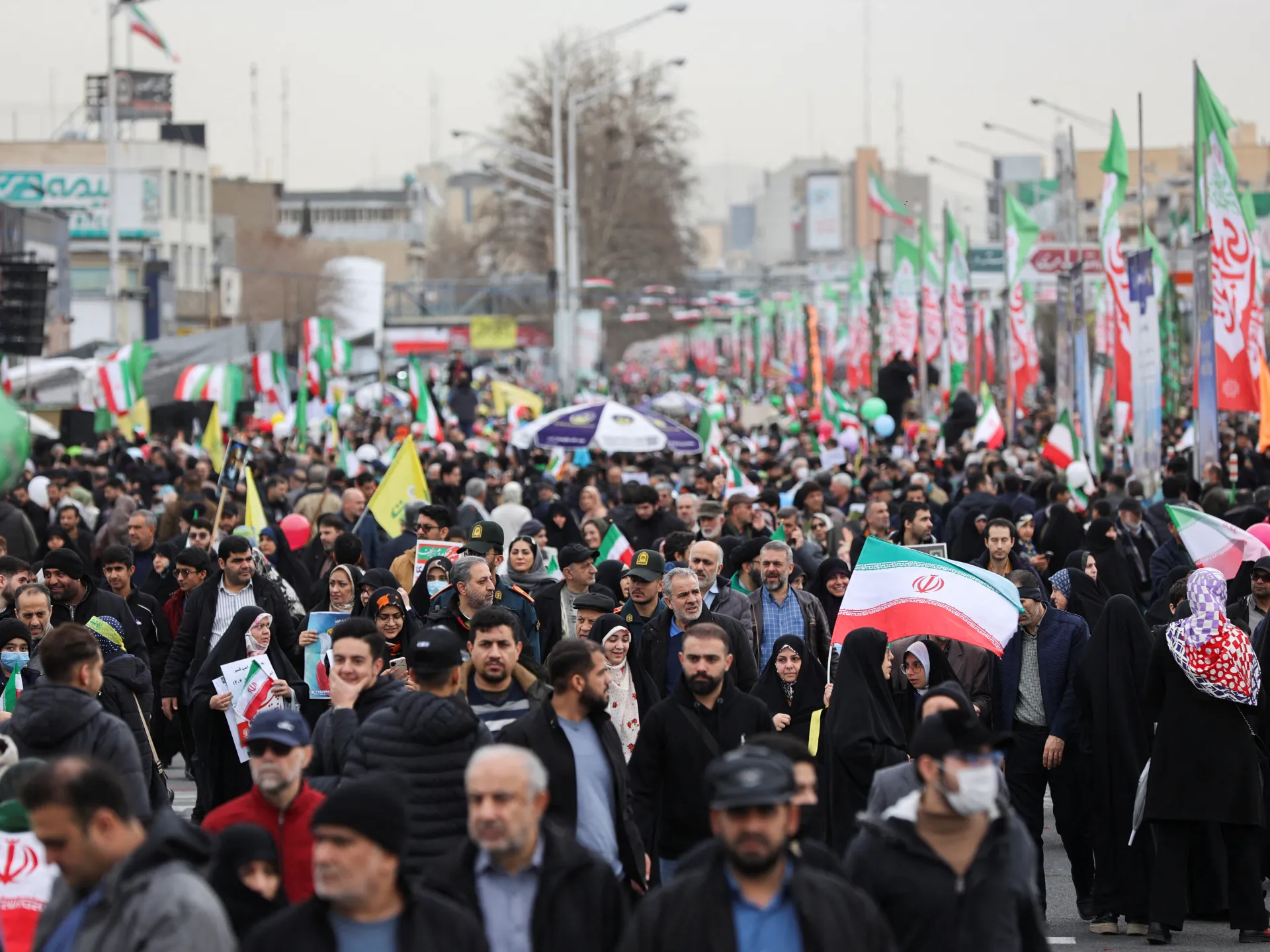
Chants of “Death to America” and “Death to Israel” rang out on Wednesday in the state-run annual demonstrations, on a day of immense symbolic significance for the Islamic republic that consolidated its power during the 1979 revolution.
Recommended Stories
list of 3 itemsend of list
Near Enghelab (Islamic revolution) Square in downtown Tehran, authorities propped up five coffins for some of the top commanders in the US military.
The coffins had the US flag painted on them, and included the names and images of Central Command chief Brad Cooper, Chief of Staff Randy Alan George and others.
This year’s festivities are especially important to the theocratic establishment as they follow the 12-day war with Israel and the US in June, the nationwide protests starting in late December, and in defiance of a potentially looming war with the US.
Threatened with assassination by the US and Israel, Iran’s Supreme Leader Ayatollah Ali Khamenei did not make an appearance in the events. He also missed a highly symbolic annual meeting with army and air force commanders for the first time in his 36-year rule.
The 86-year-old supreme leader released a video message calling on Iranians to “disappoint the enemy” by participating in the revolution anniversary. All other senior political, military and judicial authorities also released similar messages urging supporters to mobilise.
An 81-year-old private businessman who was arrested and had his assets confiscated for observing a strike during the nationwide protests also wrote in a confession letter released by state media this week that he would participate in the rallies.
The Fars news agency, affiliated with the Islamic Revolutionary Guard Corps (IRGC), released a video of a “symbol of the devil” being burned during a state-organised event in the capital. The burned effigy appeared to depict a man with horns sitting on a pedestal marked with the US and Israeli flags.
People also burned and trampled on US and Israeli flags, while ballistic and cruise missiles capable of reaching Israel and the wreckage of Israeli drones shot down during last year’s war were displayed.
These are the types of missiles that Tehran has called its own red line, as Israeli Prime Minister Benjamin Netanyahu tries to corral US President Donald Trump into following the Israeli narrative that Iran’s missile programme, as well as its nuclear one, should be on the negotiating table.
State television flew helicopters over designated areas in Tehran and other cities where demonstrations were being held and described another “epic saga”, using a term favoured by Iranian authorities to talk about the annual demonstrations.
Those attending the rallies were hailed as “the dear people of Islamic Iran” who were marching to bolster the security of the country.
Iranian President Masoud Pezeshkian called for national unity in the face of external threats while insisting that his government is willing to negotiate over its nuclear programme.
Addressing the crowds in Tehran’s Azadi Square, Pezeshkian called for solidarity among Iranians in the face of “conspiracies from imperial powers”.
Competing chants
Huge fireworks exploding around the iconic Milad Tower on Tuesday night to celebrate the revolution anniversary were so loud that they alarmed some residents and hearkened back to the bombing runs of Israeli fighter jets during the 12-day war.
Translation: I was driving when suddenly there was the sound of an explosion and the sky lit up, I thought only that it was war and that I had to be beside my parents. I lifted my head again and saw that it was fireworks – as if they were shooting into people’s hearts to prove it wasn’t war. It was worse, because the elites were celebrating while we’re in mourning for those fallen [during the protests]. In Tehran and across the country, the authorities called on supporters of the establishment to shout “Allahu Akbar” in the streets and from their homes at 9pm local time on Tuesday night. Numerous videos circulating online show some people shouting those words, only to be met by competing shouts of “Death to the dictator” or cursing from their neighbours.
The authorities also discussed the nationwide protests during Wednesday’s events, and celebrated what they described as a triumph over “enemies”.
Ahmad Vahidi, the deputy head of the IRGC, told a state-organised event in Shiraz that Wednesday’s rallies marked a third “great defeat” for the US and Israel over recent months.
He said the 12-day war was the first one, and the second was the state-organised counterdemonstrations held on January 12, days after most of the protest killings were carried out on the nights of January 8 and 9.
Like Vahidi, police chief Ahmad-Reza Radan called the protests another “sedition” and said they were “a great project by the global arrogance” that was quashed.
The Iranian government claims that 3,117 people lost their lives during the unprecedented protest killings, all of them at the hands of “terrorists” and “rioters” armed and funded from abroad.
The US-based Human Rights Activists News Agency says it has confirmed about 7,000 deaths so far and is investigating nearly 12,000 other cases. United Nations Special Rapporteur on Iran Mai Sato said more than 20,000 civilians may have been killed but information remains limited amid heavy internet filtering by the state.
The UN and international human rights organisations have accused state security forces of being behind the killings. The UN Human Rights Council last month issued a resolution condemning the killings and calling on the Islamic republic to “prevent extrajudicial killing, other forms of arbitrary deprivation of life, enforced disappearance, sexual and gender-based violence” and other actions violating its human rights obligations.