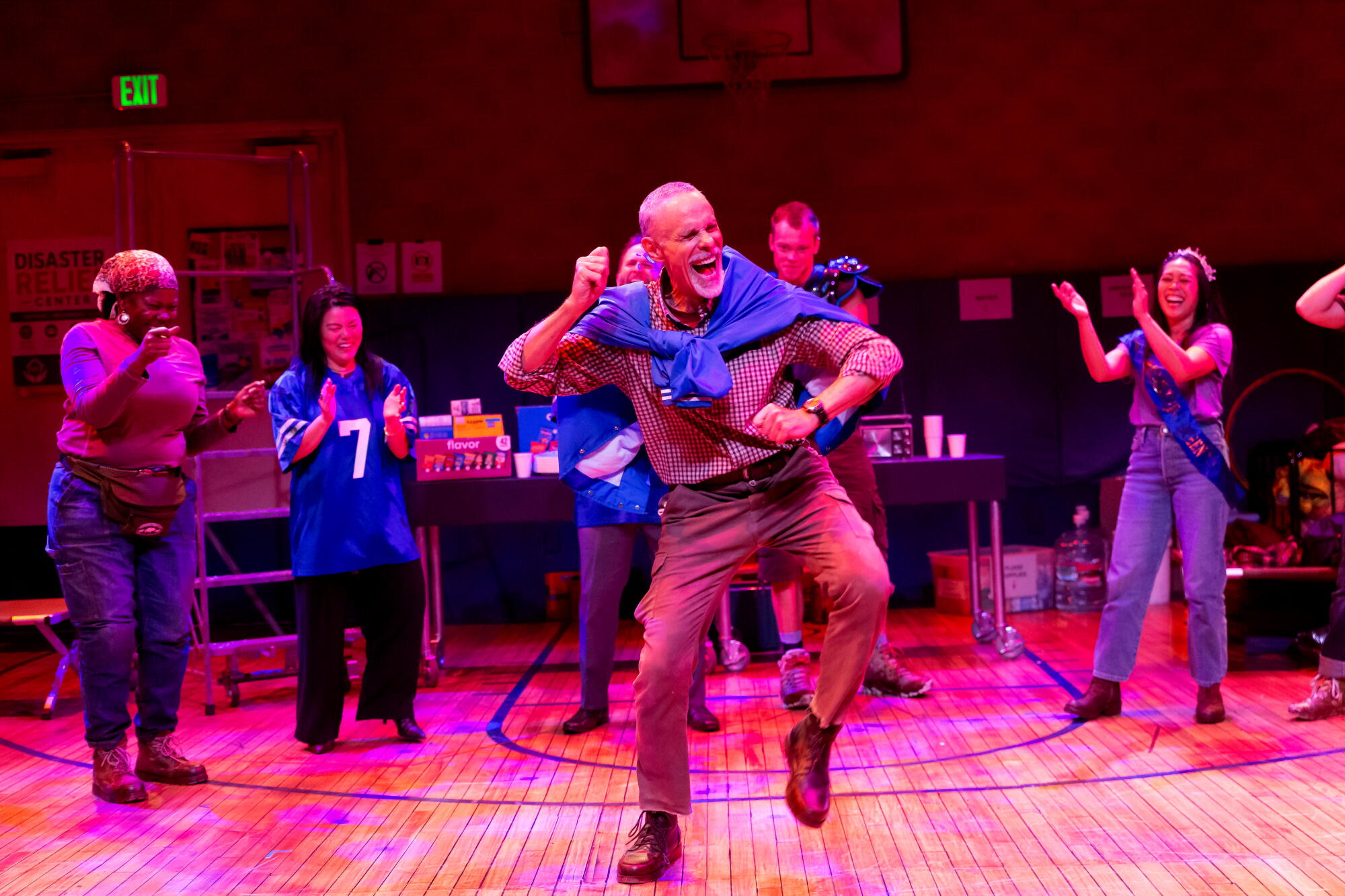
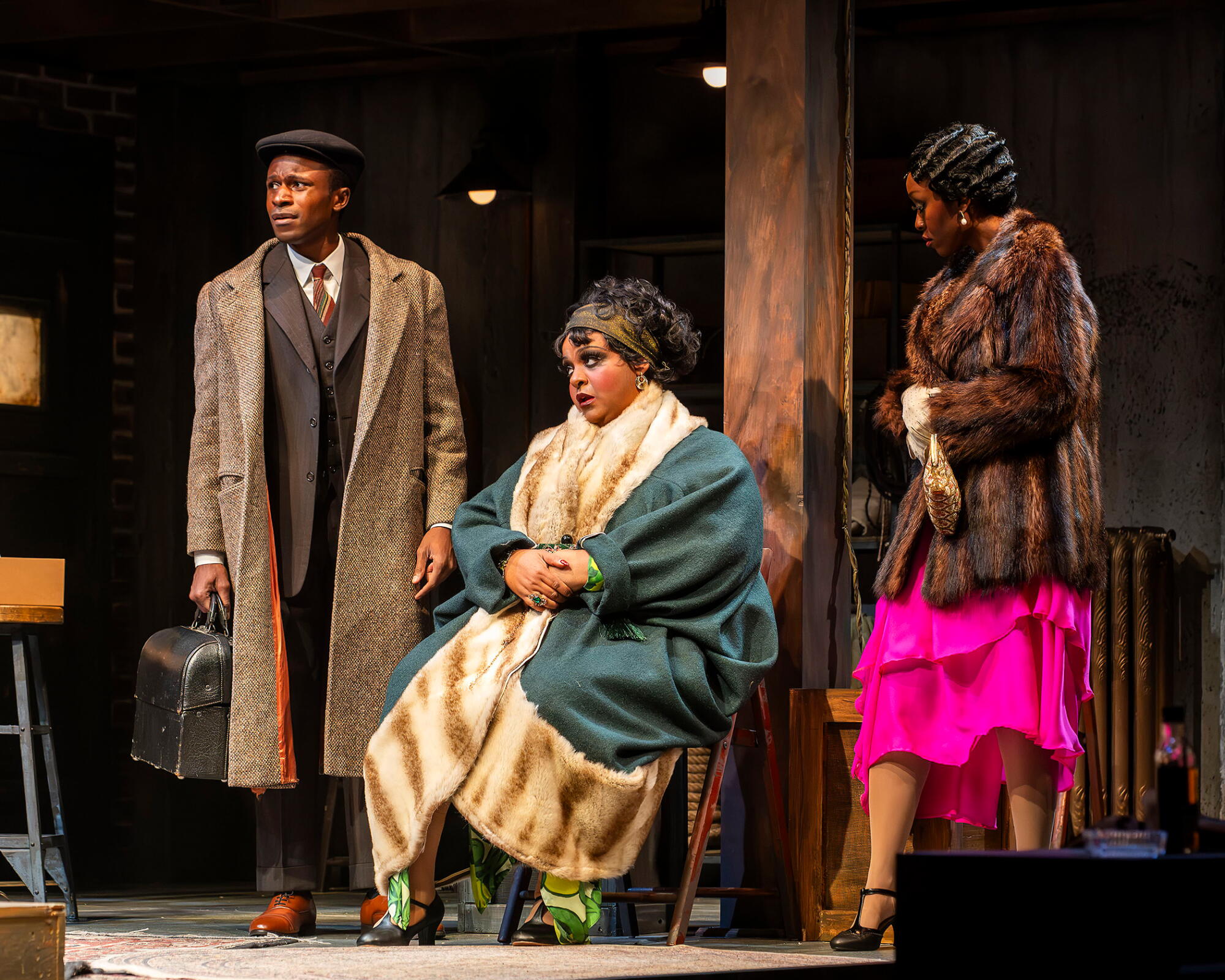
The shadow of Bill Cosby hangs over the “The Peterson Show,” a new play by Janine Nabers about the fallout of a disgraced TV dad on the grown-up cast members who played his children on the show.
Echo Theater Company, which is presenting the world premiere of this play in a production directed by Michelle Bossy, has reconfigured its Atwater Village Theatre space for the occasion. The refresh — in terms of the position of the stage and the audience and in the level of the design elements, including video monitors showing clips of Black sitcoms — promises a vital evening of theater.
Unfortunately, the production is hamstrung by fundamental problems in the writing, directing and acting, all pointing to a failure of control. Control of the story, control of the tone and control of the cast.
In my fall preview item for this show, I wrote that the “production is all but guaranteed to be more enlivening than an evening spent surfing Netflix.” Well, it’s certainly lively, but in a boisterous way that made me regret I had left my couch.
Not even Netflix would give “The Peterson Show” the greenlight. The story centers on the adult lives of the sitcom’s five child stars who are thrust once again into the spotlight after a reunion rumor goes viral and their TV mom, Valerie, kills herself.
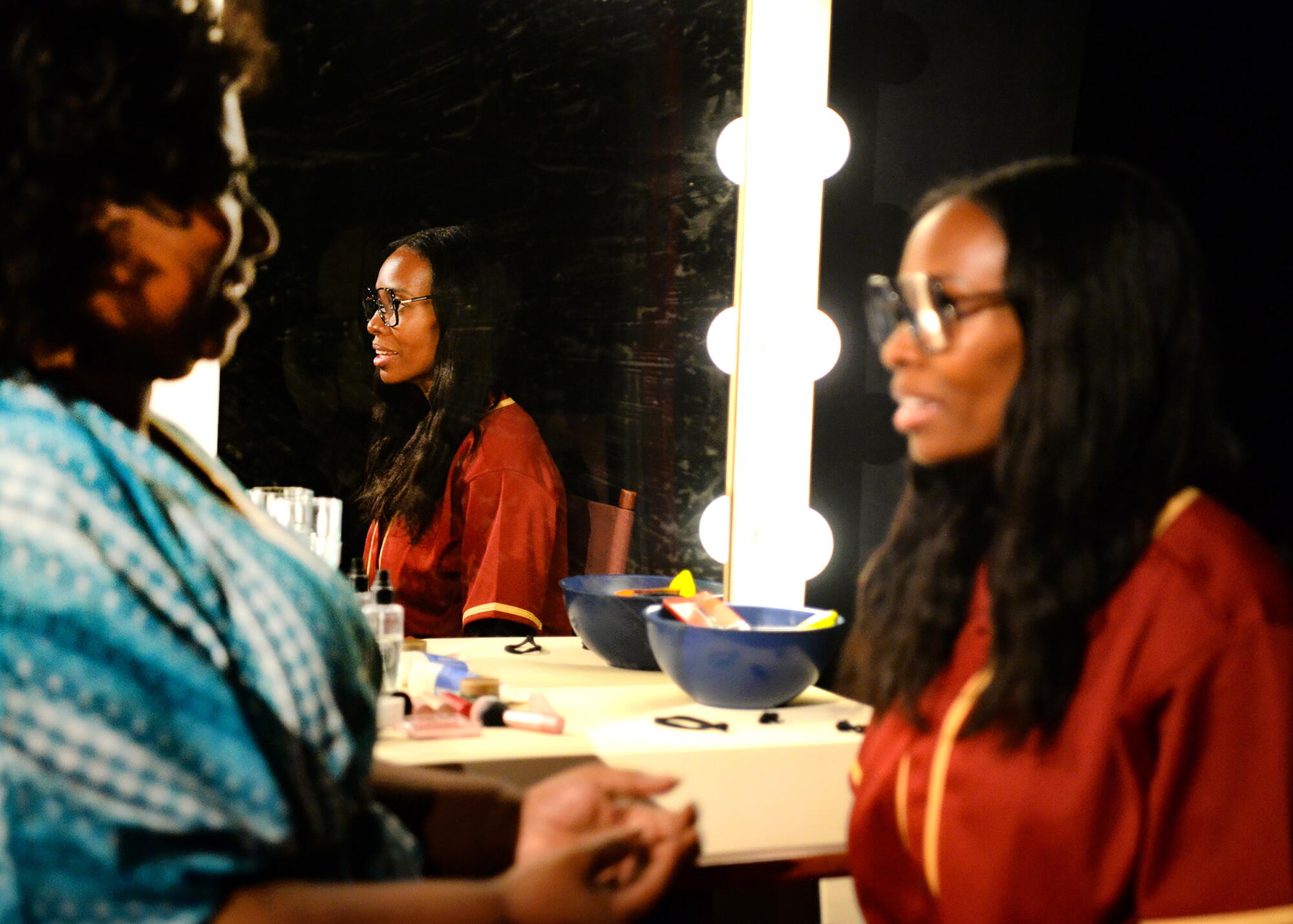
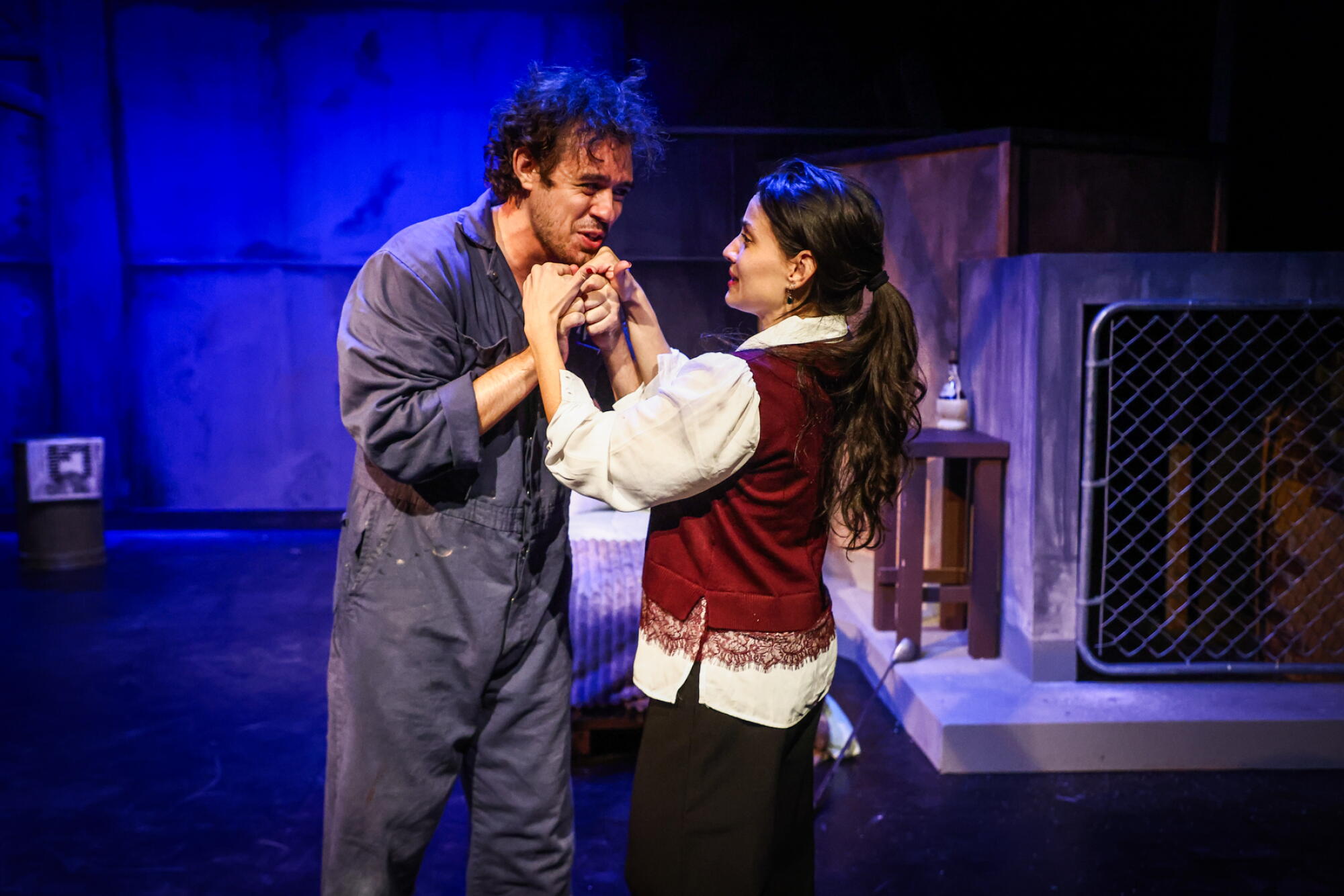
Deanna Reed-Foster, left, and Tamberla Perry in “The Peterson Show” at the Echo Theater Company.
(Cooper Bates)
Ronika (Tamerla Perry), the troublemaker of the group, careens through life with faulty brakes. Zoe (Kristen Ariza), who has traded TV stardom for an academic career and motherhood, wants the normalcy that her former fame keeps threatening.
Dwight (Devere Rogers) is messy and loud as well as addicted to fame and other substances. Blair (Kelly McCreary), who pulled herself out of a miserable childhood, has made a successful career as an award-winning actor and isn’t going to let her flimsy talent or her TV siblings stand in her way. Elliot (John Clarence Stewart), who seems the best adjusted of this crew, left the business to become a lawyer and hasn’t looked back.
Haywood Peterson, the patriarch of the TV show who’s serving jail time for rape, doesn’t appear in “The Peterson Show.” But his voice tyrannically resounds with sadistic orders and conservative cultural commentary during the second-act flashback scene, in which a fateful day on the set of the show changes the lives of Ronika and Blair.
The unsettled first act, full of false starts, feels like an early draft of the play. Nabers, an Emmy-nominated TV writer and author of the play “Serial Black Face” (winner of the Yale Drama Series Prize), can’t figure out how to center the work.
Ronika is the protagonist, but her introduction is off-putting — not only to Zoe, whose home she has invaded, but to the audience, who isn’t given much reason to care about this abrasive, screechy and just-plain-annoying personality.
The cast members perform at a fever pitch of amateur sitcom acting. Ronika evolves as the scene shifts to Blair’s home (which confusingly has the same layout as Zoe’s house in Michael Kramer’s eye-catching scenic design) for the home funeral of their TV mom. But more thought is spent in reworking Ronika’s hairstyle and outfit than in developing her story.
Kristen Ariza, left, Devere Rogers, Kelly McCreary, John Clarence Stewart and Tamberla Perry in “The Peterson Show” at the Echo Theater Company.
(Cooper Bates)
Ronika’s resentment toward Blair, who has avoided condemning Haywood in public, seethes monotonously until her own backstory is finally unearthed. Ronika’s trauma plot, however, has to compete with Valerie’s related breakdown story, and neither is given its dramatic due.
In the meantime, there’s a lot of unwieldy comic commotion involving a missing corpse, a tweaking, naked Dwight and enough insipid TV sibling bickering to clog the airwaves for a decade.
“The Peterson Show” is exhausting. The play isn’t ready for prime time. Bossy’s direction raises the clamorous volume instead of sorting out the disordered structure or digging into the unexamined silences.
The actors are led completely astray. Echo has built its reputation on quirky plays idiosyncratically performed. The theatrical marching orders here seem to involve throwing spaghetti against the wall and laughing uproariously as it slides to the floor.
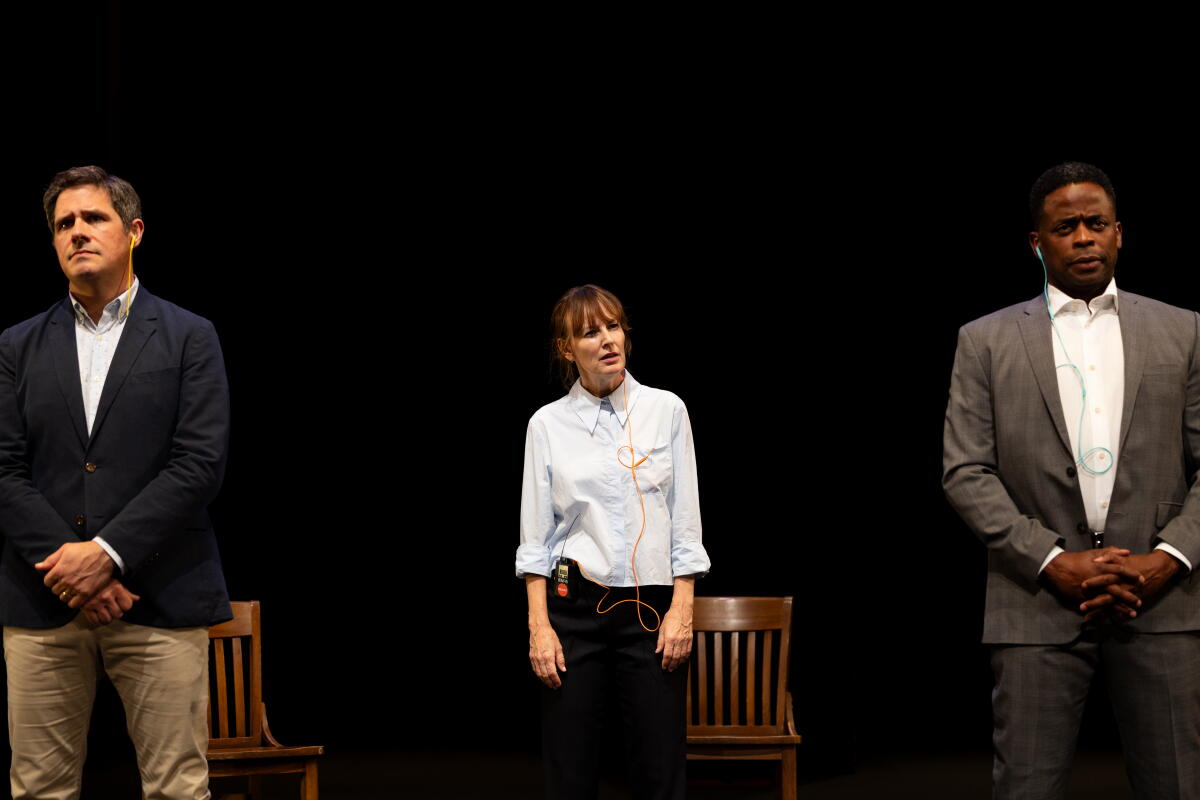
The staging is simple. A circle of nine stately wood chairs on a bare stage. Four actors, affixed with in-ear monitors, occupy different seats as testimony is elicited, provided and undermined.
The Senate Judiciary Committee is back in session in “The Ford/Hill Project,” now at REDCAT through Saturday. What follows is some of the most riveting and distressing testimony ever delivered in such a setting.
Anita Hill and Christine Blasey Ford are called back to testify under oath about the Supreme Court nominations of Clarence Thomas and Brett Kavanaugh, respectively. This documentary drama, created by Elizabeth Marvel and director Lee Sunday Evans, is composed from the verbatim transcripts of these painful proceedings.
In 1991, Hill testified that Thomas had repeatedly sexually harassed her when he was her supervisor at the U.S. Equal Employment Opportunity Commission and the Department of Education. In 2018, Ford testified that she had been sexually assaulted in 1982 by a 17-year-old Kavanaugh when she was 15.
Marvel and Evans create a double helix from excerpts of these two hearings, which are separated by nearly 30 years yet reveal highly entrenched patriarchal patterns. Two women, summoning the courage to tell what they know about two men who are about to be entrusted with the most consequential governmental power, are put through the wringer as the political machine shifts into gear.
The actors wear in-ear monitors that feed them edited clips from the real audio of the hearings.
(Angel Origgi / REDCAT)
Marvel, one of the treasures of New York theater, takes on the role of Ford at the Brooklyn Academy of Music in a run that ends Sunday. (The piece premiered at Woolly Mammoth Theatre Company in 2024.) At REDCAT, the superb Rosemarie DeWitt assumes Marvel’s place, standing in for Ford but never attempting anything as crass as an impersonation.
The production, under Evans’ precise direction, manages to find a tone that might be paradoxically described as emotionally resonant neutrality. Those in-ear monitors that the actors are wearing feed them edited clips from the real audio of the hearings.
Ford, a psychology professor with an expertise in biostatistics, answers prosecutorial questions about a life-altering trauma in a manner that leans on her scientific training for security. Hill, a Yale-educated lawyer asked to elaborate on the prurient conduct she was chronically subjected to at work, never loses her professional composure.
“Indelible in the hippocampus is the laughter,” Ford tells Sen. Patrick Leahy when asked about the strongest memory she has of the incident. (Ford’s voice, resounding at the start of the production, keeps the brutality of the assault at the forefront of our minds.)
Hill, played by Betty Gabriel, describes the threatening nature of the unwanted advances that created such a toxic work environment. Aware of the damage that Thomas could inflict on her young career, Hill was determined to do what she could to salvage an extraordinary legal opportunity.
At times during Thursday’s performance, Gabriel appeared to stumble on her lines, but it was hard to tell because Hill is speaking extempore in the most difficult of public forums and she doubles back on her sentences, carefully parsing out her words. What both DeWitt and Gabriel honor exquisitely in their performances is the quiet integrity of these women as they willingly expose themselves to political attacks for the sake of causes greater than themselves — the truth, first and foremost, but also gender equality and the Senate’s advisory role as a cornerstone of American democracy.
The actors change not only their seats but also their roles.
(Angel Origgi / REDCAT)
Dulé Hill channels the presence of Thomas, who eventually theatrically hijacks the hearing by referring to the experience as a “high-tech lynching for uppity Blacks.” Rich Sommer gives us the voice of Kavanaugh extolling the pleasures of beer and barking at senators who pointedly ask about the extent of his drinking.
The actors change not only their seats but also their roles. The interrogated become the interrogators in a way that gets a little blurry when the focus initially shifts from Hill and Ford to Thomas and Kavanaugh. But the murkiness doesn’t last long in a production that achieves an admirable balance between objectivity and emotion, abstraction and representation.
The restraint imposed by the production adds to its power. There’s no need to editorialize. The proceedings skewer themselves.
When Sen. Alan Simpson quotes from “Othello” in defense of Thomas, he uses Shakespeare’s lyrical authority but fails to realize that he is in fact invoking the false words of the tragedy’s villain, Iago. Not that the easily impressed senators, eager to exculpate a favored man, took note of the irony.
The patriarchy cares mostly about shoring up its own power. Thomas and Kavanaugh were part of the Supreme Court majority that voted to overturn Roe vs. Wade.
The ending, the only time when Evans’ direction loses its poise, blares “make it right,” performed by the Tune-Yards, as Thomas and Kavanaugh, adorning themselves in black robes, find their seated place according to seniority among the nine chairs. The theatrical flourish seems jarring, but so too is the historic moment.
“The Ford/Hill Project” filled me with sadness but not despair. The bravery of Hill, who educated a nation on sexual harassment, and the emotional strength of Ford, who bared her trauma for public enlightenment, live on in the American consciousness as it progresses, in fits and starts, toward justice.
Premiering Sunday on PBS, “Trespasses,” a four-part adaptation of Louise Kennedy’s 2022 debut novel, is a story of love in a time of choler. Set outside of Belfast in 1975 during the Troubles, it follows a clandestine affair between Cushla Lavery (Lola Petticrew, the serial killer in “Furious”), a 24-year-old Catholic elementary school teacher, and Michael Agnew (Tom Cullen), an older, married Protestant barrister known for defending stone-throwing Catholic youth with an eye to keeping them out of the IRA.
Emptying the thesaurus, press materials stress the hot stuff — “scandalous,” “risqué,” “racy,” “torrid,” “titillating” and “steamy” — and while there is more than a modicum of modest sex scenes, the actual tone of the limited series, as adapted by Ailbhe Keogan and directed by Dawn Shadforth, is quite measured; it runs on talk. That’s not to say, given the setting and the setup, which betokens tragedy as surely as Romeo meeting Juliet, it doesn’t throb with tension, let’s say, three-quarters of the time.
Along with teaching, Cushla works for her brother Eamonn (Martin McCann) at the family bar. The clientele includes Catholics and Protestants, united in their love of whiskey, lately including Michael — whose opposition to extremism grants him the honor of being disliked by both sides — seemingly there expressly, even too expressly, to gaze upon Cushla while he pretends to do crosswords. And she gazes back. Moving through discussions of Malcolm McDowell’s typecasting and group lessons in Irish, led by Cushla, they will go beyond gazing.
She’s a ray of light; he’s magnetically mature. You may or may not buy the mutual attraction the series insists upon, or for that matter, trust the lovers’ motivations. (I think we’re meant at least not to wholly trust Michael, as the older party, with a reputation as a womanizer — I didn’t, anyway.) But you will also be invited to change your mind. Because the camera never leaves Cushla’s side, anything there is to learn we learn along with her, which pays some dramatic dividends and means we’ll be forced to revise earlier judgments, usually for the better.
It’s a dangerous liaison. Michael, who is given to speechifying (and actual speechmaking), declares, “We cannot let the old bigots and the boys with guns tell us how to live … Otherwise nothing will ever change. Hate wins” and, in a favorite refrain, “We must find the bravery to choose freedom over fear.” Cushla, however notes that she comes “from a long line of Catholics that have survived by keeping their heads down and their mouths shut. Having a big opinion like yours, it’s a luxury I don’t have.”
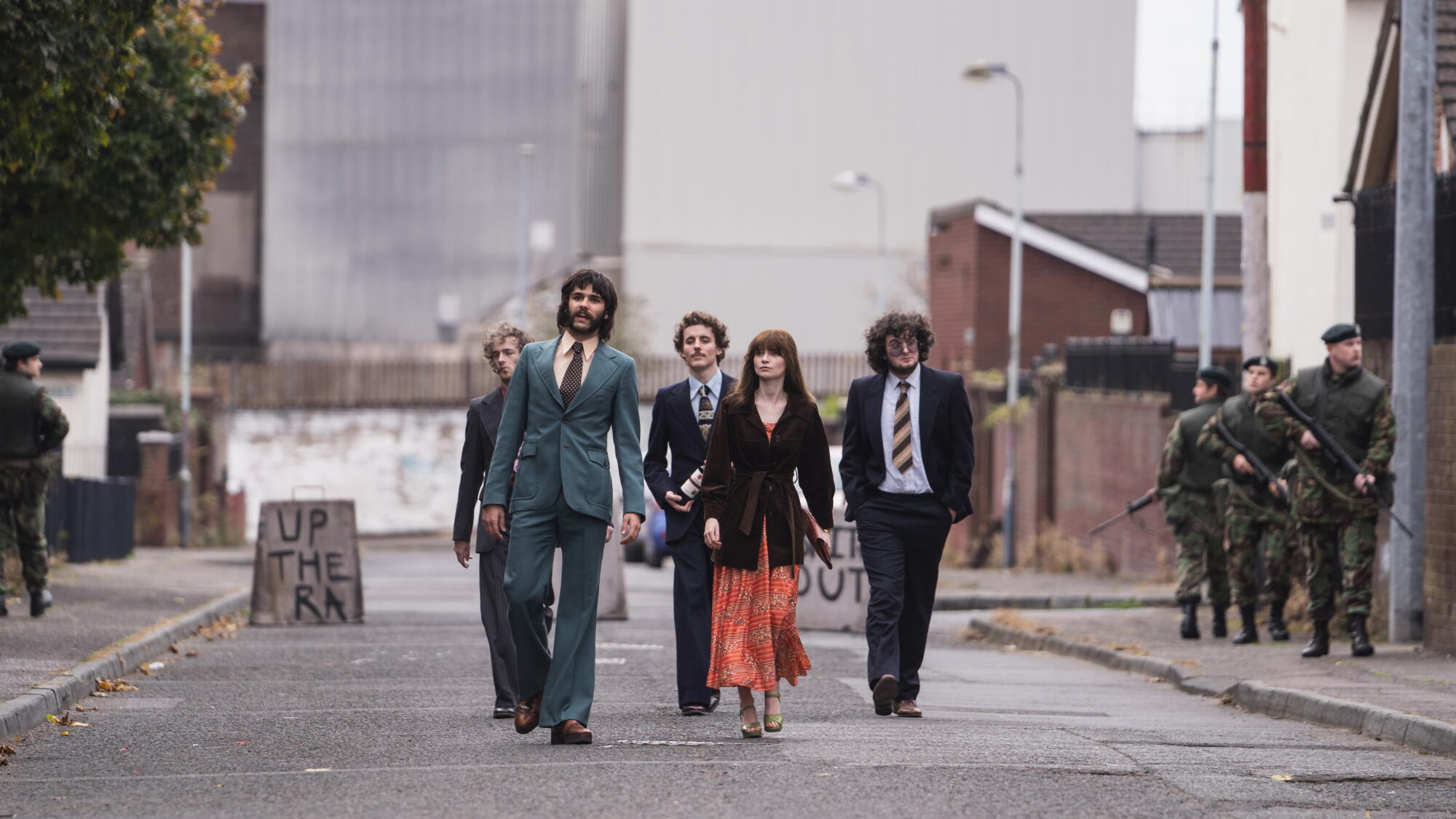
Gerry Harkin (Oisin Thompson), left, Cushla’s colleague and confidant.
(Peter Marley / Channel 4)
Many shots are framed as if Cushla and Michael are being watched, whether or not they are, though sometimes they are, including by each other. (“They like to let me know they know where I am,” Michael says, when Cushla mentions seeing a patrol car outside his flat.) We’re shown the oppressive presence of loyalist troops, and some anti-Catholic vandalism, and a neighbor reflexively checking his car for a bomb, but the greater violence comes through as background noise on the radio or TV news, or reported by Cushla’s young students.
Fortunately, if no less terribly, there is more to the story, and many of the most compelling scenes have little or nothing to do with Michael. (Every scene is a Cushla scene.) She’s wonderful with her class, and her colleague and confidant Gerry Harkin (Oisin Thompson), who will jump onstage at a school assembly to interrupt a strident, bigoted superior, leading the students in a peace song — “Take away the hate and the violence / Bring love into our hearts.” Viewers will consider his bowl haircut a romantic nonstarter, but there are levels to be revealed.
Cushla may not have the luxury of big opinions, but as an obviously good person, whatever one thinks of adultery, she’s unafraid to go against the grain in support of her student Davy McGeown (Daithi Ó Haragain), whose mother (Emily Taaffe) is Protestant and whose Catholic father, in the child’s words, has been “beat up for loving my mummy.” She’s also supportive of Davy’s bright older brother Tommy (Conlaoch Gough-Cunningham), teetering on the edge after the attack on his father.
Above all, there is Cushla’s mother, Gina, played by Gillian Anderson, in a downward spiral since the death of her husband, some two years earlier. Introduced in a state of drunken collapse, Anderson — fearful, bitter, despairing, protective — is quite magnificent limning different levels of intoxication. But she’s even more impressive in her sober scenes, participating in the world beyond her couch, bringing food to the McGeowns and, finally, acting as a mother to Gina.
Michael’s declarations not even aside, Keoghan has a gift for writing dialogue that feels native to the speaker and doesn’t land heavily on a point, and apart from the lovemaking interludes and a gauzy montage of a romantic trip to Dublin, Shadforth’s naturalistic direction enhances the drama by not underscoring it. She has an especially convincing way with party scenes — a school disco, a wedding, an art opening, a birthday party (at which Michael performs a soulful, foreshadowing version of the Carter Family’s “The Last Move For Me”) — where so many productions fall down.
Come for the promised steaminess. Stay for the rest of it.
After his existential suburban horror epic “Weapons” became an Oscar winner (for Amy Madigan’s chilling supporting performance as Aunt Gladys), filmmaker Zach Cregger has dashed off a fun little riff on one of his favorite video games. His “Resident Evil” reboot is the eighth film in the big-screen franchise based on the Japanese zombie survival game, though Cregger’s “Resident Evil” is its own beast — put those Milla Jovovich movies out of your head entirely.
There are, of course, a few shared strands of DNA in the screenplay by Cregger and Shay Hatten: an evil company, Umbrella Corporation, responsible for a virus that mutates humans into zombies and all manner of monsters, located in the lovely Raccoon City. But our hero, Bryan (Austin Abrams), a hapless medical courier, knows none of this when he takes a gig delivering what he thinks is an organ on the snowy mountain roads to the metropolis.
Abrams, who was a standout in the ensemble cast of “Weapons,” has another big movie out this fall in which he stars as the lone protagonist, “Whalefall,” and the two films comprise an apt survival thriller double feature. In “Resident Evil,” Abrams’ Bryan spends much of his lonely mission muttering to himself in annoyance and sometimes victory, much like a gamer would. During one self-reflective moment, Bryan yells, “Yeah! Video games!” elated at how his shooting is improving.
Cregger’s approach to “Resident Evil” is to seamlessly blend the cinematic with a gaming experience and his adaptation best mimics the feeling of playing an actual game or watching someone else play one. At one point, Bryan and a comrade he meets along the way (Paul Walter Hauser) marvel at the shooting skills of Maxine (Kali Reis) as if they’re watching her play the game too.
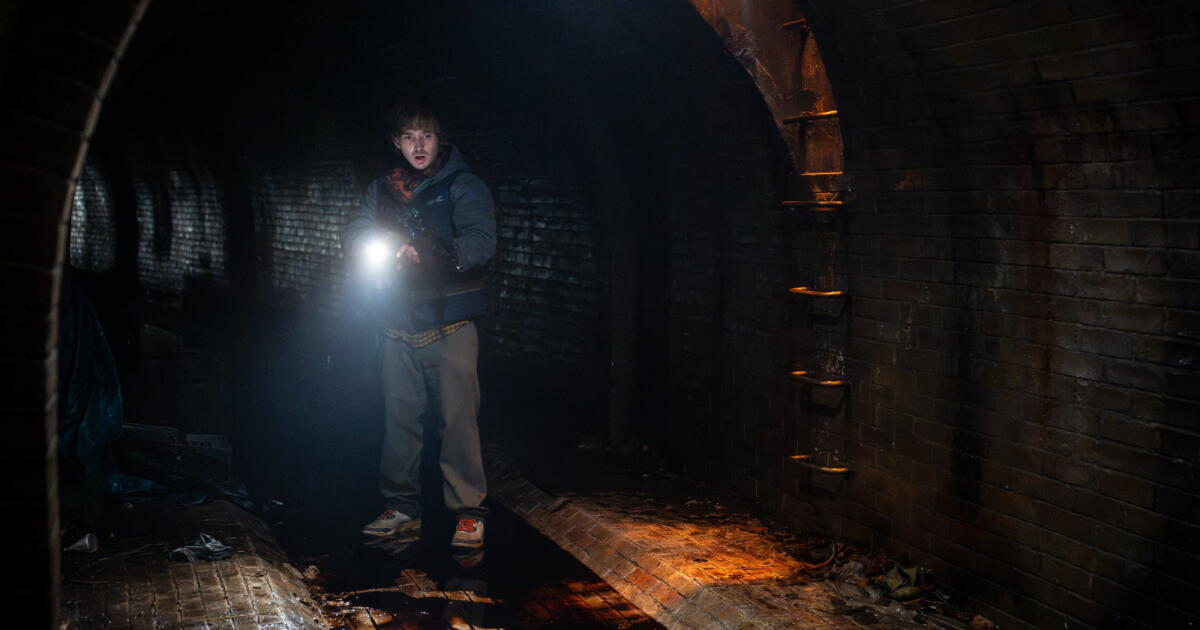
Immediately, Cregger establishes a camera that follows closely behind Bryan, a similar motif to the cinematography he used in “Weapons.” As Bryan starts to encounter the strange beings who appear on the outskirts of Raccoon City, the game mechanisms click into place. Different characters — villains and helpers — pop up along his journey, as well as different tools and weapons. He frequently encounters locked doors, obstacles and empty spaces that he has to explore. Cregger uses first-person-shooter point-of-view shots, with the long barrel of a rifle or automatic weapon lining up our sights; one running gag sees Bryan, completely hopeless with guns, having to shoot the locks off of gates.
What was already a very darkly funny and incredibly gross film gets even more disturbing as Bryan ventures into the Raccoon City hospital, trying to make his delivery. He encounters monsters that vomit acid or explode with zombie rats; one particular ward is full of undulating sacs of bloody viscera.
Cregger remains one of our finest horror image-makers, creating surreal and snowy landscapes that are as beautiful as they are disturbing: the red and blue lights of a flipped police car in a blizzard, dark pools of blood and mysterious footsteps, tentacles greeting and meeting each other, stomach acid decimating an elevator. With impeccable sound design and an eerie score by Ryan and Hays Holladay, Cregger delivers a textured, wholly realized world.
But our guide is just a regular guy, which lends to the charm. Bryan is dealing with relationship problems that add to the urgency of his desire to survive, but he’s also just a dude with questionable self-preservation instincts, which makes for a good adventure. He has an overwhelming desire to help, which leads to some ridiculous circumstances and is a quality that Cregger plays for laughs. Abrams plays the goofball well and we’re constantly rooting for him, even as his fortunes take a turn in a tragic reversal that we’ve seen in monster movies before.
Cregger wears his influences well and they aren’t just video games but pulled from the history of horror. Still, he blends it all into his own vision so it doesn’t feel derivative. While the unwieldy ending might get away from him, the tightly controlled and efficient stretch that precedes it is the work of a new master, one who delivers imaginative, terrifying and hilarious thrills and chills, whether he’s reanimating a dead franchise or dreaming up his own uncanny vibe. “Resident Evil” might be his most playful — and gooey — film yet.
Katie Walsh is a Tribune News Service film critic.
‘Resident Evil’
Rated: R, for strong bloody violence, gore and language throughout
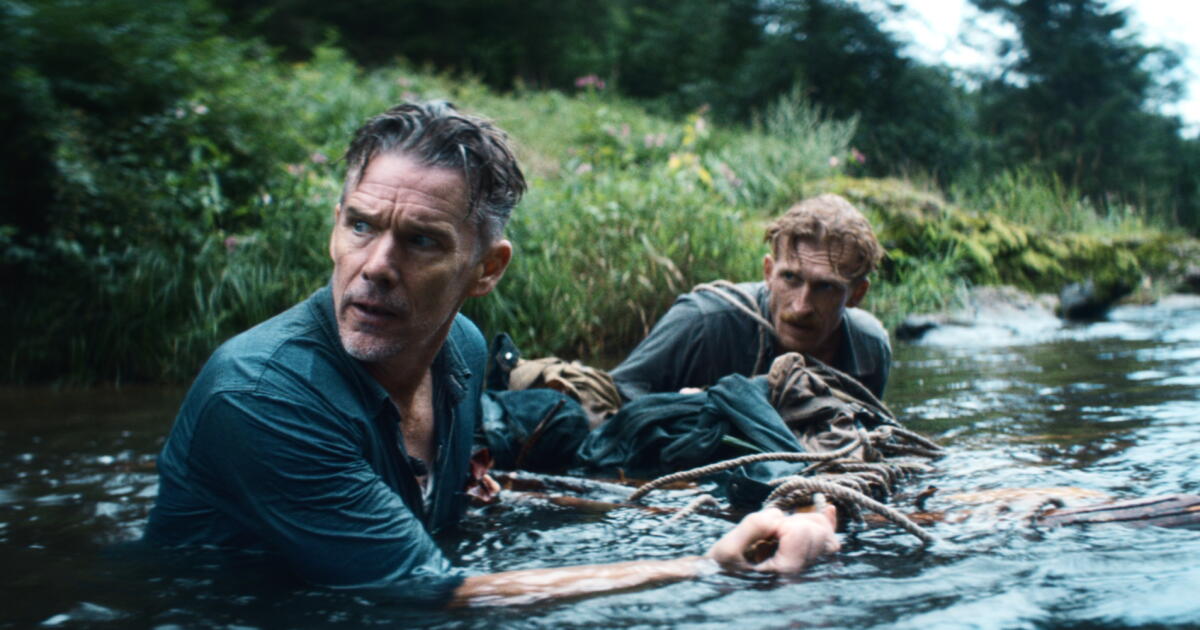
Somewhere in the overlap between William Friedkin’s 1977 action thriller “Sorcerer” and Kelly Reichardt’s 2020 Pacific Northwest pioneer indie “First Cow” lies Padraic McKinley’s directorial debut “The Weight.”
“Sorcerer” is about a group of fugitives driving a load of dynamite across the jungle; “The Weight” follows a group of Depression-era convicts transferring gold through the forest. “First Cow” is about the sweetness of friendship and French pastries in the wilds of Oregon during westward expansion; “The Weight” is about the corrupting forces of capitalism. McKinley’s movie marries the instincts of modern indie filmmaking with a New Hollywood ethos, while bringing an authenticity to the details of the period.
We follow the story of Murphy (Ethan Hawke), a World War I vet and single father in Eugene, Ore., struggling to provide for his daughter, Penny (Avy Berry), three years into the Great Depression. After an unfortunate run-in with the law, Murphy finds himself in a prison labor camp, building a road and trying to shorten his sentence so he can get out before his daughter is adopted by a new family.
Opportunity presents itself in Murphy’s foreman, Clancy (Russell Crowe), who takes a shine to him after he fixes his car and devises an ingenious way to remove boulders without dynamite. Cuddly but dangerous, Clancy makes a seemingly simple offer to Murphy: He and three friends can earn their freedom if they hike a load of gold out of a mining camp on the eve of President Franklin D. Roosevelt confiscation of all gold stockpiles.
The how and why details aren’t that important; the story is merely that the prisoners have to get from point A to point B through a rugged forested terrain, under the watch of two intimidating chaperones, Amis (Sam Hazeldine) and Letender (George Burgess). A mining camp servant, Anna (Julia Jones), joins their group as a runaway and while it seems a straightforward task, the arduous and brutal journey is one that is liable to turn these convicts into runaways.
Murphy’s gang weren’t really outlaws to begin with — he was imprisoned for defending his daughter from some undercover cops, while Singh (Avi Nash) was arrested for his associations with socialism. Olson (Lucas Lynggaard Tønnesen) was part of a group going after a judge for seizing Scandinavian farms, while the most hardened criminal among them is Rankin (Austin Amelio), who grew up in juvie. But in order to survive the woods, Murphy will have to dig deep into his wartime past and rely on his own skills and smarts to make out it out intact.
McKinley pours his craft into authentically representing the era, from the perfectly worn denim of the costumes to the refreshingly real and craggy faces of the cast (and thank goodness Hawke and Crowe are respectably aging into their character-actor looks). The Bavarian forest beautifully stands in for 1930s Oregon and cinematographer Matteo Cocco balances ’70s-inspired slow zooms with composed, high-contrast images that hark to early 20th century styles of photography. A score by Latham and Shelby Gaines balances discordant, atonal tones with suspense-driven sound design that captures the creaking noises of the forest and the concealed dangers it holds.
McKinley stages a few bullet-sweating sequences of peril, including a particularly brutal transport of gold bars across a crumbling rope bridge and an underwater accident exacerbated by floating logs. Both are nail-biters but you can’t help but think he could have pushed it even further. Tonally, the film is torn between wanting to be brutally bleak and offering some kind of hope for Murphy and his precocious, adorable daughter.
When “The Weight” leans into its nasty, mean and grim moments, it gets at something that seems closer to truth than the saccharine resolution we fear is coming. It seems like McKinley wants to deliver a crushing blow, but then feints at the last minute, opting for a more optimistic kind of fantasy.
Politically and culturally, what “The Weight” speaks to is as ugly as the violence that occurs in the mud and fog of the forest. But it ends on an oddly cheery note that doesn’t square with what we’ve seen. It’s a cutesy ’70s nod that feels more “Smokey and the Bandit” than “Sorcerer.” The bolder choice would have been to commit to expressing the despairing lessons of this world. We want to see these characters changed by what they’ve experienced, even if it’s dark. We want to see them actually carry the weight.
Katie Walsh is a Tribune News Service film critic.
‘The Weight’
Rated: R, for language and some violence/bloody images
José Rivera’s “Marisol” came out around the same time as Tony Kushner’s “Angels in America,” and both plays, vibrating with millennial anxieties, carry the earthly battle for human survival up to the heavens.
There’s a dramatically prominent Angel (Taylor Scott) as well in Rivera’s drama, now in an Open Fist Theater Company revival at Atwater Village Theatre. This celestial warrior has been protecting Marisol (Jade Santana) without her knowing it throughout her life. Marisol, referred to by a publishing colleague as “Miss Puerto Rican Yuppy Princess of the Universe,” still lives in the Bronx and is assailed by dangers just getting to and from work every day.
After an incident on the subway with a deranged man threatening her with a golf club, Marisol returns to her cramped, noisy apartment to learn that her guardian angel is abandoning her to enlist in the battle to replace a senile God, who (to judge by the ailing state of the universe) has grown too old for the job.
Jack Sharpe and Jade Santana in ‘Marisol’ at Open Fist.
(John Dlugolecki)
Marisol will have to fend for herself in New York, a dystopian landscape where crime is rampant, poverty is pervasive and the unhoused are threatened by roving gangs of Nazi skinheads who set them on fire for kicks.
What follows is a modern picaresque journey, in which a clever underdog has to rely on her wit and wiles to survive a corrupt and perilous world. Rivera’s play, which won an Obie Award, caught fire in its 1993 New York premiere at the Public Theater with its theatrical street sense, savage imagery and Puerto Rican-inflected magical realism.
The apocalyptic fears boiling up in the play are perhaps even more acutely felt today, with the ravages of climate change compounding each year and the threat of AI hanging an existential cloud over our heads.
But what’s most satisfying about this reencounter with “Marisol” is seeing a new generation embrace the play’s kinetic freedom. Rivera, who received an Oscar nomination for his adapted screenplay for the 2004 film “The Motorcycle Diaries,” solidified his reputation with this play after his breakthrough work “The House of Ramón Iglesia.”
Director Amanda Weier and her company approach “Marisol” as though it were a new play. The quicksilver changes of scene in this urban hellscape are handled with crisp dispatch. Subway cars and burned-out streets don’t require much in the way of elaborate illustration for the overhang of menace to be felt.
Occasionally, particularly in the early going, the blocking and Christopher Moscatiello’s sound design seemed to be working at cross-purposes. The production’s adventurousness, traversing every corner of Brad Bentz’s scenic design, can have a diffuse effect.
But the clever props design (Bruce Dickinson and Anna Krause) fills in any shoestring gaps. And Mylette Nora’s costumes artfully conjure both the underworld and the spiritual realm.
Jade Santana and Hutchins Foster in ‘Marisol’ at Open Fist.
(John Dlugolecki)
Santana’s Marisol, likable yet spiky, anchors the revival. Her interactions with the golf club maniac (Matthew Goodrich) and the scarred homeless man (Hutchins Foster) are fearfully intense, as they should be.
Grace Soens, who plays June, Marisol’s confederate at work, and Jack Sharpe, who takes on the role of Lenny, June’s mentally disturbed brother, expand this unstable world, where it’s hard to know who to trust.
“Marisol” is rife with ambiguity. One of the biggest questions is whether Marisol is dead or alive. But the surreal reality extends to the map of New York. Marisol can no longer tell if she is heading north or south. And the number of characters wielding golf clubs as deadly weapons raises the concern that the villains are interchangeable — and that the good guys have all fled.
One thing that’s certain is that Marisol will have to take up the fight for her own future. With no one left to protect her, she’s learning to look after herself and those she cares about. To become, in other words, the hero that’s needed to turn this momentous struggle around.
‘Marisol’
Where: Atwater Village Theatre, 3269 Casitas Ave, L.A.
When: 8 p.m. Fridays-Saturdays, 4 p.m. Sundays. (Check for exceptions and additions.) Ends Oct. 24
As the fall equinox approached from a week away, the Primetime Emmy Awards made its 78th visit, leaving trophies in some hands, the honor of just being nominated for others and bupkes for the rest of the thousands who make what we call television. Once again I have been called to witness (from afar) and report, so let’s get down to it.
It was the turn of NBC (and Peacock) in the round robin of major networks who broadcast the show, and to keep things literally in-house it was hosted by Mariska Hargitay, “America’s sweetheart sex cop Olivia Benson” from the network’s “Law & Order: Special Victims Unit” and broadcast from the Peacock Theater, formerly the Microsoft Theater, formerly the Nokia in #DTLA, formerly downtown Los Angeles.
When reviewing the Emmys, or any awards show, as television in its own right, the only real questions are what distinguishes it from its many previous appearances on the karmic wheel of life — how it tricks up the basic, immutable form, like different decorations on the same sugar cookie recipe you have been using forever. Anything unexpectedly or especially moving, rousing, funny or strange, things that go against the grain of a production that wants to keep things controlled in order to bring the ship in on time.
This year the critic has been given the gift of Hargitay, primarily a serious actor (and director and producer), following in a long line of comedians and comic actors. There have been other serious actors as host, for example, Raymond Burr in 1959, Tom Selleck in 1984 and Angela Lansbury in 1993. And certainly, if you’re looking for someone to represent the medium rather than merely to comment on, celebrate or joke about it, you could do no better than Hargitay, the longest-serving actor on the longest-running prime-time live-action series on American TV. She’s beautiful, glamorous, self-possessed. She was recently on Broadway in “Every Brilliant Thing,” which involved a degree of what comedians call “crowd work,” so standing up in front of a live audience of people no more famous than she wasn’t going to throw her. Professional comedian Nate Bargatze, who hosted last year, was much more of a dark horse.
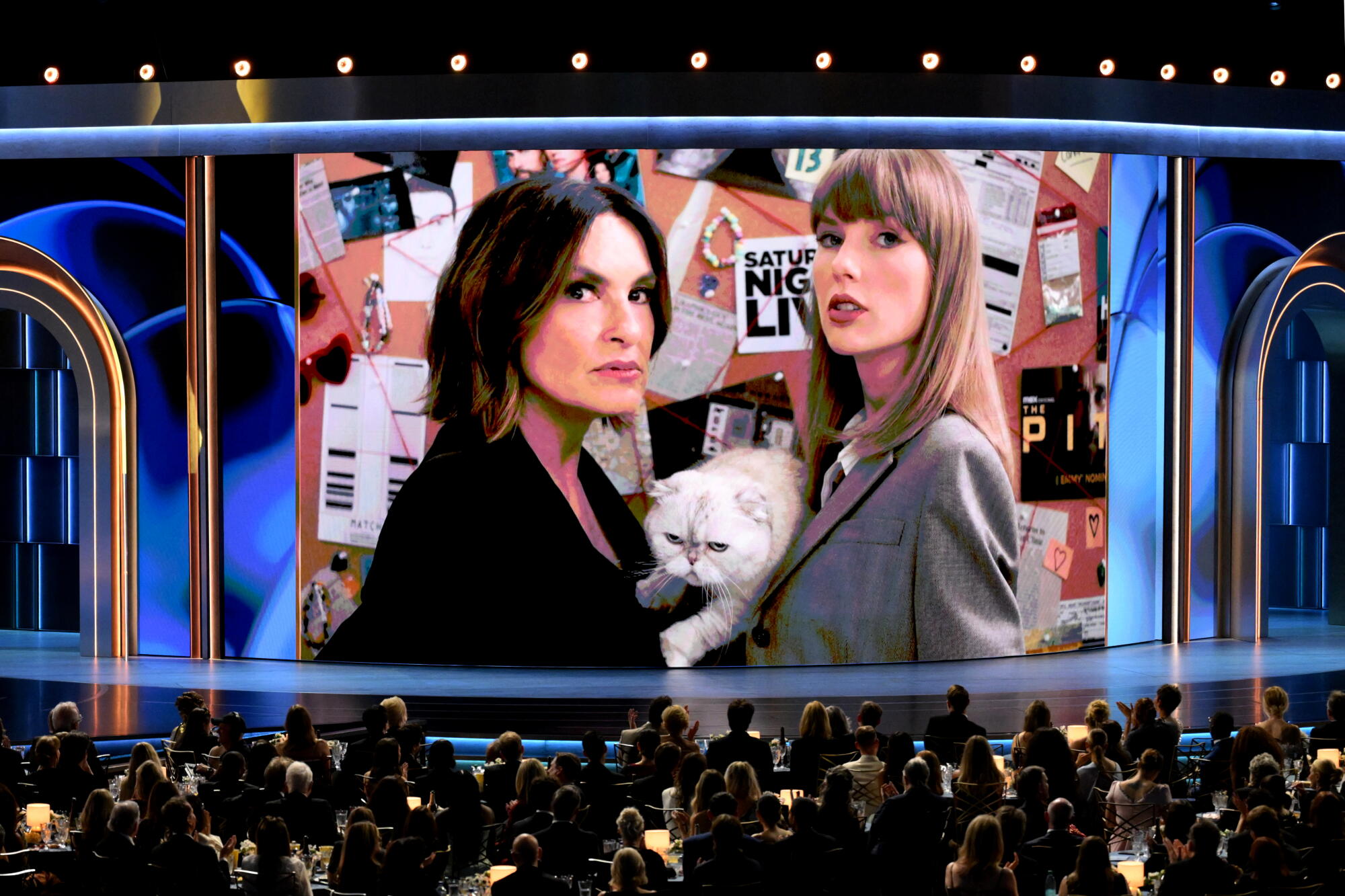
Emmys host Mariska Hargitay with singer Taylor Swift and her cat Olivia Benson on screen during a skit the 78th Primetime Emmy Awards.
(Patrick T. Fallon / AFP via Getty Images)
Although I would have bet on a pre-filmed “Special Victims Unit” routine to open the show, which is why I’m not a gambler, it wasn’t until an hour in that it appeared. (It involved murder-style boards, concerning the Case of Whether Taylor Swift would be making an appearance; she did, in the bit.) The pre-filmed production number that did open the show began with Hargitay and her actual good friend New York Knick Jalen Brunson steaming their clothes when Hargitay suddenly realizes she is due across the country to host the show. This led to Joan Jett’s “I Love Rock ’N Roll” reconceptualized as “I Love TV Screens,” which included the “Widow’s Bay” sea hag revealed to be Jennifer Coolidge, bringing boba tea (rhymes with “TV”); other rhymes matched “eating beef” and “watching ‘Beef’” and “Ed Gein” and “mean.” It moved to the live stage, with Hargitay flanked by dancers with television heads. Both segments felt more effortful than funny, but not unfunny.
On her own, however, Hargitay was above all a woman having a good time, never less than likable and game and enthusiastic, managing the scripted patter as well as anyone might have. Her monologue included several jokes about age, one about “L&O” producer Dick Wolf’s real name (Richard Penis), and another about her inability to pronounce “finale” because she’d never been in one. As is practically an Emmys tradition, some of these were confusing (even to the people performing it), or went on too long (Nick Offerman, cornered at his table, describing his work as an erotic house painter), or just had the effect of having been put on their feet without much, if any, rehearsal. Presenting the final award, for outstanding comedy, Woody Harrelson and Matthew McConaughey, told to stretch — the show was actually running short — described the plot of their upcoming Apple series, “Brothers,” until they were allowed to move on.
As to what the Television Academy calls “creative elements,” everything that isn’t a presentation or a speech, they advertised tributes to the 30th anniversary of “Buffy the Vampire Slayer,” certainly a typo, and the 50th of “Charlie’s Angels,” a logical impossibility, but these were really just themed groupings of presenters — Sarah Michelle Gellar and David Boreanaz in the former, Kate Jackson, Cheryl Ladd and Jaclyn Smith in the latter. (The Angels managed a few words for Farrah Fawcett, but none for Shelley Hack, Tanya Roberts or David Doyle.) But there were full tributes to Dolly Parton (Sally Field enthused, Reba McEntire sang); to James Burrows, with Jamie Lee Curtis pivoting emotionally to talk about old friend Rob Reiner, who won a posthumous guest appearance Emmy this year for “The Bear”; and to Catherine O’Hara, with her “Home Alone” child Macaulay Culkin and “Schitt’s Creek” children Annie Murphy and Dan Levy, who spoke to “helping her build a TV character over the age of 60 that wears leather miniskirts and eight-inch heels and speaks in a strange, sometimes unintelligible transatlantic accent, and know that she will not scare an audience away.”
And there was Julianna Margulies presenting the Bob Hope Humanitarian Award to Michael J. Fox, who, in his usual way, was eloquent and funny, and let the people know about the goodness of Bob Hope, setting up a punchline in the bargain. Like a lot of you, I love Michael J. Fox, and I’m just going to leave that here, with a pile of soaked-through tissues.
John Mulaney stole the show as a presenter at the 78th Emmy Awards ceremony at the Peacock Theater in Los Angeles.
(Robert Gauthier / Los Angeles Times)
But what America will mostly remember from this night was John Mulaney, introducing the award for lead actor in a drama, and burning the house down with a routine that went wherever it wanted. “They can play anything, these nominees. Not just doctors. They can play a cop or an FBI agent or a secret agent. And then that’s it. No other examples.”
“Since the creation of television, men have been historically underrepresented,” Mulaney said, explaining that the medium was all “beauty contests and children talking to hand puppets until the early ’60s. Until a man walked out and said, ‘Enough. My name is Fonzie and the president’s been shot.’” Mulaney is a man who has convulsed crowds in arenas and stadiums, but, as a local, nothing made me laugh harder than the words, “You know, I was shooting down Barham last night at 90 miles an hour.”
Nothing against Hargitay, but it’s clear that Mulaney should host this show, and every awards show, from now on.
Evelina Fernández’s “Antigone: In the Language of Kings” receives a theatrically entrancing staging at the Getty Villa’s Outdoor Theater in a production co-produced with Latino Theater Company.
The adaptation resets Sophocles’ tragedy to Aztec culture in a transposition that is both visually and musically enlivening. If the drama is oversimplified, it nonetheless makes for a gripping spectacle.
It’s not easy to find analogies that can reanimate the importance of burial rites to a modern audience. The production’s creative team, led by the inexhaustibly inventive director José Luis Valenzuela, returns us to a world where the dead are owed sacred duties and the living are fearful to renege on this basic human responsibility.
The incense-filled production — conducted in English, Spanish and Nahuatl (the language of the Aztecs), with English and Spanish supertitles — proceeds like a pageant. Headdress-clad warriors clash on the battlefield. A masked chorus, moving with the coordination of a Broadway musical ensemble, gives voice to the anxiety and grief of the collective. A statuesque figure of death, trailing black fabric, sweeps up the casualties of war with the efficiency of a human vacuum.
In Sophocles, Antigone, Oedipus’ headstrong daughter, defies the edict issued by her uncle Creon, the newly deputized king, declaring that her slain brother Polynices is an enemy of the state and therefore ineligible for burial. For Antigone this is an imposition of political power over divine law, and she puts her life on the line to uphold her obligation to her family and faith.
The ensemble of “Antigone: In the Language of Kings” at the Getty Villa Museum Outdoor Classical Theater.
The German philosopher Hegel considered Sophocles’ “Antigone” the high-water mark of tragedy for the way it dramatizes the collision between two equally justified moral positions. Creon, representing the claims of the polis over the clan, cannot be dismissed outright. Nor can Antigone, whose all-consuming identification with her cause renders her indifferent to other obligations, be adopted as a user-friendly hero.
Tragedy arises from the one-sidedness of their claims. Antigone loses her life and Creon, for all intents and purposes, destroys his own, suffering the deaths of his most cherished loved ones.
Hegel’s reading of “Antigone” illustrates his thesis-antithesis-synthesis view of dialectical progress. Sophocles, it can be surmised from the other plays in his Oedipus cycle, likely conceived “Antigone” with a larger metaphysical design. But even if Hegel’s interpretation would have seemed off the mark to him, Antigone and Creon are too complex to reduce to a schematic argument.
Fernández simplifies these antagonists. Her Antíkona (a formidable Esperanza América) reveals her softer side even when rejecting her sister, Ixmene (Alexis B. Santiago), for not having the courage to zealously join her fight.
Tlahtoani Klion (Cástulo Guerra), Emperor of Tenochtitlan, is a ruler so intoxicated with his own authority that he’s clearly courting rebuke from the gods. It’s only a matter of time before his hubris is slapped down.
The acting is theatrically robust, though not always subtle. I wondered if ambiguity had been outlawed along with the funeral rites of Antíkona’s warrior brother Polynices. The bold clarity of the performances was energizing, but the wailing sometimes sounded like parody grief.
The outsize nature of the production invites overacting. And Ric Salinas, who plays Chachalacani, humorously obliges, bringing his Culture Clash vaudeville skills to the role of the sentry who’s caught between the rock of Klion’s tyranny and his fellow feeling for Antíkona’s sympathetic cause.
Strong performances are elicited from José Eduardo Moreno, who plays Klion’s son Hemon, Antíkona’s fiancé, and Zilah Mendoza, who plays Cihuatlahtoani Euridice, Klion’s wife. Their portrayals, mixing ferocious strength with stark vulnerability, make the tragedy’s pileup of bodies at the end all the more piercing.
The ensemble of “Antigone: In the Language of Kings” at the Getty Villa Museum Outdoor Classical Theater.
América’s Antíkona is as unyielding as any Antigone I’ve seen. It’s a commanding portrayal, but I wish the production didn’t shrink from its protagonist’s fierceness. The obdurate side of the character is lessened with a gesture Antíkona bestows on Ixmene — a reassurance that even though she’s a revolutionary, she’s still an affectionate sister.
Sophocles is made of harsher stuff. Fernández’s adaptation is anxious to turn tragedy into a sermon, offering theatergoers moral solace where Sophocles leaves his audience in a contemplative state of stunned silence.
But the staging makes up for the dramatic shortfall. Valenzuela masterly orchestrates the mise-en-scène. The majestic costumes of Catarina Copelli, invoking a rich brocaded world on the brink of disappearance, might be the real superstar.
François-Pierre Couture’s scenic design is mesmerizing without ever being overbearing. “Lee” Xinyuan Li’s lighting heightens the sense of theatrical foreboding. Yee Eun Nam’s projections inject into this transient world a welcome subtlety.
Urbanie Lucero’s choreography and movement direction maintain the production’s graceful poise. The musicians, discreetly performing at the back of the stage under the guidance of Mesoamerican instruments director Christopher García, charge the air with percussive Indigenous wonder.
“Antigone: In the Language of Kings” marks the Getty Villa’s 20th anniversary of reinventing classical tragedy for our time. This gorgeous staging makes me ardently wish that the theater extends the tradition for at least another 20 years.
Filmmaker Paul Greengrass is often associated with a cinematic aesthetic colloquially known as “shaky cam” — handheld cinematography enabled by lightweight digital cameras that function a lot like another character in the room, on foot, at eye-level, responding and reacting to action and dialogue the way a person would.
It’s a style that has served him well in modern action thrillers like his installments of the “Bourne” franchise, and films depicting recent real-world events like “Captain Phillips” and “The Lost Bus.” Now, Greengrass applies his signature style to the Middle Ages — can shaky cam work in a medieval movie?
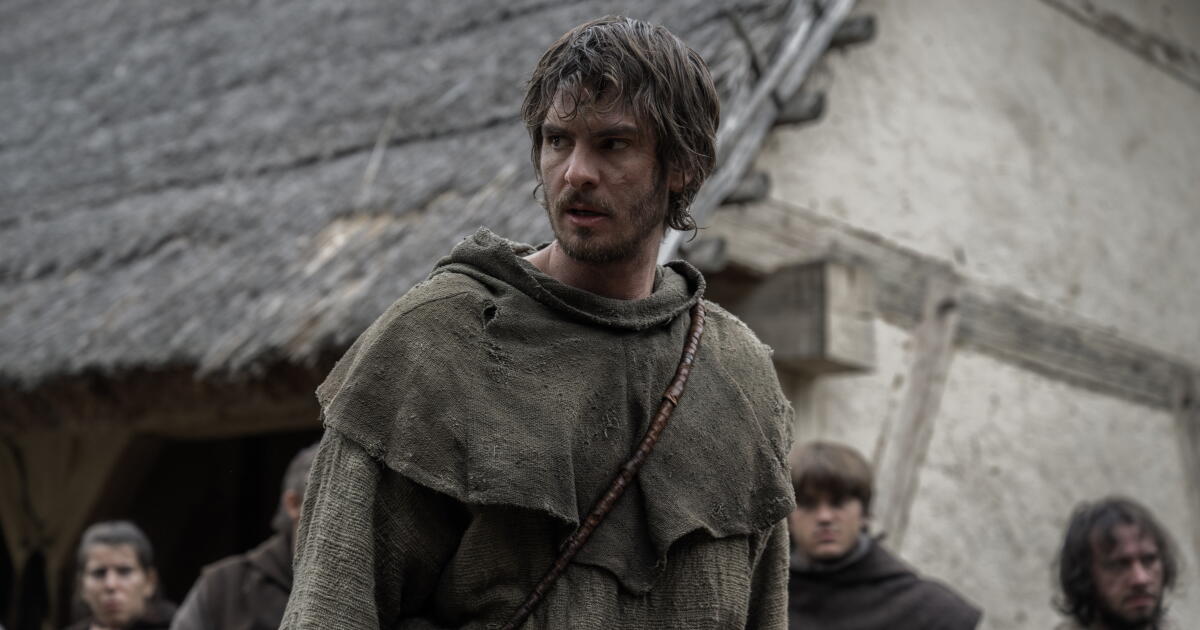
It may seem odd, but it’s a brilliant creative choice when considering that while “The Uprising” is technically about the 1381 Peasants’ Revolt in England, that’s not really what it’s about. It’s about right now.
The shaky cam is intended to jolt us into that awareness. When we pick up with our protagonist, a pathetic ploughman (Andrew Garfield) living a grief-filled and wretched existence, a plague has wiped out half the population. A small group of men hoards wealth and resources, while the peasant class is heavily taxed, laws brutally enforced. As Greengrass lays out the bare facts of this situation with a cinematic style that’s more news documentary than stuffy period piece, the parallels to our own current situation are laid bare.
“The Uprising,” which Greengrass wrote and directed, is told in a fairly simple fashion, with an emphasis on visual storytelling and visceral sensation (the disparate English accents are also lost in the melee of the mob). All we need to know is that the council advising the 14-year-old King Richard II (Woody Norman) conspires while the young royal prays and his mother (Katherine Waterston) glowers. Outside, a bloodthirsty mob armed with farm tools marches on London, led in part by Garfield’s ploughman, who started his own local uprising when he fought back against the taxman. He joins forces with Wat Tyler (Cosmo Jarvis), a former soldier, and John Ball (Jamie Bell), a priest deemed heretic, as the crowd demands an audience with the king.
As the chaos unfolds, Greengrass doesn’t pontificate on the morality of these events and, in fact, maintains a rather neutral stance on them for most of the film, withholding judgment. A revolution is not right or wrong for most of “The Uprising.” It is simply inevitable under the conditions the film presents.
The ploughman wants to play by the rules, but it’s how the revolt plays out that radicalizes him. While Greengrass shows us the uprising in all its messy confusion as the logical outcome of oppression, by following our protagonist as he witnesses treachery and deceit, Greengrass ultimately arrives at the belief that revolution is necessary, even in failure, and that freedom is worth more than anything.
The opening and closing of “The Uprising” are bracing and stark in their storytelling — the middle is a bit mushy and confusing. But it’s the performances that carry us through. Garfield, sensitive and earthy, is our bellwether as the events descend into bloody carnage dictated by muddled agendas. When he turns, we turn, and the anguish that Garfield wordlessly conveys is our compass.
Greengrass surrounds Garfield with actors who deliver bigger performances, like Jarvis as the brutish but shrewd Tyler, and Bell as the fervent Ball. Thomasin McKenzie plays a young woman, Alyce, steeped in her own trauma and loss, who attaches herself to the ploughman, and her ability to express wide-eyed, barely contained hysteria and fear is unmatched. Young Norman is riveting as the increasingly dastardly king.
The Peasant’s Revolt of 1381 is a fascinating moment because it’s a time when the notion of democracy wasn’t even a twinkle in a feudal servant’s eye. The mob’s actions are frustrating because they’re religiously bound to the king, who they believe is an emissary of God, and desperate to change their day-to-day existence. When those two instincts collide, it’s bound to be complex and conflicting, and Greengrass delivers that with a boots-on-the-ground style.
The murkiness of it all clarifies by the end of the film, not just in terms of its heroes, villains and message, but Greengrass also situates this story within a recognizable cinematic and storytelling history. There’s a thrill as it all comes together. Greengrass might be taking a big swing (of the scythe), but his blade finds its target nevertheless.
Premiering Sunday at midnight on Adult Swim, a most appropriate and maybe the only possible space, “The Terrors of Jordan Mendoza” is, as its creator describes it in a prologue, “a ‘Twilight Zone’ sketch show,” which is just what I would have said after watching eight of its 13 11-minute episodes, had he not said it first. Emphasizing its Asian bonafides — Mendoza is Filipino American — he adds, “It would be almost racist if you didn’t do it.”
Mendoza, who stars in, directs and, with David Machajewski, writes the show, has said that some of the ideas come from actual dreams — the “terrors” in the titles are nightmares — though if my own dream life is anything to go by, the jokes are more clever and the narratives at once weirder and more cohesive. At various times it recalls the eeriness of David Lynch or the non sequitur logic of Luis Bunuel, and it has something of the flavor of “The Vince Staples Show,” which also went to some strange places in its too-short life.
Sketches, of varying lengths, build a central idea out in every direction, and a little farther than you might expect. We meet a therapist obsessed with Wendy’s. Batman, convinced that he has adult ADHD because an online quiz told him so (“I know a lot of people claim they have ADHD,” he tells Alfred, “but in my case I think I really do … I’m creative but easily overwhelmed, organized but at the same time not”). A dying man (Steve Buscemi) is obsessed with getting his last words right; a prisoner is sentenced to “15 hugs and kisses” from the “nearest judge.” A bank robber holding hostages demands to be “a famous snake … and if you can’t get on board with that then everyone in here is going to die.” In a horror movie pastiche, Mendoza is dogged by middle-aged white men compelled to tell him that their wife is Asian, which does sound like something from personal experience.
Wherever the comedy goes, it’s played straight and with intensity, as is the terror. The show can be genuinely disturbing and genuinely funny. (Two things can be true at once.) There’s also a scene in which Mendoza, playing a character convinced he’s a Harry Potter wizard, runs into a brick wall he thinks he’ll pass through, and, there’s nothing more liable to make me laugh than that, unless it’s someone hitting their head on a low door frame or suddenly falling over for any number of non-fatal reasons.
Mendoza, who is in his mid-30s, has a string of writing and acting credits, including writing for “Dave,” Dave Burd’s comedy about a suburban Jew from Philadelphia who believes himself destined for rap greatness, and parts in Julio Torres’ “Problemista” and “Fantasmas,” which are located in the same hemisphere of alternative comedy. He has the Rolodex of a well-connected person; the guest list is impressively loaded for someone making his first show.
The great Martha Kelly (from “Baskets”) plays a masseuse who exteriorizes her client’s pain, and in another sketch, she’s a woman sitting in on a confirmation class in order to learn where Jesus might be “lodging” when he returns. (She has a plan.) Kate Berlant invites Mendoza to what turns out to be a one-woman poetry slam, held in secret to avoid the Slammers Union (“They’re like the Sopranos, only violent”). Chris Parnell, Randall Park, Wanda Sykes, Thomas Lennon, Clea DuVall, Lake Bell, Toby Huss, Mark Maron, Fred Armisen and Gregg Turkington (from the world of “On Cinema at the Cinema”) all muck in.
You should know from the above whether this might be your sort of thing. (It won’t be everyone’s, but it’s definitely up my dark, crooked alley.) But, really, it’s even better than these descriptions might lead you to guess, elevated by the first-class production, assured performances (Mendoza is himself very good) and everyone’s commitment to whatever bit is up at the time. The devilishness is in the details.
It’s been five years since “Call My Agent!,” known in its home country as “Dix pour cent” (“10 percent”), ended with the staff of Paris’ bankrupt ASK talent agency moving en masse toward the exit, as in the closing moments of “The Mary Tyler Moore Show.”
The rich workplace comedy mounted four seasons from 2015 to 2020; the fourth was made without its creator, Fanny Herrero (she went on to create the fine but less successful “Standing Up,” about Parisian comics). But she has returned, along with “Standing Up” writer Lison Daniel, for “Call My Agent! The Movie,” premiering Thursday on Netflix, which picks up the scattered ensemble more or less where they imagined they’d be when the series ended, and gets them back in the same frame.
As a movie, it’s its own sort of beast — a complete statement in a single package, with not just A and B stories, but C and D as well, and arcs that might develop over a season of the show compressed into a couple of hours. But its essentials are essentially unchanged: It’s still about the difficulty of making art, and the often unsavory business that lets art get made, with known actors playing fun house versions of themselves and our heroes attempting to wrangle them into order, with whatever works — lies, bribes, real shared feelings. The regular cast, many of whom Americans will first have met here, still feel identical with their characters, rather than just professionals who have been paid to play them, so that even when the action is outlandish the emotions are real.
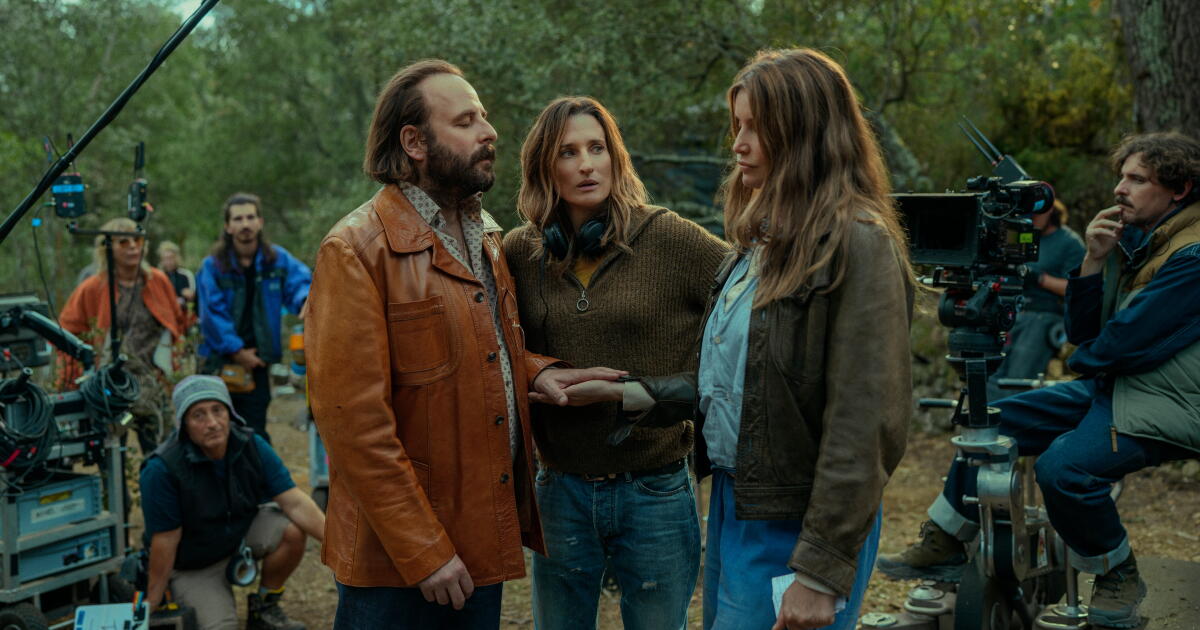
The focus here is on the fierce Andréa (Camille Cottin), who has left agenting and is about to direct her first movie, a drama set in the woods, and Noémie (Laure Calamy), whom Andrea hires as a replacement producer — she has become the producer of a hit workplace comedy, “Les Colleagues,” the sort of show that produces a lot of branded merch — believing that she can mold Noémie to her will. On the domestic front, Andréa separated from partner Colette (Ophélia Kolb), a co-parent to her daughter Flora — some sticky questions will arrive, doubling the pressure.
Noémie is still with Mathias (Thibault de Montalembert), once the most formidable of agents, who has quieted down somewhat owing to a Season 4 heart attack, and the fact that he’s working in the agency his daughter Camille (Fanny Sidney) announced at the end of the series. He’s feeling old (comparatively, he is, at 64 — though Liliane Rovère as agent emeritus Arlette beats him at 93) and things with Noémie are not great, which sets the stage for some romantic comedy, including a wild boar.
Andréa’s movie brings the old cast together, including sensitive junior agent turned aspiring actor Hervé (Nicolas Maury), and I am glad to see them. (Stéfi Celma’s Sophia, a receptionist turned actor, is sadly missing.) Much goes wrong, before things go right. (It’s a comedy, they will — though there are some moving dramatic moments along the way.) To be sure, there are no backstage comedies — or dramas, or dramedies — in which nothing goes wrong, or things even go mostly right. Disaster is the air they breathe.
On the eve of production, Andrea loses her male lead (Laurent Lafitte as himself) to a Wes Anderson movie; the psychologically delicate actor they get to replace him, Vincent Macaigne as himself, who’s represented by former ASK agent Gabriel (Grégory Montel), now working for their old rival, has a messy history with the other lead, Laetitia Casta, also as herself. They can barely work together. (There will be a bit of romantic comedy wrapped around this thread, as well.)
Then there’s a storm.
The French actors playing themselves are not well known here — Casta may be more familiar as a ’90s supermodel, for those who are familiar with that sort of thing — but Americans have been given the gift of cameos from Eva Longoria and an uncredited George Clooney who takes a comically unproductive lunch meeting with Andrea, crashed, in more than one sense, by Noémie.
Though the series finale made for a satisfying ending, there was already talk then of another season or a film. Still, “The Movie” arrives seemingly out of left field, as sort of a happy surprise. It doesn’t betray its legacy. We know from the supermarket magazines and internet scandal sites that some actors are seemingly as crazy as these actors pretend to be. But somehow movies get made. Most every show business satire is also a show business celebration. There’s no business like it.
Fox Corp.’s $22-billion acquisition of San José-based Roku, operator of streaming services and seller of hardware devices, seemed like a straightforward deal when it was announced in June: A growing media company was looking to bolster its presence in the fast-growing streaming industry.
But, on Wednesday, the Trump administration weighed in.
Fox Corp. and Roku said that the companies received requests from the Justice Department on Tuesday for additional information in connection with its review of the merger.
While Fox and Roku downplayed the requests, saying that they had expected the outreach, the timing of the move raised eyebrows among some analysts, who said it could signal further scrutiny of the transaction by the Justice Department.
“The president has been outspoken on the fact that he will take retaliatory action against networks that say things that he doesn’t agree with, or they do things that he doesn’t agree with,” said Rob Enderle, principal analyst at advisory services firm Enderle Group.
The action follows President Trump’s surprise over Fox’s ouster of anchor Maria Bartiromo. She was pushed out after she had shared internal company texts with the White House, which sources told The Times may have been the breaking point.
Trump said on social media that he couldn’t believe that Bartiromo will no longer have her shows on Fox. “Her fans, of which there are many, will not be happy,” he wrote on Truth Social on Sept. 3.
Associate Atty. Gen. Stanley Woodward said the Justice Department could not comment on pending matters but said in a statement: “We can affirm that this DOJ under President Trump’s leadership will continue to prioritize affordability for all Americans across our economy.”
Fox announced in June its plans to acquire Roku for $22 billion, which would give the company access to Roku’s 100 million households that use its platform to connect to different streaming services. The deal would benefit Fox’s advertising business, as well as make it less reliant on traditional pay TV platforms.
Fox and Roku said they expect the merger to be done by the first half of 2027, subject to regulatory and shareholder approval, according to a Sept 9 filings with the U.S. Securities and Exchange Commission.
“FOX and Roku will continue to work cooperatively with the DOJ in its review of the Mergers,” Fox said in its filing.
Some legal experts said it is fairly standard for the Justice Department to make an additional request for information.
“It doesn’t mean that their review is going to be more extensive than usual,” said Ray Seilie, an entertainment attorney at law firm Kinsella Holley Iser Kump Steinsapir.
For example, the Justice Department made a second request for information when it reviewed Paramount Skydance’s deal to buy Warner Bros. Discovery, he said. The merging companies typically send information that helps the government figure out what the market impact will be of a merger, he added.
The Justice Department ultimately approved Paramount’s planned acquisition, despite opposition from some industry stakeholders. State attorneys general and the Writers Guild of America have sued Paramount over the deal, raising antitrust concerns. Others have pointed out close ties between Trump and Larry Ellison, a financial backer of the deal, who has also donated money to a group that supports Trump. Ellison’s son, David, is chief executive of Paramount Skydance.
Legal experts and analysts said they don’t think the combination of Fox and Roku raises antitrust issues because they are not dominant players in streaming and have businesses that complement each other.
But one wild card is Trump.
“You never know what Trump is going to seize on and decide he wants to do,” said Bryan Sullivan, a partner with law firm Early Sullivan Wright Gizer & McRae on whether Trump will take retaliatory action through the Justice Department in the Fox-Roku deal. “It’s chaos in the federal government and it could very well happen because of that reason, but it could also just be a blip and not a big deal.”
Times staff writer Stephen Battaglio contributed to this report.
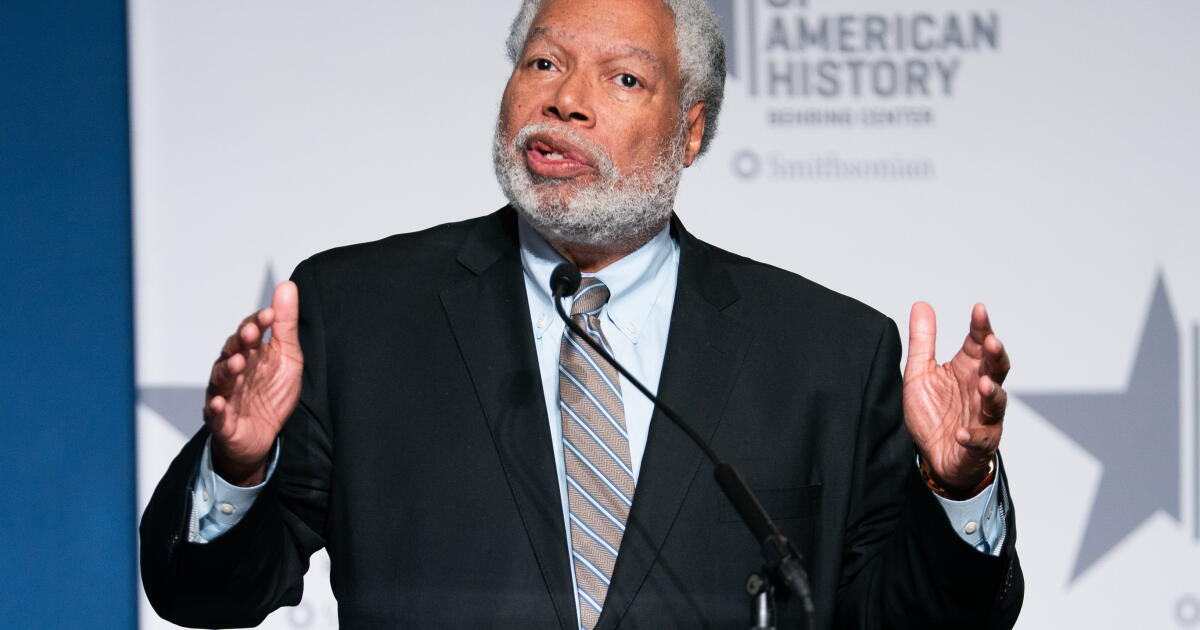
WASHINGTON — Lonnie Bunch is stepping down from the leadership of the Smithsonian Institution following a tumultuous year in which President Trump tried to remake the portrayal of U.S. history by the Smithsonian museums and other cultural entities.
Bunch said in a news release Tuesday that he was departing the position he had held since 2019 “with very mixed emotions and heartfelt gratitude.” The Smithsonian said he would leave the post at the end of the year.
Bunch’s departure comes two months after a White House report branded the leaders of the Smithsonian Institution, especially at the National Museum of American History, as radical activists who cannot be trusted, an indication that Trump could be preparing to install his own team.
Anthea M. Hartig, the first female director of that museum, faced growing scrutiny from Trump and other Republicans over the summer after the White House Domestic Policy Council’s report saying the museum’s leadership doesn’t tell history “in a way that is inspiring, unifying, and worthy of our great republic.”
Three weeks after the report’s release, Trump ordered his administration to install signs in front of the U.S. history museum telling visitors that some of the exhibits are inaccurate. Hartig pushed back, telling lawmakers during congressional hearings that the report “does not fairly or accurately characterize the full body of work at the museum.”
There had been speculation that firings were in the offing. Trump doesn’t have the power to fire leaders at the Smithsonian with the swiftness he’s managed at other top cultural institutions in Washington, most notably the Kennedy Center, where a board of his supporters named him chairman.
The Smithsonian operates outside the executive branch and museum directors report to Bunch, who is subject to oversight from a Board of Regents that includes Vice President JD Vance, Supreme Court Chief Justice John Roberts, a bipartisan group of lawmakers and so-called citizen regents.
Roberts, who serves as Smithsonian’s chancellor, said in a release that Bunch had “pursued excellence in the telling of our nation’s story.”
The White House did not immediately return a message seeking comment.
The Smithsonian has been under examination by the Trump administration since 2025 as it has focused on the images and messages presented to the public as the nation approached its 250th anniversary.
A March 2025 executive order, Restoring Truth and Sanity to American History, led to signs being changed at federal parks, exhibits being altered or in some cases removed, and military bases being renamed. Trump specifically cited the National Museum of African American History and Culture and argued that the Smithsonian as a whole was engaging in a “concerted and widespread effort to rewrite our Nation’s history.”
Several months later, the White House ordered a wide-ranging review of the Smithsonian museums and exhibitions before the country’s 250th birthday, with a goal of aligning the institution’s content with Trump’s interpretation of American history.
In a letter sent to Bunch at the time, the White House detailed the steps it expected the organization to take as part of the announced review. The examination is of all public-facing content, including social media, exhibition text and educational materials, to “assess tone, historical framing, and alignment with American ideals,” according to the letter.
That review initially focused on eight museums — the National Museum of American History, the National Museum of Natural History, the National Museum of African American History and Culture, the National Museum of the American Indian, the National Air and Space Museum, the Smithsonian American Art Museum, the National Portrait Gallery and the Hirshhorn Museum and Sculpture Garden.
Kinnard and Fields write for the Associated Press. Kinnard reported from Columbia, S.C.
“Dang!,” an amiably chaotic new adult animated comedy premiering Tuesday on Netflix, tells the story of the Dangs, three Chinese American siblings living in New York City. Eunice (Poppy Liu, “Hacks”) and older brother Andrew (Andrew Law) share a walk-up apartment in Chinatown; at 26, she’s still determinedly the baby, with little practical knowledge and dependent on him for the tiniest things. He’s the anxious middle child. (Therapist to Andrew: “I’m getting the sense that you’re an anxious people pleaser.” Andrew: “I’m cool with that if you are. Oh my God, are you?”) Somehow Andrew, who is gay, has a lot of casual sex, and only casual sex, despite being incredibly (and comically, obviously) awkward.
Both Andrew and Eunice, who makes money from a live stream in which “horny men and a few women with eating disorders pay me to step on bread,” are relationship averse. When it’s suggested she might like someone she’s been seeing, Eunice panics, “Am I catching feelings? Can it be stopped? Is there a vaccine? Damn whoever the president is.” There is little romance in this comedy.
Where Andrew and Eunice are aspirational slackers who spend off hours watching reality TV and taking whatever drug comes to hand, their older sister, Ruthie (Stephanie Hsu, “Everything Everywhere All at Once”), is a high-powered lawyer, more than comfortable defending evil corporations from the common people; she recoils at a community garden or free library, which she regards as socialism. (“I don’t even like fire departments.”) Though she’s seemingly the successful one, her life has taken an unexpected turn; she’s left her husband, Warren, a weedy Briton overeager to please her, and is pregnant by a colleague, a creep she idealizes. Her fall from perfection delights her brother and sister, who chant, “One of us!” She moves to New York and into the series.
Co-created by Law, who wrote for “Hacks,” “The Good Place” and “Late Night With Seth Meyers” and has acted a little, and Matt Murray (a smorgasbord of 21st century smart comedies are on his resume), the show was originally conceived as live-action. If anything like the present product, it would have to have been a very particular kind of comedy — something like “30 Rock,” whose beats were borrowed from cartoons in the first place. In any case, animation is the place it ought to be. The grotesqueness of Eunice’s boss, Jane, a product-damaged monster who is all face and very little body, if not unachievable in live-action — Katherine Helmond in “Brazil” comes to mind — isn’t really sustainable. You could not have a dead old man’s head come loose from his body and roll across a conference table with quite the same air of insouciance, or melt a rat walking across an overheated microwave oven, if actual people and rats were involved. On the other hand, the fact that Warren is so annoying reminds us that unreal people can elicit genuine repulsion. I ground my teeth at his every appearance; for Ruthie’s sake, I wanted him gone, and she isn’t real, either. It’s the magic of animation.
The show is generally amusing, sometimes very funny and easy to watch as an evolving story of family. (A visit to the Dang parents in Episode 8 is especially productive.) One’s mileage will vary depending on generation and experience. (“I was born in 1999,” says Eunice, who has never heard of Facebook. “Anything before ‘Skibidi Toilet’ is just cave paintings to me.” Of course, I had to look up “Skibidi Toilet,” and I don’t feel bad about admitting that.) There are sex jokes, fart jokes and pop culture jokes; there are jokes I don’t even want to describe. But there is a satisfying specificity to the humor, especially as involves Asian American culture, gay life, New York City and New York City gay Asian American life, which is not overexplained. The city itself is rendered with some light-handed detail — its delis, drug stores, coffee shops (why did I especially like the paper sleeves on the to-go cups?), Central Park on “Freaquinox,” “the first day that everyone decides it’s spring” when citizens turn into sex-crazed zombies. (Eunice: “Last year, I woke up next to an Uber Eats delivery robot.”)
As a situation comedy, its characters will spend their days and nights getting in and out of scrapes, enduring self-inflicted humiliations, experiencing minor triumphs; they are all a little stupid, and a little smart. And as a cartoon, its job is not just to tell you a story, but to give you something fresh to look at, something to set itself apart while offering easy access to its world and people. The character design, which borrows from anime, is elegant and a little odd — hands and feet are drawn tiny, which has the paradoxical effect of drawing your attention, making them more expressive.
Beyond the three stars and Noël Wells (as Greta, Jane’s cowed assistant), neither the producers nor the publicists nor the onscreen credits nor the usual websites have identified who played whom. But I copied down these names down from the screen: Al Roberts, Sungwon Cho, Jared Goldstein, John Michael Higgins, Adam Pally, Jaboukie Young-White and Mary Holland.
Kit Harington’s self-loathing lawyer is drawn into a perilous cross-Channel love triangle and political turmoil in the first major screen adaptation of Charles Dickens’ French Revolution classic in the 21st century,
Even had you never read Charles Dickens’ “A Tale of Two Cities,” or even known of its existence, the odds are good that you have somewhere encountered its much quoted opening and closing lines: “It was the best of times, it was the worst of times” and (spoiler) “It is a far, far better thing that I do, than I have ever done; it is a far, far better rest that I go to than I have ever known,” respectively, the latter possibly in the course of a Ronald Colman imitation. (Please do not ask who Ronald Colman is.)
Reckoned to be Dickens’ most popular novel, it has been several times filmed for the big and small screens, going back to 1911 — the big-budget Colman version came in 1935 — but has not been mounted in this century, until now, with a four-part adaptation premiering Sunday on MGM+ in a co-production with BBC One. It stars Kit Harington, whom “Game of Thrones” people know as Jon Snow, as Sydney Carton, a disheveled, cynical, self-loathing, alcoholic, yet clever London lawyer. London is one of the two cities whose tale this is. Paris, before and during the Revolution, is the other.
Daniel West’s adaptation hits the major plot points and select lines of dialogue, but has typically, unavoidably, been streamlined and compressed. Characters disappear, or have their attributes and actions assigned to different characters. But much has been added as well. Most of these alterations are trivial, although one major change, coming near the end, is a very bad idea. I can’t tell you what it is, though.
Francois Civil, left, and Kit Harington in “A Tale of Two Cities.”
(Marcell Piti / MGM+)
Other than that, the most substantial changes are to Lucie Manette (Mirren Mack), the female lead, in order to give her a more active, heroic role in the story, this being 2026. (Not that Dickens didn’t write a heroine or two.) So we meet her, a Frenchwoman raised in England, sneaking out at night to dissect corpses in a sort of one-woman underground medical school — knowledge that will come in handy when Charles Darnay (François Civil), a Frenchman living in London, shows up at the place where she lives, dying from a knife wound acquired in the process of chaperoning into England a young woman in danger from the French ancien régime (the king is still in his counting house); laying him out on the dining room table, she cauterizes the wound.
Darnay has also been tasked with delivering the message “Recalled to life,” which refers to the fact that the father Lucie believed dead has merely been languishing in the Bastille for 18 years and is now out. In the novel, he is simply released, but here he has escaped — or rather, has been escaped, since he is something of a wreck, as you might imagine — and is being hidden at the wine shop of the pre-revolutionary Defarges, Ernest and Thérèse. Like the novel’s first and last lines, Madame Defarge (Roxane Duran), with her knitting needles, has transcended the text into folklore.
“A Tale of Two Cities”
(Marcell Piti / MGM+)
But before a recovering Darnay can clear any of this up, he’s dragged away by English police, accused of spying for the French for the benefit of the Americans — our own revolution is in progress at this point — and put on trial. Lucie, having exhausted all other possibilities, and needing Darnay in order to find her father, hires a very reluctant Carton, who in a trick worthy of Perry Mason, gets him off when a witness cannot tell him and Darnay apart. (Make a note of their resemblance; it will be important later.) By this time, both men are in love with Lucie, which, historical action scenes and social commentary aside, is the real point of the story, which might as easily be titled “A Tale of Three Citizens.”
All this gets the miniseries off to an energetic start. After this, there will be a lot of going back and forth across the Channel; crimes of the aristocracy; Darnay’s own Big Secret revealed; more trials, more imprisonments. Still, though it wakes up when we get to the storming of the Bastille, economically but effectively rendered, and, later the Reign of Terror, in between it can turn into a murky, mopey slog. It is often dark, visually and temperamentally; the music tends to moodiness. The actors speak quietly, as if fearful of being overheard, whether or not there is anyone around to hear, and often regard one another with pained or stunned expressions. It’s not necessarily inappropriate — there’s a lot of death in the book, and in a love triangle, someone is bound to lose, at least in the pre-polyamorous 19th century. But this “Two Cities” does lean into the worst of times.
Nevertheless, as Lucie, Mack makes a consistently vital impression — one can see why everyone’s in love with her. (Harington, the big name here, is less vivid; he’s more interesting before Carton falls for Lucie, when he’s still a bit of jerk and not simply sad most of the time.) And as Madame Defarge , who will become the symbol of the revolution’s bloodthirsty overreach, Duran is splendid; she’s a monster, finally, but layered and human. She has her reasons.
JEDDAH: “Our Cut of Salt” is an extraordinary debut partly because it understands that the haunted-house story has always been most effective when it is, at heart, a story about people and the fears they carry with them.
Under Palestinian American writer Deena Helm’s pen, a haunted house in Haifa that once was home to a Palestinian family is not merely the site of a ghost story; it is itself a record of displacement, violence and belonging, as well as an indictment of military occupation.
Forthcoming from US publisher Tor’s horror imprint Tor Nightfire on Sept. 22, the gothic horror novel follows three generations of Palestinian women and the history embedded in their ancestral home, Dar Sayadi.
After Nuhad’s death, her granddaughter Marina in Chicago becomes determined to visit the house she has inherited that she only knows of through her grandmother’s stories. Her mother, Haifa — named for the city her family lost and carrying inherited trauma herself — reluctantly agrees to let her go to Palestine.
Nuhad had not returned to the house since the Nakba of 1948, but she continued to carry it in her heart until death. Rania, her childhood friend, becomes a guide and a bridge connecting Marina to her ancestry.
Helm’s characters feel remarkably full and vibrant even when they appear only briefly. The debut author’s measured prose moves deftly between the poetic and the clear-eyed. At times, her language is lyrical and atmospheric, giving the house and its haunting an almost dreamlike quality; at others, it becomes restrained and precise, allowing scenes to speak without being weighed down by narration.
In “Our Cut of Salt,” the supernatural elements expose the inadequacy of ordinary language to describe the psychological consequences of forced expulsion and Israeli military occupation.
Locals and cats alike avoid Dar Sayadi’s perimeter; strange sounds and screams sometimes emanate from within; and any Israeli settlers who occupy it either die or disappear. Even as they keep coming, the house “refuses” to become a sanctuary for the Israeli settlers.
More significantly, Dar Sayadi is a “painful, festering” wound, and as Marina digs into the family past, the illness — symbolizing the Israeli occupation — becomes increasingly physical.
By placing the supernatural alongside the very real horrors that have continued to reverberate since the Nakba of 1948, Helm takes the machinery of the American gothic haunted-house story — the ominous building, unexplained noises, apparitions, a family entering a space where it should not be — and turns it toward a history for which the word “haunting” is more than literal.
Within the architecture of Palestinian belonging, a house is never only walls, windows and a roof: It is also the place from which a family was expelled. Helm’s narrative is tightly wound around the understanding that to lose such a place is not merely to lose property.
A Palestinian home lost to colonization becomes an archive of domestic life, forever tethered to the family that once cared for it, that it continues to belong to. They are rooms in which children grew up, where meals were eaten, arguments took place, prayers were said.
Dar Sayadi’s “sickness,” anger and violation become a way of exposing the inhuman conditions that Israeli occupation has allowed to fester across generations, a violence that continues to reproduce itself in the present.
Beneath the apparitions and hauntings, “Our Cut of Salt” is about inheritance: what mothers transmit to daughters, what displacement severs, and how a place can remain an emotional time capsule even when generations have been physically separated from it.
The Oasis reunion shows of 2025 have created memories of a lifetime for hundreds of thousands of people. The incredible nights, or as some might say, biblical gigs, saw friends and loved ones grinning or crying tears of joy as they witnessed something they feared would never happen again.
With their film, creator Steven Knight and directors Dylan Southern and Will Lovelace are trying to bottle that up and recreate the greatest musical comeback ever seen in Britain on a flat screen. But then, this isn’t any old concert documentary.
It tells some of the story behind the Oasis tour and then it also allows you to relive some of those moments again. And just when you think it might be flagging a bit, they have a joint interview with Noel and Liam which is entertaining and also illustrates how their relationship has come full circle.
The tour rehearsal footage is dynamite, adding scenes of tension and comedy. As the band wait for Liam to arrive, Noel paces nervously and technicians look edgy.
Liam is then portrayed as some kind of gun slinging cowboy pushing open the saloon doors as he strides in. No sooner is he inside than the band are off and Liam is belting out the hits and attacking the microphone as if his life depends on it.
And then, almost as quickly as he stormed in, he picks up his black Adidas bag and leaves again, with the rest of the band almost in a stunned silence at this whirlwind they are working with.
Noel must have had doubts at this point about if the tour would go smoothly, but he admits despite some last minute drama he was wowed by Liam’s performance in Cardiff.
And for the majority of fans who weren’t at the Principality Stadium on July 4, 2025, the footage and sound used gives you a real taste of what that moment felt like when the Gallaghers walked back on stage holding hands – a moment that even took Noel by surprise.
It is an iconic moment, and they capture it brilliantly, leaving me close to tears as I recalled one of the greatest nights of my own life.
Lots of captivating footage is then given over to different gigs around the world and the filmmakers have found fans with poignant and interesting stories about why they love Oasis and are going to see the shows.
There’s also time for a touching tribute to their friend Mani from the Stone Roses and a section about Don’t Look Back In Anger taking on extra meaning after the 2017 Manchester bombing.
But the documentary really excited me again when it revealed Noel and Liam sat next to each other for a joint interview, the first time in two decades. It can’t compete with some of their old chats with Steve Lamacq on Radio 1 after an afternoon of cigarettes and alcohol, but Liam and Noel are older and wiser now.
However there are still some great lines and fun to be had. Liam jokes about his two hip operations and is glad he stays still rather than running around like Mick Jagger on stage.
Noel admits he would look stupid with a tambourine on his head but his brother makes it look the best thing ever. And then at the end there is the forgiveness and signs of a new chapter for the Gallagher brothers.
“The music brought us back together,” Liam says. Noel agrees things are “fixed” and admits for the first time in their lives they regularly text each other. The bond even goes way beyond them as their kids are now all great mates and enjoyed getting hammered at the Oasis gigs.
The Gallaghers are not looking back, but forwards, and the anger between them has gone. Rather than betray the Oasis memories I made or compete with them, I tried to let the songs wash over me as much as I could. The film allowed my mind to flash back to last summer, and hopefully it will for other fans too.
It is definitely worth going to the cinema to watch it too for the sound quality, as streaming it at home is unlikely to be the same.
As Oasis fans, all our dreams were made in the Summer of 2025, and this documentary is filled with reminders of that. It ensures those wonderful memories live forever on screen.
It’s also the perfect appetiser for when tickets go on sale shortly to do it all again in 2027.
* Oasis: Don’t Look Back In Anger opens in IMAX and UK Cinema on September 9.
Actor and playwright Ellen McLaughlin, who originated the role of the Angel in Tony Kushner’s “Angels in America,” has put her own modern spin on ancient Greek dramas. Her “Helen,” a satirical reworking of Euripides’ tragicomedy and the eternal beauty myth, ought to be better known.
McLaughlin’s modern verse “translation” of Shakespeare’s “Pericles” is now receiving its West Coast premiere at Boston Court Pasadena. I’m traditionally more resistant to playwrights fiddling around with Shakespeare than I am with them updating Greek tragedy. Making Shakespeare’s plays accessible is a noble goal, but there are other ways to go about this beyond modernizing the text and diluting its lyrical beauty and nuance.
When actors understand what they’re saying, audiences tend to catch their characters’ drift while absorbing poetry that’s still at the root of the English language. But “Pericles” isn’t a play that should raise purist hackles. There is an authorship question. The first two acts and the final three may have been written by different writers. There’s an assumption that the second half is Shakespeare’s, but scholars continue to quarrel over attribution.
Julanne Chidi Hill, Desiree Mee Jung, Adam J. Smith, Joel Swetow (center), Rio Rasch, Nicole Javier and Alexander Matos in “Pericles” at Boston Court Pasadena.
(Brian Hashimoto)
Whatever the scholarly truth, it’s safe to say that “Pericles, Prince of Tyre,” to give this late romance its full title, is a patchwork. A strange epic yarn ignited by incest and attempted murder, the play is crammed with shipwrecks and miraculous rescues, devastating suffering and last-minute recoveries. I don’t think I’ve ever read the final act without shedding tears. That said, the play requires an extra-strength dose of willing suspension of disbelief.
McLaughlin’s most notable change concerns the frame of the play, which now unfolds in a disaster relief center. The conceit is that the worried and impatient evacuees amuse themselves with an impromptu performance of “Pericles,” of all unlikely theatrical works.
Outside, a monstrous storm rages. Inside, under flickering lights, a group of reluctant strangers is coaxed into acting out, in a converted gymnasium, a wild tale promising redemption from agonizing tragedy.
Randolph Thompson, Nicole Javier, Joel Swetow Adam J. Smith, Desiree Mee Jung and Rio Rasch in “Pericles” at Boston Court Pasadena.
(Brian Hashimoto)
The production, directed by Margaret Shigeko Starbuck, runs with the makeshift energy and comical freedom that this contextual shift allows. The characters aren’t professional actors, so it’s fine for them to wear their masks loosely. Flashlights illuminate darkened spaces. And props are improvised so that pool noodles are used for jousting and an earbud case serves as an engagement ring.
Joel Swetow, in the role of Gower, smoothly marshals the narrative, advancing the story from one delightful implausibility to the next, recapping what’s happened in the meantime and, when necessary, urging some of the more reluctant characters to stay with the performance. He also takes on the role of malevolent and benevolent kings, whom Pericles (an excellent Randolph Thompson) encounters on his tumultuous odyssey.
Most of the lead players lock into their roles once the performance of “Pericles,” the play within the adaptation, is underway. Thompson is particularly skilled at emotionally investing in his character’s plight even as the spontaneous production refuses to take itself too seriously.
Randolph Thompson, Joel Swetow and Nicole Javier in “Pericles” at Boston Court Pasadena.
(Brian Hashimoto)
A little meta-theatrical hamminess goes a long way, and actors in general have a tendency to overdo the joke. I appreciated the restraint that the cast imposes on itself without spoiling the fun. Nicole Javier who plays Thaisa, Pericles’ seemingly doomed wife, and Troy Leigh-Anne Johnson, who plays Marina, Pericles’ transcendentally good daughter born into sorrow, ensure that we care about the fate of a man who trails disaster behind him.
Julanne Chidi Hill, Desiree Mee Jung, Adam J. Smith and Alexander Matos adroitly flesh out the world of a play that sets virtue and vice in neon opposition. Their sporting way of differentiating their roles keep the staging brisk and lighthearted, qualities that are cleverly maintained by a design team that conjures ocean swells with a metallic-looking sheet, royal garb out of contemporary casual wear and a deadly threat from a pocket umbrella.
I missed the rhythms of Shakespeare’s music, though the most compelling poetic imagery in the adaptation is from the original. But the biggest sacrifice, one that is never fully restored unlike Pericles’ grievous losses, is the emotional weight of the play’s climax. It’s hard to allow yourself to fully believe in the incredible turn of events when the prevailing attitude is so emphatically tongue-in-cheek.
Adam J. Smith, Joel Swetow, Nicole Javier, Julanne Chidi Hill, Jamie Gallo, Randolph Thompson and Rio Rasch in “Pericles” at Boston Court Pasadena.
(Brian Hashimoto)
Johnson’s Marina performs with lovely gravitas, as do Javier’s Thaisa and Thompson’s Pericles. But the rollicking jollity that accompanies the final two acts, which includes the entrance of pirates and the abduction of Marina to a brothel, robs the ending of some of its pathos. A touch more solemnity would not have been amiss.
My eyes for once failed to moisten. But I was nonetheless relieved that Pericles’ happy ending is intact — a reassuring sight in our age of successive disasters.
‘Pericles’
Where: Boston Court Pasadena, 70 N. Mentor Ave., Pasadena
When: Check theater website for schedule. Ends Sept. 27
The Federal Communications Commission has asked a judge to toss out ABC’s 1st Amendment lawsuit, arguing that parent company Walt Disney Co. is wrongly attempting to short-circuit the agency’s review into whether the broadcaster has violated the law.
The commission, in court documents, maintains ABC’s lawsuit was premature because regulators simply were in the process of reviewing whether ABC has served the public interest in operating its eight television stations. No final determination has been reached, the FCC argued.
The Disney-owned station licenses were not set to expire for several years. For example, the license for KABC-TV Channel 7 in Los Angeles extends to 2030.
But the FCC launched the probe a day after President Trump complained about ABC late night comedian Jimmy Kimmel over a joke that upset First Lady Melania Trump.
ABC has taken an aggressive stance, arguing the FCC is wielding its enforcement powers to punish the network after Trump repeatedly agitated to have ABC’s licenses revoked. ABC maintains the FCC’s enforcement action is an attempt to quell the network’s free speech, in violation of the 1st Amendment. It asked a federal judge to issue a temporary restraining order and injunction to halt the FCC’s early station review.
ABC also is fighting an FCC review into whether its daytime talk show, “The View,” should be entitled to an exemption from the so-called equal-time rule for political candidates who appear as guests.
Disney’s lawsuit has enormous 1st Amendment implications.
ABC is the first major broadcaster to challenge the FCC’s enforcement actions since Trump returned to power, joining a small handful of news organizations, including the Associated Press and the Wall Street Journal, that have pushed back against the president’s efforts to bully outlets he dislikes.
In late December, Trump wrote on social media: “If Network NEWSCASTS, and their Late Night Shows are almost 100% negative to President Donald J. Trump, MAGA, and the Republican Party, shouldn’t their very valuable Broadcast Licenses be terminated? I say YES!”
ABC, which did not comment Friday, argued the FCC’s review is “extraordinarily early” and “that timing underscores the Commission’s true purpose: coercing and retaliating against a network that refuses to bow to the Administration’s demands.”
The FCC has scoffed at the broadcaster’s arguments.
“Disney filed a meritless lawsuit in an effort to stop the FCC’s ongoing investigation into allegations that Disney violated the law,” an FCC spokesperson said in a statement. “The FCC has developed a voluminous record, and it will continue to follow the facts and the law wherever they lead.”
The government filed its motion Thursday in Washington. The 46-page document was filed by U.S. Atty. Jeanine Pirro and signed by Assistant U.S. Atty. Dimitar P. Georgiev on behalf of the FCC.
Disney was “not content to let the Commission’s ordinary investigative processes (and, if needed, ordinary processes of judicial review) run their course. They instead ask this Court to halt the license renewal proceeding in its tracks by issuing a preliminary injunction,” the FCC said.
U.S. District Judge Loren L. AliKhan has scheduled an Oct. 6 hearing.
Disney has argued the FCC has gone well beyond an examination of its internal hiring practices — the original purpose of the agency’s review.
But, in its motion, the FCC faulted Disney’s handling of the matter, saying “Disney’s responses to Commission information requests were deficient and nonresponsive,” prompting the agency to escalate the dispute.
In late April, Carr directed the FCC Media Bureau to force ABC to apply for renewal of their licenses early.
“The Commission’s Chairman has repeatedly emphasized that, although the allegations against Disney are serious, he and the agency remain ‘open-minded,’ have ‘not made a decision,’ and are ‘going to follow the facts and the law wherever they [lead],’ ” according to the motion.
The FCC also argued Disney picked the wrong court because Congress stipulated that any review of commission orders should be heard by an appeals court.
If ABC lost its licenses, it would hobble the network by forcing its largest stations off the air. Other ABC stations at risk include those in San Francisco, Fresno, Houston, Philadelphia and New York.
KABC-TV Channel 7 is owned by Disney in Glendale.
(Gina Ferazzi/Los Angeles Times)
Trump on Sunday called for the FCC to “rebuke or punish” NBC’s “Meet the Press” anchor Kristen Welker after she pointed out that the president has had mixed success in endorsing political candidates in this election season.
The FCC also has an open investigation against NBC owner Comcast, also looking at the Philadelphia company’s diversity and hiring practices. The FCC has not ruled out calling NBC-owned station licenses in for an early review as well.
WASHINGTON — Billionaire investor Leon Black refused to appear for a sworn deposition before Congress on Thursday and instead sued the House Oversight Committee, asking a federal court to block subpoenas issued as part of its investigation into disgraced financier Jeffrey Epstein.
The House Oversight Committee served Black with two subpoenas during a closed-door voluntary interview in June after lawmakers said he refused to answer questions about nondisclosure agreements. One subpoena demanded Black produce nondisclosure agreements and other documents, while the other compelled him to return for a deposition before the committee.
Black’s lawsuit argues the subpoenas exceed the committee’s authority by seeking private information unrelated to Epstein or any legitimate legislative purpose. It asks a federal judge to declare the subpoenas invalid and prevent the committee from enforcing them.
“The Committee is on a fishing expedition that oversteps its authority and completely ignores its responsibility,” Black’s attorney, Susan Estrich, said in a statement. “This is no longer about finding the truth about Epstein. It is about trying to destroy Mr. Black.”
Top Oversight lawmakers threaten to hold Black in contempt
The top Republican and Democratic lawmakers on the committee both criticized Black’s lawsuit and said they planned to discuss later Thursday whether they would hold him in contempt of Congress.
“This is unacceptable. We’re very disappointed,” said House Oversight Chair James Comer. “Of all the powerful billionaires and political people we’ve brought in for interview and depositions, this is the first time anyone’s filed suit.”
Rep. Robert Garcia, the top Democrat on the committee, called the lawsuit “laughable” and that Black is “trying to slow the process down of getting us the information.”
“Today, the process of contempt has to begin,” Garcia said.
Being held in contempt opens up a witness to criminal prosecution. If the House approves a contempt resolution against Black, it would fall to the Justice Department to decide whether to bring charges against him.
Black paid Epstein over $150 million during their yearslong relationship
Black is the co-founder and former chief executive of the private equity firm Apollo Global Management. He stepped down in 2021 during the fallout over his ties to Epstein.
Lawmakers have alleged that Black paid Epstein $180 million during their yearslong relationship.
A 2021 review commissioned by Apollo found that Black paid Epstein $158 million from 2012 to 2017, after Epstein pleaded guilty in 2008 to soliciting prostitution from a minor. The review said the payments were for “bona fide tax, estate planning and other related services.”
Black is among a number of influential figures to appear in the investigation into Epstein and the web of wealth and influence around him. Other figures to have appeared for the investigation include former Democratic President Bill Clinton, Commerce Secretary Howard Lutnick and Microsoft co-founder Bill Gates.
Black is mentioned repeatedly in files that the Justice Department has released related to the Epstein investigation. He also appears in a collection of birthday messages sent to Epstein that were released by the House committee last year, including a poem attributed to Black that refers to “Blond, Red or Brunette, spread out geographically.”
Before the June 26 appearance before the committee, Black maintained that he was not aware of Epstein’s “nefarious activity” until 2019 and that he paid Epstein for legitimate purposes, in part due to his “unrivaled network of relationships” with influential figures.
August Wilson’s “Ma Rainey’s Black Bottom,” the first of his plays to reach Broadway, catapulted the author’s playwriting career.
It’s the only drama in Wilson’s 10-play American Century Cycle not set in Pittsburgh’s Hill District. But the series might never have come to fruition were it not for the way “Ma Rainey’s Black Bottom” heralded the emergence of a major new American dramatist.
Although it’s still one of his most produced works, “Ma Rainey’s Black Bottom” has the hallmarks of an early piece. Wilson discovers his playwriting voice in this play, but he’s still working out his approach to dramatic structure.
I wasn’t champing at the bit to see another production of “Ma Rainey’s,” but I’m glad I didn’t miss this latest Wilson revival at A Noise Within, directed by Gregg T. Daniel. Acted with breathtaking ensemble naturalness, the play seems lived in rather than performed.
Francis C. Edemobi, from left, Amber Liekhus and CJ Obilom in August Wilson’s “Ma Rainey’s Black Bottom” at A Noise Within.
(Craig Schwartz)
The voices of the characters come through as though we’re eavesdropping from a discreet distance on their banter and squabbles. There’s nothing more riveting on stage than the truth, and here we have human beings in all their flagrant, unadorned and seemingly irreconcilable complications.
Set in a Chicago recording studio in 1927, the play splits its focus between the title character, a fictitious re-creation of the great blues singer Ma Rainey engaged in a power struggle with her white industry overlords, and the exchanges of her sidemen, a quartet of Black men with markedly different ambitions and sensibilities.
Levee, the role magnificently played by Chadwick Boseman in George C. Wolfe‘s 2020 film adaptation, may have more of a claim on the protagonist role than even Ma Rainey, who’s the play’s thematic center. As she throws her diva weight around in defense of a talent born out of Black suffering, she crystallizes the racial politics that Wilson powerfully illuminates.
But Levee’s role is the most dynamic in the play. A trumpeter who wants to move the band in a more musically sophisticated direction, he’s written his own arrangement of the song “Ma Rainey’s Black Bottom” that they’ve come to the studio to record. But Ma Rainey insists on doing it her way, even if Levee’s version is more interesting from a jazz perspective.
Overcome with anger from a traumatic childhood in which he witnessed his mother being raped by a mob of white men, he can’t tolerate slights, big or small. And his fiery temper, igniting at every possible moment with his older and more accommodating bandmates, turns this snapshot of history into genuine tragedy.
Kai A. Ealy, from left, Alex Morris, Gerald C. Rivers and Jamar Gilbert in August Wilson’s “Ma Rainey’s Black Bottom” at A Noise Within.
(Craig Schwartz)
The bedraggled studio has been visually renovated with the wood-slatted elegance of Tesshi Nakagawa’s scenic design. Daniel’s production demands that we experience the play in a fresh light. The period is respected but never allowed to become stiff or artificial. This isn’t a waxwork staging.
Standing microphones, placed on different tiers of the set, never let us forget that Wilson was first and foremost a conductor of voices. He bestows on his characters arias, and Daniel’s cast delivers them as though the words were expressly made for these particular actors.
Jamar Gilbert’s Levee moves through the world as if it’s a battle zone, which of course for him it has been. Conflict has dogged him his entire life, and injustice is what he’s come to expect. His focus is on himself, his music, his sensual pleasures and his determination not to be anyone’s victim. He takes as much pride in the shine of his new shoes as he does in the flirtatious giggle of a pretty woman.
Toledo (Gerald C. Rivers), the philosopher and historian of the group, tries to broaden Levee’s perspective, but the two men have a knack for getting under each other’s skin. Their antagonism is fueled in part by Levee’s immaturity, but there’s also a divide in their worldview: Levee wants society to change in time for him to make good while Toledo is more concerned with the collective spirit of his people.
Meanwhile, Slow Drag (Alex Morris) mostly wants to get on with the session, collect his money and enjoy life as it was meant to be enjoyed, with whiskey, a little reefer and good-looking women. Cutler (Kai A. Ealy) tries to be a moderating influence, but he winds up as exasperated by Levee as Toledo.
Alex Morris, from left, Amber Liekhus and Jamar Gilbert in August Wilson’s “Ma Rainey’s Black Bottom” at A Noise Within.
(Craig Schwartz)
The authenticity of the production encompasses the music. These actors don’t mime making music, as is often the case in revivals. They jam together, modestly but effectively enough to make their recording session real to us.
There’s nothing at all modest about Amber Liekhus’ musical talent. Indeed, Liekhus is the first actor who was able to convince me that the character of Ma Rainey really is a professional, jobbing singer. She doesn’t imitate being the mother of the blues, as her character is known. She earns the distinction through the wondrous depths of her soulful singing.
She refuses to be bulldozed by either Irvin (Bert Emmett), her manager, or Sturdyvant (Matt Foyer), the owner of the recording studio, knowing full well that they depend on her gift for their pile of money. Her insistence that Sylvester (Francis C. Edemobi), her nephew with a pronounced stutter, speaks the intro to her new record, is her way of asserting human control over corporate greed.
Liekhus’ Ma Rainey isn’t merely being temperamental, as Sturdyvant and Irvin assume. She’s using her limited leverage in whatever ways she can. There’s something touching about her imperiousness, a regal vulnerability that shines through even in her romantic interaction with Dussie Mae (CJ Obilom), whom Levee has his predatory eye on.
The honesty of the acting is so enlivening that I’m tempted to rank this production among the very best Wilson revivals I’ve seen. If there’s one slight misstep, it happens at the play’s violent climax. The moment makes perfect psychological and dramatic sense, but the confrontation needs a few more beats than Daniel allows.
But this encounter with “Ma Rainey” reveals that even early Wilson can, in the right hands, offer unadulterated playwriting greatness.
‘Ma Rainey’s Black Bottom’
Where: A Noise Within, 3352 E. Foothill Blvd., Pasadena