John Tavares redirected a shot from Morgan Rielly into the net with five seconds left in overtime to lift the Toronto Maple Leafs to a 5-4 come-from-behind victory over the Ducks in a fight-marred game Monday night.
The Leafs overcame a 3-1 deficit with three goals in the third period, including Rielly’s snap shot from the high slot that beat Ducks goalie Ville Husso stick-side to give Toronto a 4-3 lead with three minutes left in regulation.
But Leo Carlsson, who hobbled to the locker room after taking a hard hit and falling to the ice in the first minute of the third, gathered a loose puck near the left circle and flicked a shot past Toronto goalie Anthony Stolarz to make it 4-4 with 1:39 left.
Tavares added a first-period goal, and Stolarz stopped 28 of 32 shots for Toronto, which took the ice about 1½ hours after general manager Brad Treliving was fired near the end of his third season, with the Maple Leafs on the verge of being eliminated from the playoffs for the first time in a decade.
Carlsson and Cutter Gauthier scored in the first 10 minutes, and John Carlson scored his first goal for the Ducks. Gauthier, who leads the Pacific Division-leading Ducks with 38 goals and 65 points, suffered an upper-body injury on a cross-check late in the first and did not return. Husso had 22 saves.
Ducks captain Radko Gudas, slowed by a lower-body injury, insisted on playing in the rematch of a March 12 game in which his knee-on-knee hit on Auston Matthews led to a season-ending injury for the Toronto captain and a five-game suspension for Gudas.
It took three seconds for the Leafs to exact some revenge, Toronto forward Max Domi and Gudas dropping the gloves and exchanging punches as soon as the puck dropped.
That set the tone for a hard-hitting game that featured a combined 85 penalty minutes, numerous scuffles and game misconducts incurred by Toronto’s Michael Pezzetta and Domi in the second.
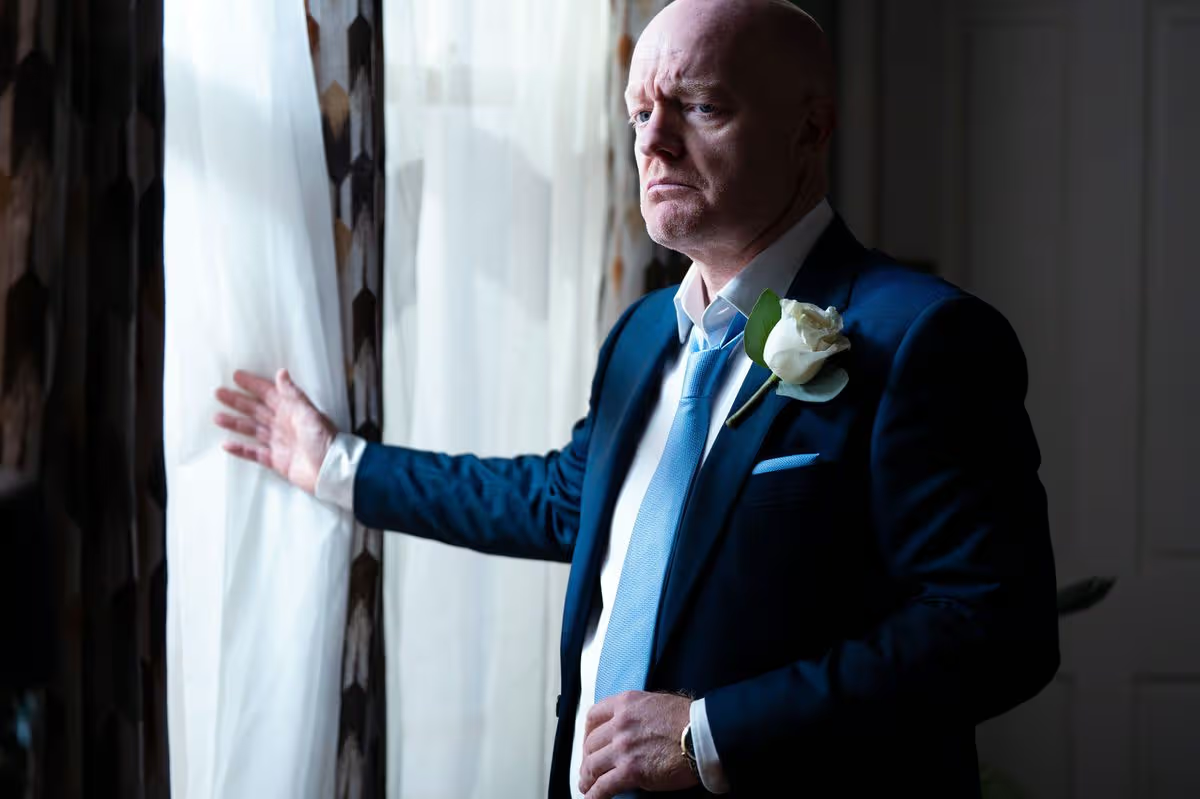
In the New Year episode, Max Branning was revealed to be marrying a mystery woman in 2027, and EastEnders fans think the soap has subtly ‘confirmed’ who that bride will be – along with her unorthodox reason for marriage
EastEnders fans think they know who the mystery bride marrying Max Branning is(Image: CREDIT LINE:BBC/Jack Barns/Kieron McCarron)
EastEnders aired the start of a love story in their most recent episode, and fans think this confirms one woman as his bride for 2027, but she won’t be marrying him for love. Instead, she’s out for revenge.
Cindy Beale (Michelle Collins) has been one of the potential brides since Max Branning‘s (Jake Wood) fifth marriage was first teased. The two had already hooked up whilst unaware of each other’s identities, leading to an explosive punch up at their shared grandson Jimmy’s christening as Cindy realised she’d slept with her son’s killer. But after scenes airing on 19 March, fans are sure this enemies to lovers arc will end with a trip down the aisle.
During Thursday’s episode, Cindy and Max were having a chat in the Prince Albert as she closed up shop. The two quickly started eyeing each other up and Max leaned in for a kiss. When Cindy initially rejected him – on the grounds that he had killed her beloved Steven (Aaron Sidwell) – he apologised for Steven’s death. This was enough for Cindy to give in and start kissing Max, as a jealous Linda Carter (Kellie Bright), who was also a teased bride, looked on.
Fans are now more certain than ever that this means Cindy will marry Max, but they’re not convinced that she loves him. Rather, could Cindy be marrying Max as part of a revenge plan?
“If Cindy marries Max, it’s 100% for revenge,” said one fan. “She HATED Max for what happened to Steven and she’s way too smart to fall for Max’s greasy little lines.”
Ensure our latest headlines always appear at the top of your Google Search by making us a Preferred Source. Click here to activate or add us as your Preferred Source in your Google search settings.
They added that the bride mystery might not be the only part of the New Year flashforward that Cindy is part of. The fan predicted that Cindy would be the gunman who will hold Lauren and Oscar Branning (Jacqueline Jossa and Pierre Counihan-Moullier) hostage, forcing their father to pick one to save.
“I reckon, Max is marrying Cindy in 2027, but Linda is getting ready to crash the wedding because she knows Cindy is planning something horrible for Max,” the fan said. “What is that horrible thing? She’s the gunman. An eye for an eye, a child for a child you know?”
Another fan agreed that scenes from tonight’s episode pointed more towards a vengeful Cindy than a loved-up one. “OMG yeah you could be right! That look she gave him when he said he was sorry for Steven’s death wasn’t giving attraction for me, it was giving revenge!”
A third said they hoped this was the case: “Cindy has hated Max with a passion for years and I know they say there’s a thin line between love and hate, but her just falling for his chat yet again just doesn’t add up. I actually hope she’s playing him for some sort of revenge for Steven further down the line.”
Cindy’s hatred of Max dates back to 2017. Then, he manipulated her son into a sweeping revenge plot against the Square, particularly Jane Beale (Laurie Brett), who had let Max go to prison for the murder of Lucy Beale (Hetti Bywater) even though she knew it was really her young son Bobby (Eliot Carrington).
After setting fire to a restaurant, Steven tried to save Jane, but Max, desperate to stop him, pushed Steven into a countertop. This caused fatal internal injuries, eventually leading to a cardiac arrest and his death.
If you buy books linked on our site, The Times may earn a commission from Bookshop.org, whose fees support independent bookstores.
Pierre Choderlos de Laclos, the author of “Dangerous Liaisons,” is often credited with “Revenge is a dish best served cold.” Given our aggrieved times, it’s not surprising how many of this year’s new mysteries explore revenge, but these four recent releases are especially notable.
Author Jose Ando
(Yuka Fujisawa)
Jackson Alone By Jose Ando Soho Press; 160 pages; $29
While English translations of Japanese crime novels have increased in the last 20 years, most still focus on a culturally homogeneous, straight, Japanese society. Now comes Jose Ando’s “Jackson Alone,” published in Japan in 2022 andtranslated into English by Kalau Almony, which centers on a mysterious African Japanese massage therapist whose life is upended after his clients and colleagues at a fictional sports conglomerate discover a violent revenge porn featuring someone who looks like him. Despite having no memory of the incident, Jackson joins three other outraged, queer men like him in switching identities to seek out and confront their abusers, who can’t seem to tell them apart.
As the quartet’s scheme plays out, this slim novel becomes less a revenge thriller and more a satiric unmasking of Japanese racism and homophobia which spurs “the four Jacksons” to claim their right to exist authentically without the judgment and stereotyping of the hetero, “pure Japanese” gaze. This bold debut earned “Jackson Alone” wide praise and Japan’s Bungei Prize, awarded to first-time novelists, and makes Ando, now in his early 30s, a writer to watch. (The author’s answers to the following questions were translated by Almony.)
Why was it important for you to tell the stories of queer African Japanese men in your novel?
The primary reason was that those characters never really showed up in Japanese literature, and even when they did, they’d be reshaped into something that was easily digestible for the majority. Before I became an author, I would get irritated whenever I encountered that sort of representation. I wrote “Jackson Alone” to submit to a competition for new writers. In my head, it felt like Jackson and the other characters were there the whole time hollering, “Hurry up and get us out there!”
While there are some frank sex scenes in the novel, what shocked me was how dehumanizing encounters with many “pure Japanese” were for Jackson and his friends. Why were those scenes important to the story?
Living as a minority, you often get questions along the lines of, “What kind of painful things have you experienced?” Right? When you’re asked something like that, don’t you always want to shoot back, “Before you ask me about my experience, why don’t you tell me what you’ve done?” Victimization doesn’t just happen because a person from a minority group is standing around, there’s almost always a perpetrator. The different kinds of dehumanization I wrote about in this book are based on the sorts of things I experience almost every day.
In terms of novels I’ve read, there’s “Out”by Natsuo Kirino and the works ofMieko Kawakami. My direct inspiration though comes mostly from my own life.
Author Caroline Glenn
(William Morrow)
Cruelty Free By Caroline Glenn William Morrow; 320 pages; $30
In Glenn’s fiction debut, Lila Devlin, once one of the most famous actresses on the planet, returns to Los Angeles 10 years after the kidnapping and death of her daughter, Josie. The kidnapping caused a media frenzy, which precipitated Devlin’s meme-worthy downward spiral and the end of her marriage to a rising young Hollywood actor. After an “Eat Pray Love” retreat from the spotlight, Devlin is back with Glob, a line of ethical skincare products with a higher purpose: “A way for Josie to live on by applying the principles of self-actualization and inner peace that she learned in India. She wanted to help people heal just as she had.”
But Hollywood has a short memory and most of the people who benefited from Devlin’s meteoric rise and the kidnapping can’t be bothered to help her now. After a meeting with one of them goes horribly wrong, Devlin and her publicist Sylvie, another a victim of Hollywood’s censure, find revenge offers a unique albeit gruesome ingredient for Glob’s products. Although the novel’s flashbacks seem to digress at times, it all clicks into place once Lila starts exacting her increasingly unhinged revenge. “Cruelty-Free” is an edgy journey with razor-sharp observations about fame and revenge. Readers will be looking forward to what comes next for this talented creator.
What inspired your novel?
I love Sondheim’s “Sweeney Todd.” So much. And the core of that story, a man falsely imprisoned for a crime he didn’t commit and eventually driving him insane, is unfortunately pretty evergreen. Other inspirations: the Lindbergh baby, how much I hate true crime media, NYC publicist Lizzie Grubman, cash grab celebrity beauty brands, rich white women going on “Eat Pray Love” trips to Asia, the city of Los Angeles (go Dodgers).
Lila Devlin makes a journey from being a grieving mother to being a villain. How do you keep the reader’s sympathies?
I don’t think the reader’s sympathies are supposed to necessarily stay with Lila. The core of this book, stripping away the weird digressions, is about how society makes monsters. Lila’s career, her body, her entire life was consumed by the world until she was left with nothing, and now she’s holding a mirror back up to it. You can understand where she’s coming from, but after a certain point … she’s gonna hit diminishing returns.
In your thinking, is revenge ever justified?
The point isn’t whether or not it’s justified. It’s whether or not it’ll make you feel better. And it can’t, it’s hollow. Nothing will ever undo the original sin, and devoting your life to ruining someone else’s is a loss for both of you.
Author Leodora Darlington
(YellowBelly Photo)
The Exes By Leodora Darlington William Morrow; 384 pages; $29
This UK fiction editor’s debut centers on Natalie, driven into therapy to get to the root of her blackouts and the murderous impulses toward former boyfriends they may be hiding. But then Natalie meets “the one” — James, her boyishly handsome boss at a London start-up — and becomes even more terrified that the monster inside her may strike again.
In carefully interwoven flashbacks and letters to her exes, readers learn why: Natalie’s disastrous dating histories — and the deaths of her abusive boyfriends — are detailed as well as her early relationship with James and the family trauma she and her younger sister suffered at the hands of a father who they saw abuse, and almost kill, their mother.
But, empathy aside, does any amount of family or romantic trauma justify revenge, even murder? By the time Darlington builds her case for and against Natalie, James and the other characters in this tightly drawn circle, readers will be taken through a number of sometimes shocking reveals that suggest that the family ties that bind can also cut off opportunities for forgiveness. Darlington has crafted a dark, edgy thriller whose engaging protagonist and intriguing psychological insights linger in the mind long after the memory of that last, jaw-dropping twist fades away.
What inspired your novel? “The Exes” began with a title that just popped into my head: “To All the Boys I Killed Before.” I adore the romance genre — I’m a huge fan of tropes, from enemies-to-lovers to fake dating. But that love for romance exists alongside a growing frustration with the rollback of women’s rights globally. That convergence of feelings made me wonder: What kind of girl would write letters to former flames, not out of love, but out of despair?
For much of the novel, readers can’t be sure whether Natalie has murdered her exes in a fit of rage or if something else is at play. How did you draw on this uncertainty to build the reader’s sympathies for the character?
What felt important in drawing readers close to Natalie was letting them see through a window into her past and why she is the way she is. Understanding her as a vulnerable child or anxious teen feels crucial to making sure we’re invested in all of the twists that slam through the second half of the novel. I really do think a great twist requires deep character empathy as much as it does clever plotting.
In your thinking, is revenge ever justified? Yes. Ha! Well, in all seriousness, quite a few characters in this story are pursuing their own revenge plots. I do think it is possible to justify revenge to a jury, but never to oneself. Not in a soul-deep way. The pursuit of revenge takes a spiritual tax on a person that can sometimes cost more than they’ve bargained for, and we see the unraveling effects of that in “The Exes.”
Author W. M. Akers
(Gianna Smorto)
To Kill a Cook By W.M. Akers G.P. Putnam’s Sons; 384 pages; $30
After so much revenge, W.M. Akers has just the palate cleanser in “To Kill a Cook”, a homage to 1970s Manhattan and its fine dining temples. Bernice Black, a sharp-tongued restaurant critic for the Sentinel, a struggling newspaper, is meeting chef Laurent Tirel, her culinary mentor and friend, at his restaurant to plan her fiancé’s birthday party. But Tirel, once lauded as “King of the Butter Boys,” is struggling too. Caviar and truffle prices are skyrocketing, forcing Tirel to cut corners while clinging to his restaurant’s former glory. When Bernie finds the restaurant empty and a veal stock reduced to the consistency of “cold blood,” she thinks Tirel is making an aspic for the party. Instead, she finds Tirel’s head in the refrigerator, suspended in the aspic along with the decorative veggies.
Thus begins an intense romp through New York’s finest restaurants when Bernice — who realizes the NYPD doesn’t know their aspics from a hole in the ground — decides to get the scoop of the decade by finding Tirel’s killer herself. Akers nails 1970s New York’s glitz and grime as Bernie interviews an assortment of renowned chefs, fellow critics, criminals as well as Tirel’s business associates and son, Henri, who also happens to be an old flame. But the pièce de résistance of this delectable mystery is Bernice herself — a bold, brash feminist who’s trying to figure out her sexuality while being honest with the ones she loves. Here’s Bernice replying to an NYPD detective’s accusation that she’s not a lady: “I guess that was supposed to hurt my feelings, but I quit trying to be ladylike sometime around the first grade.” “To Kill a Cook” is a decadent treat, with enough loose ends in Bernice Black’s life and career to leave readers hungry for more.
Why did you decide to set your novel in 1970s Manhattan?
1972 was a key turning point in the history of American fine dining. It’s the moment when old-school French — think white tablecloths, heavy sauces and snooty maitre’d’s — faded into the background, allowing nouvelle cuisine and what we now call New American to take its place. It’s also a moment when exceptional, modern cooking would share a menu with “parsleyed ham in aspic” or something else that today’s diners would consider repulsive. That tension between old and new, and the question of what fine dining would become, drives a lot of the conflict in the book.
How did you research the restaurants you describe so well in the book? Did any of those chefs/restaurateurs inspire Laurent Tirel, the murder victim?
I have a big pile of old cookbooks that inspired a lot of the specific dishes in the book, but the best resource was the New York magazine archives, particularly Gael Greene’s old columns. Bernice Black’s name is a little nod to Greene. And Tirel is very much inspired by Henri Soulé, whose Le Pavillon was the definitive New York restaurant for a generation, and whom Greene wrote about beautifully.
Bernice spends a lot of time trying to perfect a Charlotte Russe for her fiancé. Why that particular dish?
The Charlotte Russe is a specialty of my mother, a former caterer who helped run New York’s Hard Rock Café in the ’70s. It’s the kind of lavish, creamy, boozy party dessert that you don’t see often anymore, and it’s involved enough to offer Bernice a challenge. Julia Child’s got a good recipe in “Mastering the Art of French Cooking,” but I relied on my mom’s recipe, whichreaders can find on my Patreon, and which my mom once cooked for Jacques Pépin!
Woods is abook critic, editor and author of several anthologies and crime novels.
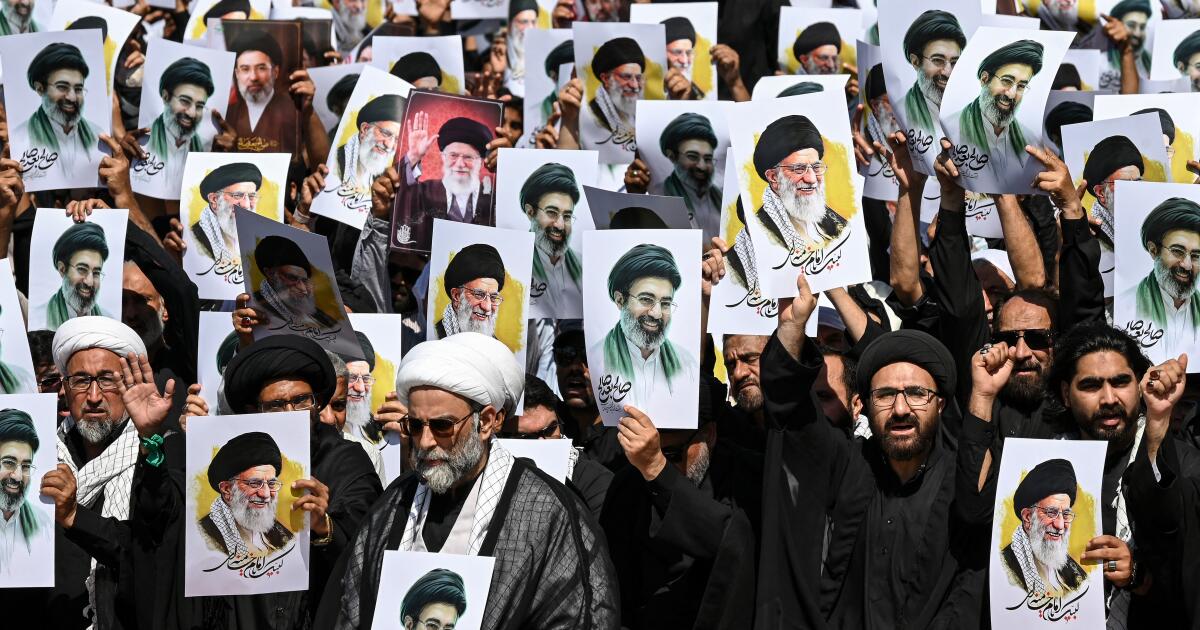
WASHINGTON — Iran’s new supreme leader, Mojtaba Khamenei, vowed retaliation Thursday against the United States and Israel and signaled that Tehran will continue to choke off the world’s most critical oil route, as the war strained global energy markets and raised new security concerns in the United States.
In his first public remarks since U.S.–Israeli strikes killed his father, former Supreme Leader Ayatollah Ali Khamenei, Mojtaba Khamenei swore revenge. The new leader, notably, did not appear in person for the televised statement. Instead, his written words were read aloud on Iranian state media.
“We will never retreat and vow to avenge the blood of our martyrs,” he said. “Our revenge will be never ending, not only for the late supreme leader, but also for the blood of all of our martyrs. … Those who killed our children will pay the price.”
The new leader expressed condolences to families who lost children in a strike on a girls school in Minab that killed more than 165 people, many of them children. He also warned that the war could expand, declaring that the continuation of the conflict “depends on the interests of the parties.”
The Associated Press, citing two sources, reported that outdated intelligence likely led to the United States carrying out the deadly missile strike on the elementary school. U.S. Central Command relied on target coordinates for the strike using outdated data provided by the Defense Intelligence Agency, according to a person familiar with the preliminary finding.
Khamenei indicated that Tehran would maintain its blockade in the Strait of Hormuz, a key choke point through which 20% of the world’s oil supply is shipped. He also said he believes in friendship with his country’s neighbors, but that attacks on U.S. military installations in the region will continue. He described maintaining pressure on the passage as a necessary part of Iran’s war strategy.
His remarks came as attacks continued to disrupt shipping and energy infrastructure across the Persian Gulf. The war sent oil up 10% Thursday as hostilities in Iran drag on.
Reports from the region said Iranian forces have intensified strikes on vessels attempting to pass through the Strait of Hormuz, leaving hundreds of ships stranded at its entrances and rattling global oil markets.
Two oil tankers were struck by explosives in Iraqi waters near the port of Basra. The Islamic Revolutionary Guard Corps claimed responsibility for the attacks, which killed at least one crew member and set both vessels ablaze, according to the Associated Press. A third unnamed vessel was reported to have been struck by an “unknown projectile” near Dubai and Jebel Ali, causing a small fire, the United Kingdom Maritime Trade Operations reported.
The latest incidents come after drone strikes targeted fuel storage facilities across the Gulf, including at energy sites in Bahrain and at the port of Salalah in Oman, an important hub for tankers seeking to bypass the Strait.
“They will pay the price. We will destroy their facilities,” Khamenei said. “It is necessary to continue our defensive activity, including continuing to close the Strait of Hormuz.”