CURVY Kylie Jenner is hip to it as she promotes her new activewear range.
The US beauty mogul, 29, showed off her toned physique in a pink sports bra and matching leggings.
Kylie Jenner showed off her toned physique in a pink sports bra and matching leggingsCredit: Alo/Mert & MarcusThe outfits are part of the Kylier’s Alo Yoga Pink Marshmallow collectionCredit: Alo/Mert & Marcus
They are part of her Alo Yoga Pink Marshmallow collection — one more to add to the billionaire businesswoman’s portfolio.
Yet the mother-of-two is increasingly seeking privacy with actor boyfriend Timothée Chalamet, 30.
Sign up for the Showbiz newsletter
Thank you!
Reality star Kylie said: “Some of the most meaningful parts of my life happen when no one’s watching.”
She said: “Some of the most meaningful parts of my life happen when no one’s watching.
“Those moments of stillness are what help me feel grounded and present, and I’ve learned to protect them.
“That’s what I love about this campaign – it reminds us that taking care of yourself starts with making space for the things that are yours alone.”
Mother-of-two Kylie is dating Dune actor Timothee ChalametCredit: GettyThe reality star says the most meaningful parts of her life happen when nobody is watchingCredit: AFP
A CONTROVERSIAL US rock star has cancelled his European tour after revealing he’s “wildly sick”.
Singer Ryan Adams, 51, also shared that he is selling all of his prized possessions after falling on hard times
Singer Ryan Adams has cancelled his European tour as he is ‘wildly sick’Credit: Getty – ContributorThe star is also selling off his belongings as he is ‘broke’Credit: Getty – Contributor
Announcing the news that the star had pulled out of his tour dates, his promoter posted: “Due to circumstances beyond our control, the upcoming Ryan Adams European Tour has been cancelled.
“We apologize to all those who bought tickets and were excited for these shows.
Sign up for the Showbiz newsletter
Thank you!
“Refunds will be processed automatically and if you have any questions please contact your point of purchase.
“Ryan is doing ok and working hard to finish the new album trilogy. New music on the way.”
Ryan re-posted the statement and wrote: “Tough times. Been sick. Fall tour cancelled.”
Shortly before he revealed that his tour was cancelled, Ryan also shared a post on Instagram where he revealed he was selling his belongings, as he was “broke”.
The singer announced he was putting guitars, studio equipment, and a Cadillac up for sale, among other things,
The emotional statement read: “I’m broke and sick and tired and defeated but my heart is blasting with hope and love and riff optimism and I appreciate anybody who can give these treasured things a new life.
“I’m proud that I did this. That I remain transparent. This business is vile and full of snakes.
“But I’m proud to call it and man up to this. I’ll keep making records as long as I can afford to.
“Now I’m going to go sit in the sunlight with my cats and cry because I need to and I’m not sure how many more times I can hit this wall. When is it enough?”
Ryan has released 30 albums and sold millions of records worldwide.
But despite his fame, he has often hit the headlines for the wrong reasons.
In 2019, seven women came forward, including his ex wife, actress Mandy Moore, with accusations of inappropriate behaviour from him.
At first he denied the allegations, however, the following year he issued a statement where he apologised.
Lily Allen legs it backstage during her recent concert tour in a range of eye-popping lingerieCredit: IntimissimiLily wore off a pale blue body suit and matching fur trimmed negligeCredit: Intimissimi
The mother-of-two is a brand ambassador and wore the outfit during her recent West End Girl tour described as a highly personal piece of musical theatre.
The stage show was inspired by her acrimonious split with American actor husband David Harbour in 2025 also documented in her hit album of the same name.
Sign up for the Showbiz newsletter
Thank you!
The bodysuit inspired by Intimissimi’s Pretty Flowers Collection, the Italian’s brand core fashion lingerie offering.
Lily finished the UK run earlier this month with sell out shows at London’s O2 arena.
She was later snapped riding an electric hire bike in London depsite owning a £120,000 Porsche.
Lily hasn’t been seen driving the German sports car since she said a a truck ran it off the road back in January.
A winess said: “She probably thinks pedal power is the way to go around London’s crowded roads.”
Lily has defended herself against complaints that the setlist of her West End Girl Tour is “too short”.
Lily is a brand ambassador and wore the outfit during her recent West End Girl tourCredit: IntimissimiLily was snapped riding an electric hire bike in London despite owning a £120,000 PorscheCredit: TillenDove
The singer released the album in October of last year and it features 14 songs.
The album in its entirety is only 45 minutes, which has led some to question if the £86 ticket fee is value for money.
As the destructive Bobcat fire sent plumes of smoke billowing from the Angeles National Forest in 2020, Ryan Huling recalled that at the time news reports claimed the blaze caused “no injuries” and that no homes had been destroyed.
That irked the Sierra Madre writer, who watched from his cabin as flames incinerated the home of bears, coyotes, pumas and squirrels. He believes countless critters were killed or maimed by flames, and points to accounts of mountain lions emerging with singed paws and bears scrambling into communities.
“Anonymity has done them no favors, in the sense that people don’t know where they live, they don’t know what landmarks are important to them, they don’t know what areas carry special significance to bears and other animals,” Huling said.
Yet through his research he discovered that rapidly advancing technology — including artificial intelligence, GPS tracking and crowdsourcing — is revealing more about animal “societies” than ever before. The revelation launched him on a worldwide tour of non-human communities, culminating in his debut book, “The Hidden Nations of Animals.”
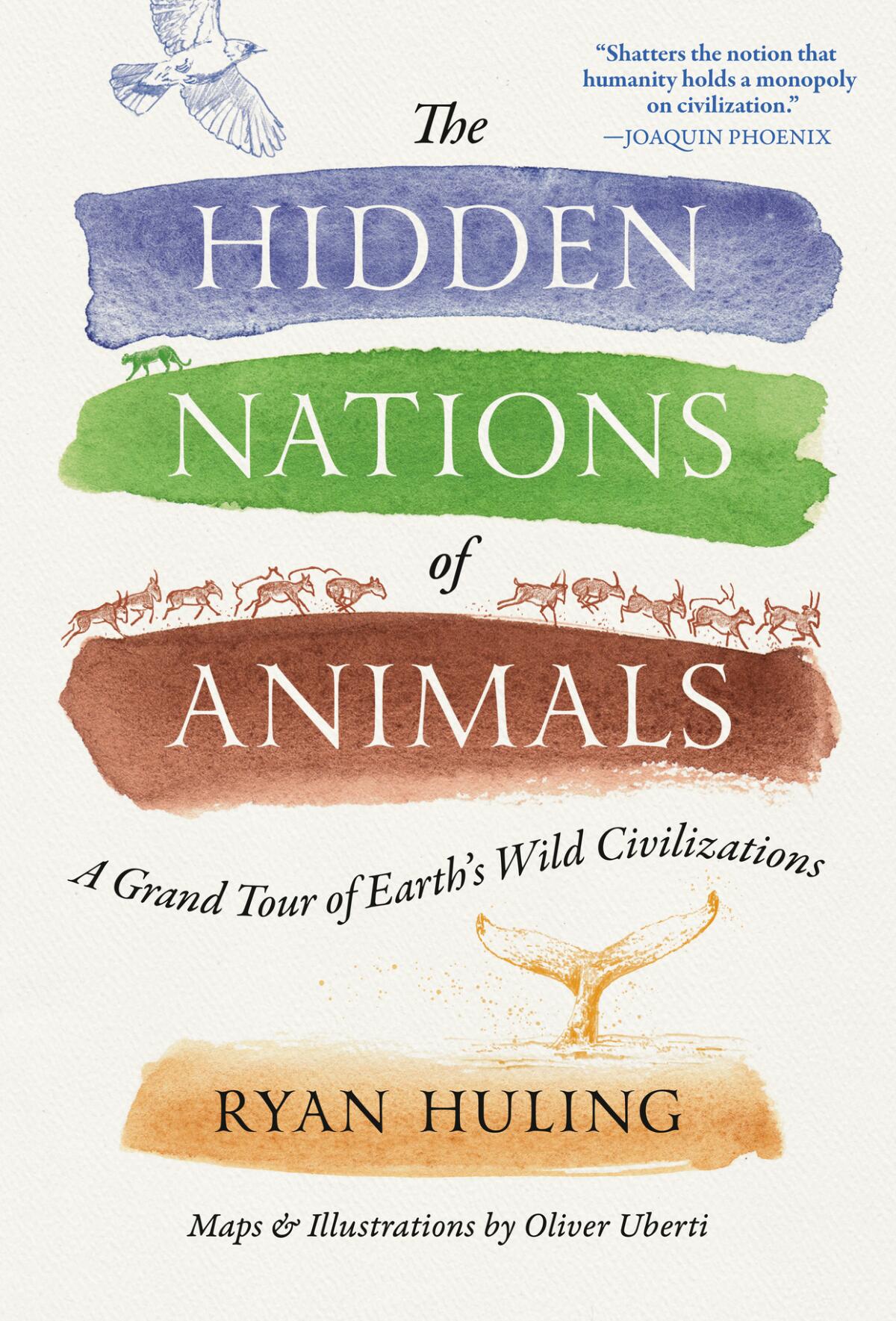
The cover of Ryan Huling’s first book, published in June.
(Penguin Random House)
Published this month, the book’s first chapter takes readers to North America’s “beaver belt,” roughly 1,100 miles in northern Canada that are jam-packed with beaver dams. According to Huling, the sheer density of those dams only became apparent thanks to technology that allows researchers to analyze high-resolution satellite imagery and identify them from space. One analysis found 2,700 dams surrounding a town of only about 1,000 people.
Another stop took him to Zambia, where African mole-rats dig complex tunnel systems that include designated nurseries, pantries and bathrooms. Just before Huling arrived, a researcher had used radio trackers to determine that the subterranean animals operate on a biological clock that has them alternate between a few hours of activity and a few hours of napping — not a bad work schedule!
Some of Huling’s other adventures include exploring a tornado of Mexican free-tailed bats outside of San Antonio and red-crowned cranes that have found refuge in the Korean Demilitarized Zone.
But uncovering these hidden worlds isn’t just left to the experts anymore. While the expense or difficulty of tracking wild animals has resulted in knowledge voids in the past, crowdsourcing is helping to fill in the gaps.
Today, any smartphone-toting nature lover can snap a photo of a great horned owl or a ground squirrel and upload it to a citizen science app such as iNaturalist. Some platforms are specialized, for example Merlin for birds and Happywhale for marine mammals. All that data is a rich playground for scientists. According to an article published last year in BioScience, iNaturalist data in peer-reviewed research grew tenfold in the previous five years.
Now, AI is making it so humans don’t have to necessarily look at the raw material. Instead, AI can mine images, videos or sound clips for the appearance of an animal of interest — or even catalogue individual critters. Happywhale has an AI feature that identifies particular humpbacks by unique patterns and shapes on their tails.
Technology is advancing so fast that Huling said it was hard to stay current. In his prologue, he mentions a researcher showing him a prototype of a teeny solar-powered radio tag for monarch butterflies. By the time the book hit the shelves, the concept was already live — harnessed, in one instance, to study how the brilliant orange insects use overwintering groves along the California coast. Just this week on Instagram, the California Department of Fish and Wildlife highlighted a study in which rare bumblebees are tagged with minute QR codes that can be read by remote cameras.
After about a half-year of travel, Huling returned home with a heightened awareness of what he calls “inconspicuous abundance” — that the world is teeming with more life than meets the eye. He puts this new lens to the test by venturing to the storm-battered shores of San Miguel Island off the coast of Santa Barbara. Considered “uninhabited” in the traditional sense, he finds that the rarely visited corner of Channel Islands National Park is a haven for lumpy seals, glimmering fish and squawking seabirds. Sharks lurk beneath the waves.
“For them, as now for me, this distinctive island remains anything but deserted,” he writes.
On San Miguel Island, Huling saw and heard hundreds of sunbathing seals and sea lions.
(Oliver Uberti / Penguin Random House)
In other animal news
Earlier this month, in Big Bear Lake, a memorial service was held for Sandy Steers, the late conservationist who was best known for turning two bald eagles into an international phenomenon by livestreaming their nest. It was a touching gathering, where Steers’ friends and colleagues got personal about a woman who they said was willing to go to the mat for her beloved raptors.
An illustration for “Hidden Nations” depicts author Huling at home, surrounded by the natural environment — including a black bear.
(Oliver Uberti / Penguin Random House)
For decades, Steers battled a planned development near the nest of famed eagle couple Jackie and Shadow, and helped to negotiate an agreement in which a land trust could buy the site for $10 million. The nonprofit she led is now racing to raise the money by July 31 so it can be bought and conserved.
In the desperately needed good-news department, endangered steelhead trout that scientists feared had perished in last year’s Palisades fire unexpectedly survived — and even had babies. It’s a big deal: they represent the last known population of steelhead in the Santa Monica Mountains.
A civil grand jury has found that the L.A. Zoo needs new leadership, citing deterioration of its facilities and rapidly declining membership. In less than a year, membership dropped 23% and exhibits for lions, bears, sea lions and pelicans have closed because they need major renovations.
Last summer, researchers made an astonishing discovery off the Sonoma County coast — 18 sunflower sea stars, a species decimated by disease and all but gone from California waters. SF Gate writes that the finding was only just announced, with scientists now racing to learn all they can about the survivors. As previously reported, the stars with up to 24 arms could hold the key to restoring the state’s ravaged kelp forests.
And news about the environment
This is the latest edition of Boiling Point, a newsletter about climate change and the environment in the American West. Sign up here to get it in your inbox. And listen to our Boiling Point podcast here.