Hiltzik: Why consumers won’t see a tariff refund
The Supreme Court just declared most of Trump’s tariffs to be unconstitutional. But consumers probably won’t be getting any money back
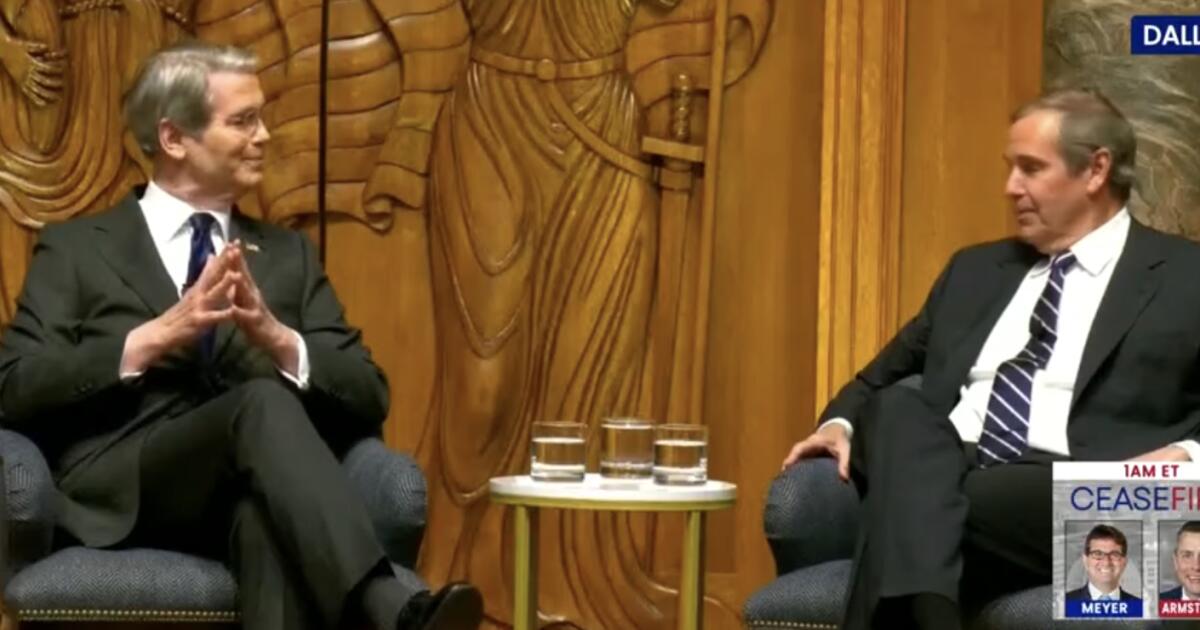
Treasury Secretary Scott Bessent, who has a way of saying the quiet parts out loud in defending President Trump’s economic policies, told the truth again Friday, during a public appearance a few hours after the Supreme Court threw out most of Trump’s tariffs.
Asked about the prospects that Americans would be receiving refunds of the illegal tariffs paid since Trump imposed them in April, Bessent replied with a condescending smirk: “I get a feeling the American people won’t see it.”
A couple of things about that. One is that there doesn’t seem to be any legal question that those who paid the tariffs are entitled to refunds. In his 6-3 ruling invalidating levies imposed on imports under the International Emergency Economic Powers Act of 1977, or IEEPA, Chief Justice John Roberts made clear that those tariffs were unconstitutional and illegal from their inception.
The refund process is likely to be a ‘mess.’
— Supreme Court Justice Brett Kavanaugh
Therefore, there’s no excuse for the government to hold on to the money it has collected — estimated at somewhere between $135 billion and $170 billion. But Roberts didn’t state whether refunds are warranted or, if so, how they should be calculated and distributed.
Trump has dangled the prospect of tariff refunds — actually, tariff “dividend” checks of $2,000 — in front of taxpayers for months. In effect, that would mean returning to taxpayers the money that his tariffs have cost them. Bessent’s comments put paid to that promise.
Today, no one is arguing seriously that checks should be cut for taxpayers — except Illinois Gov. JB Pritzer, who demanded refund checks totalling $8.7 billion for his constituents. But that has the aroma of a campaign stunt for Pritzker, who is running for a third term and may be positioning himself for a presidential run.
By not specifying a refund process, the Supreme Court decision left a vacuum that Bessent tried to fill. In his comments, he explained why refunds will be nothing but a dream for the average American — and those comments were chilling.
First, he said, Trump has the authority to reimpose the same tariffs under different laws. Indeed, Trump has already announced that he will be imposing 15% tariffs across the board.
He also signaled that although Roberts pushed refund decisions down to the Court of International Trade, the government is poised to challenge importers’ applications for reimbursement, generating litigation that “can be dragged out for weeks, months, years.”
In other words, Bessent implied that, far from resolving the economic confusion Trump has generated through his on-again-off-again tariff policies during 2025, the court’s decision provoked Trump to inject even more uncertainty into U.S. trade relations and domestic business decisions.
That dime appeared to drop for stock market investors Monday. The markets rose modestly in a relief rally Friday after the Supreme Court released its decision, but tumbled Monday as Trump doubled down on tariffs. At the close, the Dow Jones industrial average was down by 821.91 points, or nearly 1.7%, and the Nasdaq and Standard & Poor’s 500 indices both fell by more than 1%.
Bessent didn’t mention the most important reason why American consumers are unlikely to see anything resembling a tariff refund.
Tariffs on imported products are, by any measure, a tax on domestic consumers. Economic opinion is virtually unanimous on that point. As I reported in January, the Kiel Institute for the World Economy, a German think tank, concluded that 96% of the 2025 Trump tariffs were paid by American importers and their domestic clients.
“The tariffs are, in the most literal sense, an own goal,” Kiel’s researchers wrote. “Americans are footing the bill.” Their conclusion was largely echoed earlier this month by the Federal Reserve Bank of New York, which placed the burden on American importers and consumers at “nearly 90%.”
That said, the specifics of tariff payments are in the hands of importers and retailers, which keep records of how much they’ve paid and on what products or parts. Consumers don’t normally know the numbers. (I actually received an invoice last year breaking out the tariffs charged by a Japanese retailer on a set of pens I had bought for a birthday present, but since the sum came to $12 I’m not sure that demanding a refund from the government would be worth it.)
So far, about 1,500 businesses have filed claims for refunds through the Court of International Trade. Most filed these claims to secure for themselves a position in the scrum for refunds, like music fans lining up overnight for tickets to a star’s upcoming concert.
Many of these businesses may not actually have put a number on their claim. Costco, perhaps the biggest retailer to file with the CIT, didn’t say in its Nov. 28 filing how much it thought it was owed, possibly because it was still bound to pay the tariffs until the Supreme Court issued a final decision.
U.S. Customs and Border Protection, which actually computes and collects the tariffs, says it will cease collecting the invalidated levies when the clock strikes 12:01 a.m. Tuesday morning.
What consumers don’t know is how much of the tariffs have been passed down to them. Some sellers decided to eat some or all of the tariffs to keep consumer prices steady. Some may have stocked up on tariff-eligible products ahead of the formal imposition of the levies.
Will retailers seek out customers who paid higher prices on products that were tariffed to hand them refunds? None has said that such an eventuality is in the cards, though it might not be surprising to see some businesses use the end of tariffs as a marketing device — you know, “We’re cutting prices on Toyotas during ‘tariff freedom month!’” etc., etc.
It’s also conceivable that retailers passed imaginary tariff costs on to their customers, putting through price increases that had nothing to do with the levies but could be blamed on them anyway.
That’s what happened after Trump imposed tariffs on washing machines, which were almost all foreign-made, in 2018. According to a 2020 survey by Federal Reserve and University of Chicago economists, the tariffs forced washing machine prices up by nearly 12%, or about $86 each. The researchers discovered, however, that prices on clothes dryers increased by about the same amount, even though they weren’t subject to the tariffs at all.
What happened? The researchers conjectured that because washers and dryers are typically sold as pairs, retailers may have simply spread the washing machine cost increase between the two products to keep their prices similar. It’s also possible that retailers, figuring that consumers would expect to pay more for tariffed washing machines and would assume the same effect held for dryers, charged more for the latter to fatten their profits. One wouldn’t expect consumer refunds in those cases.
Another imponderable is the effect of Trump’s tariffs on the U.S. consumer economy generally. The Trump tariffs cost the average American household the equivalent of a tax increase of about $1,000, the Tax Foundation has calculated.
About $600 of that sum was due to the IEEPA tariffs now struck down. But the new tariffs Trump announced after the Supreme Court ruling will raise the tariff tax for American families by $300 to $700, the Foundation reported — potentially a greater total burden than existed before the court’s action.
All of Trump’s tariffs increased the average tariff rate to 13.8%, the Foundation reckoned. The Supreme Court’s ruling reduced that to about 6% — still the highest U.S. tariff rate since 1971 — but the new 15% tariff Trump announced would raise the applied rate back to 12.1%. By law, the new tariff can remain in effect for only five months unless it’s extended by Congress. In 2022, America’s applied tariff rate was 1.5%.
Perhaps the most immediate question facing businesses is how refund claims will be administered. In his dissent to Roberts’ IEEPA decision, Justice Brett Kavanaugh wrote that “the refund process is likely to be a ‘mess.’”
Possibly Kavanaugh’s concern was that the Court of International Trade will have to adjudicate 1,500 claims one by one. But it need not be so.
In 1998, the Supreme Court declared a Harbor Maintenance Tax on exports, based on the constitutional provision that exports can’t be taxed. Responsibility for those refunds also fell to the Court of International Trade, which established a standardized procedure for claims. Even under the streamlined system, however, the resolution of all those claims took until 2005, or seven years. And that involved only about $1 billion in claims, not the more than $130 billion at stake today.
What remains unexplained in the miasma created by Trump’s tariff policies is why he is doing this. None of his rationales has been borne out. The tariffs haven’t restored manufacturing employment in the U.S., which have fallen throughout Trump’s current term. They haven’t eliminated America’s trade deficit with the rest of the world, which has persisted since 1975 and — despite Trump’s assertions — isn’t anywhere close to an economic crisis.
As it happens, while the overall trade deficit fell modestly last year by less than $3 billion, or about one-third of 1%, most of the reduction was in services; the deficit in goods rose by $25.5 billion to a record $1.24 trillion.
All that’s left is Trump’s inclination to wield tariffs as tools of geopolitical bullying. He has raised or threatened to raise tariffs on Brazil because of that country’s criminal pursuit of former President Jair Bolsonaro for leading a coup attempt; on Switzerland because he felt dissed by a Swiss government leader; and on several European countries for thwarting his effort to annex Greenland.
None of those actions bore fruit (Bolsonaro was convicted and is currently serving a 27-year prison sentence). America’s trading partners plainly recognize that the new tariffs must expire within 150 days and can’t be renewed without action by a Congress plainly queasy about giving Trump his tariffs back after the Supreme Court took them away. They don’t seem to be taking Trump seriously.
They can tell that on tariffs, as on many other things, Trump is increasingly behaving like a lame duck, albeit one with a whim of iron. But as the stock market seemed to be telling us Monday, even a whim of iron can be very, very costly.