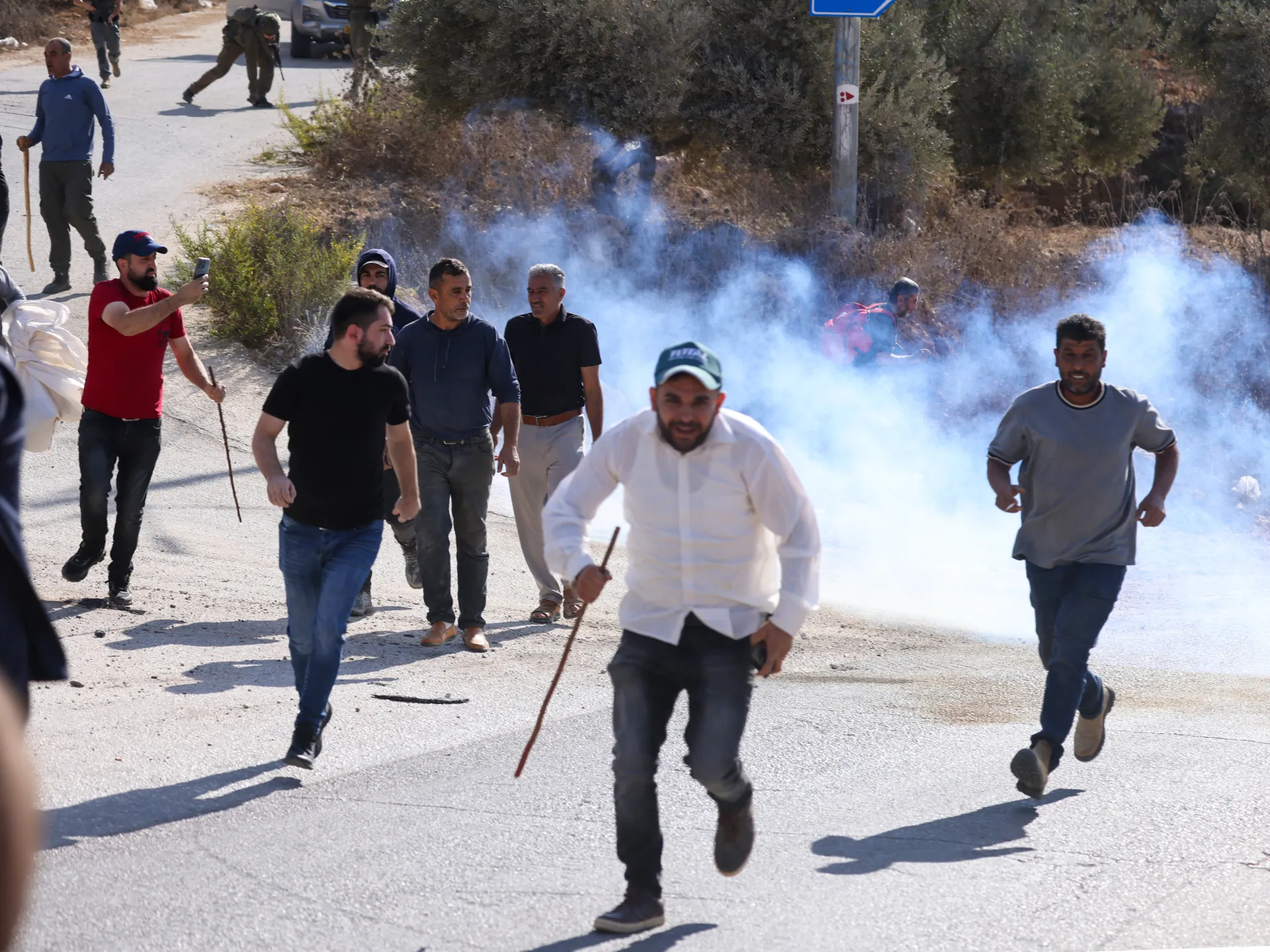
It is increasingly difficult to regard what is happening in the West Bank as merely a series of measures that the Israeli government justifies on security grounds or as part of counterterrorism operations. Taken together, the cumulative pattern and expanding scope of these measures point to a broader political and territorial trajectory: one aimed at reshaping the West Bank, imposing new facts on the ground, entrenching Israeli control and advancing the de facto annexation of large parts of the territory while simultaneously subjecting Palestinians to mounting pressure that, directly or indirectly, pushes them from their land.
Israeli, journalistic and research reports have documented the intensification of this trajectory through settlement expansion, land confiscation, restrictions on Palestinian movement, control over water resources and grazing areas as well as military operations and repeated internal displacement in several parts of the West Bank.
Considered individually, each of these measures may appear to be a separate issue. Viewed together, however, they reveal a more consequential development: an effort to re-engineer the geography and demography of the West Bank in ways that undermine the prospect of establishing a contiguous and viable Palestinian state.
The question, therefore, is no longer simply what is happening in the West Bank.
The more urgent question is how can Jordan, the Palestinians, the Arab world and the international community prevent this trajectory from becoming a permanent reality.
Jordan Valley at the heart of the equation
The Jordan Valley assumes exceptional importance in this context, not only because of its geographical and security significance but also because of its agricultural and economic importance and its water resources for the Palestinian people.
Reports concerning the construction of a new Israeli barrier, referred to as the “Crimson Thread”, extending roughly 480km (300 miles) from the Golan Heights to the Red Sea, warrant serious Jordanian, Arab and international scrutiny, particularly if such a project is intended to isolate the Jordan Valley and place as much as 83 percent of its total area under Israeli control.
Such a development could in effect sever the West Bank from Jordan and deprive Palestinians of one of their most important agricultural and water resources.
Borders, walls, roads and settlements cease to be merely physical infrastructure when they are combined with control over land and water. They become instruments for reshaping political and demographic geography and weakening the ability of Palestinians to remain on their land.
This is precisely where the Palestinian issue intersects directly with Jordan’s national security.
Jordan faces a different phase
Jordan cannot treat developments in the West Bank as an exclusively Palestinian matter. At its core, this is an issue of Jordanian national security, regional stability and the future of the Palestinian cause.
Any fundamental change to the geographical or demographic reality of the West Bank will inevitably carry direct consequences for Jordan because of geography, history and proximity. And if the eventual outcome is forced displacement, then, as King Abdullah II has repeatedly made clear, such a scenario would amount to a declaration of war on Jordan.
The policy required of Jordan at this stage, therefore, must be proactive: one that anticipates possible scenarios and prepares for them politically, diplomatically, economically and in security terms.
First: Protect Jordanian national unity
Jordan’s first line of defence is its national unity.
At this stage, it is essential to strengthen the concepts of citizenship and the state, consolidate full equality among Jordanians, and reject any discourse or practice that creates divisions on the basis of origin, region or roots.
The Palestinian cause must remain a national, Arab and humanitarian cause. It must not be allowed to become a source of division within Jordanian society.
Responsibility falls on both the state and society to confront hate speech and incitement, apply the law equally and fairly, and protect the national fabric from attempts to exploit regional turmoil to sow division among Jordanians.
One of the gravest outcomes Jordan must prevent is the transfer of the conflict into its own domestic sphere. Relations among Jordanians of different origins, including those of Jordanian and Palestinian heritage, must never become a vulnerable fault line through which those seeking discord, whether from within the country or from abroad, can operate.
National unity, therefore, is not merely a social value. It is an integral component of Jordan’s national security architecture.
Second: Move from diplomacy of protest to diplomacy of pressure and proportionate action
Jordan has accumulated considerable international credibility and diplomatic capital. The present phase, however, requires Jordan to expand the tools at its disposal.
It is no longer sufficient simply to condemn settlement activity, reject annexation or warn against displacement. What is needed is an Arab, Islamic and international diplomatic front capable of translating political positions into practical measures.
In coordination with Palestine and Arab and Islamic states, Jordan should work to:
- Mobilise countries that reject annexation and settlement expansion.
- Support international legal action.
- Push for concrete measures and sanctions not only against settlements but also against state policies that enable and encourage them.
- Systematically document violations.
- Use Arab political and economic relations with influential states more strategically, expanding economic cooperation with countries that adopt firm positions against the Israeli occupation while recalibrating engagement with those that remain reluctant to take clear positions towards Israeli policies.
- Build an international coalition capable of preventing the imposition of irreversible facts by force.
A comparison with Russia’s war in Ukraine is instructive. When Russia occupied large areas of Ukrainian territory, sanctions were not confined to the territories under occupation; they were imposed on Russia itself. The question, therefore, is why a different standard should apply elsewhere.
The international community does not lack resolutions or statements. What it lacks is the conversion of political will into a tangible cost for those who violate international law.
Third: Establish an Arab and Islamic fund for Palestinian resilience
If the objective is to prevent displacement and enable Palestinians to remain on their land, financial support must become a sustained strategic policy rather than seasonal assistance tied to moments of crisis.
One option would be to establish an Arab, Islamic and international fund dedicated to strengthening Palestinian resilience with a mandate to finance specific projects in the West Bank and Gaza, including:
- Protecting land threatened with confiscation.
- Supporting farmers.
- Developing water resources and irrigation networks.
- Assisting affected families.
- Financing housing projects in vulnerable areas.
- Supporting education and health services.
- Assisting municipalities and local councils.
- Providing alternative sources of income to families who have lost employment as a result of Israeli measures.
Resilience is not merely a political slogan. It is a material reality.
Every Palestinian family who remains on its land, every farmer who continues to cultivate his fields and every village that retains access to its water resources represents part of the effort to prevent displacement.
Fourth: Treat the Jordan Valley as a Jordanian national security issue
Jordan should address developments in the Jordan Valley as a permanent strategic file.
A specialised Jordanian mechanism should be established to monitor:
- Settlement expansion.
- Land confiscation.
- The construction of roads, barriers and walls.
- Demographic changes.
- Control over water resources.
- Population movements and displacement.
- Any measures that could permanently alter the status quo.
These developments should be documented through maps, satellite imagery, statistics and official records so Jordan maintains a comprehensive dossier that can be used politically and legally before the international community.
Struggles over land are not determined by force alone. They are also shaped by documentation, maps, law and the ability to present an authoritative, evidence-based account of what is happening.
Fifth: Strengthen Jordan’s national defence architecture
Strengthening Jordan’s ability to protect its security, borders and national interests is not optional.
Jordan is a country with limited resources, but it possesses significant human and institutional expertise. It can further develop an advanced national defence, civil protection and crisis-management architecture.
This could include strengthening national service and training programmes, enhancing civil defence preparedness, protecting critical infrastructure, reinforcing cybersecurity and border security, and improving disaster and emergency management.
Jordan could also draw on the extensive experience of retired military personnel through structured national programmes under the supervision of appropriate state institutions, thereby strengthening the country’s overall defensive readiness.
The strength Jordan requires is the strength of deterrence, protection and preparedness, not an impulse towards an ill-considered confrontation.
Sixth: Prevent Jordan from becoming an “alternative homeland”
This issue must remain at the centre of Jordanian strategic calculations.
Any project that directly or indirectly leads to the depopulation of the West Bank or pushes large numbers of Palestinians towards Jordan is not merely a humanitarian question. It would carry profound political, security and demographic consequences for the kingdom.
Jordan’s position, therefore, must remain unequivocal: Resolving the Palestinian question cannot come at Jordan’s expense; displacement is not a political solution; and Jordan is not an alternative homeland for the Palestinian people.
At the same time, Jordan must preserve the humanitarian and legal dimensions of its response to any forced developments, so that opposition to displacement does not translate into further suffering for civilians.
The views expressed in this article are the author’s own and do not necessarily reflect Al Jazeera’s editorial stance.