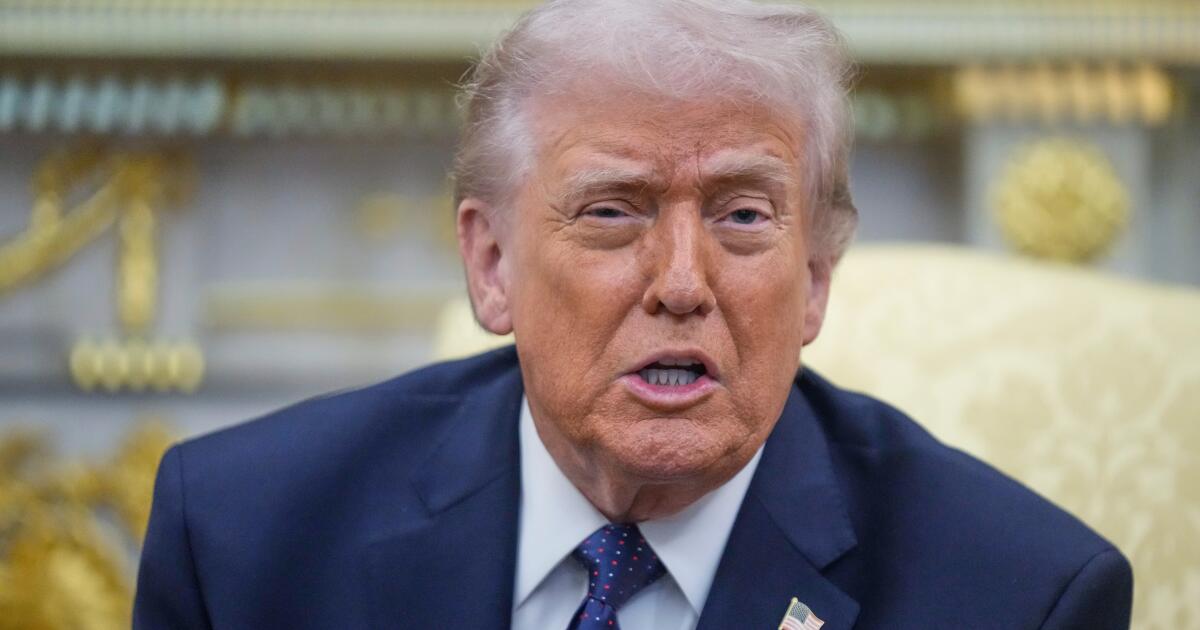
Israel believes Iran war could last months, testing U.S. resolve
NEW YORK — U.S. and Israeli officials are privately casting doubt on projections from the Trump administration that the war with Iran could end within a matter of weeks — instead warning that a months-long campaign may be required to destroy the country’s ballistic missile capabilities and install a pliant government, multiple sources told The Times.
The prospect of extended combat creates new political risks and uncertainties for President Trump, whose penchant for dramatic, short-term military operations has suddenly given way to a full-scale assault on the Islamic Republic, shocking a MAGA base that for years supported his calls to end forever wars in the Middle East.
One Israeli official told The Times — despite internal guidance among Israeli officials to adhere to the U.S. president’s stated time frame — that the war “definitely could be longer” than the four-week window that Trump repeatedly offered to reporters.
A U.S. official said that in private conversations, top administration officials presume the campaign will require a longer runway now that remnants of Iran’s government have chosen to resist rather than acquiesce to Washington.
Protracted war was always a possibility. Trump was presented with U.S. intelligence assessments gaming out the potential conflict that emphasized how highly unpredictable the results of an attack would be — an analysis the intelligence community believes has borne out on the ground in the chaotic early days of the conflict.
A longer conflict could create diplomatic space between Trump and Israel’s prime minister, Benjamin Netanyahu, who has advocated for the overthrow of the Islamic Republic for over 30 years.
The Israeli leader has succeeded in convincing Trump to take military actions in Iran that American presidents have rejected for decades, from bombing its nuclear facilities to assassinating its leadership, including Ayatollah Ali Khamenei, who was killed in an opening strike over the weekend.
Goal of regime change fades
Yet, mere days into the war, White House officials have all but ceased references to a democratic spring that could sweep Iran’s government aside.
A set of four U.S. goals for the mission no longer calls for changing the regime itself. Still, Netanyahu’s government remains keen on replacing the government, and the nation’s longest-serving premier sees the current war as his best opportunity to do so, one official said.
Speaking with reporters Tuesday, Trump rejected reports that the Israelis had convinced him to launch the attack.
“No, I might have forced their hand,” Trump said. “Based on the way the negotiations were going, I think they were going to attack first, and I didn’t want that to happen. So if anything, I might have forced Israel’s hand, but Israel was ready, and we were ready, and we’ve had a very, very powerful impact because virtually everything they have had been knocked out.”
In a series of interviews this week, Trump said he had been given projections of a four- or five-week war, while noting he is prepared to go longer if necessary.
Michael Rubin, a former Pentagon official who is Iran expert at the American Enterprise Institute, said that projecting a deadline to the conflict at its start would be a strategic mistake for the Trump administration, as it would in effect give Iran’s remaining leadership an end date to wait out the fighting.
“Successive presidents have shown that America has strategic attention deficit disorder,” Rubin said. “If that was the case in Iraq and Afghanistan, it’s especially true under Trump. He imposed a ceasefire on Gaza that let Hamas survive to fight another day; they still haven’t disarmed.”
The duration of the war will depend, in part, on Iran’s ability to resist and defend its remaining capabilities — but also on the president’s willingness to accept an outcome that leaves the Islamic Republic in place.
That decision has not yet been made by Trump, who has vacillated between calls for a democratic uprising across Iran — and U.S. military options to support resistance groups inside the country — as opposed to a shorter campaign that cripples Iran’s political leadership and Islamic Revolutionary Guard Corps.
“I can go long and take over the whole thing, or end it in two or three days and tell the Iranians, ‘See you again in a few years if you start rebuilding,” Trump told Axios.
One of Israel’s primary goals is to effectively eliminate the country’s ballistic missile program, and progress on that score is ahead of schedule, another source familiar with the operation said. “Things are going very well at the moment,” the source added. “Great pace.”
An Israeli military source noted to The Times that the stated goal of the mission is to significantly degrade, but not necessarily destroy, Iran’s ballistic missile capabilities, a goal the source said could be accomplished within Trump’s preferred time frame.
“Israel was quite unhappy Trump ordered the [June 2025] 12-day war ended when it did,” said Patrick Clawson, director of the Iran program at the Washington Institute for Near East Policy. He said he expected the current war would “take time” to comprehensively set back Iran’s ballistic missile capabilities, after a series of Israeli missions in 2024 against the missile program failed to set them back by more than a matter of months.
“Some Israelis think before the recent strikes, Iranian production was fully restored,” Clawson said. “So a really comprehensive attack on Iranian missiles is an important Israeli objective.”
The Maduro model
But no one inside the Islamic Republic system has emerged so far to serve in a supplicant role to Trump in the way that Delcy Rodríguez has stepped in as acting president of Venezuela, after U.S. forces captured that country’s strongman president, Nicolás Maduro, in an audacious overnight raid in January.
Since then, the Stars and Stripes have flown alongside the Venezuelan tricolor at government buildings in Caracas, where senior Trump administration officials have been welcomed to discuss lucrative opportunities in Venezuela’s oil industry.
Trump is now looking for an Iranian counterpart to Rodríguez, he said Tuesday, suggesting he is willing to keep the Islamic Republic in place despite encouraging its citizens to rise up against their government.
“Most of the people we had in mind are dead,” Trump said in the Oval Office. “We had some in mind from that group that is dead. And now we have another group. They may be dead also. Pretty soon we’re not gonna know anybody.”
“I mean, Venezuela was so incredible because we did the attack and we kept the government totally intact,” he added.
Dennis Ross, a veteran diplomat on the Israeli-Palestinian conflict who served in the George H.W. Bush, Clinton and Obama administrations, expressed doubt that Trump would be willing to proceed with a months-long campaign, regardless of Israel’s aspirational objectives.
“I believe President Trump doesn’t define clear objectives so he can decide to end the war at a time of his choosing, and declare the objective at that point, announcing we have achieved what we sought to do,” said Ross, noting that finding a figurehead in Iran as he did in Venezuela was always “a long shot.”
“Unilaterally, he could declare we made the regime pay a price for killing its citizens, and we have weakened Iran to the point that it is not any longer a threat to its neighbors,” Ross added. “He could then say, if Iran continues the war, we will hit them even harder.”