resolution

Trump’s lawyers are in talks with the IRS to resolve president’s $10-billion lawsuit

Lawyers for President Trump are engaged in talks with the IRS to resolve a $10-billion lawsuit the president filed against his own tax collection agency over the leak of his tax information to news outlets between 2018 and 2020.

In a federal court filing Friday, Trump asks a judge to pause the case for 90 days while the two sides work to reach a settlement or resolution.

“This limited pause will neither prejudice the parties nor delay ultimate resolution,” the filing says. “Rather, the extension will promote judicial economy and allow the Parties to explore avenues that could narrow or resolve the issues efficiently.”

Tax and ethics experts say the lawsuit raises a plethora of legal and ethical questions, including the propriety of the leader of the executive branch pursuing scorched-earth litigation against the very government he oversees.

Earlier this year, Trump filed a lawsuit in a Florida federal court, alleging that a previous leak of his and the Trump Organization’s confidential tax records caused “reputational and financial harm, public embarrassment, unfairly tarnished their business reputations, portrayed them in a false light, and negatively affected President Trump, and the other Plaintiffs’ public standing.”

The president’s sons, Donald Trump Jr. and Eric Trump, are also plaintiffs in the suit.

In 2024, former IRS contractor Charles Edward Littlejohn, of Washington — who worked for Booz Allen Hamilton, a defense and national security tech firm — was sentenced to five years in prison after pleading guilty to leaking tax information about President Trump and others to two news outlets between 2018 and 2020.

The outlets were not named in the charging documents, but the description and time frame align with stories about Trump’s tax returns in the New York Times and reporting about wealthy Americans’ taxes in the nonprofit investigative journalism organization ProPublica. The 2020 New York Times report found Trump paid $750 in federal income tax the year he first entered the White House, and no income tax at all some years, thanks to reported colossal losses.

When asked in February how he would handle any potential damages from the case, Trump said, “I think what we’ll do is do something for charity.”

“We could make it a substantial amount,” he said at the time. “Nobody would care because it’s going to go to numerous very good charities.”

Several ethics watchdog groups have filed friend-of-the-court briefs challenging the president’s lawsuit.

The watchdog group Democracy Forward’s February filing states that the case is “extraordinary because the President controls both sides of the litigation, which raises the prospect of collusive litigation tactics,” and “the conflicts of interest make it uncertain whether the Department of Justice will zealously defend the public fisc in the same way that it has against other plaintiffs claiming damages for related events.”

Hussein writes for the Associated Press.

Source link

Democrats tackle outside groups flooding their primaries with campaign cash

Democrats are struggling to come up for air after outside groups flooded their first round of midterm primaries with campaign cash.

As the Democratic Party fights to regain control of Congress, organizations affiliated with the American Israel Public Affairs Committee, cryptocurrency and artificial intelligence have dominated the airwaves, sometimes leaving candidates on the sidelines of their own campaigns.

Democratic pollster Zac McCrary said the primaries have “become proxy wars, and the candidates are almost afterthoughts in larger skirmishes.”

Now the Democratic National Committee is advancing a resolution at its New Orleans spring meeting to condemn the surge of spending that has scrambled its primaries and exacerbated tensions within the party.

Candidates who lost have pointed their fingers at special interests, blaming them for derailing their campaigns. Others who are still in the running are courting voters by denouncing deep-pocketed outside groups. Even those who have benefited from the spending have expressed concern.

“It’s definitely a brave new world,” McCrary said.

“We’re not talking about doubling of campaign expenditures,” he added. “We’re talking about 10 times or 20 times more.”

Dan Sena, a former executive director at the Democratic Congressional Campaign Committee, said party organizations are no longer the ones with the clout to push favored candidates.

“All that’s been completely smashed now,” Sena said. Even if Democrats regain control of the U.S. House, he warned that outside spending could damage the party in the long run.

Referring to House Minority Leader Hakeem Jeffries, he said, “You’re going to hand Jeffries a caucus that is divided.”

Democrats bear the brunt of big spending

So far this cycle, outside money in U.S. House races has largely targeted districts particularly friendly to Democrats, meaning the primaries will likely determine who will win the general election in November. After a record number of House members retired this year, many of those seats opened up for the first time in years, drawing dozens of Democratic hopefuls.

In Illinois, for example, there was more than $125 million in outside spending across five open Democratic primaries. In all but one of those congressional races, the outside spending exceeded candidate spending.

While it’s still early in the calendar, there are indicators that many more races could see big spending. Almost 40 seats have already seen more than $1 million in outside spending, according to Federal Election Commission filings.

In Illinois, the top three spenders in U.S. House races were groups affiliated with American Israel Public Affairs Committee, or AIPAC, according to AdImpact, which tracks ad buys in political races, followed by the cryptocurrency-affiliated Fairshake.

AIPAC was founded to support strong ties between the U.S. and Israel, a particularly controversial issue as Democratic hostility toward Israel rises over the war in Gaza. Some Democratic National Committee, or DNC, members wanted to call out AIPAC’s role in primaries, but the final resolution did not.

“We had various resolutions that focused on different industries and groups, and instead of going one-by-one, we passed a blanket repudiation,” DNC Chair Ken Martin said in a statement.

Campaign spending has divided Democrats

The latest DNC meeting marks another chapter in longstanding disputes between progressives and the party establishment.

Progressives want the party to adopt official language that all Democratic presidential contenders oppose money from dark-money groups, or super PACs that aren’t required to disclose their donors.

“It’s necessary that we actually have the party do something on this issue, not just say something,” said Larry Cohen, co-chair of Our Revolution, a progressive group founded by independent Sen. Bernie Sanders of Vermont, who caucuses with Democrats.

The resolution being advanced at the DNC meeting in New Orleans is viewed by progressives as a step toward that goal. However, some Democrats warn against weakening their candidates when facing a Republican Party that’s flush with cash.

“Provided that we don’t handcuff ourselves in the general elections — because if the Republicans are going to use dark money in general elections, we should be using our money in general elections, too — if you provide an even playing field, I think then that’s fine,” said Sen. Ruben Gallego, an Arizona Democrat. “But we just can’t be handcuffing ourselves in the general to lose races.”

Any DNC resolutions would not stop outside groups from surging funds into primary contests or general elections. But some Democrats believe the issue is core to the party’s values.

“We should eliminate any super PAC in a Democratic primary. And I think every presidential candidate in 2028 should pledge that they will not have any super PAC spending in a Democratic primary,” said Rep. Ro Khanna, a progressive and possible Democratic presidential contender who co-chaired Sanders’ 2020 presidential campaign.

“That should be a litmus test,” Khanna argued. “If you’re not willing to take that pledge, then you’re part of the problem.”

Askarinam, Brown and Sweedler write for the Associated Press. Brown reported from New York.

Source link

Russia and China block UN resolution on Strait of Hormuz | United Nations News

A total 11 out of 15 members supported the resolution, which was already watered down to evade vetoes.

Russia and China have vetoed a United Nations Security Council (UNSC) resolution aimed at protecting commercial shipping in the Strait of Hormuz.

The draft text, on which a vote was held on Tuesday, was proposed by Bahrain. Eleven of the 15 members of the UNSC voted in favour, and two abstained. However, Russia and China said that the measure was biased against Iran.

Recommended Stories

list of 3 itemsend of list

Under the resolution, affected states would have been asked to “coordinate efforts, defensive in nature, commensurate to the circumstances, to contribute ‌‌to ‌‌ensuring the safety and security of navigation across the Strait of Hormuz”.

Shipping through the narrow waterway, through which a fifth of global oil and gas shipments previously passed, has effectively come to a standstill after Tehran threatened to attack vessels in response to the war launched against Iran by the United States and Israel on February 28.

The blockade has sent fuel prices soaring across much of the world and led some countries, particularly in Asia, to introduce restrictions on consumption and ration supplies.

A deadline set by US President Donald Trump for Iran to reopen the water passage or else face even worse bombardment is set to expire later on Tuesday, after he repeatedly issued – and delayed – similar threats.

The US ambassador to the United Nations, Mike Waltz, condemned the Russian and Chinese vetoes, saying they marked “a new low”, as Iran’s shutting of the strait was preventing medical aid and supplies from reaching humanitarian crises in the Congo, Sudan and Gaza.

“No one should tolerate that. They are holding the global economy at gunpoint. But today, Russia and China did tolerate it.”

France deplored the vetoes. “The aim was to encourage strictly, purely defensive measures to provide the security and safety for the strait without spiralling towards escalation,” its UN ambassador, Jerome Bonnafont, said.

Russia and ⁠⁠China said the resolution was biased against Iran.

China’s UN envoy Fu Cong said adopting such a draft when the US was threatening the survival of a civilisation would have sent the wrong message.

Russia’s ⁠⁠UN ambassador, Vasily Nebenzya, said Russia and China were proposing an alternative resolution on the ⁠⁠situation in the Middle East, including maritime security.

Iran’s UN ambassador, Amir Saeid Iravani, praised the Chinese and Russian moves, saying “Their action today prevented the Security Council from being misused to legitimise aggression.”

The wording of the resolution had been the subject of behind-the-scenes negotiations for days.

An earlier version of the document had explicitly referred to Chapter 7 of the UN Charter, which grants the UNSC the authority to take measures ranging from sanctions to the use of military force.

But after China’s opposition, Bahrain had significantly weakened its draft, dropping any authorisation of the use of force.

An explicit reference to binding enforcement, included in an earlier draft, was also left out.

Source link

Why UN slavery resolution won’t be enough | Slavery

Slavery declared the gravest crime against humanity.

Slavery has been declared the gravest crime against humanity in a United Nations resolution. Argentina, Israel, and the United States were the only countries that voted against it, with many others abstaining. So what does this resolution mean, and why won’t the countries that built their wealth on slavery agree to a path for justice? Al Jazeera’s Marthe van der Wolf explains.

Source link

U.N. Human Rights Council adopts North Korea resolution

The U.N. Human Rights Council adopted a resolution condemning North Korea’s human rights violations during a session in Geneva Monday. The Council’s 61st session opened on Feb. 23, as seen in this file photo. File Photo by Valentin Flauraud/EPA

SEOUL, March 31 (UPI) — The United Nations Human Rights Council adopted a resolution condemning North Korea’s human rights violations, with South Korea joining 49 other countries as a co-sponsor despite speculation it might withhold support as it seeks to improve relations with Pyongyang.

The resolution was adopted by consensus at the Council’s 61st regular session Monday in Geneva. It expresses “deep concern about the systematic, widespread and gross human rights violations in the Democratic People’s Republic of Korea [and] the pervasive culture of impunity and lack of accountability for such violations.”

The measure urges Pyongyang to undertake sweeping reforms, including dismantling political prison camps, ending forced labor and ensuring freedom of expression and movement.

The Council has adopted a North Korean human rights resolution every year since 2003.

South Korea had reportedly weighed opting out of co-sponsorship this year, as the administration of President Lee Jae Myung pursues renewed engagement with the North and seeks to ease tensions on the Korean Peninsula.

However, Seoul ultimately decided to join as a co-sponsor “following in-depth consultations among relevant government agencies,” Foreign Ministry spokesman Park Il said at a press briefing Tuesday.

He pointed to the resolution’s references to humanitarian issues such as abductions and reunions for separated families, as well as language supporting dialogue and engagement.

“It was by taking all these aspects into account that we decided to participate as a co-sponsor,” Park said.

South Korea also backed a similar U.N. resolution at the General Assembly in November. Seoul had co-sponsored such measures from 2008 through 2018, but stepped back during a period of inter-Korean detente between 2019 and 2022 under then-President Moon Jae-in.

The latest resolution comes as Seoul weighs how to balance engagement with Pyongyang against pressure to address its human rights record.

President Lee has taken conciliatory steps since taking office in June, including restricting activist groups from sending propaganda leaflets across the border.

Last week, Human Rights Watch and more than two dozen organizations and individuals urged Lee’s government to continue supporting the resolution, warning in an open letter that recent policy moves “signal a troubling shift away from support for the victims of the North Korean government repression.”

“Sustainable peace on the Korean Peninsula cannot be achieved by excluding human rights,” the letter said. “Dialogue and engagement need to go hand in hand with the protection of human rights and accountability.”

North Korea has long rejected such resolutions as hostile acts, accusing the United Nations and Western countries of using human rights as a pretext to undermine its government.

Speaking at a session ahead of the vote Monday, North Korea’s deputy permanent representative to the United Nations in Geneva, Kang Myong Chol, said Pyongyang “categorically rejects” the measure.

“We condemn it as a falsified document motivated by ulterior political objectives of undermining the dignity of my country and discrediting its ideology and system,” Kang said.

A recent report by the U.N. special rapporteur found that the country’s human rights situation has “shown no improvement” over the past decade and in many cases has worsened, despite limited engagement with international mechanisms.

The report cited persistent restrictions on movement, expanded surveillance and the continued use of forced labor, as well as growing difficulty for citizens attempting to leave the country.

The resolution was adopted without participation from the United States, which withdrew from the Human Rights Council after President Donald Trump signed an executive order ending U.S. membership in February 2025.

Source link

S. Korea weighs co-sponsorship of U.N. North Korea rights resolution

Photo shows Foreign Ministry spokesperson Park Il speaking at a briefing in Seoul on March 12. Photo by Asia Today

March 24 (Asia Today) — South Korea is taking a cautious approach to whether it will join as a co-sponsor of an upcoming United Nations resolution on North Korean human rights, officials said Tuesday, citing a need to balance diplomacy with Pyongyang and international cooperation.

The resolution is expected to be adopted at the current session of the U.N. Human Rights Council later this week.

Foreign Ministry spokesperson Park Il said the government’s position remains that improving human rights in North Korea is important and that Seoul will continue to work with the international community. However, he said the decision on co-sponsorship is still under review.

“The issue is being considered comprehensively, taking into account the government’s efforts toward peaceful coexistence on the Korean Peninsula and the content of the resolution,” Park said at a regular briefing.

He added that the government’s cautious stance does not signal opposition, but reflects the complexity of factors involved, and that a decision will be made through consultations among relevant agencies.

A ministry official said there is a procedural window allowing countries to join as co-sponsors within two weeks after the resolution is adopted, giving Seoul time to assess its position.

The deliberations come amid strained inter-Korean relations and President Lee Jae-myung’s call to pursue even limited openings for dialogue with North Korea.

South Korea previously joined as a co-sponsor of a similar resolution at the U.N. General Assembly last November, easing concerns that the current administration might withdraw from such efforts.

Separately, the Unification Ministry has signaled a willingness to ease tensions. Unification Minister Chung Dong-young recently made conciliatory remarks, including urging North Korea not to miss opportunities for dialogue with the United States.

Civil society groups have urged the government to take a more active role. The International Federation for Human Rights and the Transitional Justice Working Group said in a joint letter to Lee that declining to co-sponsor the resolution would send a troubling signal domestically and internationally.

They warned that overlooking human rights concerns may create only a temporary easing of tensions, while leaving underlying instability unresolved and making lasting peace more difficult to achieve.

— Reported by Asia Today; translated by UPI

© Asia Today. Unauthorized reproduction or redistribution prohibited.

Original Korean report: https://www.asiatoday.co.kr/kn/view.php?key=20260324010007372

Source link

Senate Republicans block Democrat’s war powers resolution

March 19 (UPI) — Senate Republicans have blocked a Democrat-led effort to curb President Donald Trump‘s powers to wage war against Iran, as the nearly three-week-old conflict escalates and rattles global energy markets.

The Senate voted 53-47 mostly along party lines Wednesday night to reject a resolution that would withdraw U.S. armed forces from conflict with Iran absent congressional approval.

Sen. Rand Paul of Kentucky was the only Republican to join his Democratic colleagues and vote in favor of the motion, while Democratic Sen. John Fetterman of Pennsylvania was the only member of his caucus to vote against it.

“We do not have a king. We are a democratic republic with a constitution and no one is above the law,” Sen. Cory Booker, D-N.Y., said Wednesday from the Senate floor before the vote.

“This president cannot take us to war without coming through this body. He is not able to do that unless this body supplicates itself before that man and surrenders its responsibilities.”

Senate Democrats forced the vote on the resolution that Booker sponsored as the conflict escalated on Wednesday, with Iran attacking Persian Gulf energy facilities in retaliation for Israel striking its South Pars gas field.

Thirteen American service members have been killed, and another 200 have been wounded so far in the conflict, which is threatening to become a regional war as Iran has retaliated by attacking U.S. bases and its allies in the Middle East.

Democrats of both chambers of Congress have been attempting to rein in Trump’s war powers through resolutions since the war with Iran began late last month. They argue the United States’ ongoing war with Iran violates the Constitution, which mandates that only Congress has the power to declare war.

The conflict has also seen the cost of oil surge. On Thursday, Brent crude reached nearly $110 a barrel, up from an average $71 before the war began on Feb. 28.

Wednesday’s vote is the third time — and the second by the Senate — that the majority Republicans have blocked war powers motions.

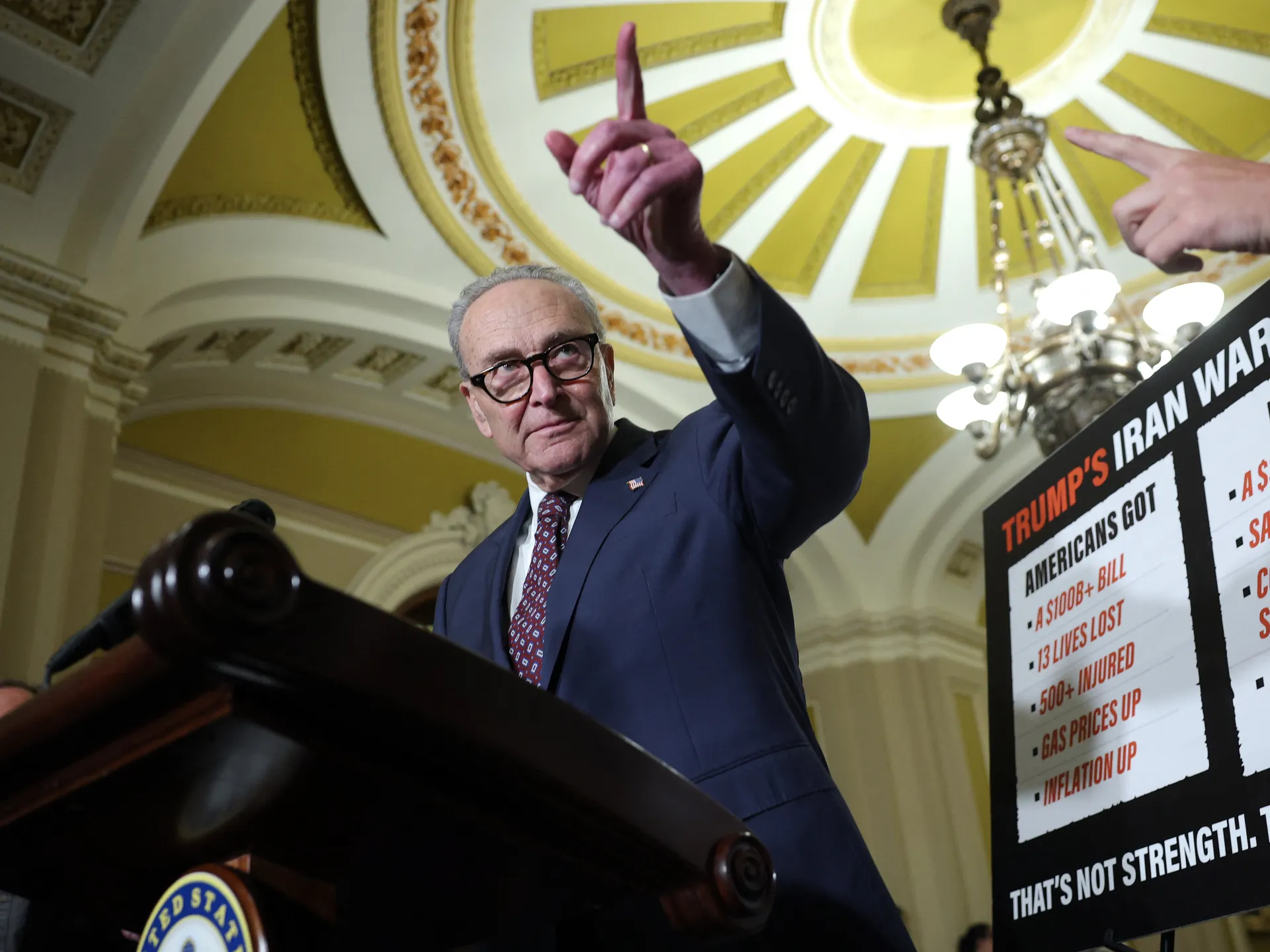
From the floor, Senate Minority Leader Chuck Schumer said, “Enough is enough.”

“To my Republican colleagues: The American people are watching. They oppose this war. They expect us to do our jobs,” he said.

“No more senseless wars in the Middle East. No more gas prices shooting through the roof. No more U.S. service members fighting and dying for in endless wars.”

Though the war has exposed fissures in the Republican Party, its members still mostly stand behind the president, who campaigned on ending conflicts and warning Americans that the Democrats would wage war with Iran if they won the White House.

Sen. Lindsey Graham, a staunch Trump ally, argued on the Senate floor that the war is intended to prevent Iran from securing a nuclear weapon.

He said during the prior negotiations the United States offered Iran what he called “a lifetime fuel supply for free” if the Islamic regime agreed to hand over its cache of highly enriched uranium. It is believed that Iran had enriched uranium to 60%, according to a recent International Atomic Energy Agency report, which is below weapons grade enrichment at 90%.

Graham compared the Islamic regime of Iran to Nazi Germany.

“If you do not see this as an imminent threat, then you’re blind from your hatred of Trump,” he said.

“There are people on the left and people in my own party that are more afraid of Trump being successful than the Ayatollah having a nuclear weapon. That’s sick.”

Source link

UN Security Council adopts Gulf countries’ draft resolution | GCC

NewsFeed

The UN Security Council has passed a resolution put forward by Gulf Cooperation Council members calling on Iran to halt its attacks on Gulf countries. The measure was adopted with 13 votes in favour and two abstentions, while no member states voted against it.

Source link