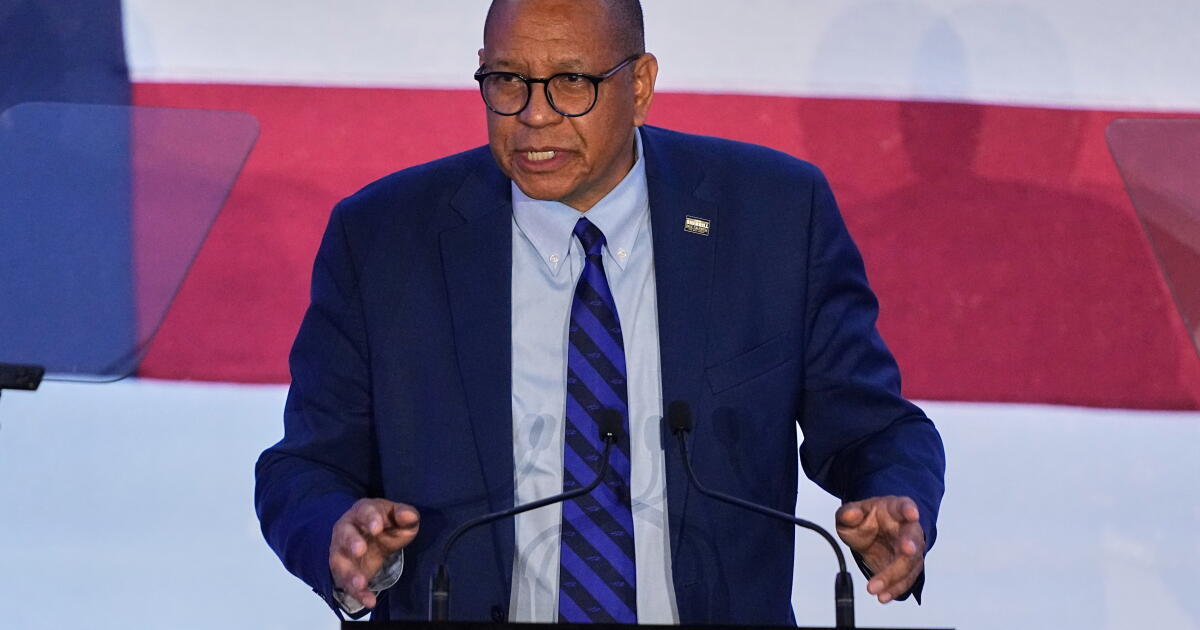
resigns

Swalwell resigns seat in Congress amid rape and sexual misconduct allegations

California Rep. Eric Swalwell resigned his congressional seat on Monday under intense pressure from lawmakers of both parties after several women accused him of sexual misconduct, including a former staffer who alleged rape.

Swalwell, a Dublin Democrat who suspended his campaign for California governor on Sunday, said in a statement that he was stepping down from the House, where he has served since 2013, and planned to continue fighting what he called “serious, false” allegations made against him.

“However, I must take responsibility and ownership of the mistakes I did make,” Swalwell wrote without specifying which mistakes those were.

His resignation came hours after the House Ethics Committee opened an investigation into the sexual misconduct allegations against him and as lawmakers from both parties threatened to expel him from the House if he did not leave his post. He said he was aware of the expulsion efforts underway and said that it was “wrong” to expel a member of Congress “without due process, within days of an allegation being made.”

“But it is also wrong for my constituents to have me distracted from my duties. Therefore, I plan to resign my seat in Congress,” he said.

Asked about replacing Swalwell, Gov. Gavin Newsom’s office said in a statement that it is “reviewing the matter. Once the seat is officially vacant, our office will make an official announcement.”

The allegations, detailed in reports by the San Francisco Chronicle and CNN last week, drew swift bipartisan condemnation, with lawmakers from both parties calling the accusations “disgusting” and demanding that he either resign or be removed from office.

Rep. Anna Paulina Luna (R-Fla.) intended to lead the charge to expel Swalwell. In an interview Monday, Luna said she planned to file a motion as early as Tuesday on the grounds that he violated House rules over an alleged inappropriate sexual relationship with a subordinate. A House floor vote could have been held as early as Wednesday, she said.

Following Swalwell’s resignation, Luna said the Northern California lawmaker did “the right thing.” But she took issue with him saying that the allegations were not grounds for expulsion, noting that he was under criminal investigation.

In New York, the Manhattan district attorney’s office opened an investigation into sexual assault allegations against Swalwell by a former staffer and issued a statement over the weekend that urged “survivors and anyone with knowledge of these allegations to contact our Special Victims Division.”

After the sexual allegations came to light, Democrats called on Swalwell to resign, but when it comes to expulsion, they said they would not move against Swalwell alone. They were also pushing to expel Rep. Tony Gonzales (R-Texas), who last month admitted to a sexual relationship with a staffer who later died by suicide.

Late Monday, Gonzales said he too was stepping down. “When Congress returns tomorrow, I will file my retirement from office,” he wrote on X.

The push to get Swalwell expelled had gained traction even among his friends.

Sen. Ruben Gallego (D-Ariz.) wrote on X on Monday that Swalwell should be kicked out of Congress, saying he “trusted someone who I believed was a friend, but is now clear that he is not the person I thought I knew.” Gallego said the woman “deserves to be believed, to be supported, and to see justice served.”

Had Swalwell been expelled, it would have been the first such removal in congressional history on the grounds of sexual misconduct, and among the rare instances in the House’s 237-year history in which members ousted one of their own.

Only six members have been expelled from the House. Three were fighting for the Confederacy, two were convicted of bribery and one was the fraudster George Santos, whose sentence was later commuted by President Trump.

Now that Swalwell has resigned, he is still eligible for his pension and for a number of other perks extended to other former members, including the ability to enter the House floor and access to the congressional gym.

Swalwell said Monday that he is working with his staff to “ensure they are able, in my absence, to serve the needs of the good people of the 14th congressional district.”

While many of Swalwell’s staffers have already quit, remaining staffers not involved in constituent services would lose their jobs and receive no severance pay.

Daniel Schuman, executive director of the American Governance Institute, which is focused on congressional reform, argues that the practice is unfair.

“I think the House owes them a duty for what they’ve had to go through,” Schuman said.

Longtime ethics expert Meredith McGehee said that members have been reluctant to expel their colleagues in recent years because of the razor-thin majorities in the House, but that not doing so hurts the credibility of the institution.

“It’s really important at this moment that the House act to expel these men who have been seriously and credibly accused of wrongdoing,” said McGehee, a former executive director of the ethics watchdog Issue One. “To allow either one of them to stay in office and serve out their term would be a farce.”

The Swalwell scandal could still prompt an ever larger surge of expulsion calls. Some lawmakers called for two additional members to be swept into any expulsion vote: Rep. Cory Mills (R-Fla.), who has been accused of sexual assault, and Rep. Sheila Cherfilus-McCormick (D-Fla.), who was indicted on charges that she laundered $5 million of federal disaster money and used it to fund a political campaign.

“Reps. Swalwell, Gonzales, Cherfilus-McCormick, and Mills should resign. If they refuse, they should be expelled,” Rep. Nydia Velazquez (D-N.Y.) wrote on X on Monday. “Americans deserve better and Congress must hold our members accountable.”

Any expulsion would require a two-thirds majority vote, or 290 of 435 votes if every House member participates. The Senate would not be required to concur with the House vote to make the expulsion effective, but it remains to be seen whether the House could meet the two-thirds threshold.

Times staff writer Melody Gutierrez in Sacramento contributed to this report.

Source link

Embattled Director of State Lottery Resigns : Government: Sharon Sharp cites family reasons. She had been criticized over awarding of major contracts.

Sharon Sharp, the embattled director of the California Lottery criticized for her handling of major contracts, resigned Monday, saying that months of controversy had made her “tired and angry.”

Insisting the resignation was her idea and not that of Gov. Pete Wilson, Sharp said she was stepping down so she could spend more time with her husband, who lives in Illinois. However, a source in the Administration said she was urged to resign.

“It’s just time for me to go home,” said Sharp, who is credited with adding several lottery games, including Keno, and of helping to turn around the agency’s downward revenue slide.

“I’m grateful to the governor . . . who I’m sure wished many times that the lottery would stay out of the news and most especially that I would stay out of the news.”

Sharp’s resignation came several weeks after it was disclosed that the former lobbyist for a company that received lucrative lottery contracts described Sharp in a secretly tape-recorded conversation as “our gal.” The conversation was played during a federal court trial of lobbyist Clayton R. Jackson, who has been charged with racketeering and money laundering.

On Monday, Sharp dismissed Jackson’s comments as the idle boasting of a lobbyist who wanted to impress others with his ability to gain access to public officials. Calling Jackson’s statement “ridiculous,” she maintained that her relationship with his former client, GTECH Corp. of Rhode Island, had always been professional and that there was no conflict of interest.

“I’m Don Sharp’s gal,” she quipped, referring to her husband of 34 years.

In a short statement, Wilson praised Sharp for “innovative leadership” at the lottery, especially improvements in customer services and the addition of new games–Keno, Fantasy 5, Daily 3 and multiple Scratchers, which helped boost sales. A spokesman for the governor said Wilson’s staff would conduct a nationwide search for her replacement.

“Her job is completed,” Wilson said. “She will give her successor a more efficient and more effective lottery to support education for California’s children.”

But the tense news conference announcing Sharp’s resignation contrasted starkly with the one two years ago in which the governor proudly announced her appointment.

At the time, Wilson said Sharp was his handpicked choice to revitalize a demoralized lottery and reverse a decline in sales that had caused deep reductions in the agency’s contributions to public schools.

Sharp, 53, left office Monday having accomplished the sales turnaround but also having created so much controversy over her handling of contracts that she became a political liability for the Wilson Administration.

Sharp was director of the Illinois lottery before coming to California. She commuted to her home in Chicago throughout her tenure and said Monday that she has no job lined up after leaving.

Although the governor’s office Monday had nothing but public praise for her work, staff members privately have been expressing concern about the appearance of favoritism in the awarding of lottery contracts.

Just days before Sharp’s resignation, Wilson’s chief of staff, Bob White, spoke generally of worries about the lottery’s contracting process.

“You want to make sure that the process and every contract let, on something as major as this, is above suspicion,” he said. “Our main goal was to make the things not sole sources; to make it as competitive as could be in a not very competitive world.”

White denied that Sharp was pressured to resign, but a source familiar with the lottery said an Administration official sent to review the lottery’s operation came away “concerned at the way they conducted business.” The source said the governor’s office urged Sharp to resign.

“I think it’s a welcome step,” said Sen. Tom Hayden (D-Santa Monica), one of Sharp’s most vocal critics. “I think it has just become a tainted and unmanageable mess over there. She would have nothing to look forward to but grief.”

Hayden said he will ask the governor and attorney general to investigate the lottery’s relationship to GTECH and to work with other states where the company’s contracts are being criticized.

As one of her final acts in office, Sharp said she had asked for a state audit of the lottery’s handling of a $400-million, five-year contract awarded GTECH to operate its computerized games. “For the sake of the future of the California Lottery, this issue must be put to rest,” she said.

During Sharp’s tenure, GTECH was awarded three lottery contracts totaling nearly $500 million and was recommended for a fourth–all without competitive bids.

Sharp had been in office only a few months in 1991 when she proposed a one-year extension of GTECH’s contract to operate the computerized games.

Her recommendation came just days after former state Sen. Alan Robbins pleaded guilty to a series of charges including accepting a $13,500 bribe allegedly from Jackson, to influence legislation of interest to GTECH.

Although the company was never implicated in the charges, an embarrassed governor’s staff asked the agency to delay awarding the contract for at least a month. Before the contract extension expired, Sharp again recommended–and the Lottery Commission approved–a $25-million amendment for the purchase of 2,000 additional terminals and upgrades to the computer system. Several staff members complained internally that the purchase should have been handled by competitive bids.

A year later, she did seek competitive bids, this time for a new computer contract, but GTECH was the only company to submit a proposal.

Rival companies complained that the specifications for the contract so favored GTECH that it was useless for them to bid. Sharp insisted that the specifications were standard for the industry and again recommended that GTECH get the contract. The commission agreed.

In September, she proposed that GTECH receive another contract without competitive bid to provide an automated system that would make it easier to cash lower-prize Scratchers. She later withdrew her recommendation after the governor’s office expressed displeasure at the lack of competition. That contract is still pending.

Asked at the conclusion of proceedings Monday in his corruption trial for his opinion on Sharp’s resignation, Jackson said: “That’s too bad. . . . If this (the trial) was all over, I’d say something.”

Times staff writer Mark Gladstone contributed to this story.

Out of the Game

California State Lottery Director Sharon Sharp announced her resignation Monday, two years after she was appointed to the job by Gov. Pete Wilson. Here is a snapshot of the performance of the lottery under her tenure.

NUMBER OF PLAYERS: 8 million a month

GAMES INTRODUCED

* Dec. 1991: SuperLotto

* Feb. 1992: Fantasy 5

* April, 1992: Daily 3

* Nov. 1992: Keno

ANNUAL LOTTERY REVENUE (In billions of dollars) ‘85-’86: $1.8 ‘86-’87: $1.4 ‘87-’88: $2.1 ‘88-’89: $2.6 ‘89-’90: $2.5 ‘90-’91: $2.1 Sharp’s term: (Sept. 1991 to Nov. 1993) ‘91-’92: $1.4 ‘92-’93: $1.8

Source link

Italy 2026 World Cup: Gabriele Gravina resigns as head of the Italian Football Federation

Gabriele Gravina has resigned as the head of Italy’s football association (FIGC) following their failure to qualify for a third consecutive World Cup.

The four-time world champions suffered another play-off final defeat when they were beaten 4-1 on penalties by Bosnia-Herzegovina on Tuesday.

No previous winner of the tournament has missed three World Cups in a row, which Italy now have after missing out on Russia in 2018 and Qatar 2022.

Also on Thursday, former goalkeeper Gianluigi Buffon, who was working closely with the men’s national team, resigned as delegation head via Instagram., external

Buffon, who was part of Italy’s 2006 World Cup-winning side, wrote that with Gravina’s decision to go, he felt, “as an act of responsibility”, he should do the same.

“The main objective was to bring Italy back to the World Cup. And we didn’t succeed,” Buffon, 48, added.

“It’s fair to leave it to those who will come after the freedom to choose the figure they think is best to play my role.”

Gravina, 72, who is the Uefa first vice-president, announced his resignation following a meeting held at the FIGC’s headquarters in Rome.

He took the job in October 2018, with his predecessor Carlo Tavecchio having stepped down following Italy’s failure to beat Sweden in a World Cup play-off the previous year.


Source link